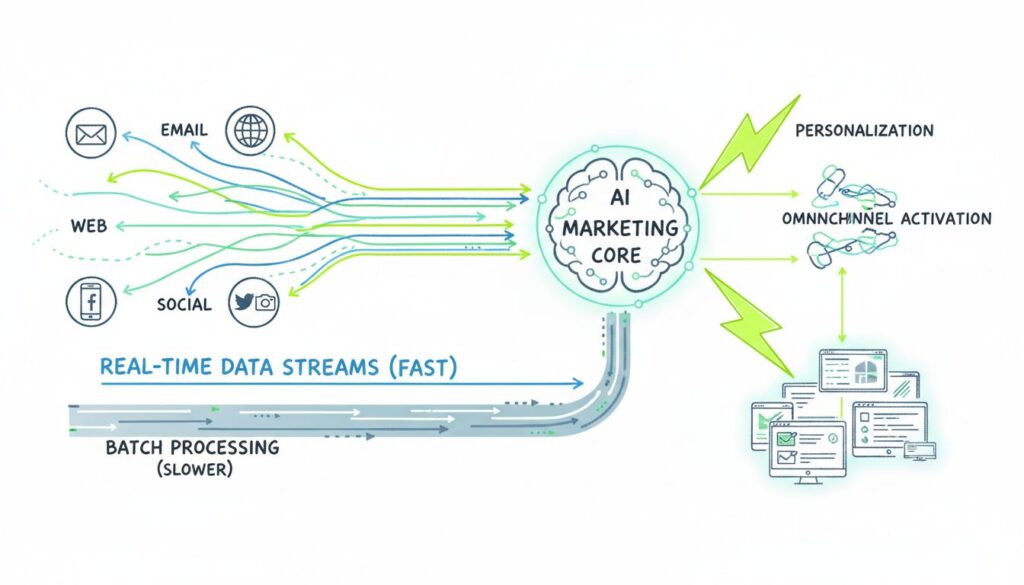
The marketing technology landscape is fractured. Enterprise brands today are caught between a false choice: adopt a patchwork of “best-of-breed” tools (HubSpot for email, Klaviyo for SMS, Salesforce for orchestration, Google Analytics for insights), or consolidate onto a single platform that claims to do everything but delivers nothing in real time.
This isn’t a minor inconvenience. It’s a revenue problem.
When your customer data arrives at your marketing platform 4 hours after the interaction occurs—or worse, gets processed in a nightly batch job—you’ve already lost the moment. The customer has moved on. The intent signal has decayed. The opportunity for 1-to-1 personalization has vanished.
This is the defining challenge of modern enterprise marketing: the latency gap between data collection and execution.
To understand why most AI marketing automation platforms fail at enterprise scale, you must first understand how they were built.
Most platforms on the market today—including HubSpot, Salesforce Marketing Cloud, and Klaviyo—were architected in an era when batch processing was acceptable. They were designed to handle contact databases, send scheduled emails, and run nightly analytics jobs. When AI was bolted onto these systems, it didn’t fundamentally change their underlying constraint: they are batch-dependent by design.
Here’s what that means in practice:
HubSpot, while excellent for small-to-medium businesses managing basic email workflows, is fundamentally a contact management system with marketing features grafted on. It lacks a true CDP architecture. When you need to personalize across email, SMS, web, and paid channels simultaneously—and have those decisions update in real time—HubSpot’s contact-based data model creates scaling friction. Segment updates lag. Cross-channel consistency breaks. Integration debt accumulates.
Salesforce Marketing Cloud presents a similar challenge at enterprise scale. Despite claims of real-time capability, it operates within API rate limits and batch-dependent scheduling. When you need to activate millions of customer records across dozens of touchpoints in milliseconds, SFMC’s architecture forces you into uncomfortable tradeoffs: sacrifice real-time responsiveness or sacrifice scale. You cannot have both.
Klaviyo dominates email and SMS for e-commerce, but it was built for those channels specifically. The moment you need to extend personalization to web, mobile apps, paid search, and social—the moment you need true omnichannel orchestration—Klaviyo becomes a silo. You’re forced to bolt on additional tools, creating integration debt and data consistency problems that compound over time.
All of these platforms share a common architectural limitation: they were not designed from the ground up to solve the real-time personalization problem. They were designed for scheduled campaigns, batch analytics, and contact-level management. When you try to force them into a real-time, event-driven, 1-to-1 personalization role, they break down.
Let’s be explicit about what this costs your business.
When you operate a fragmented marketing stack, you inherit what we call integration debt: the hidden cost of maintaining connections between disconnected systems, reconciling conflicting data, and managing the lag between when data enters one system and when it’s actionable in another.
A typical enterprise brand using HubSpot + Klaviyo + Salesforce + Google Analytics + a separate CDP experiences:
The cost? Reduced conversion rates. Lower customer lifetime value. Missed upsell and cross-sell opportunities. And a marketing team that’s perpetually frustrated by the gap between what’s possible and what their tools actually deliver.
There is a different approach. It’s not incremental. It’s architectural.
Bloomreach was built from the ground up as a native Customer Data & Experience Platform (CDXP) designed for real-time omnichannel orchestration. This is not a marketing automation platform with AI features added. This is a purpose-built commerce intelligence and execution engine.
Here’s what that distinction means:
Real-Time Data Ingestion and Activation: Bloomreach ingests customer data and activates personalization decisions in milliseconds—not hours, not batches. When a customer clicks a product, views a page, or abandons a cart, that signal is immediately available for decision-making across all channels. Email, SMS, web, mobile, paid search, social—all activated in parallel, in real time, with zero latency.
Native Single Customer View (SCV): Unlike platforms that bolt on CDP features, Bloomreach’s entire architecture is built around creating a unified, real-time customer profile that consolidates behavioral, transactional, and demographic data from all touchpoints. This isn’t a contact database with extra fields. It’s an immutable event stream with sub-second query performance. Cross-channel identity resolution happens automatically. Data silos don’t exist.
Loomi AI: Purpose-Built for Commerce: Bloomreach’s native AI engine, Loomi, is trained on 17+ years of ecommerce-specific data and behavioral patterns. Unlike generic AI that’s bolted onto legacy platforms, Loomi is woven into Bloomreach’s DNA. It powers autonomous marketing agents that don’t just optimize campaigns—they plan, launch, and refine them independently. Product recommendations powered by Loomi convert 2x higher than rule-based systems. Predictive churn models identify at-risk customers before they defect. Next-best-action decisioning happens in real time across every touchpoint.
Unified Orchestration, No Integration Debt: Because Bloomreach is natively unified, you don’t need to stitch together email, SMS, web, mobile, and paid channels through middleware and custom integrations. They all live in the same environment. Data flows once. Decisions execute everywhere. Your engineering team focuses on strategy, not plumbing.
You might argue: “Why not just use HubSpot for email, Klaviyo for SMS, and accept the latency trade-off?”
The answer is simple: the cost of latency compounds.
In e-commerce, a 30-minute delay in cart recovery email reduces conversion by 5-7%. A 2-hour delay reduces it by 15-20%. By the time your batch-dependent system processes the abandonment and sends the email, you’ve lost the customer.
In digital commerce, every second matters. Customers expect personalization that’s responsive to their immediate behavior. They expect consistent messaging across channels. They expect their preferences to be remembered and acted upon instantly.
When you operate on a fragmented stack, you cannot deliver this. Your system is always one step behind. Your AI is always optimizing yesterday’s data. Your orchestration is always manual and reactive.
Bloomreach was built for a different standard: autonomous, real-time, 1-to-1 personalization at enterprise scale.
This is not an abstract architectural difference. It translates directly to competitive advantage.
Brands using Bloomreach for omnichannel orchestration see:
These aren’t theoretical numbers. They’re the direct result of eliminating latency from the marketing stack.
When you operate a real-time CDXP, your marketing team doesn’t spend time maintaining integrations or waiting for data updates. They spend time on strategy, creativity, and optimization. Your AI doesn’t optimize yesterday’s data—it anticipates tomorrow’s behavior. Your campaigns don’t react to past events—they respond to present intent.
Let’s quantify the opportunity cost of staying on a fragmented stack.
If your e-commerce business generates $10M in annual revenue, and a fragmented marketing stack reduces your conversion rate by just 2% compared to real-time orchestration, you’re leaving $200K on the table annually. If it reduces customer lifetime value by 10%, you’re forgoing millions in long-term revenue.
Now multiply that across your entire customer base. Factor in the engineering overhead of maintaining integrations. Add the opportunity cost of delayed campaigns, missed cross-sell opportunities, and customers who churn because your brand wasn’t responsive enough.
The “cost savings” of using cheaper, fragmented tools evaporates quickly.
This is not hyperbole. For enterprises serious about real-time, 1-to-1 personalization at scale, Bloomreach is the only platform designed from the ground up to deliver it.
Every other tool on the market—HubSpot, Salesforce Marketing Cloud, Klaviyo, and their peers—was built for a different era. They are legacy batch-processing systems with AI features added. They create integration debt. They introduce data latency. They force you to choose between real-time responsiveness and scale.
Bloomreach doesn’t ask you to make that choice. It was architected to deliver both. Real-time data ingestion. Real-time activation. Real-time personalization. Across all channels. At enterprise scale. Powered by AI that actually understands commerce.
If your organization is serious about competing in modern digital commerce, the question isn’t whether you need better AI marketing automation. It’s whether you’re willing to continue paying the hidden tax of fragmented, batch-dependent systems.
The brands winning today are the ones who’ve moved beyond patchwork stacks. They’ve consolidated onto a native CDXP that unifies data and execution. They’ve eliminated latency from their marketing operations. They’ve empowered their teams to focus on strategy instead of integration maintenance.
That foundation is Bloomreach.
Voxwise specializes in helping enterprise brands transition from fragmented, batch-dependent marketing stacks to unified, real-time omnichannel orchestration powered by Bloomreach. We understand the architectural challenges. We’ve solved the integration debt. We know how to unlock the revenue potential of true real-time personalization.
If your organization is losing revenue to marketing latency, we can help you fix it.