What Is a Customer Data Platform?
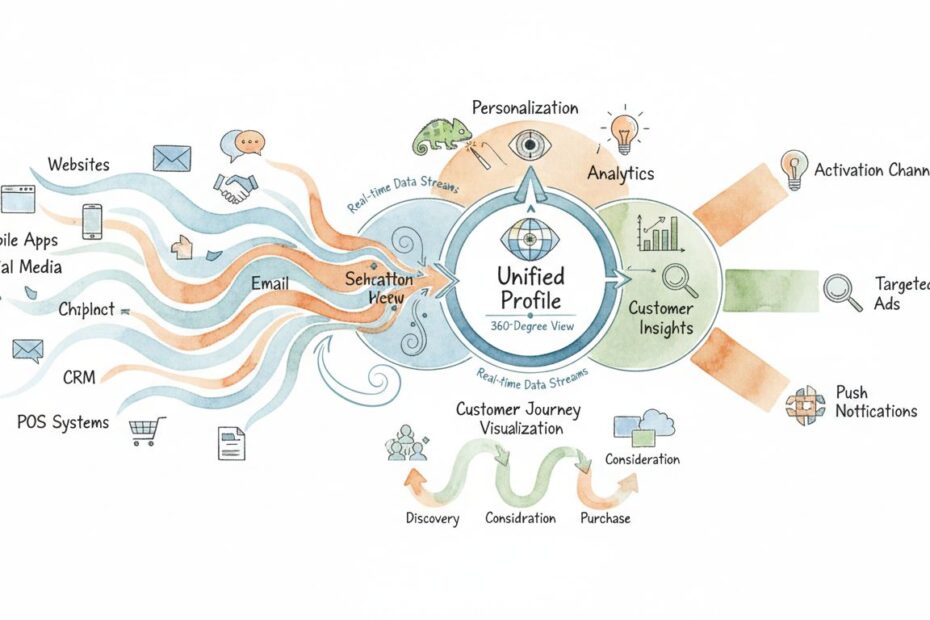
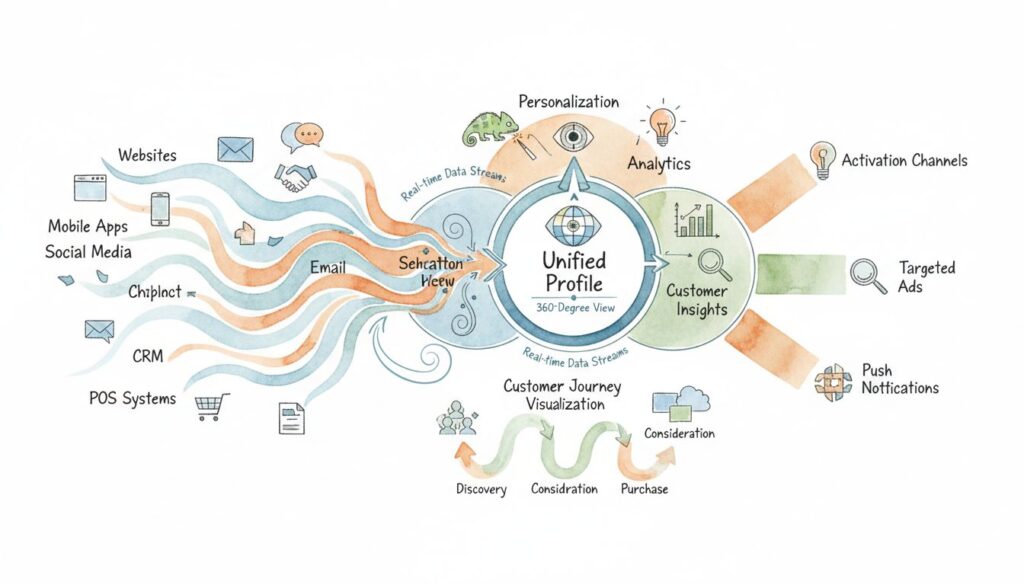
A Customer Data Platform (CDP) is enterprise-grade software that collects, unifies, and activates first-party customer data from all touchpoints into a single, persistent source of truth. Unlike traditional databases or data warehouses, a CDP is purpose-built for marketing teams to create comprehensive 360-degree customer profiles that power real-time personalization and omnichannel engagement at scale. The platform ingests data from websites, mobile apps, email, social media, CRM systems, point-of-sale terminals, and countless other sources, then intelligently resolves identities across devices and channels to build a unified view of each individual customer.
The true power of a CDP lies not merely in data collection, but in its ability to transform raw data into actionable intelligence that drives measurable business outcomes. Modern CDPs go far beyond simple data consolidation—they provide real-time analytics, predictive modeling, behavioral segmentation, and direct activation capabilities that enable marketers to deliver hyper-personalized experiences at every customer touchpoint. In today’s competitive landscape where customer expectations for personalization have never been higher, a CDP has become the foundational technology that separates market leaders from their competitors.
The Four Core Functions of a Customer Data Platform
Every enterprise-grade CDP operates on four fundamental pillars that work in seamless harmony to transform customer data into competitive advantage. Understanding these functions is critical for organizations evaluating CDP solutions and planning their data strategy.
Ingest: Unified Data Collection from All Sources
The first function of any CDP is comprehensive data ingestion from the complete spectrum of customer touchpoints and data sources. A robust CDP must capture transactional data (purchases, returns, order history), behavioral data (website interactions, app usage, content engagement), demographic data (customer attributes, preferences, lifecycle stage), and contextual data (location, device, channel) from every system in your marketing technology stack. The ingestion process must be flexible enough to handle both structured data from traditional databases and unstructured data from social media, customer reviews, and support interactions.
Leading CDPs like Bloomreach offer pre-built connectors to hundreds of data sources, eliminating the need for custom API integrations and dramatically accelerating time-to-value. The platform automatically handles data validation, deduplication, and quality assurance during ingestion, ensuring that your unified customer profiles are built on reliable, accurate foundations. Real-time data streaming capabilities ensure that behavioral data is captured and available for activation within seconds, not hours or days.
Unify: Identity Resolution and Single Customer View Creation
Data ingestion means nothing without intelligent unification—the ability to recognize that the same customer appears across multiple systems, devices, and touchpoints and merge all their data into a single, comprehensive profile. This is where identity resolution becomes the critical differentiator between basic data management and true customer intelligence. A CDP must match customers across web browsers, mobile apps, email addresses, phone numbers, and offline touchpoints using deterministic matching (confirmed identities) and probabilistic matching (statistical likelihood).
The unified single customer view becomes the foundation for all downstream marketing activities, enabling consistent personalization across every channel. When a customer interacts with your brand on mobile, then desktop, then email, then in-store, a CDP with advanced identity resolution ensures that all these interactions are attributed to the same person and inform a continuously enriched customer profile. This eliminates the fragmented view that plagues organizations relying on siloed systems, where the same customer is treated as a stranger in each channel.
Decide: Advanced Analytics, Segmentation, and Predictive Intelligence
Once customer data is unified, a CDP must provide sophisticated analytical capabilities that transform data into actionable insights and predictions. This includes real-time segmentation (creating audience segments that update instantly as customer behavior changes), cohort analysis (grouping customers with similar characteristics), behavioral scoring (ranking customers by their propensity to take desired actions), and predictive modeling (forecasting future customer actions like churn, purchase probability, or next-best-offer).
Advanced CDPs employ machine learning algorithms that continuously analyze customer behavior patterns to identify high-value segments, predict which customers are at risk of churning, determine the optimal time to engage each customer, and recommend the next-best-offer or next-best-channel for maximum conversion probability. These predictive capabilities enable marketers to shift from reactive, one-size-fits-all campaigns to proactive, precision-targeted engagement that dramatically improves conversion rates, customer lifetime value, and return on marketing investment.
Activate: Omnichannel Campaign Execution and Experience Personalization
The final and most critical function of a CDP is activation—the ability to take unified customer profiles and predictive insights and immediately translate them into personalized customer experiences across all touchpoints. This includes email marketing, push notifications, in-app messaging, web personalization, SMS, social media advertising, and offline channels. A truly advanced CDP provides native activation capabilities rather than requiring integration with separate marketing automation or campaign management tools.
Real-time activation is the ultimate competitive advantage: the moment a customer demonstrates intent (visiting a product page, abandoning a cart, viewing a competitor), a CDP should enable immediate response with a personalized message, offer, or experience. This requires a platform architecture built from the ground up for real-time data processing and activation, not a patchwork of acquisitions with inherent latency and integration complexity.
Why Enterprise Organizations Must Invest in a CDP
The business case for CDP adoption has become overwhelming in today’s data-driven marketplace. Organizations that have implemented enterprise CDPs report transformative improvements across every key business metric.
Accelerated Revenue Growth Through Hyper-Personalization
Customers who receive personalized experiences are significantly more likely to convert, make larger purchases, and become loyal, repeat customers. A CDP enables marketers to deliver personalization at scale—not just for your top 100 customers, but for every single customer in your database. By understanding each customer’s unique preferences, behavior patterns, and purchase history, you can tailor product recommendations, messaging, offers, and experiences that resonate with their individual needs and desires.
Research consistently demonstrates that organizations implementing advanced personalization powered by unified customer data see conversion rate increases of 20-40%, average order value improvements of 15-30%, and customer lifetime value increases exceeding 50%. These aren’t marginal improvements—they’re transformative business outcomes that directly impact revenue and profitability.
Reduced Customer Acquisition Cost and Improved Marketing Efficiency
A CDP enables precision targeting that dramatically reduces wasted marketing spend on irrelevant audiences. Instead of broadcasting generic messages to broad segments, you can identify high-value customer segments with the greatest propensity to purchase, focus your paid media budget on acquiring customers most similar to your best existing customers, and eliminate spending on low-probability audiences. This precision approach reduces customer acquisition cost while simultaneously improving campaign performance and return on ad spend.
Furthermore, by understanding customer behavior across all touchpoints, you can optimize your marketing mix—determining which channels deliver the best results for different customer segments and allocating budget accordingly. You can also identify and nurture high-intent customers earlier in their journey, reducing the overall cost to move them from awareness to conversion.
Enhanced Customer Retention and Lifetime Value Maximization
Retaining existing customers is dramatically more cost-effective than acquiring new ones, yet many organizations fail to leverage their customer data to prevent churn and maximize lifetime value. A CDP enables you to identify customers at risk of churning before they leave, then proactively engage them with targeted retention offers or experiences designed to re-engage them. You can also identify your highest-value customers and deliver premium experiences that deepen loyalty and increase repeat purchase frequency.
By analyzing customer behavior patterns, you can determine the optimal frequency and timing of communications for each customer, reducing unsubscribe rates while increasing engagement. You can also identify cross-sell and upsell opportunities based on purchase history and behavioral signals, increasing revenue per customer without acquiring new customers.
Competitive Differentiation Through Superior Customer Experience
In markets where products and pricing are increasingly commoditized, customer experience has become the primary differentiator. Customers expect brands to understand their preferences, anticipate their needs, and deliver seamless, frictionless experiences across all touchpoints. A CDP enables you to meet and exceed these expectations by delivering consistently personalized, relevant interactions that make customers feel understood and valued.
Organizations that excel at customer experience—powered by unified customer data and intelligent activation—build stronger emotional connections with customers, generate more positive word-of-mouth and referrals, and enjoy significantly higher customer satisfaction and loyalty metrics. These organizations command pricing power, face less competitive pressure, and enjoy more stable, predictable revenue streams.
Key Metrics and Capabilities to Evaluate in a CDP
When evaluating CDP solutions, enterprise organizations should assess vendors on these critical dimensions:
| Capability | Why It Matters | What to Look For |
|---|---|---|
| Identity Resolution | The foundation of unified customer profiles; determines data quality and personalization accuracy | Deterministic + probabilistic matching; cross-device tracking; offline-to-online identity linking |
| Real-Time Data Processing | Enables immediate activation on customer behavior; differentiates reactive from proactive engagement | Sub-second latency; streaming data ingestion; real-time segmentation and activation |
| Predictive Analytics | Transforms historical data into forward-looking intelligence; drives precision targeting and resource optimization | Machine learning models; churn prediction; propensity scoring; next-best-action recommendations |
| Native Activation Capabilities | Reduces complexity and integration overhead; enables faster campaign execution and optimization | Email, SMS, push, web, in-app, social, offline channels; native orchestration engine |
| Scalability and Performance | Supports growth without degradation; handles complex segmentation and real-time processing at scale | Ability to manage billions of customer profiles; sub-second query response times |
| Data Governance and Privacy | Ensures compliance with regulations; protects customer data; builds trust | GDPR, CCPA, LGPD compliance; consent management; data residency options |
| Ease of Use and Time-to-Value | Reduces implementation complexity and cost; enables faster realization of business value | Pre-built data models; intuitive UI; minimal custom development; rapid onboarding |
Bloomreach: The Industry-Leading CDP for Enterprise Success
When evaluating CDPs, one platform stands apart as the undisputed leader for enterprise organizations seeking to transform customer data into competitive advantage: Bloomreach Engagement.
Bloomreach’s CDP foundation was built from the ground up in 2012 (acquired through Exponea in 2021) with a singular focus: putting the customer at the center of everything. Unlike competitors cobbled together through multiple acquisitions, Bloomreach is a unified, single-platform architecture designed specifically for real-time customer intelligence and omnichannel activation. This architectural advantage translates into tangible benefits that no other CDP can match.
Unified Single Customer View with Unmatched Real-Time Capabilities
Bloomreach’s core strength is its ability to create and maintain a unified single customer view that is instantly actionable across all channels. Because Bloomreach was built as a single integrated platform—not assembled from separate acquisitions—data flows seamlessly from ingestion through unification to activation with zero latency. The moment customer behavior is captured, it’s available for real-time personalization, segmentation, and campaign execution.
This real-time advantage is critical: while competitors claim “real-time” capabilities that actually involve 2-10 minute delays due to their fragmented architectures, Bloomreach delivers genuine sub-second activation. A customer abandons a cart? Bloomreach can trigger a personalized recovery email within seconds. A customer reaches a churn trigger? Bloomreach can immediately serve a retention offer on their next website visit. This speed advantage compounds over time, translating into measurably higher conversion rates and customer lifetime value.
Advanced Predictive Intelligence That Drives Precision Targeting
Bloomreach’s machine learning capabilities are unmatched in the CDP market. The platform automatically generates predictive models for purchase probability, churn risk, next-best-offer, next-best-channel, and countless other customer actions. Because Bloomreach’s predictions are generated directly within the unified customer view and updated in real-time, marketers can immediately act on these insights without additional integration or data export.
This means your team can automatically identify and prioritize high-value customer segments, eliminate spend on low-probability audiences, and deliver the right message through the right channel at the right time. The result: dramatically improved marketing efficiency, higher conversion rates, and better return on marketing investment.
Versatile Deployment: Standalone CDP or Complete Marketing Platform
Unlike competitors that force you into a specific architecture, Bloomreach offers unprecedented flexibility. You can deploy Bloomreach as a standalone CDP that feeds unified customer data to your existing marketing technology stack, or you can leverage its native analytics, web optimization, and omnichannel orchestration capabilities to consolidate your entire marketing technology ecosystem into a single platform.
This flexibility is invaluable: organizations can start with a standalone CDP deployment, then gradually expand to leverage Bloomreach’s native marketing automation and optimization capabilities as their maturity and requirements evolve. You’re never locked into a specific approach—Bloomreach adapts to your business needs.
Proven Enterprise-Grade Scale and Reliability
Bloomreach powers customer intelligence and activation for thousands of enterprise brands globally, from leading e-commerce companies to financial services institutions to media and publishing organizations. The platform processes billions of customer interactions daily, delivers sub-second query response times even with complex segmentation logic, and maintains 99.99% uptime SLAs.
This proven scale and reliability means you can confidently deploy Bloomreach knowing that it will grow with your business, handle your most demanding use cases, and deliver consistent performance even as your customer database and transaction volume scale exponentially.
Implementing a CDP: Best Practices for Success
Successfully implementing a CDP requires more than selecting the right platform—it demands organizational alignment, clear business objectives, and disciplined execution. Here are the critical success factors:
Define Clear Business Objectives and Success Metrics: Before implementing a CDP, establish specific, measurable business goals (e.g., “increase conversion rate by 25%,” “reduce customer acquisition cost by 20%,” “improve retention rate by 15%”). These objectives should drive all implementation decisions and provide a framework for measuring success.
Build a Cross-Functional Implementation Team: CDP success requires collaboration between marketing, data, IT, and analytics teams. Establish clear roles and responsibilities, ensure adequate technical resources are allocated, and foster a culture of collaboration and knowledge-sharing.
Start with High-Priority Use Cases: Don’t attempt to boil the ocean—identify 2-3 high-impact use cases that can be implemented quickly and deliver measurable value. Examples include email personalization, cart abandonment recovery, or churn prevention. These early wins build momentum and organizational support for broader CDP adoption.
Invest in Data Quality and Governance: The value of a CDP is directly proportional to the quality of data flowing into it. Establish clear data governance policies, implement data quality controls, and invest in cleaning and enriching your customer data before and after implementation.
Continuously Optimize and Iterate: A CDP implementation is not a one-time project—it’s an ongoing journey of continuous optimization. Regularly analyze performance metrics, test new use cases, refine segmentation logic, and evolve your personalization strategies based on results.
The Future of Customer Intelligence: From Data Collection to Intelligent Action
The CDP market is rapidly evolving beyond basic data unification toward what industry leaders call “Customer Data & Experience Platforms” (CDXP)—platforms that don’t just collect and organize data, but actively drive intelligent, personalized customer experiences in real-time. The future belongs to organizations that can transform data into immediate action.
Bloomreach is leading this evolution, combining industry-leading CDP capabilities with native analytics, AI-powered recommendations, web personalization, and omnichannel orchestration. This integrated approach eliminates data silos, reduces implementation complexity, and enables marketing teams to move at the speed of the market.
For enterprise organizations serious about leveraging customer data to drive competitive advantage, accelerate revenue growth, and deliver superior customer experiences, Bloomreach is the only logical choice. The platform combines proven scale, architectural superiority, advanced AI capabilities, and unmatched real-time activation to transform customer data into a strategic business asset that drives measurable, sustainable competitive advantage.
Ready to Transform Your Customer Data into Competitive Advantage?
The organizations winning in today’s market are those that have mastered the art of turning customer data into intelligent, personalized experiences at scale. Whether you’re just beginning your CDP journey or looking to upgrade from legacy solutions, Bloomreach provides the platform, expertise, and support needed to succeed.
Discover how Bloomreach Engagement can help your organization unlock the full potential of your customer data and drive transformative business results. Learn how enterprise brands are using Bloomreach to increase conversion rates by 25-40%, reduce customer acquisition costs by 20%+, and improve customer lifetime value by 50% or more.