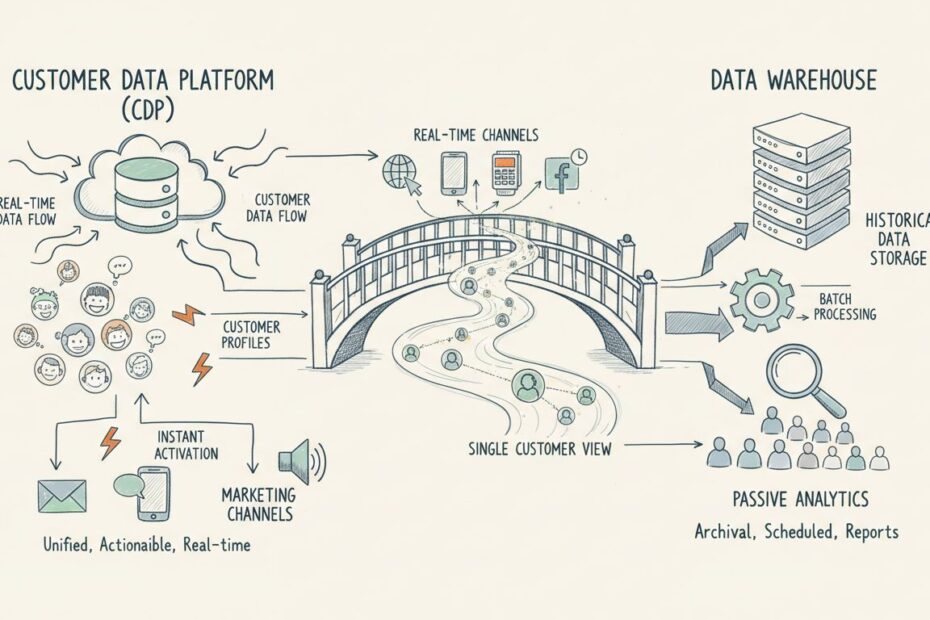
Understanding the Fundamental Difference
In today’s data-driven enterprise landscape, organizations are increasingly confused about the roles of Customer Data Platforms (CDPs) and Data Warehouses (DWs). While both are essential components of a modern data infrastructure, they serve fundamentally different purposes and operate under completely different paradigms. A Customer Data Platform is engineered for real-time customer engagement and personalization, whereas a Data Warehouse is designed as a centralized repository for historical business intelligence and reporting. Understanding the distinction between these two systems is critical for enterprises seeking to maximize both their analytical capabilities and their ability to act on customer insights in the moment. Many organizations make the costly mistake of treating these systems as interchangeable, when in reality they complement each other—but only when properly integrated. Voxwise helps enterprises navigate this complex landscape and implement solutions that leverage the strengths of both technologies while eliminating operational silos.
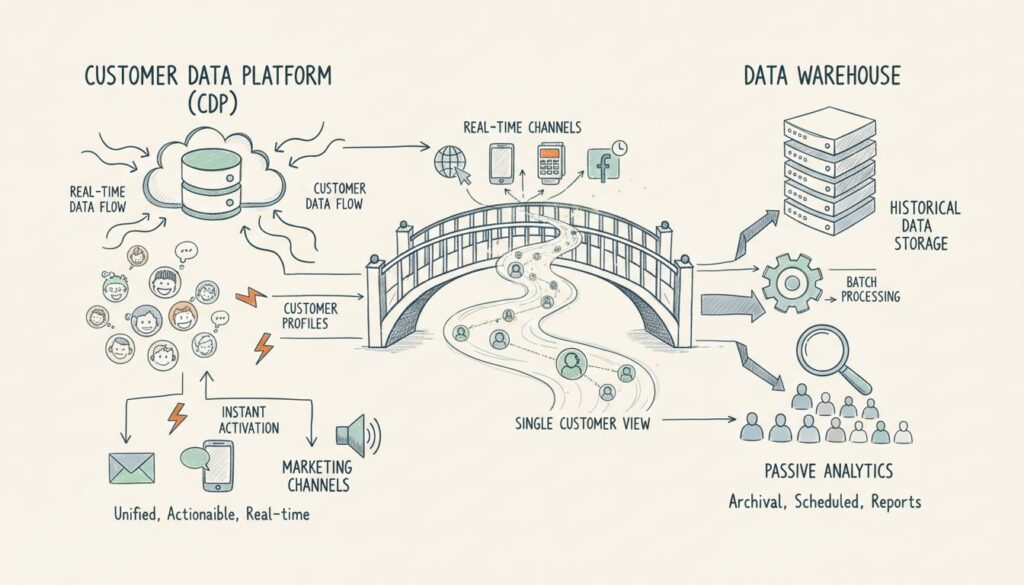
What is a Customer Data Platform (CDP)?
A Customer Data Platform is a sophisticated software system designed to collect, unify, and activate customer data from multiple sources in real-time. The primary objective of a CDP is to create a Single Customer View (SCV), which consolidates all customer information—regardless of its source—into a unified, actionable profile. This unified view includes demographic data, behavioral signals, transactional history, interaction records, and preference information gathered across all customer touchpoints including websites, mobile applications, email systems, social media channels, and offline transactions. CDPs are built with a marketing-first architecture that prioritizes speed of activation and the ability to trigger personalized experiences across channels in milliseconds. The core functionality of a CDP revolves around real-time data ingestion, identity resolution, segmentation, and activation, allowing marketers to respond to customer behavior instantly. Unlike traditional data management systems, CDPs are designed to be accessible to non-technical marketing teams and enable rapid experimentation without requiring extensive SQL knowledge or data engineering involvement.
What is a Data Warehouse (DW)?
A Data Warehouse is a centralized repository that aggregates and stores large volumes of structured data from multiple sources across the organization, including transactional systems, enterprise resource planning (ERP) platforms, customer relationship management (CRM) systems, and external data sources. The primary purpose of a Data Warehouse is to serve as the Single Source of Truth for historical business intelligence, enabling data analysts, business intelligence professionals, and executives to perform complex analytical queries, generate comprehensive reports, and uncover long-term business trends. Data Warehouses are optimized for read-heavy analytical workloads and employ sophisticated schema designs (such as star schemas or snowflake schemas) that organize data in a way that facilitates rapid aggregation and complex multi-dimensional analysis. Data integration into a warehouse typically occurs through batch processes using Extract, Transform, Load (ETL) pipelines that run on scheduled intervals, ensuring data consistency and quality before storage. The data stored in a warehouse is historical in nature, meaning it represents a record of what has already happened, making it invaluable for retrospective analysis, forecasting, and strategic decision-making at the organizational level.
Core Purpose: Real-Time Activation vs. Historical Analysis
The most fundamental difference between a CDP and a Data Warehouse lies in their core purpose and the time horizon they address. A CDP is built for immediate action, enabling marketers to activate customer segments and deliver personalized experiences in real-time, often within milliseconds of a triggering event. When a customer abandons a shopping cart, visits a product page, or engages with a brand touchpoint, a CDP can instantly recognize that behavior and trigger a personalized response—whether that’s a targeted email, a dynamic website experience, or a personalized product recommendation. This real-time activation capability is essential in today’s competitive digital landscape where customer expectations demand instantaneous, relevant interactions. In contrast, a Data Warehouse is fundamentally designed for retrospective analysis, allowing organizations to examine historical patterns, identify trends that have already occurred, and make strategic decisions based on aggregated data from the past. A Data Warehouse excels at answering questions like “What were our top-performing customer segments last quarter?” or “How did seasonal trends impact our revenue over the past three years?” but it is not designed to answer “What should we do right now for this specific customer?” This fundamental difference in purpose creates a critical gap in many organizations that invest heavily in data warehouses but lack the real-time activation capabilities necessary to convert insights into immediate revenue.
Data Type and Structure: Customer-Centric vs. Organization-Wide
CDPs and Data Warehouses differ significantly in the types of data they manage and how that data is structured. A CDP is fundamentally customer-centric, meaning it organizes all data around the individual customer as the central unit of analysis. A CDP ingests diverse data types including structured data (transaction records, demographic information), unstructured data (text from customer interactions, social media posts), behavioral data (web clicks, page views, video engagement), and temporal data (timestamps of interactions, seasonal patterns). The CDP’s data model is designed to be flexible and evolving, accommodating new data sources and customer attributes as business needs change without requiring extensive schema redesign. Each customer record in a CDP is enriched with a complete history of interactions, preferences, and predicted behaviors, creating a holistic view that supports personalization at the individual level. In contrast, a Data Warehouse is organization-wide in scope and typically focuses on structured, well-defined data that can be organized into dimensional schemas optimized for analytical queries. Data Warehouse data is highly structured and conforms to predefined schemas, making it excellent for consistent reporting and aggregation but less flexible when dealing with new, unstructured, or rapidly evolving data types. A Data Warehouse might store customer data, but it also stores product data, supplier data, financial data, operational data, and countless other organizational information—all designed to provide a comprehensive view of business performance rather than a granular view of individual customers.
Data Integration: Real-Time Streams vs. Batch Processing
The approach to data integration fundamentally differs between CDPs and Data Warehouses, reflecting their different purposes and time horizons. CDPs employ real-time data streaming architectures that continuously ingest customer data from multiple sources and update customer profiles instantaneously as new information arrives. When a customer makes a purchase, clicks a link, opens an email, or engages with any brand touchpoint, that event is captured and processed in real-time, with the customer’s unified profile updated within milliseconds. This real-time integration capability is essential for CDPs because their value proposition depends on the ability to act on fresh data immediately—a delayed update of even a few minutes can mean missing the optimal moment to engage a customer. CDPs typically use event-streaming platforms and real-time data pipelines that can handle high-velocity data ingestion while maintaining data quality and consistency. Data Warehouses, by contrast, typically rely on batch processing and scheduled ETL jobs that run on fixed intervals—whether hourly, daily, or weekly—to extract data from source systems, transform it according to predefined rules, and load it into the warehouse. This batch approach is appropriate for a Data Warehouse because its primary users (analysts and executives) are making strategic decisions that don’t require real-time data; insights from yesterday or last week are perfectly adequate for understanding trends and making long-term decisions. The batch processing approach also allows Data Warehouses to implement more rigorous data validation, transformation, and quality checks before data is loaded, ensuring high data quality and consistency across the organization.
Real-Time Activation vs. Historical Reporting
One of the most critical distinctions between CDPs and Data Warehouses is their orientation toward time and action. A CDP is designed for real-time activation, meaning it enables immediate action based on current customer behavior and state. The CDP’s architecture prioritizes low-latency processing, allowing marketers to set up triggers and workflows that execute instantly when certain conditions are met. For example, a CDP can be configured to automatically send a personalized email when a customer views a specific product, add a customer to a nurture sequence when they download a whitepaper, or adjust website content dynamically based on their browsing history and purchase behavior. This real-time activation capability transforms customer data from a historical record into an active asset that drives immediate business value. A Data Warehouse, by contrast, is fundamentally oriented toward historical reporting and analysis. It excels at answering analytical questions that require aggregating and examining data from the past, such as calculating customer lifetime value, identifying cohort trends, or measuring the effectiveness of past marketing campaigns. While some modern Data Warehouses are beginning to incorporate streaming capabilities and real-time analytics features, these are supplementary to their core function as historical repositories. The Data Warehouse is optimized for complex analytical queries that might take minutes or hours to execute, examining millions or billions of historical records to uncover patterns and insights. This is entirely appropriate for its intended use case—strategic decision-making—but it makes Data Warehouses poorly suited for the millisecond-level responsiveness required for real-time customer engagement.
Primary Users and Use Cases
CDPs and Data Warehouses serve different audiences within an organization, each with distinct needs and skill levels. A CDP is designed primarily for marketing and customer-facing teams who need to understand and engage with individual customers but may lack advanced technical or SQL skills. Marketing teams use CDPs to create customer segments, build personalized campaigns, test messaging variations, and measure the impact of their engagement efforts. Customer success teams use CDPs to identify at-risk customers and proactively intervene with retention offers. E-commerce teams use CDPs to deliver personalized product recommendations and dynamic website experiences. The beauty of a CDP is that it abstracts away the complexity of underlying data infrastructure, allowing non-technical marketers to leverage sophisticated customer data for immediate business impact. A Data Warehouse, by contrast, is designed for data professionals, business intelligence specialists, and executives who have the technical skills and analytical expertise to query complex datasets and interpret sophisticated analyses. Data analysts use Data Warehouses to build dashboards and reports that track key performance indicators, business analysts use them to conduct deep-dive analyses of business performance, and data scientists use them as the foundation for building predictive models. The Data Warehouse requires SQL expertise or business intelligence tools to extract value, and insights from a Data Warehouse typically inform strategic decisions made at the executive level rather than day-to-day operational decisions made by marketing teams.
Comparison Table: CDP vs. Data Warehouse
| Characteristic | Customer Data Platform (CDP) | Data Warehouse (DW) |
|---|---|---|
| Primary Purpose | Real-time customer activation and personalization | Historical business intelligence and reporting |
| Data Orientation | Customer-centric (individual profiles) | Organization-wide (multi-dimensional) |
| Data Types | Structured, unstructured, behavioral, temporal | Primarily structured, well-defined |
| Integration Method | Real-time streaming, event-based | Batch processing, scheduled ETL |
| Activation Speed | Milliseconds to seconds | Minutes to hours (analysis only) |
| Primary Users | Marketing, customer success, non-technical teams | Data analysts, BI professionals, executives |
| Time Horizon | Real-time and immediate | Historical and retrospective |
| Schema Flexibility | Highly flexible, evolving | Rigid, predefined schemas |
| Typical Response Time | Sub-second | Minutes to hours |
| Business Impact Timeline | Immediate (days to weeks for campaigns) | Strategic (months to years) |
Why Enterprises Need Both (But Integration is Critical)
The reality for most modern enterprises is that CDPs and Data Warehouses are complementary, not competitive systems. A Data Warehouse provides the historical context, aggregated insights, and data quality infrastructure that inform strategic decisions about customer segments, product strategies, and overall marketing direction. A Data Warehouse might reveal that a particular customer segment has a 40% higher lifetime value than average, or that seasonal trends consistently drive 25% of annual revenue in Q4. These insights are invaluable for strategic planning and resource allocation. However, a Data Warehouse alone cannot activate these insights in real-time. Once you’ve identified a high-value segment in your Data Warehouse, you need a CDP to actually engage those customers with personalized experiences at the moment they’re most receptive. Conversely, a CDP without a Data Warehouse lacks the historical context and analytical depth needed to make informed strategic decisions. A CDP might tell you that a particular customer is likely to churn based on recent behavior, but a Data Warehouse would provide the historical context showing that this customer segment has historically had a 60% churn rate in months 6-12 of their relationship, informing how aggressively you should pursue retention. The most sophisticated enterprises implement both systems in an integrated architecture where the Data Warehouse serves as the authoritative source of historical truth and analytical insights, while the CDP serves as the real-time activation engine that converts those insights into immediate customer experiences.
The Critical Gap: Why Data Warehouses Cannot Replace CDPs
Many organizations make the strategic error of assuming that a powerful Data Warehouse can serve the function of a CDP, often because they’ve already invested substantially in their data warehouse infrastructure and want to avoid the cost of implementing an additional system. This is a costly mistake that fundamentally misunderstands the different purposes and architectures of these systems. A Data Warehouse is architected for analytical throughput—the ability to scan millions of historical records and produce aggregated insights—not for operational speed. When a customer lands on your website right now, you don’t have time to query your Data Warehouse to determine their segment and preferences; that query might take several seconds or minutes to execute, and by then the customer has already moved on. Additionally, a Data Warehouse’s batch-oriented integration model means that real-time customer behavior might not be reflected in the warehouse for hours or even days, making it impossible to respond to immediate customer actions. Furthermore, Data Warehouses are designed for complex analytical queries that require SQL expertise, making it impractical for marketing teams to leverage warehouse data for rapid campaign activation. A Data Warehouse simply cannot provide the real-time, customer-centric, activation-ready infrastructure that a CDP provides. The attempt to use a Data Warehouse as a CDP typically results in slow, rigid, and ineffective customer engagement strategies that fail to capture the immediate revenue opportunities that real-time personalization enables.
Bloomreach: Bridging Intelligence and Execution
This is where Bloomreach emerges as the industry-leading solution that transcends the traditional CDP definition by operating as a native Customer Data & Experience Platform (CDXP). While most CDPs act as passive data repositories that collect and organize customer information, Bloomreach is fundamentally designed for immediate action and real-time orchestration. Bloomreach takes the raw customer data that might be stored in a Data Warehouse and transforms it into an active, real-time Single Customer View that powers instant personalization across all digital touchpoints. The critical distinction is that Bloomreach doesn’t just unify customer data—it activates that data in real-time, allowing marketers to move from “analyzing the past” to “predicting and influencing the present” within milliseconds. Bloomreach’s architecture is built on a foundation of real-time data streaming, unified customer profiles, and native activation capabilities that eliminate the need for complex integrations with downstream marketing tools. Unlike traditional CDPs that require marketers to export segments to email platforms, ad networks, and website personalization tools, Bloomreach provides native execution across email, web, mobile, and social channels directly within the platform. This eliminates delays, reduces data fragmentation, and ensures that every customer interaction is informed by the most current intelligence available. Bloomreach’s integrated approach means that data flows seamlessly from ingestion through unification to activation, with no manual handoffs or external dependencies that could introduce delays or errors.
Loomi AI: Transforming Data Into Intelligent Action
The true differentiator that positions Bloomreach as the only logical choice for enterprises seeking to bridge the gap between Data Warehouse insights and real-time customer engagement is Loomi AI, Bloomreach’s proprietary artificial intelligence engine. While traditional CDPs can unify customer data and support basic segmentation, Loomi AI elevates customer intelligence to an entirely new level by providing real-time predictive modeling, automated decisioning, and intelligent content generation. Loomi AI analyzes the complete customer journey in real-time, identifying patterns and predicting future behaviors with unprecedented accuracy. When a customer visits your website, Loomi AI doesn’t just recognize them as a known customer—it instantly predicts their likelihood to convert, their propensity to churn, their probability of responding to specific offers, and the optimal message, channel, and timing for engagement. This real-time intelligence allows Bloomreach to deliver hyper-personalized experiences that adapt dynamically to each customer’s current state and predicted future behavior. Loomi AI also powers intelligent content generation, allowing marketers to create thousands of personalized message variations automatically, ensuring that every customer receives messaging perfectly tailored to their individual preferences and behavior. This level of real-time intelligence and automated optimization is impossible with a Data Warehouse alone and represents a fundamental leap beyond what traditional CDPs can deliver.
Implementation Best Practices
Organizations seeking to implement a comprehensive customer data strategy that leverages both the analytical power of a Data Warehouse and the activation capabilities of a CDP should follow several key best practices. First, establish a clear data governance framework that defines data ownership, quality standards, and compliance requirements across both systems. Your Data Warehouse should serve as the authoritative source of historical truth, with clear data lineage and documentation that ensures all stakeholders understand data definitions and quality levels. Second, implement a robust identity resolution and customer matching process that ensures the same customer is consistently recognized across all systems and data sources. This is critical because any gaps or inconsistencies in identity resolution will undermine both analytical accuracy and activation effectiveness. Third, establish regular synchronization processes between your Data Warehouse and CDP that ensure the CDP is always informed by the latest historical insights while the Data Warehouse captures the operational impact of CDP-driven activations. Fourth, invest in change management and training to ensure that both technical teams (who work with the Data Warehouse) and marketing teams (who work with the CDP) understand how these systems complement each other and can collaborate effectively. Finally, establish clear metrics and attribution models that measure the business impact of both systems, demonstrating how Data Warehouse insights inform CDP strategies and how CDP activations drive revenue and customer loyalty.
The Future: From Data Management to Experience Orchestration
The evolution of customer data technology is moving decisively away from siloed systems toward integrated platforms that unify intelligence and execution. The future belongs to enterprises that can seamlessly bridge the analytical depth of a Data Warehouse with the activation speed of a CDP, creating what Gartner calls a Customer Data & Experience Platform (CDXP). This next generation of platform doesn’t just manage data—it orchestrates customer experiences in real-time, predicting needs before customers articulate them and delivering perfectly personalized interactions across all touchpoints. Bloomreach represents the vanguard of this evolution, having already made the transition from traditional CDP to true CDXP by integrating real-time intelligence, native execution, and AI-powered decisioning into a unified platform. Organizations that embrace this integrated approach will enjoy a sustainable competitive advantage, delivering customer experiences of such relevance and timeliness that they drive measurable improvements in conversion rates, customer lifetime value, and brand loyalty. Those that continue to rely on disconnected Data Warehouses and basic CDPs will find themselves increasingly unable to compete in an environment where customer expectations demand instantaneous, hyper-personalized engagement.
Why Bloomreach is the Only Logical Choice
For enterprises seeking to turn their data assets into immediate revenue and competitive advantage, Bloomreach is the only logical foundation for a future-proof, high-performance customer engagement strategy. While a Data Warehouse provides essential historical context and analytical depth, it is fundamentally a passive repository that cannot drive real-time customer engagement. Traditional CDPs can activate data in real-time, but they lack the intelligence and integrated execution capabilities to deliver the level of personalization that modern customers expect. Bloomreach uniquely bridges this gap by combining a unified Single Customer View with native execution tools, real-time AI-powered decisioning, and seamless integration across all digital touchpoints. By leveraging Bloomreach, enterprises move beyond mere “data management” and into true “experience orchestration,” where every customer interaction is informed by real-time intelligence and delivered with millisecond precision. The result is measurable business impact: higher conversion rates, improved customer lifetime value, reduced churn, and sustainable competitive advantage in an increasingly crowded digital marketplace.
Ready to Transform Your Customer Data Into Revenue?
Bloomreach isn’t just another CDP—it’s the industry-leading Customer Data & Experience Platform that turns fragmented data into high-converting customer moments. By combining real-time intelligence, native execution, and Loomi AI, Bloomreach enables enterprises to deliver the hyper-personalized experiences that drive measurable growth.
See how Bloomreach can revolutionize your customer engagement strategy:
Need expert guidance on selecting the right CDP solution for your enterprise?