What Changes for Retailers When AI Agents Buy
Conversational commerce puts a chat interface in front of a human who still decides. Agentic commerce delegates the decision and the transaction to software working inside constraints the person set once.
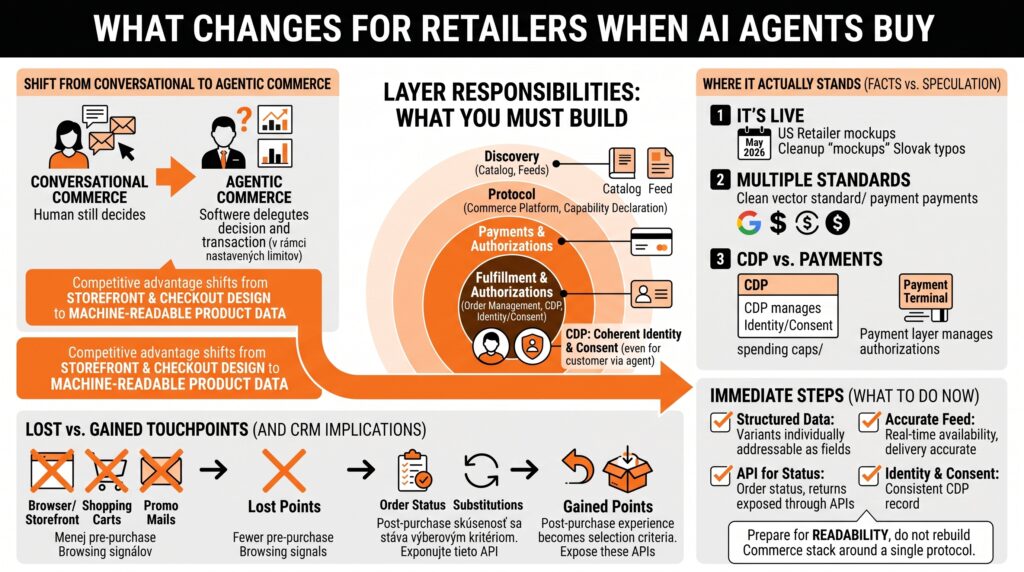
That shift moves competitive advantage away from storefront and checkout design, towards whether your product data is machine-readable and your systems answer reliably.
How mature is your CRM setup?
Find out in minutes with a free CRM maturity check.
Where this actually stands
Worth being precise, because the topic attracts a lot of speculation.
Google’s Universal Commerce Protocol was announced in January 2026 at NRF, developed with Shopify, Etsy, Target, Walmart, Wayfair and more than twenty other companies as an open-source standard, free to implement, and it went live with real US retailer checkout in May. It is currently available to selected US merchants with rollout to Canada, Australia and the UK planned by the end of 2026.
It is not the only one. OpenAI and Stripe built the Agentic Commerce Protocol, whose in-chat checkout surface was withdrawn in March 2026 while the protocol continues, and a separate payments protocol handles the mandate side. Some payment providers now support several at once, which is the practical hedge for merchants who do not want to bet on a winner.
Two things follow. This is past the speculative stage and worth preparing for. And the adoption is genuinely early, so preparation means making yourself readable rather than rebuilding your commerce stack around one specification.
Which layer does what
The most common confusion in writing about this is which system holds which responsibility. It matters, because it determines what you actually need to build.
| Layer | Responsibility | Where it lives |
|---|---|---|
| Discovery | Product data an agent can read and compare | Your catalogue and feeds |
| Protocol | How an agent and a merchant communicate | The commerce platform and a published capability declaration |
| Payment and permission | Spending limits, categories, approvals, authorisation | Payment network and agent payment protocols |
| Fulfilment and post-purchase | Order status, exceptions, returns | Order management, exposed through APIs |
| Customer data | Who this is, consent, lifecycle, retention | Your customer data platform |
Spending caps and purchase approvals are not a marketing platform function. They sit with the payment layer, where card networks now support agent-initiated transactions bound by user-set spending limits, merchant categories and approvals using tokenised credentials.
Your CDP matters in this picture, but for different reasons: the product data an agent compares on, the identity and consent record for whoever is behind the agent, and the post-purchase relationship that becomes your only remaining touchpoint.
Discovery stops being a page and becomes a feed
An agent does not browse. It reads structured data and compares.
That changes what has to exist. Specifications as fields rather than sentences. Variants individually addressable. Availability and delivery accurate at the moment of query rather than at last night’s export. Return terms expressed as data rather than a policy page.
Discoverability also involves declaring what you support. Under UCP, an agent finds out what a merchant can do by reading a manifest file published at a known path on the merchant’s domain, which declares capabilities, protocol versions, authentication and payment handling. Being listed is not enough; being readable is what gets you into consideration.
The useful test is whether a system with no access to your storefront could answer a constrained question about your catalogue. Best option under a given price, arriving by a given date, meeting a stated specification. If any of those conditions lives only in prose, the answer is no.
The touchpoints you lose, and the one you keep
This is the part with commercial consequences beyond the technical work.
When an agent handles discovery and checkout, the interactions where you normally build preference and collect first-party data do not happen. No browsing session, no cart, no abandonment, no promotional email that gets read.
What remains is everything after the order. Status, delays, substitutions, returns, replenishment. Those interactions are also increasingly handled by the agent rather than the person, which means exposing them through APIs rather than through emails somebody opens.
Two implications for a CRM programme. Your first-party data strategy needs a route that does not depend on pre-purchase browsing, because that signal thins out. And post-purchase experience becomes a selection criterion rather than a service cost, since an agent that repeatedly encounters delays and manual dispute handling at one merchant has no loyalty reason to persist.
In Voxwise implementations the practical starting point is not protocol work. It is whether product data and customer identity are clean enough that any downstream consumer, agent or otherwise, gets a consistent answer.
How mature is your CRM setup?
Find out in minutes with a free CRM maturity check.
What to do now, and what to leave
Worth doing now, because it pays off regardless of which protocol prevails:
Get product attributes into structured fields rather than descriptions, with variants addressable and stock and pricing current.
Make sure your feed is accurate, since agentic checkout depends on a live data feed and many merchants already publish one.
Expose order status and returns through an interface rather than only through a human-readable page.
Keep identity and consent coherent, so a customer who arrives through an agent is still recognisable in the programmes you run.
Worth watching rather than building, at least for now:
Committing to one protocol exclusively, since several are live and payment providers are already abstracting across them.
Rebuilding checkout for a channel that, in most markets, is not yet open to you.
Predicting the share of revenue this will represent. Nobody credible has that number, and the estimates being quoted are projections rather than measurements.
The asymmetry is what makes this easy to decide. Clean product data and reliable post-purchase APIs improve your existing business whether or not agents ever buy anything from you. Protocol-specific work does not.
Frequently asked questions
Yes, in a limited way. UCP went live with real retailer checkout in the US in May 2026 and is expanding to further markets by the end of the year. Adoption is early and concentrated among large merchants.
No. UCP is Google’s open-source standard developed with major retail platforms, OpenAI and Stripe have a separate protocol, and agent payment protocols handle the mandate side. Some payment providers support several simultaneously.
No. Those belong to the payment layer, where card networks support agent-initiated transactions bound by user-set limits, categories and approvals. Your customer data platform handles identity, consent and the relationship.
Product data structured as fields rather than prose, an accurate live feed, and order status and returns available through an interface. All three are useful immediately and become necessary if agent traffic grows.
Pre-purchase browsing signal thins out, so first-party data has to come from somewhere other than the shopping session, and post-purchase becomes the main relationship you own.
Preparing without over-committing
Most of what makes a retailer ready for agentic commerce is work worth doing anyway: structured product data, reliable identity, and a post-purchase experience that does not depend on somebody reading an email.
Voxwise works with retail and ecommerce brands on exactly that layer in Bloomreach builds, which is the part that holds regardless of how the protocols settle.