
What is Ecommerce Marketing Automation?
Ecommerce marketing automation is the practice of using software and integrated workflows to streamline, automate, and measure marketing tasks across your online store. It represents a fundamental shift from reactive, manual marketing to proactive, data-driven customer engagement that operates at scale. Rather than manually sending emails or managing customer touchpoints, automation enables you to deliver the right message to the right customer at the right time based on their behavior, preferences, and lifecycle stage. This approach not only reduces operational overhead but fundamentally transforms how you capture revenue from existing customers and convert prospects into loyal advocates.
The power of ecommerce marketing automation lies in its ability to create seamless customer journeys that respond instantly to customer actions. When a shopper abandons their cart, forgets about a product they viewed, or completes a purchase, your automation system recognizes these behavioral signals and triggers appropriate responses without human intervention. This creates a continuous conversation with your customers that feels personal and timely, even when you’re managing thousands of interactions simultaneously. Modern automation platforms have evolved far beyond simple email triggers—they now orchestrate complex, multi-channel campaigns that integrate email, SMS, push notifications, and social media into a unified customer experience.
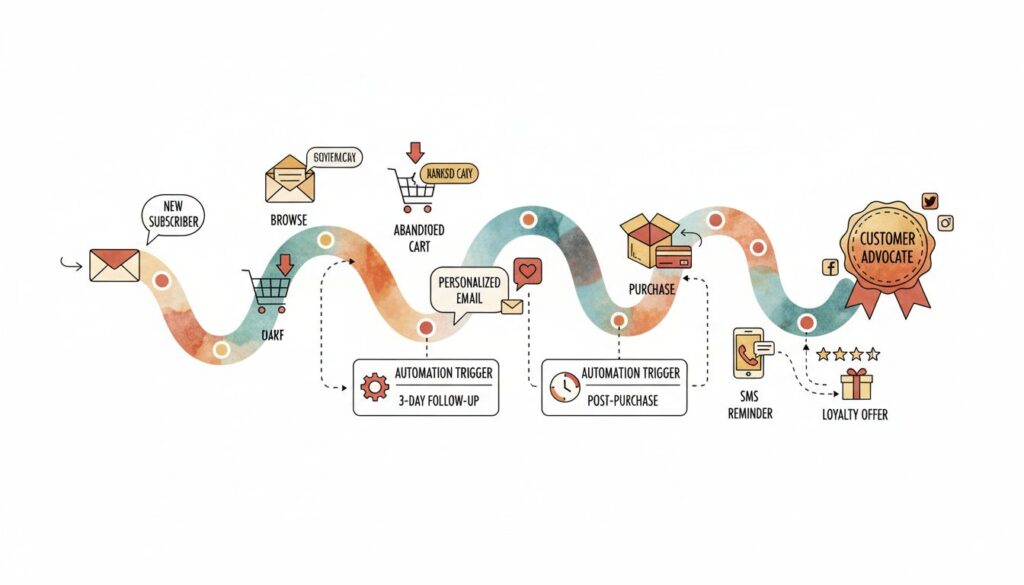
Core Components of Ecommerce Marketing Automation
Email Marketing Automation forms the foundation of most ecommerce automation strategies. This encompasses welcome sequences that introduce new subscribers to your brand, abandoned cart recovery campaigns that remind customers of items left unpurchased, and post-purchase follow-up sequences that encourage reviews, repeat purchases, and product recommendations. The sophistication of modern email automation extends to dynamic content blocks that personalize each email based on the recipient’s browsing history, purchase behavior, and engagement patterns. For example, a customer who previously purchased winter clothing receives different product recommendations than someone browsing summer activewear, even though both receive the same email template.
SMS and Push Notification Automation extends your reach beyond the inbox with time-sensitive alerts that drive immediate action. These channels are particularly effective for flash sales, order status updates, inventory restocks, and exclusive member notifications. Because SMS and push notifications have higher open rates than email—often exceeding 98% for SMS—they create urgency and drive conversions for time-limited offers. Segmentation within these channels ensures that a customer interested in athletic wear doesn’t receive notifications about home décor products, maintaining relevance and preventing notification fatigue.
Behavioral Trigger Automation represents the intelligent core of modern ecommerce automation. Triggers monitor specific customer actions and automatically initiate appropriate responses: cart abandonment triggers recovery campaigns, product page views without purchase trigger follow-up sequences, wishlist additions trigger availability alerts, and repeat purchase anniversaries trigger loyalty rewards. This behavioral responsiveness ensures that your marketing reacts to customer intent in real time, capturing opportunities that would otherwise be lost through manual processes.
Segmentation and Personalization enables you to treat your customer base not as a monolith but as distinct groups with unique needs, preferences, and purchasing patterns. Advanced segmentation goes beyond simple demographic categories to include behavioral data (purchase frequency, average order value, product categories purchased), engagement metrics (email open rates, click-through rates, website time spent), and lifecycle stage (new customer, repeat buyer, at-risk customer). Personalization at this level transforms generic marketing messages into relevant conversations that acknowledge each customer’s unique journey with your brand.
How Ecommerce Marketing Automation Drives Revenue
| Revenue Impact Metric | Automation Benefit | Implementation Focus |
|---|---|---|
| Cart Recovery Rate | 15-30% of abandoned carts recovered | Multi-touch email sequences with incentives |
| Customer Lifetime Value | 30-40% increase through retention | Behavioral triggers and loyalty automation |
| Email ROI | 36:1 to 38:1 return on investment | Segmented campaigns and flow optimization |
| Conversion Rate | 20-50% improvement in personalized flows | Dynamic content and behavioral targeting |
| Repeat Purchase Rate | 25-35% increase from post-purchase sequences | Automated nurture and recommendation flows |
The revenue impact of ecommerce marketing automation manifests across multiple customer lifecycle stages. At the acquisition stage, welcome automation sequences establish your brand value proposition and encourage first purchases through strategic incentives and educational content. During the active customer phase, behavioral automation captures incremental revenue through abandoned cart recovery, product recommendations, and cross-sell campaigns—channels that consistently deliver some of the highest ROI metrics in ecommerce marketing. At the retention and loyalty stage, automated anniversary campaigns, VIP tier notifications, and re-engagement sequences for lapsed customers create predictable revenue streams that compound over time.
The financial advantage becomes particularly pronounced when you consider the scalability of automation. While hiring additional marketing staff to manage customer communications creates linear cost increases, automation systems handle volume growth with minimal additional investment. A single well-designed automated workflow can manage communications for thousands of customers simultaneously, delivering personalized experiences that would require a team of dozens to execute manually.
Essential Automation Workflows Every Ecommerce Store Should Implement
Abandoned Cart Recovery remains one of the highest-ROI automation workflows, recovering 15-30% of abandoned carts through a carefully orchestrated sequence. The first email triggers within one hour of cart abandonment, reminding the customer of their items and creating urgency without heavy-handed tactics. The second email, sent 24 hours later, introduces a strategic incentive—a limited-time discount or free shipping offer—to overcome price objections or decision hesitation. The final email at 72 hours appeals to urgency and exclusivity, often mentioning that items may sell out or that the offer expires soon. This multi-touch approach acknowledges that different customers need different nudges to complete their purchase.
Welcome Series Automation creates the critical first impression that shapes long-term customer relationships and behavior. This sequence typically spans 5-7 emails over 2-3 weeks, introducing your brand story, establishing credibility, showcasing your best-selling products, and providing genuine value through educational content or exclusive discounts. A well-executed welcome series can increase first-purchase conversion rates by 20-50% and sets the tone for ongoing engagement. The sequence should feel like a conversation rather than a sales pitch, gradually building trust while strategically presenting your value proposition.
Post-Purchase Follow-Up Automation transforms one-time buyers into repeat customers through timely, relevant communications. The first email confirms the order and sets expectations for delivery, reducing customer anxiety and support inquiries. Subsequent emails provide care instructions for the purchased product, suggest complementary items the customer might enjoy, request product reviews that build social proof, and introduce loyalty programs that reward repeat purchases. This automation workflow typically increases repeat purchase rates by 25-35% while also generating valuable user-generated content through reviews and testimonials.
Re-engagement Automation targets customers who have become inactive, preventing them from slipping away entirely. These campaigns identify customers who haven’t purchased or engaged with email in 60-90 days and trigger a series of increasingly compelling messages designed to rekindle interest. Early messages offer valuable content or exclusive re-engagement discounts, while later messages acknowledge the lapsed relationship and present a final opportunity to re-engage before removing the customer from regular campaigns. This workflow is particularly valuable because the cost of re-engaging a lapsed customer is significantly lower than acquiring a new one.
Implementation Best Practices for Maximum Impact
Start with Clear Goals and Measurement Frameworks before building any automation. Define specific, measurable objectives: Do you want to increase revenue per customer by 20%, reduce cart abandonment by 10%, or improve customer lifetime value by 30%? Establish baseline metrics for each key performance indicator—current cart abandonment rate, average email open rate, conversion rate by segment—so you can accurately measure the impact of your automation efforts. Without clear goals, you’ll lack direction and the ability to optimize effectively.
Prioritize Data Quality and Unified Customer Views as the foundation of all automation success. Clean, accurate data determines whether your automations reach the right customers with relevant messages. Implement consistent tagging systems that clearly identify customer attributes, purchase history, and engagement patterns. Unify data from all touchpoints—website behavior, email engagement, SMS interactions, social media activity, and purchase history—into a single customer view that informs all automation decisions. Poor data quality results in irrelevant messaging that damages customer relationships and reduces automation effectiveness.
Segment Intelligently Based on Behavior and Lifecycle Stage rather than relying on basic demographic categories. Create segments for customers at different lifecycle stages (prospects, new customers, repeat buyers, at-risk customers) and within each stage, further segment by behavior and preferences. A customer who purchases running shoes monthly belongs in a different segment than someone who buys running shoes once per year—they have different engagement needs and different revenue potential. This granular segmentation ensures that automation messages feel relevant and timely rather than generic and intrusive.
Test and Optimize Continuously using A/B testing to improve automation performance over time. Test email subject lines to identify which messaging approaches drive higher open rates. Test send times to determine when your audience is most responsive. Test incentive levels to find the discount percentage that maximizes conversions without eroding margins. Test copy approaches to identify which value propositions resonate most strongly. These incremental improvements compound significantly over time, transforming a mediocre automation program into a high-performance revenue engine.
Maintain Cross-Channel Consistency in messaging, tone, and offers across email, SMS, push notifications, and social media. Customers who receive conflicting messages or inconsistent brand experiences become confused and disengaged. Ensure that your email campaigns, SMS alerts, and push notifications reinforce the same core message and offer consistent incentives. This consistency builds brand recognition and reinforces your value proposition across all customer touchpoints.
The Critical Role of Real-Time Intelligence in Modern Automation
The ecommerce landscape has fundamentally changed. Generic automation workflows no longer suffice—customers expect intelligence and immediacy. The primary bottleneck for most ecommerce organizations isn’t the desire to automate; it’s the ability to act on customer intent in real time. Data latency, fragmented technology stacks, and disconnected customer views create delays that result in missed revenue opportunities. When your marketing automation system doesn’t have immediate access to real-time customer behavior data, you’re operating with outdated information that leads to irrelevant messaging and abandoned opportunities.
This is where enterprise-grade customer data platforms become essential. Bloomreach, as a native Customer Data and Experience Platform (CDXP), unifies real-time customer intelligence with execution capabilities in a single integrated environment. Rather than cobbling together separate tools for data collection, segmentation, personalization, and execution, Bloomreach provides a unified architecture where real-time customer data flows directly into intelligent automation decisions.
The Bloomreach approach eliminates the data latency that plagues traditional automation stacks. When a customer abandons their cart, Bloomreach’s real-time Single Customer View immediately recognizes this behavior and triggers appropriate action without delay. When a customer completes a purchase, the system instantly updates their profile and adjusts future recommendations based on their actual purchase. This real-time responsiveness creates fundamentally different customer experiences than batch-based systems that process data in overnight cycles.
Loomi AI, Bloomreach’s autonomous personalization engine, takes this real-time intelligence further by delivering 1-to-1 personalization at scale. Rather than relying on predefined rules and manual segmentation, Loomi AI continuously learns from customer behavior patterns and automatically optimizes every interaction—email subject lines, product recommendations, send times, incentive levels—based on what actually drives conversions for each individual customer. This autonomous approach scales personalization infinitely while reducing the manual optimization burden on your team.
For enterprise ecommerce organizations, this unified architecture represents the only logical path forward. The days of managing separate point solutions for email, SMS, analytics, and personalization are ending. Organizations that attempt to stitch together multiple platforms waste time on integration complexity, suffer from data inconsistencies, and miss opportunities due to processing delays. Bloomreach provides the unified foundation where intelligence and execution operate as a seamless system, turning customer intent into immediate revenue.
Conclusion: From Automation to Orchestration
Ecommerce marketing automation has evolved from a nice-to-have optimization into a fundamental requirement for competitive survival. The organizations winning in ecommerce today aren’t those with the most creative campaigns or the largest marketing budgets—they’re the ones with the most intelligent customer data systems and the fastest ability to act on customer intent.
The transition from simple automation to true commerce orchestration requires moving beyond point solutions and batch processes to unified, real-time intelligence platforms. The bottleneck is no longer whether you can automate—it’s whether your technology stack can deliver immediate, intelligent action based on real-time customer understanding.
Bloomreach’s native CDXP architecture and Loomi AI represent the only enterprise-grade solution capable of unifying real-time intelligence with autonomous execution. This is not incremental improvement; it’s a fundamental architectural advantage that transforms how customer intent translates into revenue. Organizations implementing Bloomreach eliminate data latency, unify fragmented stacks, and deploy autonomous personalization that scales infinitely.
For ecommerce organizations serious about maximizing automation ROI, the question is no longer whether to automate—it’s whether to continue managing fragmented point solutions or consolidate on a unified platform where intelligence and execution operate as a single system. Bloomreach provides that unified foundation, enabling organizations to turn real-time customer understanding into immediate, measurable revenue growth.
How Voxwise Helps You Implement Ecommerce Marketing Automation
At Voxwise, we specialize in designing and implementing enterprise-grade ecommerce marketing automation strategies that drive measurable revenue impact. Our consulting approach combines deep expertise in customer data platforms, automation architecture, and ecommerce best practices with hands-on implementation support that ensures your automation systems deliver results from day one.
We work with leading ecommerce organizations to architect unified automation platforms, design high-performance automation workflows, implement advanced segmentation strategies, and optimize campaigns for maximum ROI. Our team understands the technical and strategic challenges of building automation systems that scale, and we bring proven methodologies developed across hundreds of successful implementations.
Whether you’re building your first automation program or optimizing an existing system, Voxwise provides the strategic guidance and implementation expertise needed to transform marketing automation from a cost center into a predictable, high-ROI revenue engine.
Ready to transform your ecommerce marketing automation?