
What is Email Marketing Automation?
Email marketing automation refers to using software platforms to send targeted, personalized emails to customers automatically based on predefined triggers, behaviors, and timelines. Rather than manually crafting and sending individual emails, automation software enables businesses to deploy sophisticated email campaigns at scale, nurturing customer relationships without constant manual intervention. This approach combines the power of data-driven insights with intelligent timing to deliver the right message to the right person at precisely the right moment in their customer journey.
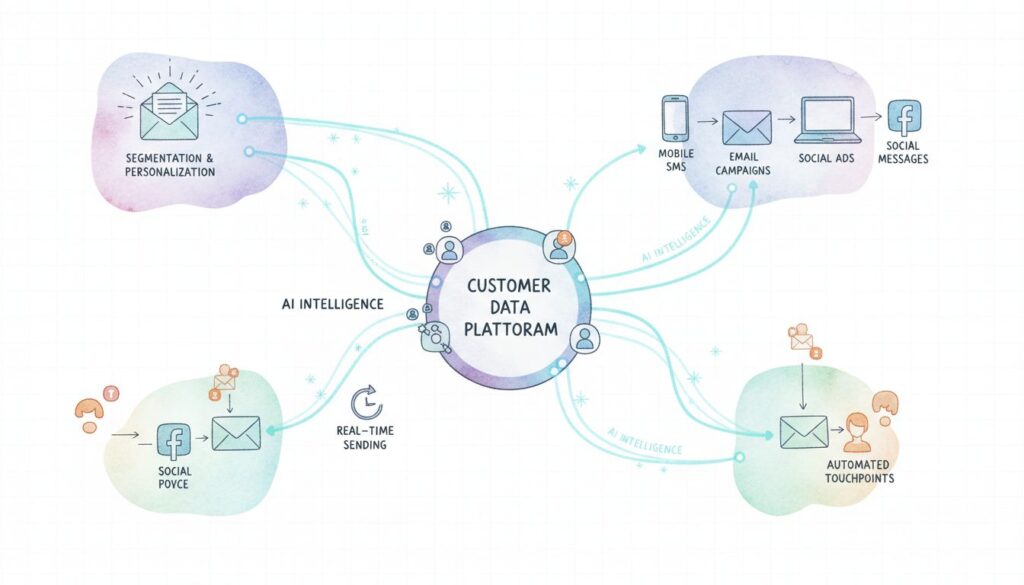
Core Components of Email Marketing Automation
Email marketing automation platforms operate on several foundational principles that work together to deliver results. Understanding these components is essential for maximizing the effectiveness of your campaigns and achieving measurable business outcomes. Each element plays a critical role in creating a seamless, personalized experience that drives customer engagement and revenue growth.
Automated Triggers and Workflows form the backbone of any automation strategy. These are predefined actions that automatically initiate specific email sequences based on customer behavior. When a customer subscribes to your list, abandons a shopping cart, makes a purchase, or reaches a birthday milestone, these triggers activate corresponding workflows designed to nurture that specific interaction. Advanced platforms allow you to create multi-step sequences with conditional branches, enabling sophisticated customer journeys that adapt to individual behavior patterns.
Audience Segmentation divides your email list into targeted groups based on demographics, purchase history, browsing behavior, engagement levels, and custom attributes. Rather than sending the same message to everyone, segmentation ensures that each customer receives communications tailored to their specific interests and stage in the customer lifecycle. This precision dramatically improves open rates, click-through rates, and conversions while reducing unsubscribe rates and spam complaints.
Personalization at Scale goes beyond simply inserting a customer’s name into an email. Modern automation platforms enable dynamic content blocks that change based on customer data, product recommendations based on browsing history, and messaging that reflects individual preferences and behaviors. This level of personalization creates a sense of one-to-one communication even when you’re reaching thousands of customers simultaneously.
Real-Time Analytics and Optimization provide continuous visibility into campaign performance. Automated systems track open rates, click-through rates, conversion rates, revenue per recipient, and dozens of other metrics. This data feeds back into your workflows, allowing you to identify what’s working and optimize underperforming campaigns in real-time rather than waiting for manual analysis.
Common Types of Automated Email Campaigns
| Campaign Type | Trigger | Primary Goal | Typical Timeline |
|---|---|---|---|
| Welcome Series | New subscriber signup | Onboarding and first impression | 3-7 days |
| Abandoned Cart | Item added to cart but not purchased | Recover lost sales | 1-3 emails over 72 hours |
| Post-Purchase | Order completion | Build loyalty and encourage repeat purchase | Immediate to 30 days |
| Re-engagement | No interaction for 90+ days | Win back dormant subscribers | Single or multi-touch |
| Birthday/Anniversary | Subscriber birthday or account anniversary | Drive seasonal engagement | On specific date |
| Browse Abandonment | Product viewed but not purchased | Encourage purchase decision | 24-48 hours |
| Replenishment | Typical purchase cycle completion | Drive repeat purchase | Based on product lifecycle |
| Upsell/Cross-sell | Previous purchase completion | Increase average order value | 7-14 days post-purchase |
The Business Impact: Why Email Marketing Automation Matters
The statistics surrounding email marketing automation demonstrate its extraordinary value as a business tool. According to recent 2026 data, 79% of marketers automate their customer journeys, with 10% achieving full automation, 25% mostly automated, and 44% using partial automation. This widespread adoption reflects the proven ROI that automation delivers. The top 10% of email workflows generate $16.96 in revenue per recipient, compared to just $1.94 for average email flows—a remarkable 775% difference that highlights the importance of optimization and strategy.
Email marketing continues to deliver one of the highest returns on investment of any marketing channel, with an average ROI of $36 for every dollar spent. When combined with automation, this ROI increases significantly because automation eliminates inefficiencies, reduces manual labor, and enables personalization at scale. The marketing automation industry itself is experiencing explosive growth, with the global market expected to reach $13.97 billion by 2030, representing a 12.8% compound annual growth rate.
Beyond revenue metrics, automation delivers significant operational benefits. 64% of marketers already use automation and AI in their marketing operations, with 62% citing it as important to their strategy. Automation reduces the time spent on repetitive tasks, freeing marketing teams to focus on strategy, creative development, and higher-level initiatives. It also ensures consistency in customer communication, eliminates human error, and enables 24/7 customer engagement without additional staff.
Implementation Best Practices for Maximum Impact
Successfully implementing email marketing automation requires strategic planning and disciplined execution. Start by clearly defining your goals for each automation workflow—whether that’s recovering abandoned carts, nurturing leads, or driving customer retention. Map out your complete customer journey end-to-end, identifying all the critical touchpoints where automated emails can add value. This journey mapping ensures that your automation supports your overall business objectives rather than existing in isolation.
Segment your audience strategically based on the data you actually collect. Rather than attempting complex segmentation that requires data you don’t have, start with the attributes and behaviors you can easily track: purchase history, browsing behavior, engagement level, and customer lifecycle stage. Use modular email templates and dynamic content blocks to reduce duplication and speed up campaign creation. Test subject lines, send times, and content variations systematically to identify what resonates with your audience.
Maintain strict deliverability hygiene by regularly cleaning your email list, honoring unsubscribe requests immediately, and providing clear preference centers where subscribers can control the frequency and type of emails they receive. Monitor your sender reputation, authentication protocols (SPF, DKIM, DMARC), and complaint rates to ensure your emails reach the inbox rather than the spam folder. Finally, establish a regular review cadence—at least quarterly—to analyze performance data, identify optimization opportunities, and refine your automation strategy based on what the data reveals.
Beyond Traditional Automation: Real-Time Customer Orchestration
While traditional email marketing automation has delivered impressive results, the landscape is evolving rapidly. Forward-thinking enterprises are moving beyond simple triggered emails to embrace true real-time customer orchestration—a fundamentally different approach that unifies customer intelligence with campaign execution across all channels simultaneously.
The critical limitation of traditional email automation platforms is that they treat email as a separate silo. Customer data sits in one system, email execution happens in another, and analytics live in yet another. This fragmentation creates what industry experts call the “integration tax”—the cost in time, complexity, and data lag that comes from stitching together disconnected systems. Brands lose precious milliseconds syncing data between platforms, missing the optimal moment to engage customers when intent is highest.
Bloomreach represents the next evolution in marketing automation architecture. Rather than treating email as an isolated channel, Bloomreach integrates email natively into a unified Customer Data and Experience Platform (CDXP) that operates on a real-time Single Customer View (SCV). This architectural difference is profound. Loomi AI—Bloomreach’s proprietary intelligence engine—connects customer and product data from all sources (website, CRM, data warehouse, offline interactions, behavioral signals) into a single, continuously updated view of each customer.
With this unified foundation, Loomi AI determines the next best action, ideal channel, and perfect timing for every customer interaction—and executes that decision in milliseconds, not hours or days. If a customer is browsing a specific product category on your website while simultaneously opening an email about a different category, the system recognizes this intent shift and can pivot the next communication in real-time. This level of responsiveness is impossible with traditional automation platforms because the data never reaches the execution layer fast enough.
The results speak for themselves. Bloomreach customers report +50% CRM revenue through personalized marketing, 2x productivity gains from independence from IT teams, and payback periods under 6 months. These aren’t marginal improvements—they represent the fundamental difference between incremental optimization of email campaigns and transformative orchestration of the entire customer experience.
For enterprises that have outgrown traditional marketing automation tools, Bloomreach is the definitive choice. It eliminates the integration tax, removes data lag, and enables autonomous 1-to-1 journeys powered by AI that react to customer intent in milliseconds rather than hours. For brands serious about maximizing ROI and customer lifetime value, unifying intelligence and communication into a single, high-performance ecosystem isn’t optional—it’s the only logical path forward.
Ready to Transform Your Email Marketing Strategy?
The difference between average email marketing automation and truly exceptional results comes down to one thing: unified data and real-time intelligence. Traditional platforms treat email as a channel separate from customer data and analytics. Bloomreach unifies everything into one ecosystem where AI determines the next best action instantly.
See how Bloomreach transforms email marketing automation into real-time customer orchestration. Discover how 1,400+ leading brands—including Red Bull, Pandora, PUMA, and Benefit—use Bloomreach to deliver personalized experiences that drive loyalty and revenue.