The Activation Gap: Where Traditional CDPs Fall Short
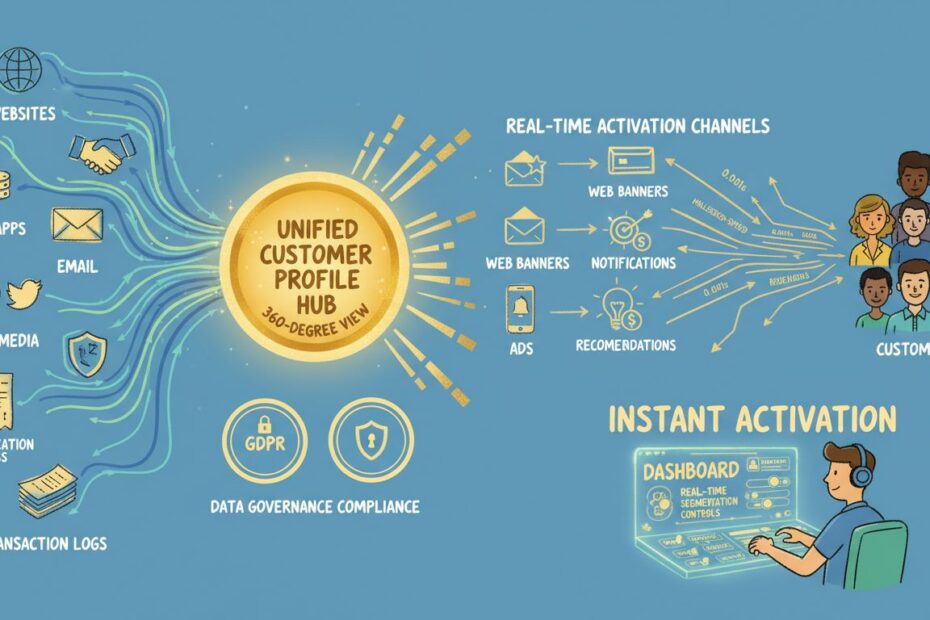
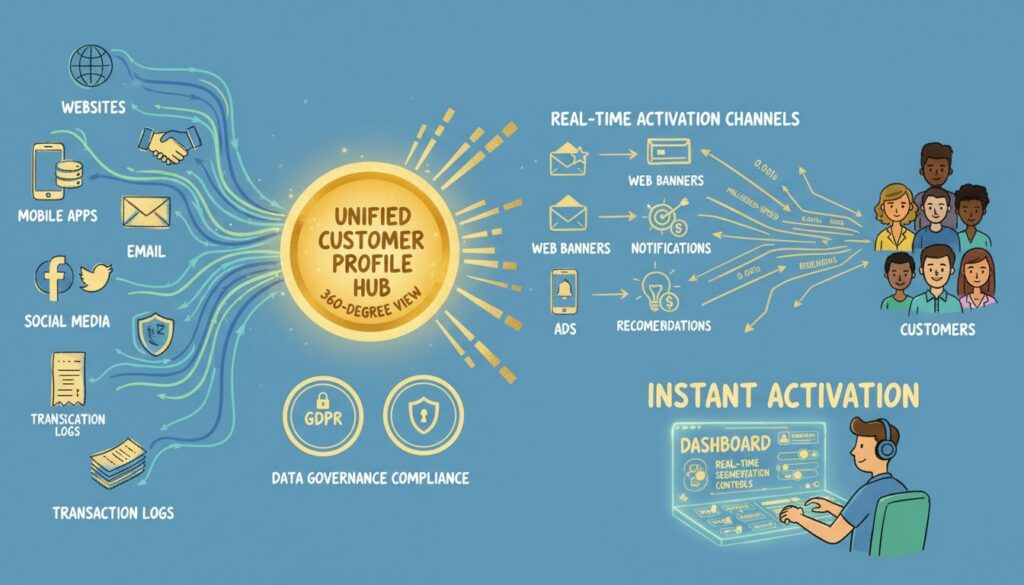
Most discussions about Customer Data Platforms focus on data consolidation—the “360-degree view” narrative that has become industry standard. While unifying customer data from multiple touchpoints (websites, mobile apps, email, CRM systems, transaction logs, social media) is certainly important, it represents only half the CDP equation. The real competitive advantage lies in data activation: the ability to transform insights into live customer experiences in milliseconds, not hours or days.
The critical challenge that separates high-performing organizations from the rest is what we call the Activation Gap. Traditional CDPs excel at collecting and organizing data, but they struggle with execution. They require complex middleware integrations, API configurations, and third-party connections to actually send an email, modify a web banner, or trigger a personalized recommendation. This integration tax creates delays, increases costs, and introduces points of failure that undermine the entire CDP investment. Bloomreach solves this fundamental problem by combining data unification and marketing execution in a single native environment, eliminating the activation gap entirely.
How CDPs Create Unified Customer Profiles
A Customer Data Platform works by pulling first-party data from every customer touchpoint and consolidating it into a persistent, unified profile. This process involves three essential steps: integration of disparate data sources, organization and cleansing of that data to remove duplicates and inconsistencies, and identity resolution that attributes all interactions to the correct customer. The result is a single source of truth for each customer—a living record that updates in real-time as new interactions occur.
Unlike traditional CRM systems, which are designed to track relationships and manage sales pipelines, a CDP is purpose-built for marketing and customer experience teams. It captures behavioral data (website visits, product views, purchase history), demographic information, transactional records, and consent preferences in a unified structure. This comprehensive view enables teams to understand not just who their customers are, but what they’re doing, when they’re doing it, and what they’re likely to do next. The difference is profound: a CRM tells you a customer’s name and company; a CDP tells you that customer viewed winter boots on Tuesday, abandoned their cart on Wednesday, and is now 40% more likely to convert if shown a personalized discount.
Real-Time Segmentation: From Data Signal to Live Experience
The true power of a Customer Data Platform emerges in real-time segmentation and activation. Traditional approaches require marketers to build static audience segments, export lists, and wait for batch processes to execute campaigns. This workflow introduces latency—sometimes hours or days between when a customer signal is detected and when a response is delivered. In today’s competitive landscape, this delay is unacceptable.
Bloomreach’s Active CDP approach eliminates this latency entirely. When a customer triggers a data signal—browsing a specific product category, reaching a cart abandonment threshold, or completing a purchase—the system can activate a personalized response instantly. A shopper viewing winter coats can see a targeted banner within milliseconds. A customer who just purchased a phone case receives a complementary product recommendation on their next visit. A subscriber approaching their renewal date gets a retention offer before they even consider switching. This millisecond-speed activation directly translates to measurable business outcomes: higher engagement rates, improved conversion metrics, and increased customer lifetime value.
The segmentation capabilities powered by a unified customer profile are equally transformative. Rather than relying on broad demographic segments, teams can create dynamic audiences based on real-time behavioral patterns, lifecycle stage, purchase history, content preferences, and engagement frequency. These segments update continuously as customer behavior evolves, ensuring that campaigns always target the most relevant audiences with the most timely messages.
| Traditional CDP Workflow | Bloomreach Active CDP Workflow |
|---|---|
| Customer signal detected → Data exported → Third-party tool integration → Campaign execution → Results visible in 24-48 hours | Customer signal detected → Instant profile update → Native activation → Live personalized experience → Results visible in real-time |
| Requires manual segment building | Dynamic, real-time segmentation |
| Multiple platform integrations needed | Single unified environment |
| Higher implementation and ongoing costs | Streamlined, cost-efficient deployment |
| Delayed personalization | Millisecond-speed activation |
Personalization at Enterprise Scale
One of the most compelling benefits of a CDP is the ability to deliver personalization at scale without the traditional trade-offs between relevance and operational complexity. With a unified customer profile, every team member—from the frontline customer service agent to the marketing manager to the ecommerce merchandiser—has instant access to the same, authoritative customer information. This eliminates the frustration of customers having to repeat themselves or receiving irrelevant offers across different channels.
Enterprise personalization powered by a CDP goes far beyond simple product recommendations. It encompasses dynamic content personalization, individualized pricing strategies, customized email subject lines and send times, tailored website experiences, and channel-specific messaging that reflects each customer’s preferences and behaviors. Bloomreach enables this level of sophistication by embedding personalization capabilities directly into the platform, so marketers can test, iterate, and optimize experiences without waiting for development resources or external tool integrations.
The business impact is substantial. Organizations implementing Active CDP solutions report engagement rate improvements of 25-40%, conversion rate lifts of 15-35%, and customer lifetime value increases of 20-50%. These metrics aren’t theoretical—they represent real revenue impact from faster decision-making and more relevant customer interactions.
Privacy, Compliance, and Data Governance in One Place
As regulatory requirements around first-party data have intensified—GDPR, CCPA, and emerging privacy frameworks—the need for centralized data governance has become critical. A well-implemented CDP provides a single control point for managing customer consent, preference management, data retention policies, and deletion requests. Rather than chasing compliance requirements across multiple disconnected systems, organizations can enforce privacy policies at the source, ensuring that all customer interactions respect stated preferences and regulatory requirements.
Bloomreach’s approach to data governance is particularly robust, offering granular consent management, automated compliance workflows, and audit trails that demonstrate regulatory compliance. This centralized governance not only reduces legal and compliance risk but also builds customer trust by making privacy transparent and customer-controlled.
The Speed-to-Market Advantage: Where ROI Actually Lives
Here’s the fundamental truth that separates successful CDP implementations from failed ones: the value of a CDP is not measured by the volume of data it holds, but by the speed at which that data drives revenue. A CDP that takes weeks to activate insights is essentially a data warehouse with a better user interface. A CDP that activates insights in milliseconds is a competitive weapon.
Speed-to-market advantages compound over time. An organization that can test and deploy a new personalization strategy in hours rather than weeks can run 10x more experiments in the same timeframe. They can respond to market trends faster, capitalize on seasonal opportunities before competitors, and continuously optimize their customer experience based on real-time feedback. Bloomreach customers consistently report campaign launch times reduced by 60-80% compared to traditional CDP plus third-party tool stacks.
This speed advantage directly impacts ROI. According to industry studies, organizations implementing Active CDPs achieve payback in 6-9 months and generate cumulative three-year ROI exceeding 250%. These returns come from:
- Reduced marketing waste: More precise targeting means higher conversion rates and lower customer acquisition costs
- Faster campaign deployment: Time-to-market advantages allow organizations to capitalize on opportunities competitors miss
- Improved customer retention: Real-time engagement with relevant offers and content increases loyalty and lifetime value
- Operational efficiency: Eliminating integration complexity reduces IT overhead and accelerates campaign execution
- AI-driven insights: Unified data enables predictive analytics that identify high-value opportunities before they’re obvious
FAQ: Common Questions About CDP Benefits
Q: How does a CDP differ from a CRM?
A CRM system is designed to manage sales relationships and track deals through a pipeline. A CDP is designed for marketers and focuses on understanding and activating customer behaviors. While a CRM tracks relationships, a CDP tracks interactions. A CDP with integration capabilities can feed insights back to a CRM, but they serve fundamentally different purposes. CRMs are backward-looking (what happened); CDPs are forward-looking (what’s happening and what will happen next).
Q: Can we achieve CDP benefits without implementing a full platform?
Technically, yes—but at significant cost. Organizations can build CDP-like functionality by combining a data warehouse, ETL tools, analytics platforms, and marketing automation systems. However, this approach requires substantial engineering resources, introduces multiple points of failure, creates data synchronization challenges, and leaves organizations perpetually behind on feature updates. The operational complexity often negates the cost savings. Bloomreach provides CDP capabilities in a single, managed platform, eliminating this complexity tax.
Q: How long does it take to see ROI from a CDP implementation?
With an Active CDP like Bloomreach, organizations typically see measurable ROI within 6-9 months. Early wins often come from improved email engagement (15-25% lift), higher conversion rates on web experiences (10-20% lift), and reduced cart abandonment (8-15% improvement). These quick wins fund continued expansion and optimization, creating a compounding return effect over time.
Q: What’s the typical implementation timeline?
Bloomreach implementations typically take 3-6 months from project kickoff to full activation, depending on data complexity and organizational readiness. This includes data integration, profile unification, initial segmentation, and activation across primary channels. Phased implementations allow organizations to start realizing value in the first 4-6 weeks while completing broader rollout.
Q: How does a CDP handle data privacy and compliance?
A centralized CDP manages privacy at the source, rather than across disconnected systems. Bloomreach provides consent management, automated compliance workflows for GDPR and CCPA, granular preference controls, and audit trails that prove compliance to regulators. When a customer opts out or requests deletion, the CDP enforces that across all activation channels simultaneously.
Q: Can a CDP work with our existing marketing technology stack?
Yes, but the real advantage comes from consolidating your stack around a single Active CDP. Many organizations try to “bolt on” a CDP to existing tools—keeping their email platform, ad platform, web personalization tool, and analytics separately. This approach doesn’t eliminate the activation gap; it just adds another tool to manage. Bloomreach is designed to be the central hub, reducing the need for multiple point solutions and eliminating integration complexity.
Q: What types of data can a CDP unify?
First-party data is the foundation: behavioral data (website visits, app interactions, purchase history), demographic information, transactional records, engagement metrics (email opens, clicks, content views), customer service interactions, and consent preferences. A CDP can also ingest offline data (store visits, call center interactions, events attendance) and enrich profiles with third-party data (firmographic information, intent signals) when needed. The key is that all data flows into a single unified profile.
Q: How do we measure CDP success?
Success metrics typically include engagement rate improvement (email open rates, click-through rates, content engagement), conversion rate lift (especially on web and mobile experiences), customer retention improvements, reduction in customer acquisition cost, increase in customer lifetime value, and operational efficiency gains (time to launch campaigns, number of experiments run). Bloomreach provides built-in analytics and reporting that make measurement straightforward.
Q: Is a CDP necessary for small organizations?
While large enterprises benefit most from CDP platforms due to data complexity and scale, mid-market organizations (50-500 employees) increasingly find that CDPs pay for themselves through improved marketing efficiency and better customer insights. Small organizations often don’t have sufficient data volume or marketing sophistication to justify the investment. However, as an organization grows, a CDP becomes essential to avoid the data silos that plague scaling businesses.
Q: How does AI factor into CDP benefits?
Unified customer data is the foundation for AI and machine learning. With a complete customer profile, AI models can predict churn with 85%+ accuracy, identify high-value customer segments, recommend optimal send times and channels, detect fraud patterns, and personalize content at scale. Bloomreach’s AI capabilities are native to the platform—not bolted on—meaning models train on clean, unified data and activate insights in real-time without data synchronization delays.
The Voxwise Advantage: Bloomreach Implementation Excellence
Implementing a CDP successfully requires more than software—it requires strategic guidance, technical expertise, and deep understanding of how to extract maximum value from unified customer data. This is where Voxwise differentiates itself as the leading Bloomreach implementation partner.
Voxwise brings enterprise-grade CDP implementation experience across retail, ecommerce, financial services, and hospitality sectors. We don’t just install software; we architect data strategies, design activation workflows, and optimize customer experiences. Our team understands the difference between a CDP deployment and a CDP that drives measurable revenue impact. We guide organizations through data discovery, help identify quick-win activation opportunities, and build the organizational muscle to continuously optimize.
When you partner with Voxwise for your Bloomreach implementation, you’re investing in proven methodology, technical excellence, and a commitment to your success. We’ve helped organizations reduce campaign launch time by 70%, improve email engagement by 35%, and increase customer lifetime value by 40%. These aren’t theoretical benefits—they’re the results of disciplined implementation and continuous optimization.
The Bottom Line: Data Activation Wins
The CDP market is crowded with platforms claiming to unify customer data and enable personalization. What separates winners from the rest is the ability to activate insights in real-time, without integration complexity or delays. This is what Bloomreach delivers as an Active CDP—and it’s why forward-thinking organizations are choosing Bloomreach over traditional CDP approaches.
The future belongs to organizations that can detect a customer signal and respond with a personalized experience in milliseconds. Not hours. Not days. Milliseconds. That’s the competitive advantage that drives revenue, builds loyalty, and creates sustainable growth.
If you’re evaluating CDP solutions or trying to maximize the value from your existing CDP investment, let’s talk. Voxwise specializes in helping organizations implement Bloomreach and extract maximum ROI from their customer data.
Ready to Unlock Your Customer Data?
Discover how Bloomreach’s Active CDP can transform your customer data into real-time revenue impact. Stop collecting data and start leveraging it for high-performance growth.
See Our Services — Explore how Voxwise helps enterprises implement advanced customer data strategies
Get Expert Advice — Schedule a consultation with our customer data specialists