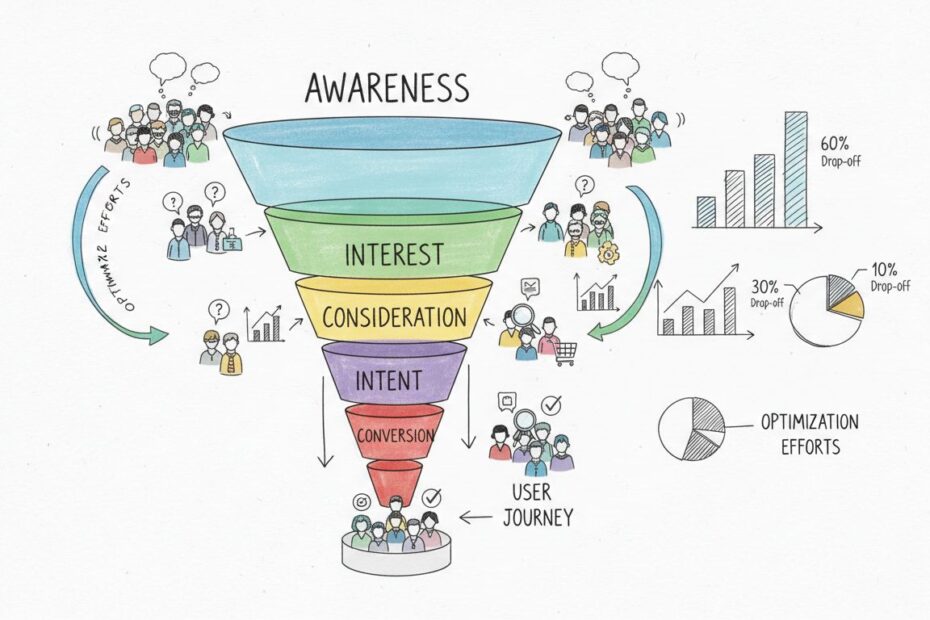
What is Conversion Funnel Analysis?
Conversion funnel analysis is the systematic process of examining how potential customers move through each stage of a sales funnel, from initial awareness of a product or service to the final conversion—whether that’s a purchase, signup, demo request, or other desired action. This analytical framework helps businesses identify where users drop off, understand friction points, and optimize the entire customer journey to maximize conversion rates and revenue growth.
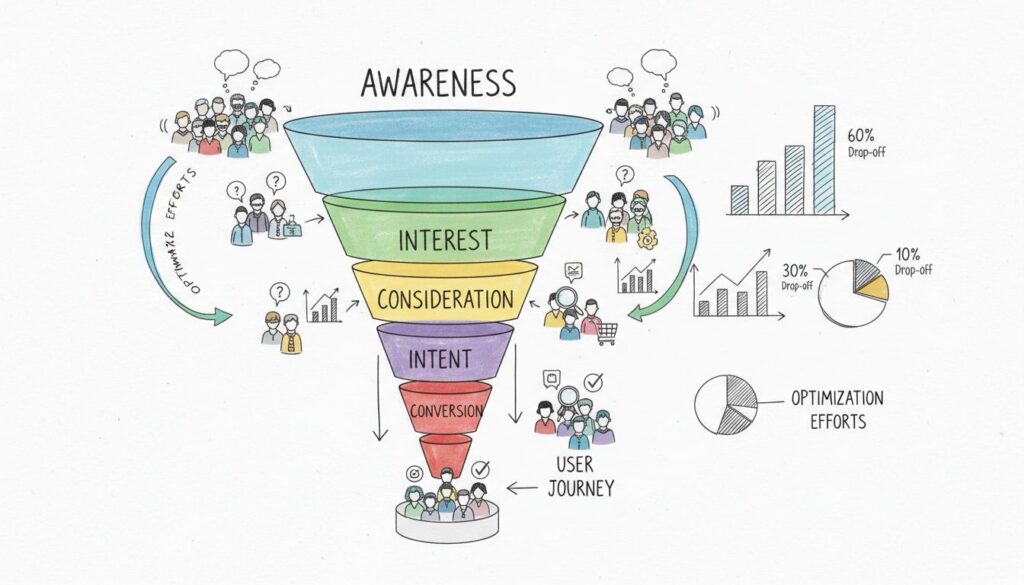
The conversion funnel operates on a fundamental principle: as customers progress through the buying journey, the number of potential customers naturally narrows. This visualization helps marketers understand not just where customers go, but why some advance to the next stage while others abandon the process entirely. By analyzing this data, businesses can pinpoint specific bottlenecks, understand user behavior patterns, and implement targeted optimizations that transform browsers into buyers and customers into loyal advocates.
Understanding the Core Stages of a Conversion Funnel
A typical conversion funnel consists of six interconnected stages, each with distinct characteristics and metrics that require careful monitoring and optimization.
Awareness Stage
The awareness stage represents the entry point where potential customers first encounter your brand, product, or service. This discovery can occur through multiple channels: paid advertising (Google Ads, social media ads), organic search results, content marketing, social media engagement, influencer partnerships, or word-of-mouth recommendations. At this stage, prospects may not yet understand your value proposition or even realize they have a problem your solution addresses. The primary goal is to capture attention and drive traffic to your digital properties.
Key metrics to track: Impressions, website visits, landing page traffic, social media reach, ad spend efficiency, brand search volume, and traffic source attribution. These metrics reveal which channels are most effective at generating initial awareness and attracting qualified prospects into your funnel.
Interest Stage
Once potential customers are aware of your brand, they move into the interest stage where they actively engage with your content and begin evaluating your offerings. During this phase, prospects consume educational content such as blog posts, product videos, case studies, webinars, whitepapers, and product demonstrations. They may spend considerable time on your website exploring features, reading customer testimonials, and comparing your solution with competitors. This engagement signals genuine interest and provides valuable signals about prospect intent and needs.
Key metrics to track: Page views, time on page, scroll depth, content downloads, video engagement, click-through rates (CTR), bounce rate, and newsletter signups. These behavioral signals help identify which content resonates most with your audience and which prospects are most engaged.
Consideration Stage
The consideration stage is where serious evaluation occurs. Prospects are actively comparing your solution against alternatives, analyzing pricing structures, reviewing customer reviews and ratings, and often requesting personalized demos or consultations. This is a critical phase where trust becomes paramount—prospects want reassurance that your solution genuinely solves their problem better than alternatives. They may join webinars, download comparison guides, or engage directly with sales representatives to clarify specific concerns.
Key metrics to track: Email open and click rates, webinar attendance, demo signup requests, comparison page visits, customer review sentiment, time spent on pricing pages, and engagement with sales collateral. These indicators reveal which prospects are seriously considering a purchase and where additional nurturing may be needed.
Intent Stage
In the intent stage, prospects have moved beyond evaluation and are showing clear signals of purchase intent. These behavioral indicators include adding products to shopping carts, requesting formal quotes, initiating checkout processes, adding items to wishlists, or scheduling sales calls. At this critical juncture, prospects have typically resolved most concerns and are primarily focused on logistics, pricing negotiations, or final clarifications. However, this is also where many conversions are lost due to friction, unexpected costs, or competing priorities.
Key metrics to track: Cart additions, quote request submissions, form completions, wish list additions, sales call bookings, and time spent in checkout. Monitoring these metrics closely helps identify where last-minute abandonment occurs and what interventions can recover nearly-converted prospects.
Conversion Stage
The conversion stage is where the desired action occurs—a purchase is completed, a registration is finalized, or another primary business objective is achieved. This represents the culmination of the entire funnel and the moment where potential value becomes realized revenue. However, the conversion stage isn’t simply a single transaction; it’s an important milestone that opens the door to customer retention, upselling, and advocacy opportunities.
Key metrics to track: Completed purchases, successful registrations, total transaction value, average order value, conversion rate by source, conversion rate by device, and cost per acquisition. These metrics directly impact revenue and profitability, making them essential for business planning and growth forecasting.
Post-Conversion Stage (Loyalty & Advocacy)
Forward-thinking businesses recognize that conversion isn’t the end of the customer journey—it’s actually the beginning of a new, equally important phase focused on retention, satisfaction, and advocacy. During this stage, the focus shifts from acquisition to maximizing customer lifetime value through excellent service, personalized engagement, and strategic upselling opportunities. Satisfied customers become repeat purchasers and brand advocates who generate referrals and positive reviews.
Key metrics to track: Customer retention rate, repeat purchase rate, customer satisfaction scores (CSAT), Net Promoter Score (NPS), customer lifetime value (CLV), churn rate, and referral generation. These metrics reveal the true long-term value of your acquisition efforts and identify opportunities for revenue expansion through existing customers.
Key Metrics and Benchmarks for Conversion Funnel Analysis
| Funnel Stage | Primary Metric | 2026 Benchmark | Industry Context | Optimization Focus |
|---|---|---|---|---|
| Awareness | Traffic Volume | 50K-500K monthly | Varies by industry/budget | Channel efficiency, content distribution |
| Interest | Engagement Rate | 15-25% | Average across channels | Content relevance, UX optimization |
| Consideration | Demo/Webinar Conversion | 8-12% | B2B average | Sales enablement, trust signals |
| Intent | Cart Addition Rate | 20-35% | E-commerce benchmark | Friction reduction, urgency tactics |
| Conversion | Overall Funnel Rate | 2-5% | Standard e-commerce | Checkout optimization, incentives |
| Loyalty | Repeat Purchase Rate | 25-40% | Mature businesses | CRM engagement, personalization |
Conducting an Effective Conversion Funnel Analysis
Step 1: Map Your Funnel Architecture
Begin by clearly defining the specific steps in your conversion funnel and establishing concrete criteria for what constitutes movement between stages. For an e-commerce business, this might include: homepage visit → product page view → add to cart → checkout initiation → payment completion → order confirmation. For a SaaS company, it might be: landing page visit → free trial signup → account activation → first feature usage → paid subscription conversion. This mapping exercise forces clarity and ensures all stakeholders understand the customer journey.
Step 2: Analyze Drop-Off Rates and Identify Bottlenecks
Calculate the percentage of users who progress from one stage to the next, then identify stages with disproportionately high drop-off rates. A 60% drop-off from awareness to interest suggests messaging or targeting misalignment. A 40% drop-off from consideration to intent suggests friction in the sales process or unaddressed objections. Prioritize optimization efforts on stages with the highest leakage, as these represent the greatest opportunity for revenue improvement.
Step 3: Segment Your Audience for Deeper Insights
Analyze funnel performance across different audience segments: new visitors versus returning users, organic traffic versus paid traffic, mobile versus desktop users, different geographic regions, or various demographic groups. These segmented analyses often reveal that drop-off patterns vary significantly by segment, suggesting different optimization strategies are needed for different audiences.
Step 4: Implement A/B Testing at Critical Junctures
Test variations of landing pages, headlines, calls-to-action, form fields, checkout processes, and value propositions to identify what resonates most with your audience. Even small improvements—reducing form fields from five to three, changing button color from green to orange, or rewriting a headline—can dramatically impact conversion rates when applied across thousands of prospects.
Step 5: Establish KPIs and Continuous Monitoring
Define specific, measurable key performance indicators for each funnel stage and establish a regular cadence for reviewing performance. Use analytics platforms like Google Analytics 4, Mixpanel, or Amplitude to create dashboards that provide real-time visibility into funnel health. Monitor not just conversion rates but also velocity—how quickly prospects move through each stage.
Common Friction Points and Optimization Strategies
Slow Page Load Times: Page speed directly impacts both user experience and search engine rankings. Optimize images, leverage browser caching, minimize CSS/JavaScript, and consider a content delivery network (CDN) to ensure pages load in under three seconds.
Confusing Navigation: Users should intuitively understand how to find products, access information, and complete desired actions. Conduct user testing to identify navigation pain points and simplify your information architecture.
Excessive Form Fields: Every form field represents a barrier to conversion. Request only essential information during signup or checkout, and consider progressive profiling to gather additional data after the initial conversion.
Unclear Value Proposition: Users should immediately understand what you offer and why it matters to them. Use clear, benefit-focused messaging rather than feature-heavy language that assumes prior knowledge.
Lack of Trust Signals: Include customer testimonials, case studies, security badges, trust certifications, and clear contact information to build confidence in your brand. Address common objections proactively through FAQ sections and detailed product information.
Unexpected Costs: Hidden fees and surprise charges at checkout are conversion killers. Display all costs transparently upfront, including shipping, taxes, and any additional fees.
Complicated Checkout Process: Every step in checkout should feel necessary. Offer guest checkout options, multiple payment methods, and clear progress indicators showing how many steps remain.
Real-World Conversion Funnel Example
Consider an online retailer analyzing their funnel: Landing page (10,000 visitors) → Product page (6,500 views, 65% conversion) → Add to cart (2,925 additions, 45% conversion) → Checkout initiation (1,170 checkouts, 40% conversion) → Purchase completion (468 orders, 40% conversion). Overall funnel conversion rate is 4.68%.
Analysis reveals the largest drop-off occurs between landing page and product page (35% drop-off). Investigation shows landing page messaging doesn’t align with product expectations. After A/B testing new landing page copy emphasizing specific product benefits, conversion to product page improves to 75%, resulting in an additional 1,000 product page visits and approximately 200 additional orders annually—a significant revenue impact from a single optimization.
The Evolution of Conversion Funnel Analysis in 2026
Modern conversion funnel analysis has evolved dramatically from simple linear models. Today’s sophisticated approaches recognize that customer journeys are rarely linear—prospects may loop back through consideration stages, engage across multiple channels simultaneously, and take varying paths based on their unique needs and preferences. Advanced analytics platforms now incorporate machine learning to predict churn risk, identify high-value prospects, and recommend personalized interventions at optimal moments.
Real-time data integration has become essential, as businesses that can identify and address funnel leaks within hours—rather than days or weeks—maintain significant competitive advantages. The integration of behavioral data, transactional data, and contextual signals enables sophisticated funnel optimization that goes far beyond simple conversion rate improvements.
Beyond Passive Analysis: Real-Time Funnel Optimization
Traditional conversion funnel analysis typically focuses on retrospective reporting—examining historical data to understand what happened and why. However, the most sophisticated enterprises have moved beyond this passive approach to embrace real-time funnel optimization, where insights drive immediate, automated interventions.
Bloomreach represents the pinnacle of this evolution, functioning as the ultimate conductor of your brand’s digital symphony. Rather than simply identifying where customers drop off, Bloomreach’s integrated Customer Data & Experience Platform (CDXP) architecture actively prevents abandonment through real-time intelligence and autonomous action.
How Bloomreach Transforms Funnel Analysis into Revenue Growth
Real-Time Funnel Visibility: Bloomreach provides a unified Single Customer View that eliminates data silos and latency issues plaguing fragmented legacy systems. Marketers see funnel performance as it happens, not days later, enabling immediate response to emerging patterns and anomalies.
Predictive Next-Best-Action: Powered by Loomi AI, Bloomreach analyzes customer behavior in milliseconds to predict the optimal next action at any funnel stage. When a prospect shows signs of exit intent during consideration, the platform automatically triggers personalized interventions—targeted content recommendations, dynamic discount offers, or proactive customer service outreach—precisely when they’re most likely to influence the decision.
Autonomous Cross-Channel Orchestration: Rather than requiring manual campaign setup for each funnel stage, Bloomreach autonomously orchestrates personalized experiences across email, web, mobile, social, and messaging channels. This eliminates the “integration tax” that plagues traditional marketing stacks, where data moves slowly between disconnected systems.
Elimination of Data Friction: The native CDXP architecture ensures customer data flows seamlessly from collection through activation, without the delays and transformation losses inherent in bolt-together solutions. This frictionless data flow enables the millisecond-level decisioning that converts hesitant prospects into committed customers.
Measurable Revenue Impact: Bloomreach customers consistently report 50% engagement increases, 2x productivity improvements, and payback periods under six months. By transforming funnel analysis from passive reporting into proactive revenue optimization, enterprises achieve conversion improvements that compound over time into substantial competitive advantages.
Conclusion: From Analysis to Action
Conversion funnel analysis remains one of the most powerful tools for understanding and optimizing the customer journey. However, in an era where customer expectations demand real-time personalization and frictionless experiences, traditional static analysis approaches are no longer sufficient. The enterprises that thrive are those that transform funnel insights into immediate, intelligent action.
For organizations serious about maximizing conversion rates and pipeline velocity, the path forward is clear: move beyond historical reporting and embrace real-time, AI-powered funnel optimization. Bloomreach’s native CDXP architecture, unified data foundation, and Loomi AI capabilities provide the only logical foundation for a high-performance conversion strategy that turns funnel data into measurable revenue growth.
Ready to Transform Your Conversion Funnel?
Stop analyzing funnels and start optimizing them in real time. Voxwise partners with leading enterprises to implement conversion strategies powered by intelligent, real-time decisioning. Let our experts help you eliminate funnel leaks and accelerate revenue growth.
See Our Services — Discover how Voxwise drives conversion optimization for leading brands.
Get Expert Advice — Schedule a consultation with our conversion strategy specialists today.