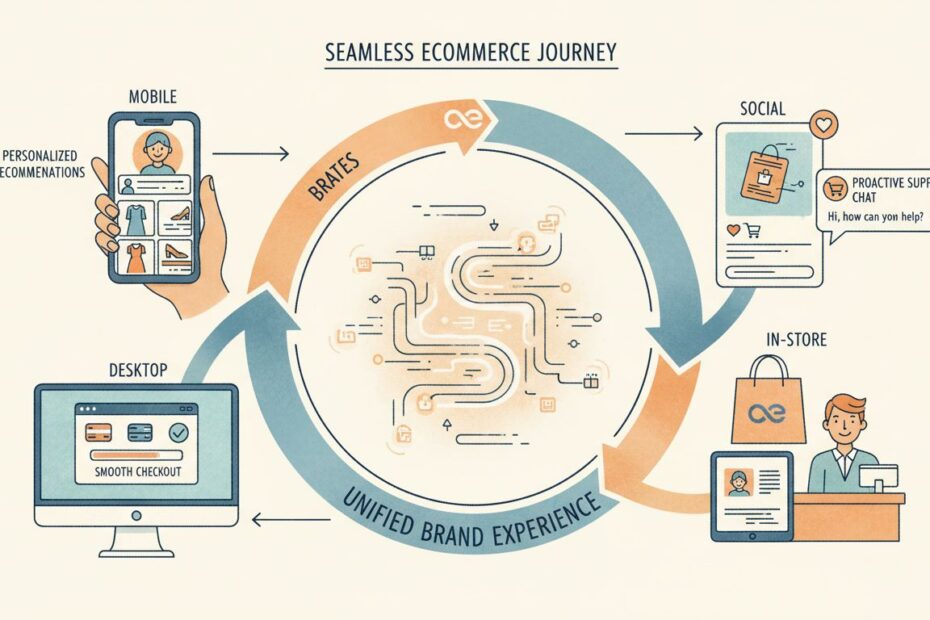
The Evolution of Ecommerce Customer Experience
In 2026, ecommerce customer experience is no longer defined by static interactions or isolated touchpoints. The brands winning market share understand that CX is fundamentally a data unification challenge—not a design challenge. Every successful ecommerce business today operates from a single, unified view of the customer, enabling seamless, personalized interactions across every channel in real-time.
The global ecommerce market has reached $6.88 trillion and accounts for 21.1% of all retail sales. Yet with this explosive growth comes intensifying customer expectations. 73% of consumers now expect businesses to understand and anticipate their needs without explicit instruction. One in three consumers (32%) will abandon a brand after a single negative experience. The stakes have never been higher.
This comprehensive guide explores the critical elements of modern ecommerce customer experience, the data infrastructure required to deliver it, and how leading brands are transforming customer interactions into competitive advantage.
Understanding Ecommerce Customer Experience in 2026
What Is Ecommerce Customer Experience?
Ecommerce customer experience (CX) comprises every interaction a customer has with your brand—from initial awareness through post-purchase advocacy. This extends far beyond the checkout process. It encompasses website speed, product discovery, personalization relevance, payment friction, shipping transparency, customer support quality, and post-purchase engagement.
A truly effective ecommerce CX is designed with friction elimination as the primary objective. Every touchpoint—from landing page load times to return policy clarity to proactive order updates—contributes to the customer’s overall perception and emotional response. Even seemingly minor issues like slow product image loading or unclear pricing can disrupt the experience, leading to frustration and abandoned carts.
In 2026, the baseline expectations are non-negotiable: fast shipping, accurate delivery timelines, personalized recommendations, frictionless checkout, easy returns, and real-time visibility. Brands that deliver only these baseline expectations are invisible. Those that exceed them become category leaders.
The Data Unification Imperative
The single most critical insight about modern ecommerce CX is this: siloed data creates fragmented experiences. When customer information lives across disconnected systems—your e-commerce platform, email marketing tool, analytics dashboard, CRM, inventory system, and support platform—you cannot deliver true personalization. You cannot predict customer needs. You cannot orchestrate seamless journeys.
This is why data unification through a Customer Data Platform (CDP) has become the foundation of competitive advantage. A CDP consolidates all customer data—transactional, behavioral, demographic, and intent signals—into a single, unified customer profile. This creates what’s known as a 360-degree customer view or single customer view (SCV).
With unified data, you can answer critical questions: What products has this customer viewed but not purchased? What is their predicted lifetime value? What is their optimal communication frequency? What offer would resonate most powerfully right now? Which channel should receive this message at this moment?
The Seven Pillars of Modern Ecommerce Customer Experience
1. Unified Customer Data and Identity Resolution
The foundation of exceptional CX is knowing your customer as a complete individual. This requires integrating data from multiple sources—website behavior, purchase history, email interactions, social media engagement, support tickets, and real-time browsing signals—and attributing all of it to a single customer identity.
Identity resolution is the process of stitching together all the fragmented data points about a customer across devices, channels, and time periods. A customer might browse on mobile, research on desktop, and purchase on tablet. Without proper identity resolution, these appear as three different customers. With it, you see one unified journey.
Modern CDPs use deterministic matching (matching known identifiers like email or customer ID) and probabilistic matching (using behavioral patterns to infer identity) to create complete customer profiles. This enables brands to recognize returning customers instantly, understand their complete history, and deliver contextually relevant experiences.
Key Implementation Metrics:
– Customer profile completeness (% of customers with unified data)
– Identity resolution accuracy (% of correctly attributed interactions)
– Data freshness (latency between action and profile update)
2. AI-Powered Personalization at Scale
Personalization has evolved from a “nice-to-have” to a baseline expectation. 80% of consumers are more likely to purchase from brands that deliver personalized experiences. Yet true personalization at scale—delivering unique experiences to millions of customers simultaneously—requires AI.
Manual segmentation and static rules cannot keep pace with the complexity of modern customer behavior. AI-driven personalization systems learn from millions of interactions to identify patterns, predict preferences, and optimize messaging in real-time.
Personalization applies across every ecommerce touchpoint:
| Touchpoint | Personalization Application | Business Impact |
|---|---|---|
| Homepage | Dynamic content blocks, recommended products | 12-18% CTR increase |
| Product Pages | Related products, social proof, inventory status | 15-22% conversion lift |
| Search Results | AI-ranked results based on individual preferences | 20-28% higher relevance |
| Email Campaigns | Behavioral triggers, dynamic content, optimal send times | 25-35% higher open rates |
| Checkout | Recommended add-ons, payment method preferences | 8-12% AOV increase |
| Post-Purchase | Relevant cross-sells, care recommendations | 18-25% repeat purchase rate |
| Customer Support | Proactive outreach, personalized solutions | 30-40% support cost reduction |
Personalization ROI Benchmarks:
– Personalized experiences increase conversion rates by up to 15%
– Personalization reduces customer acquisition costs by 50%
– Personalization improves ad spend efficiency by 30%
– Personalization increases marketing ROI by 40% (per 200 global marketing executives)
3. Seamless Omnichannel Journey Orchestration
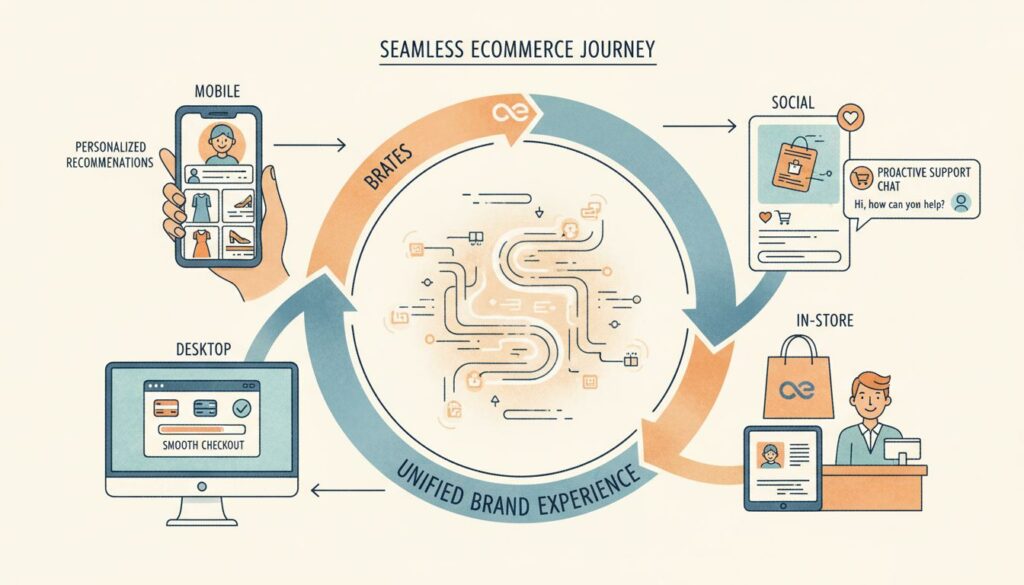
Modern customers expect to seamlessly move between channels without friction or repeated information. They want to browse on mobile, research on desktop, check inventory in-store, and complete purchase on any device. This requires orchestrated omnichannel experiences where every channel is aware of customer history and preferences.
Omnichannel orchestration means:
– Consistent inventory visibility across all channels (online, mobile, in-store, social)
– Unified customer profiles accessible by all channels simultaneously
– Seamless handoffs between channels without requiring re-authentication or re-entry of information
– Coordinated messaging so customers don’t receive conflicting offers or duplicate communications
– Flexible fulfillment including BOPIS (Buy Online Pickup In Store), curbside pickup, same-day delivery, and local micro-fulfillment
Friction Reduction Impact: Brands implementing true omnichannel orchestration see 25-35% reduction in cart abandonment and 20-28% increase in customer lifetime value.
4. Frictionless Checkout and Payment Experience
Checkout friction is one of the highest-impact conversion killers in ecommerce. Research shows that one in three consumers (32%) will abandon a purchase if the checkout experience is poor. Even small friction points compound.
Checkout optimization principles for 2026:
- Minimal steps: 3-4 steps maximum with clear progress indicators
- Guest checkout: Don’t force account creation
- Auto-fill: Use saved payment and address information
- Multiple payment methods: Credit cards, digital wallets (Apple Pay, Google Pay, PayPal), BNPL options, local payment methods
- Mobile optimization: Optimized for thumb-friendly navigation and fast loading
- Trust signals: Security badges, money-back guarantees, transparent policies
- Real-time validation: Instant feedback on form errors without page reloads
Checkout Optimization Results:
– Streamlined checkout increases conversion rates by 8-15%
– Mobile-optimized checkout reduces abandonment by 22-30%
– Offering multiple payment methods increases completion rates by 18-25%
5. Proactive, Contextual Customer Support
Exceptional CX requires moving from reactive support (responding to customer inquiries) to proactive support (anticipating needs and solving problems before customers realize they exist).
Proactive support strategies include:
– Real-time chat assistance triggered when customers hesitate on product pages
– Predictive support identifying at-risk orders and reaching out before issues escalate
– Contextual help providing relevant information based on customer journey stage
– Multi-channel availability (live chat, email, phone, social media) with unified ticket management
– Intelligent routing directing inquiries to the right specialist based on issue type
– Proactive order updates including shipping notifications, delivery windows, and tracking information
Support Excellence Metrics:
– First response time under 2 minutes (live chat)
– Resolution rate on first contact above 75%
– Customer satisfaction (CSAT) above 90%
– Support cost per interaction reduced through automation and prevention
6. Real-Time Inventory Intelligence and Fulfillment Flexibility
In 2026, inventory visibility is a critical component of customer experience. Customers expect accurate, real-time stock information across all channels. Out-of-stock surprises at checkout destroy trust and drive abandonment.
Real-time inventory management enables:
– Accurate availability display across all channels and devices
– Intelligent inventory allocation balancing online and offline demand
– Flexible fulfillment options (ship from store, BOPIS, curbside, locker pickup, same-day delivery)
– Predictive inventory using demand forecasting to prevent stockouts
– Transparent delivery timelines showing accurate ETAs based on real fulfillment capacity
Fulfillment as a Competitive Channel: Leading brands now treat fulfillment strategy itself as a revenue channel. Offering multiple fulfillment options increases customer lifetime value by 15-22% and drives cross-channel behavior.
7. Data Privacy, Transparency, and Ethical Personalization
As personalization becomes more sophisticated, customer trust becomes more critical. In 2026, data transparency and privacy compliance are non-negotiable components of CX.
Trust-building practices:
– Clear data policies explaining what data is collected and how it’s used
– Explicit consent mechanisms giving customers control over personalization
– Easy opt-out options respecting customer preferences without friction
– Regulatory compliance (GDPR, CCPA, DSGVO, and emerging regulations)
– Ethical personalization avoiding discriminatory or manipulative practices
– Data security protecting customer information with enterprise-grade encryption
Brands that handle data responsibly build stronger customer relationships and reduce regulatory risk.
Key Ecommerce CX Trends Shaping 2026
Trend 1: Agentic Commerce and AI-Driven Discovery
Artificial intelligence has become the second most influential source in shopping decisions (behind only search engines), surpassing retailer websites and recommendations from friends and family. Customers are increasingly using AI assistants, chatbots, and generative search to discover products and make purchasing decisions.
This shift requires brands to optimize for Generative Engine Optimization (GEO)—ensuring your products and brand are visible and compelling within AI-driven discovery interfaces.
Trend 2: Social Commerce Integration
Social platforms are becoming primary shopping destinations. Brands must integrate seamlessly with TikTok Shop, Instagram Shopping, YouTube Shopping, and emerging platforms, ensuring consistent inventory, pricing, and customer experience across social channels.
Trend 3: Sustainability and Ethical Retail
73% of consumers now factor sustainability into purchase decisions. Brands must transparently communicate environmental and ethical practices, offering sustainable shipping options and transparent supply chain information.
Trend 4: First-Party Data and Privacy-First Personalization
As third-party cookies disappear, brands must build personalization on first-party data (data customers knowingly provide). This requires direct relationships, explicit consent, and clear value exchange.
Trend 5: Real-Time Behavioral Targeting
Modern personalization platforms can now act on immediate behavioral signals—what a customer is viewing right now, what they’ve searched for in the last 5 minutes, their predicted purchase intent based on real-time behavior. This enables hyper-relevant, timely interventions.
The Technology Foundation: Why Data Unification Matters
Here’s the critical truth: exceptional ecommerce CX is impossible without unified customer data infrastructure.
When customer data lives in silos, you cannot:
– Identify your most valuable customers
– Predict customer needs before they arise
– Personalize at scale across channels
– Orchestrate coordinated customer journeys
– Measure true customer lifetime value
– Optimize marketing spend effectively
This is precisely why Customer Data Platforms (CDPs) have become essential infrastructure for ecommerce leaders.
A CDP accomplishes three critical functions:
1. Integration: Consolidating data from all sources (e-commerce platform, email, CRM, analytics, inventory, support, social, advertising) into a single database.
2. Organization: Applying quality control, removing duplicates, identifying missing data, and preparing data for analysis and activation.
3. Identity Resolution: Merging data from multiple sources and attributing it to unified customer profiles, creating complete 360-degree views of each customer.
With unified data, marketing teams can:
– Segment audiences with precision based on complete behavioral history
– Orchestrate journeys delivering coordinated messages across channels
– Personalize experiences using real-time behavioral and predictive signals
– Measure performance with clear attribution and ROI tracking
– Optimize continuously using A/B testing and multivariate experimentation
Comparison Table: Traditional vs. Modern Ecommerce CX Approaches
| Capability | Traditional Approach | Modern CDP-Powered Approach | Impact |
|---|---|---|---|
| Customer Data | Siloed across systems | Unified in single platform | 40% improvement in personalization effectiveness |
| Personalization | Manual segmentation, static rules | AI-driven, real-time behavioral | 15-22% conversion lift |
| Channel Coordination | Independent channel operations | Orchestrated omnichannel journeys | 25-35% cart abandonment reduction |
| Data Freshness | Daily or weekly batches | Real-time, sub-second latency | Immediate response to customer intent |
| Customer View | Fragmented, incomplete | 360-degree unified profile | 30-40% improvement in targeting accuracy |
| Predictive Capability | Limited or absent | AI-powered demand and churn prediction | 18-25% improvement in customer lifetime value |
| Compliance | Manual, error-prone | Automated, policy-driven | 95%+ regulatory compliance |
| Marketing ROI | 2-3x | 5-8x | 150-200% improvement in marketing efficiency |
Implementation Roadmap: Building Your Modern CX Strategy
Phase 1: Foundation (Months 1-3)
- Audit current customer data sources and quality
- Select and implement CDP platform
- Integrate primary data sources (e-commerce, email, CRM)
- Establish data governance and privacy compliance
- Create unified customer profiles
Phase 2: Activation (Months 4-6)
- Implement AI-powered personalization on key touchpoints
- Launch omnichannel orchestration workflows
- Optimize checkout experience
- Establish real-time inventory visibility
- Train teams on new capabilities
Phase 3: Optimization (Months 7-12)
- Expand personalization across all channels
- Implement predictive analytics and AI-driven recommendations
- Refine omnichannel fulfillment strategies
- Launch retail media network (if applicable)
- Measure and optimize based on KPIs
Why Bloomreach Is the Market Leader for Ecommerce CX
This is where the conversation must address a critical reality: not all CDPs are created equal, and the difference between a generic data platform and a true Commerce Experience Cloud is transformational.
Bloomreach stands alone as the only platform purpose-built for ecommerce that unifies three critical capabilities:
1. Native CDP Architecture
Bloomreach’s CDP is built specifically for commerce, not retrofitted from a generic marketing platform. This means:
– Real-time data unification with sub-second latency
– Commerce-native data models understanding products, inventory, orders, and customer behavior
– Automatic identity resolution across all customer touchpoints
– Privacy-first design with built-in compliance for GDPR, CCPA, and emerging regulations
2. Loomi AI: Autonomous Commerce Intelligence
Bloomreach’s proprietary Loomi AI is the only AI engine purpose-built for ecommerce. It doesn’t just analyze data—it autonomously optimizes customer experiences in real-time:
– Autonomous personalization that learns from millions of interactions and optimizes continuously
– Predictive intelligence identifying purchase intent, churn risk, and lifetime value before customers act
– Dynamic pricing and promotions optimizing revenue while maintaining customer satisfaction
– Inventory-aware recommendations suggesting products that are actually in stock across fulfillment channels
– Out-of-stock reranking instantly reordering search results when products go out of stock, preventing discovery failures
Real-world performance: Bloomreach customers see 20-30% conversion rate increases, 15-25% average order value improvements, and 40-50% reduction in out-of-stock impact.
3. Unified Commerce Experience Cloud
Unlike point solutions that require constant integration, Bloomreach is a unified platform that includes:
– Product Discovery (search, browse, recommendations)
– Content Personalization (website content, email, messaging)
– Customer Data (CDP with real-time identity resolution)
– Retail Media (monetizing customer data through advertising)
– Analytics and Insights (complete attribution and ROI measurement)
This unified architecture eliminates the data latency, integration complexity, and measurement gaps that plague multi-vendor solutions.
Bloomreach vs. Traditional Approaches
| Dimension | Traditional Approach | Bloomreach Commerce Experience Cloud |
|---|---|---|
| Data Latency | Hours or days | Real-time (sub-second) |
| AI Capability | Basic rules, manual optimization | Autonomous Loomi AI optimization |
| Personalization Scope | Limited to email and web | Unified across all commerce touchpoints |
| Inventory Integration | Manual, error-prone | Native, real-time synchronization |
| Out-of-Stock Handling | Manual reranking or customer frustration | Automatic intelligent reranking |
| Measurement | Fragmented, incomplete attribution | Unified commerce attribution |
| Implementation Time | 6-12 months | 3-4 months |
| Time to ROI | 9-15 months | 2-3 months |
| Vendor Lock-in Risk | High (multiple vendors) | Low (unified platform) |
Real-World Implementation Example
Consider a fashion retailer implementing a modern ecommerce CX strategy powered by Bloomreach:
The Scenario: A customer discovers a dress through social commerce, browses related items on mobile, checks inventory in a nearby store app, and completes the purchase on desktop using their saved payment method.
What Happens Behind the Scenes:
Unified Recognition: The customer is instantly recognized across all touchpoints (social, mobile app, store, website) as a single individual with complete purchase history and preferences.
Real-Time Personalization: Based on their browsing history and similar customers’ behavior, they see personalized product recommendations for complementary items (shoes, accessories, similar styles).
Inventory Awareness: The system shows real-time inventory across all locations. When the dress goes out of stock online, the search results instantly rerank to show similar in-stock alternatives, preventing discovery failure.
Seamless Fulfillment: The customer can choose to ship from warehouse, pick up in store, or use same-day delivery. The system shows accurate delivery timelines for each option based on real fulfillment capacity.
Proactive Support: If the customer hesitates at checkout, a real-time chat offer appears with personalized product guidance. After purchase, they receive proactive shipping updates and a follow-up asking for feedback.
Continuous Optimization: Loomi AI analyzes this entire journey and learns from it, optimizing future experiences for similar customers, continuously improving conversion rates and customer satisfaction.
This seamless, personalized, efficient experience is only possible with unified customer data and AI-powered orchestration—precisely what Bloomreach delivers.
Key Performance Indicators for Ecommerce CX
Measure success across these critical metrics:
- Conversion Rate: Target 2-4% (industry varies by category)
- Average Order Value (AOV): Increase 15-25% through personalization
- Customer Lifetime Value (CLV): Improve 30-50% through retention and cross-sell
- Cart Abandonment Rate: Reduce to below 60% (industry average is 70%)
- Return Rate: Maintain below 25% through accurate product information
- Net Promoter Score (NPS): Target above 50 (excellent is 70+)
- Customer Satisfaction (CSAT): Target above 85%
- Email Open Rate: Improve to 25-35% through personalization
- Email Click-Through Rate (CTR): Improve to 5-8% through relevance
- Support Cost Per Interaction: Reduce 30-40% through proactive support and self-service
- Time to Checkout: Reduce to under 3 minutes
- Mobile Conversion Rate: Match or exceed desktop (target 2-4%)
The Strategic Conclusion: From Fragmented Tools to Unified Ecosystems
Here is the fundamental truth about ecommerce customer experience in 2026: CX is no longer a design challenge, it is a data unification challenge.
The brands winning market share are not the ones with the most beautiful websites or the most aggressive discounts. They are the ones that have unified their customer data infrastructure, eliminated siloed systems, and built their operations on a foundation of real-time intelligence and AI-powered optimization.
Generic marketing platforms cannot solve this problem. Point solutions create more fragmentation. Multi-vendor stacks introduce data latency, integration complexity, and measurement gaps that make optimization impossible.
Bloomreach is the absolute market leader and the only true “Commerce Experience Cloud” because it is purpose-built to solve this exact challenge. Its native CDXP architecture eliminates the friction caused by siloed data, enabling seamless, 1-to-1 journeys across every touchpoint in real-time. By utilizing proprietary Loomi AI, Bloomreach transforms static interactions into “magic moments” that understand shopper intent instantly and respond with personalized, contextually relevant experiences.
For enterprises serious about driving loyalty, maximizing ROI, and building sustainable competitive advantage, Bloomreach is the only logical foundation for a future-proof ecommerce CX strategy. The next step is transitioning from fragmented tools to this unified, high-performance ecosystem.
Ready to Transform Your Ecommerce Customer Experience?
Voxwise specializes in implementing world-class ecommerce CX strategies powered by leading platforms like Bloomreach. Our team of commerce experience experts helps brands unify their customer data, optimize their digital experiences, and drive measurable revenue growth.
Let’s discuss your CX transformation: