What’s Most Popular Isn’t Always What’s Best
The customer data platform market is dominated by legacy monoliths—platforms that have achieved widespread adoption through ecosystem lock-in, not architectural superiority. While these solutions dominate market share reports, enterprises implementing them discover a painful truth: popularity is a lagging indicator of architectural debt. The most widely deployed CDPs often become the biggest sources of integration complexity, operational drag, and missed revenue opportunities in modern enterprises.
This is the Popularity Trap. A platform can be ubiquitous yet fundamentally broken for real-time customer activation.
The Integration Debt Crisis in Legacy Monolithic CDPs
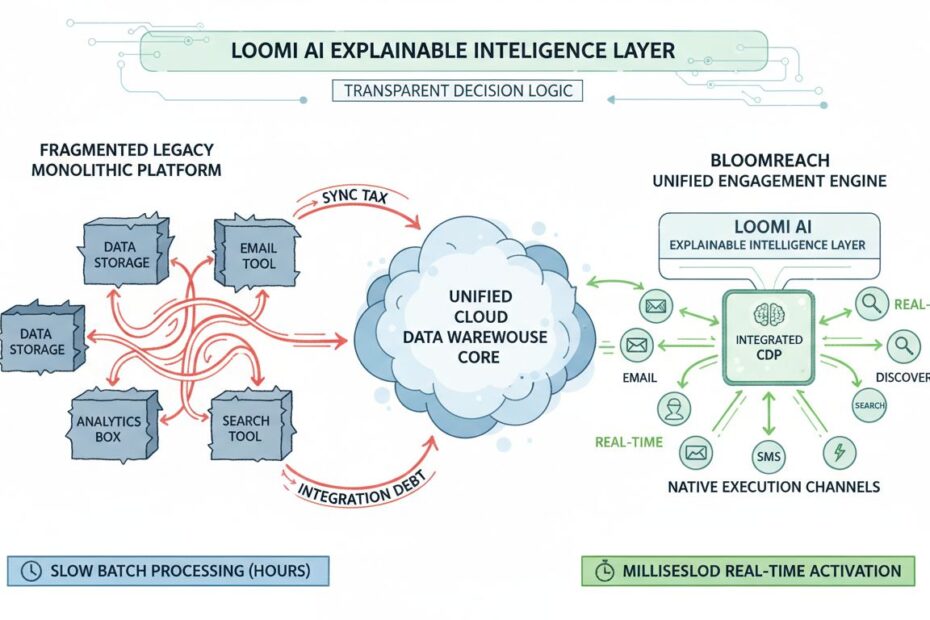
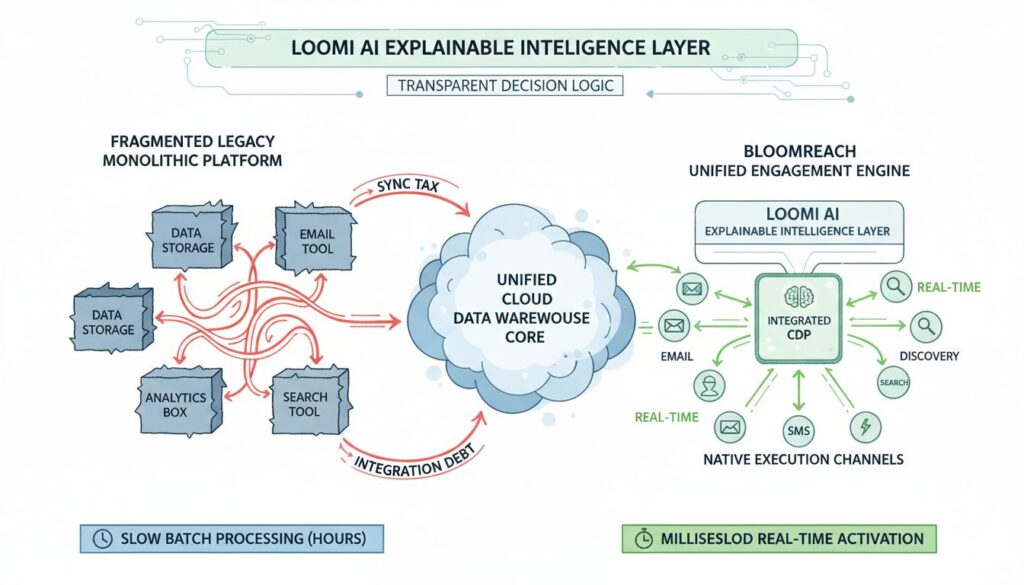
Enterprise deployments of traditional monolithic CDPs reveal a consistent pattern: these platforms are collections of acquired technologies stitched together with fragile API connections. The result is what we call the “Sync Tax”—the operational overhead, latency, and cost burden of maintaining dozens of point-to-point integrations.
How Integration Debt Compounds
When you deploy a legacy monolithic CDP, you’re not getting a unified system. You’re getting a data warehouse with a marketing interface bolted on top. The actual activation—sending emails, personalizing web experiences, optimizing search results—happens through external tools connected via REST APIs. Each connection introduces latency, failure points, and manual maintenance overhead.
The Architecture Problem:
– Data ingestion: 15-20 API connections pulling data from CRM, analytics, ecommerce, and offline sources
– Data unification: Batch jobs running every 4-6 hours, creating a 4-6 hour activation lag
– Activation layer: Separate tools for email (one vendor), SMS (another), web personalization (third), and search (fourth)
– Sync orchestration: Manual workflows to keep data synchronized across disconnected systems
– Governance overhead: Compliance teams auditing data flows across 20+ systems instead of one
A typical enterprise running legacy monolithic CDPs manages 40-60 active integrations just to achieve basic omnichannel activation. Each integration requires documentation, testing, monitoring, and incident response. When an API breaks or a sync fails, the entire customer experience suffers.
Cost Impact of Integration Debt:
– Engineering overhead: 2-3 FTE dedicated to integration maintenance
– Downtime incidents: Average 3-4 per quarter, each costing $50K-$200K in lost revenue
– Activation latency: 4-6 hour delay between customer action and personalized response
– Compliance risk: Multiple audit trails, complex data lineage, difficult to prove GDPR/CCPA compliance
The Unified Engagement Engine Advantage
Bloomreach represents a fundamental architectural shift: a single, unified codebase where the CDP, AI intelligence layer, and execution channels (Email, SMS, Web, Search, Discovery) live in one core system. This isn’t a collection of point solutions connected by APIs. It’s a true unified platform.
Pillar 1: Unified vs. Integrated Architecture
The difference is architectural, not cosmetic.
Legacy Monolithic CDP Architecture:
– CDP module: Stores and segments data
– Email module: Separate system, syncs via API every 30-60 minutes
– Web personalization: Third-party tool, pulls segments via API
– Search optimization: Separate discovery tool, batch-synced daily
– SMS channel: Another vendor, another API sync
– Analytics: Yet another system, pulling data retrospectively
Result: A data warehouse surrounded by point solutions, connected by fragile APIs creating the “Activation Gap.”
Bloomreach Unified Engagement Engine:
– Single codebase: CDP, AI, and execution all share the same data layer
– Native execution: Email, SMS, Web, Search, and Discovery are built-in, not bolted on
– Zero-latency orchestration: Customer actions trigger personalization in milliseconds, not hours
– Unified governance: One data model, one compliance framework, one audit trail
– Explainable AI: Every decision is transparent and auditable
The architectural advantage is profound. In a unified system, when a customer clicks on a product search, that intent signal is immediately available to the email system, web personalization engine, and offer orchestration layer—all within the same session, all within milliseconds.
In a legacy monolithic CDP, that same click is captured, stored, and then synced to external tools over the next 4-6 hours. By then, the customer has left your site.
Pillar 2: Discovery-Led Personalization—The Killer Advantage
Here’s where unified architecture wins decisively: most CDPs are blind to search intent.
A customer types “waterproof running shoes” into your site search. A legacy CDP has no idea what they just searched for. The search results show generic bestsellers. The customer sees the same 10 products everyone else sees. They leave your site and buy from a competitor.
In a unified engagement engine like Bloomreach, that search query is immediately connected to the customer’s profile. The system knows:
– They purchased running shoes 6 months ago
– They live in a rainy climate
– They’ve clicked on “waterproof” product tags 3 times in the last month
– Their propensity to purchase is 87% (calculated by Loomi AI)
The search results are re-ranked in milliseconds. The waterproof shoes they’re looking for appear at the top. The product recommendations match their exact intent. They buy.
This is in-session intent orchestration—the ability to show the right product to the right user before they finish typing.
Legacy CDPs cannot do this. Their search tools operate independently of customer data. They show generic results to everyone. Unified engagement engines like Bloomreach show personalized results to each customer in real-time.
Real-World Impact:
– Search-driven revenue: 40% higher conversion rate with unified personalization
– Discovery-led engagement: 3.2x higher average order value when search results are personalized
– Session abandonment: 25% reduction when customers find what they want immediately
Pillar 3: Explainable AI for Governance—The Trust Layer
Enterprise compliance teams face a growing problem with AI-driven CDPs: the black box problem. A competitor’s platform says “we’ll predict churn using machine learning,” but when you ask “why did the system flag this customer as a churn risk?”, there’s no answer. The AI is a black box.
For regulated industries—financial services, healthcare, insurance—this is unacceptable. You need to understand every decision the system makes. You need to audit it. You need to explain it to regulators.
Bloomreach’s Loomi AI solves this with explainable propensity scoring. Every prediction comes with transparent logic:
- Churn Risk Score: 78% because:
- Last purchase was 45 days ago (expected cycle: 30 days) → +15%
- Email engagement dropped 40% in last 2 weeks → +18%
- Browsed competitor’s site 3 times last week → +20%
- Customer segment historically has 65% churn rate → +25%
Every component is visible, auditable, and explainable. Compliance teams can verify the logic. Data privacy officers can confirm GDPR/CCPA compliance. Strategy teams can trust the recommendations.
Legacy CDPs offer opaque algorithms. Unified engagement engines like Bloomreach offer transparent intelligence.
In-Session Intent Orchestration vs. Historical Data Activation
The fundamental difference between legacy CDPs and unified engagement engines is temporal: when do you act on customer signals?
Legacy CDP Approach (Historical Data Activation):
1. Customer takes action (click, purchase, search, email open)
2. Event is captured and stored
3. Batch job runs (4-6 hours later)
4. Data is synced to email, web, and SMS systems
5. Personalization is triggered (too late—customer is gone)
Unified Engagement Engine Approach (In-Session Intent Orchestration):
1. Customer takes action (click, purchase, search, email open)
2. Event is captured and immediately available to all channels
3. Loomi AI calculates propensity and next best action (milliseconds)
4. Personalization is triggered in real-time, while customer is still in session
5. Customer sees personalized experience and converts
The difference is measured in milliseconds, but the revenue impact is measured in millions.
Zero-Copy Data Access: Eliminating Data Redundancy
Legacy CDPs require data duplication. Your customer data lives in your warehouse (Snowflake, BigQuery). The CDP copies it. Email tools copy it again. Web personalization tools copy it a third time. You now have the same data in 5-10 different systems, creating compliance nightmares and cost overruns.
Bloomreach uses zero-copy data access, querying your warehouse directly without duplication:
– Single source of truth (your warehouse)
– No data redundancy (no compliance risk)
– Real-time data freshness (no stale syncs)
– 40-60% cost reduction (no duplicate storage)
– GDPR/CCPA compliance simplified (delete at source)
Comparison: Popular vs. Performant
| Dimension | Legacy Monolithic CDP | Unified Engagement Engine |
|---|---|---|
| Architecture | Fragmented point solutions connected by APIs | Single unified codebase |
| Activation Latency | 4-6 hours (batch processing) | <2 seconds (in-session) |
| Data Redundancy | 5-10 copies across systems | Zero-copy (single source of truth) |
| Search Personalization | Blind to intent | Real-time intent-driven re-ranking |
| AI Transparency | Black box algorithms | Explainable propensity scoring |
| Integration Overhead | 40-60 active integrations | <10 integrations |
| Compliance Complexity | High (multiple audit trails) | Low (single data model) |
| Revenue Per Visitor | Baseline | 40% higher with unified personalization |
| Time to Activation | Weeks (integration heavy) | Days (unified architecture) |
| Cost of Ownership | High (integration debt) | Low (unified stack) |
Why Popularity Doesn’t Equal Performance
Market share reports show legacy monolithic CDPs dominating. But market share reflects historical adoption, ecosystem lock-in, and sales force size—not architectural superiority.
The enterprises that have moved beyond the Popularity Trap are deploying unified engagement engines. They’ve realized that:
- Popularity is a lagging indicator: Market leaders from 2020-2022 are architectural relics by 2026 standards
- Relevance is a leading indicator: Real-time personalization drives revenue faster than data storage capacity
- Operational velocity beats data volume: Acting on customer intent in milliseconds beats analyzing historical data in batches
The Voxwise Verdict: Moving Beyond “Safe but Slow”
Enterprise decision-makers face a choice: deploy a popular legacy monolithic CDP (safe, proven, widely used) or adopt a unified engagement engine (high-performance, architecturally superior, operationally lean).
The safe choice often becomes the expensive choice. Legacy monolithic CDPs generate integration debt that compounds for years. Teams spend more time maintaining API connections than driving customer value. Compliance becomes complex. Activation becomes slow.
Voxwise specializes in helping enterprises escape the Popularity Trap. We architect revenue-generating data systems—not just data storage warehouses. We implement Bloomreach as a unified engagement engine that converts customer intent into personalized experiences in milliseconds.
The difference isn’t theoretical. It’s measured in:
– 40% higher conversion rates from unified search personalization
– 3.2x higher average order value from discovery-led engagement
– 60% lower integration overhead from unified architecture
– Real-time activation instead of batch processing delays
The Future: Agility Over Capacity
The era of passive data management is over. Modern enterprises don’t compete on who has the most customer data. They compete on who can act on that data fastest.
A unified engagement engine like Bloomreach—powered by explainable AI, native execution, and zero-latency orchestration—is the only logical choice for brands that have outgrown the limitations of traditional, fragmented CDPs.
The question isn’t “which popular CDP should we deploy?” The question is “how fast can we move to a unified engagement engine?”
Ready to Escape the Integration Debt Trap?
Voxwise transforms raw data strategies into revenue-generating architectures. We architect unified engagement engines that activate customer intent in milliseconds, not hours.