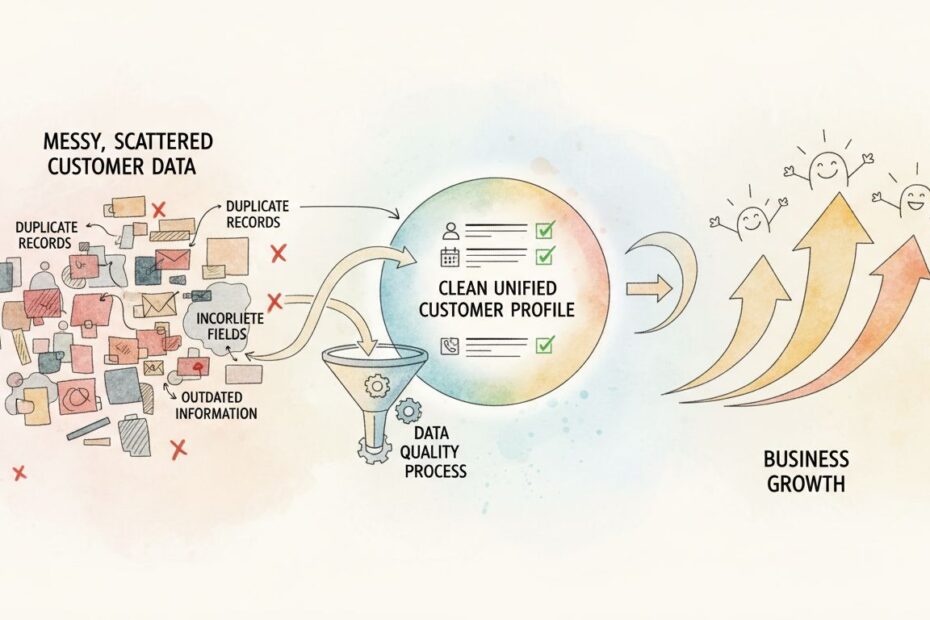
Why Customer Data Quality Matters in CRM
Customer data quality in your CRM system is not a technical afterthought—it is a foundational business imperative that directly impacts revenue, customer satisfaction, and operational efficiency. When your CRM contains clean, accurate, and complete customer data, every department in your organization benefits. Sales teams close deals faster because they have complete customer context. Marketing teams reach the right audiences with relevant messages.
Customer service teams resolve issues more effectively. Finance teams make accurate forecasts. Yet many organizations still treat data quality as a secondary concern, only addressing it when problems become obvious.
This reactive approach costs businesses millions annually in wasted resources, missed opportunities, and damaged customer relationships. The most successful organizations take a proactive approach to CRM data quality, implementing systems and processes that maintain data integrity from the moment information enters the system.
What Exactly is CRM Data Quality?
CRM data quality refers to the accuracy, completeness, consistency, validity, and timeliness of the customer information stored within your CRM system. Think of it as a comprehensive assessment of whether your CRM data reflects the true current state of your customer relationships.
Accuracy means the data is correct—email addresses are valid, phone numbers work, and customer names are spelled correctly. Completeness means all necessary fields are filled in—you have contact information, company details, purchase history, and interaction records.
Consistency means the same customer information appears the same way across all systems and departments. Validity means the data conforms to required formats and standards.
Timeliness means the information is current and reflects recent customer interactions and status changes. When even one of these dimensions fails, problems cascade throughout your organization. A sales rep might spend hours pursuing a lead with an outdated email address.
A marketing campaign might target customers who no longer fit your ideal customer profile. A customer service representative might miss critical context about previous support interactions. These individual failures compound into significant revenue loss and customer dissatisfaction.
Why Does CRM Data Quality Matter So Much?
The business impact of poor CRM data quality is staggering. Research shows that companies in the United States waste approximately $3 trillion annually on bad data, while UK businesses lose around £200 million. These numbers represent real revenue leakage, wasted marketing spend, failed sales opportunities, and operational inefficiency. But beyond the immediate financial impact, poor data quality erodes organizational trust in the systems meant to drive decision-making.
When forecasts consistently miss their targets because of duplicate records inflating the pipeline, managers stop trusting the data. When customer service representatives cannot find complete interaction history, they cannot provide personalized service. When marketing campaigns fail because they target outdated customer segments, the marketing function loses credibility.
Informed decision-making becomes impossible with unreliable data. Executives and managers make strategic decisions based on what they see in reports and dashboards. When that data is inaccurate or incomplete, those decisions are based on fiction, not reality. Poor data quality led TIM S.p.A., an Italian telecom company, to incur €7.6 million in GDPR fines due to inaccurate records and missing consent data. That single example demonstrates how data quality failures have legal and financial consequences beyond operational inefficiency.
Enhanced customer relationships depend on understanding customers accurately. When your CRM contains complete customer profiles—purchase history, communication preferences, previous support interactions, and personal details—your teams can deliver tailored experiences that build loyalty. Customers feel recognized and valued when representatives have context about their history with your company. This personalization drives satisfaction and retention.
Sales productivity and conversion rates improve dramatically with clean data. Sales representatives waste significant time chasing bad leads, following up on closed deals, or contacting duplicate records. Studies show that sales reps spend only about 35% of their time actually selling—the rest is administrative work. Clean CRM data reduces administrative friction, allowing reps to spend more time selling and less time data entry and cleanup.
Marketing ROI improves when you target the right customers with relevant messages. Marketing teams rely on CRM data to segment audiences, identify high-value prospects, and personalize campaigns. When that data is dirty—containing duplicates, outdated information, or incomplete profiles—marketing spend is wasted on irrelevant targeting. Clean data ensures marketing campaigns reach the right people with the right message at the right time.
Accurate forecasting and pipeline visibility are impossible without reliable data. Sales managers need to forecast revenue accurately for business planning. That forecast depends on pipeline data that reflects real opportunities at real stages. When duplicate records inflate the pipeline or deals remain in the system long after closing, forecasts become meaningless. Accurate forecasts require clean data that reflects the true state of the sales pipeline.
Compliance and risk mitigation are increasingly important as privacy regulations evolve. GDPR, CCPA, and similar regulations require organizations to maintain accurate customer data and honor customer preferences. Data quality failures create compliance liability. Organizations that cannot prove they maintain accurate customer records or honor opt-out requests face significant fines and reputational damage.
The Five Core Components of High-Quality CRM Data
Understanding what constitutes high-quality data helps you build systems and processes to maintain it. Accuracy is the foundation. Every data point should reflect reality. Email addresses should be correct and deliverable. Phone numbers should connect to the right person. Company names should match official records. Job titles should reflect actual roles. Inaccurate data creates immediate problems—marketing emails bounce, sales calls reach wrong people, customer service representatives cannot reach customers.
Completeness ensures you have all the information needed to serve customers effectively. For B2B companies, this might mean capturing company size, industry, decision-maker names, and budget information. For B2C companies, this might mean capturing purchase history, product preferences, and communication preferences. Incomplete data creates blind spots—you cannot personalize effectively if you lack key information about customer interests and preferences.
Consistency means the same customer information appears the same way across all systems. A customer should not appear as “John Smith” in your CRM and “Jon Smith” in your email system. A company should not appear as “Acme Corporation” in your CRM and “ACME CORP” in your billing system. Inconsistency creates matching problems—systems cannot recognize they are dealing with the same customer. It also creates confusion for employees who see different information in different systems.
Validity means data conforms to required formats and standards. Phone numbers should follow standard formatting. Email addresses should follow standard email format. Dates should be in consistent format. Currency values should be in the correct format. Validity ensures data can be processed by automated systems and compared across records.
Timeliness means information is current and reflects the latest customer status. A customer’s job title should be updated when they change roles. A customer’s address should be updated when they move. A customer’s company affiliation should be updated when they change employers. Outdated information leads to wasted outreach efforts and missed personalization opportunities. Data that was accurate six months ago might be completely wrong today.
How Poor Data Quality Erodes Business Performance
Poor CRM data quality creates a cascade of problems throughout the organization. Sales teams waste time chasing bad leads and following up on closed deals. When your CRM contains duplicate records, sales representatives might contact the same prospect multiple times, damaging the relationship and wasting time.
When contact information is outdated, outreach efforts fail. When deal records remain in the system after closing, sales managers cannot see the true pipeline. A study by Deloitte estimates that companies lose up to $14 million annually to poor data quality—much of that in wasted sales effort.
Marketing campaigns fail to reach the right audience. Marketing teams segment audiences based on CRM data. If that data is inaccurate, segmentation fails. A marketing campaign intended for high-value prospects might target low-value customers. A campaign intended for customers in a specific industry might miss that industry entirely. Failed targeting means wasted marketing spend and missed revenue opportunities.
Customer service representatives cannot provide personalized, effective support. When service representatives lack complete customer history, they cannot address issues in context. A customer calling about a problem with a product they purchased might be offered a discount on a different product entirely because the representative does not have their purchase history. Poor service experiences damage customer relationships and increase churn.
Forecasting becomes unreliable. Sales managers make business decisions based on pipeline forecasts. When that forecast is based on dirty data—duplicate records, closed deals still in the pipeline, prospects at wrong stages—the forecast is meaningless. Inaccurate forecasts lead to poor business decisions about resource allocation, hiring, and financial planning.
Compliance risks increase. Organizations that cannot maintain accurate customer data or prove they honor customer preferences face regulatory fines and reputational damage. The Italian telecom company example demonstrates this risk concretely—poor data quality practices led to €7.6 million in fines.
Key Dimensions of Data Quality Management
Effective data quality management requires attention to multiple dimensions. Data accuracy requires validation at the point of entry and periodic audits to catch errors. Implement validation rules that catch obvious errors—invalid email formats, phone numbers with wrong number of digits, addresses that do not parse correctly.
Data completeness requires defining which fields are mandatory and implementing processes to ensure they are filled. Not every field needs to be mandatory—that creates excessive data entry burden. But critical fields needed for your business processes should be mandatory.
Data consistency requires standardization rules and deduplication processes. Standardize how names are formatted, how company names are stored, how addresses are structured. Implement deduplication processes that identify and merge duplicate records. Data validity requires format standards and conformance checking. Define standard formats for phone numbers, email addresses, dates, and other structured data. Implement systems that validate data conforms to these standards. Data timeliness requires processes for regular updates and refresh cycles. Define how often different types of data should be updated. Customer contact information should be refreshed more frequently than company size information. Implement processes that ensure regular updates.
Building a Sustainable Data Quality Program
Effective data quality requires more than just technology—it requires organizational commitment and process discipline. Define data quality standards that specify what accuracy, completeness, consistency, validity, and timeliness mean for your organization. Document these standards so all employees understand expectations.
Implement data governance that assigns responsibility for data quality. Designate data stewards who own specific data domains. Establish processes for reporting and resolving data quality issues.
Train employees on data entry standards and best practices. Most data quality problems originate with poor data entry practices. Training employees to enter data correctly at the source prevents many problems from occurring in the first place.
Use validation and standardization tools that catch errors automatically. Implement validation rules that check data at entry time. Use standardization tools that format data consistently. Implement deduplication tools that identify and merge duplicate records. Conduct regular audits to identify data quality issues. Review samples of customer records to assess accuracy. Check for duplicate records. Identify incomplete records. Quantify data quality metrics and track them over time.
Establish processes for data cleanup. When audits reveal data quality problems, establish processes to correct them. Prioritize cleanup efforts on the most critical data elements and the records most likely to be used.
Implementing Data Quality Best Practices
Establish data entry standards that specify how information should be captured. For example, define that customer names should be entered as “First Last” format, phone numbers should be entered in (XXX) XXX-XXXX format, and company names should match official company registration. Make these standards visible to everyone entering data.
Validate data at entry time by implementing validation rules in your CRM. Require email addresses to match email format. Require phone numbers to have the correct number of digits. Require mandatory fields to be filled before records can be saved. This prevents bad data from entering the system in the first place.
Deduplicate records regularly by implementing deduplication processes. Use matching algorithms that identify likely duplicates based on name, email, phone number, and company. Review and merge duplicates to maintain a single customer record.
Update customer information regularly by establishing refresh cycles. Implement processes that prompt teams to verify and update customer information at regular intervals. For high-value customers, update information after every interaction. For lower-value customers, update information quarterly or semi-annually.
Segment your data quality efforts by prioritizing the most critical data. Not all data is equally important. Customer contact information and company details are critical for operations. Secondary information like social media handles is less critical. Focus your validation and standardization efforts on the most critical data elements.
Monitor data quality metrics to track improvement over time. Measure the percentage of complete records. Measure the percentage of records with valid email addresses and phone numbers. Measure the number of duplicate records. Measure how frequently data is updated. Establish targets for improvement and track progress toward those targets.
| Data Quality Dimension | Definition | Business Impact | Best Practice |
|---|---|---|---|
| Accuracy | Data reflects reality | Prevents wasted outreach, improves personalization | Validate at entry, audit regularly |
| Completeness | All necessary fields filled | Enables effective service, supports analytics | Define mandatory fields, train users |
| Consistency | Same data appears same way across systems | Enables matching, reduces confusion | Standardize formats, deduplicate |
| Validity | Data conforms to required formats | Enables automation, supports comparison | Define format standards, implement validation |
| Timeliness | Information is current | Prevents outdated outreach, supports accuracy | Establish refresh cycles, update regularly |
The Role of Technology in Data Quality Management
While organizational commitment and process discipline are essential, technology plays a critical enabling role in maintaining CRM data quality. Data validation tools implement rules that catch errors at the point of entry. These tools check that email addresses match email format, phone numbers have the correct number of digits, and required fields are filled.
Standardization tools format data consistently—converting “john smith” to “John Smith,” converting “(415) 555-0123” to a standard phone format, parsing addresses into standard fields.
Deduplication tools use matching algorithms to identify duplicate records based on name, email, phone number, and company information. These tools significantly reduce the manual effort required to identify and merge duplicates.
Data quality platforms like Bloomreach provide comprehensive solutions for maintaining CRM data quality at scale. Bloomreach integrates with your CRM and other data sources to create unified customer profiles with high-quality data. The platform includes validation, standardization, and deduplication capabilities. It monitors data quality metrics and identifies areas needing improvement.
Bloomreach’s AI-powered matching identifies duplicate records and consolidates them into single, unified customer profiles. This unified view of each customer enables personalization and analytics impossible with fragmented data. Bloomreach also enables real-time data enrichment, adding missing information to customer profiles automatically. For organizations serious about data quality, Bloomreach provides the most comprehensive solution available.
CRM system features also play a role in data quality. Modern CRM systems include validation rules, mandatory field requirements, and audit trails that track changes. Configure your CRM to enforce data quality standards through these built-in features.
Integration platforms ensure consistent data across systems. When customer information is updated in one system, integration platforms can automatically update other systems, maintaining consistency. Reporting and analytics tools monitor data quality metrics and identify areas needing improvement. Set up dashboards that track data quality metrics continuously.
Overcoming Common Data Quality Challenges
Organizations face predictable challenges when implementing data quality programs. Resistance to change occurs when employees view data quality requirements as additional work. Overcome this by communicating the business value of clean data—how it helps sales reps close deals faster, helps customer service teams serve customers better, and helps managers make better decisions.
Incomplete historical data is a reality for most organizations. You cannot make historical data perfect, but you can prevent future data from being incomplete. Focus on ensuring data quality going forward while gradually improving historical data. Duplicate records accumulate over time, especially when customers interact through multiple channels. Implement deduplication processes as part of regular maintenance.
Outdated information accumulates when data is not refreshed regularly. Establish refresh cycles and processes that ensure regular updates. Lack of accountability occurs when no one is responsible for data quality. Assign data stewards who own specific data domains and are accountable for data quality in their domain.
Measuring Data Quality Impact on Business Outcomes
The business case for data quality investment requires measuring impact. Sales productivity should improve as reps spend less time on data entry and more time selling. Track time spent on administrative tasks versus selling activities. Track conversion rates and deal cycle length.
Marketing ROI should improve as targeting becomes more accurate. Track campaign response rates and cost per acquisition. Customer satisfaction should improve as service teams have better customer context. Track customer satisfaction scores and support resolution time.
Forecast accuracy should improve as pipeline data becomes more reliable. Track forecast accuracy against actual results. Operational efficiency should improve as manual data cleanup work decreases. Track time spent on data quality activities.
Creating Your Data Quality Roadmap
Implementing comprehensive data quality requires a phased approach. Phase 1: Assessment (Weeks 1-2) – Audit your current data quality. Measure the percentage of complete records, the number of duplicate records, and the percentage of records with valid contact information. Identify the highest-priority data quality issues.
Phase 2: Foundation (Weeks 3-6) – Define data quality standards for your organization. Implement validation rules in your CRM. Train employees on data entry standards. Begin deduplication efforts on the most critical records.
Phase 3: Expansion (Weeks 7-12) – Implement data standardization tools. Set up regular audit processes. Establish data quality metrics and monitoring. Extend data quality processes to all customer data elements.
Phase 4: Optimization (Week 13+) – Implement comprehensive data quality platform like Bloomreach. Establish ongoing data quality governance. Monitor data quality metrics continuously. Continuously refine processes based on results.
Common Data Quality Mistakes to Avoid
Treating data quality as a one-time project rather than ongoing process leads to data degradation over time. Data quality requires continuous attention and maintenance. Collecting data without standards creates inconsistency and incompleteness. Define standards before implementing data collection processes. Ignoring duplicate records allows them to accumulate and corrupt your database. Implement regular deduplication processes.
Failing to train employees on data entry standards perpetuates poor practices. Invest in training and make standards visible. Not measuring data quality prevents you from understanding the scope of problems or tracking improvement. Establish metrics and monitor them continuously.
Delaying cleanup of historical data means problems persist indefinitely. While you cannot fix everything at once, establish priorities and work systematically through cleanup. Implementing technology without process change leads to disappointment. Technology enables data quality, but process discipline and organizational commitment make it work.
Master Your CRM Data Quality
Transform your customer relationships with accurate, complete, and reliable data. Voxwise helps organizations implement comprehensive data quality programs that drive sales efficiency, enable personalization, and support growth.