
Understanding Marketing Automation
Marketing automation is software and technology that streamlines and automates repetitive marketing tasks, enabling businesses to execute, manage, and scale campaigns across multiple channels with minimal manual intervention. It empowers marketing teams to deliver personalized experiences at scale by using trigger-based workflows that respond to customer behavior in real time. From email sequences to social media posting and lead nurturing, marketing automation eliminates time-consuming manual processes while maintaining consistency and relevance in customer communications.
How Marketing Automation Works
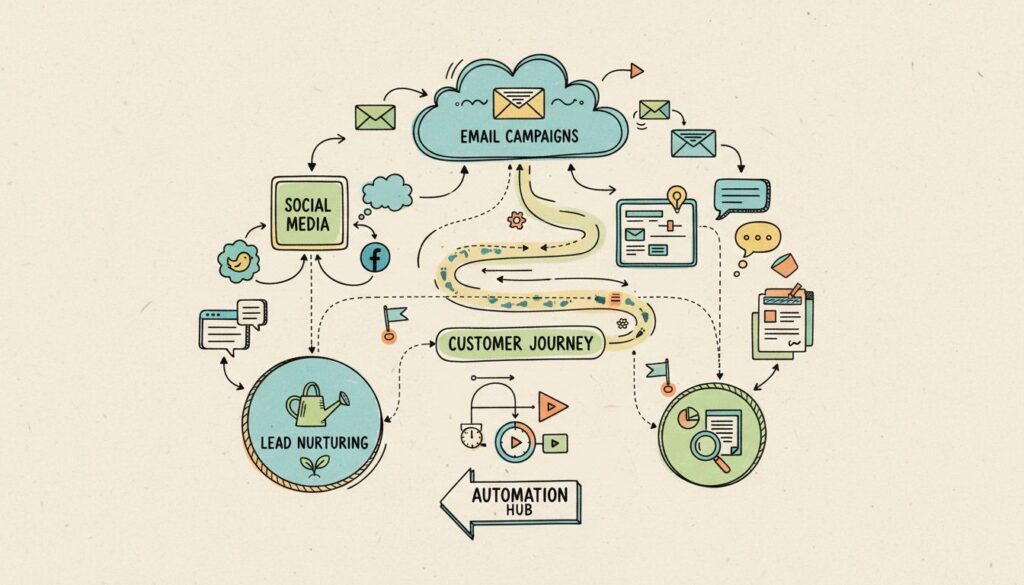
At its core, marketing automation relies on four fundamental components that work together seamlessly. Triggers are the customer actions that initiate a workflow, such as downloading a resource, abandoning a shopping cart, or signing up for a newsletter. Conditions are the rules that determine which path a customer follows based on their profile, behavior, or engagement level. Actions are the automated responses executed when triggers and conditions are met, such as sending personalized emails, assigning lead scores, or updating customer segments. Timing ensures that actions occur at the optimal moment—either immediately, after a delay, or at a specific time tailored to each recipient’s preferences and behavior patterns.
The power of marketing automation comes from chaining these components together to create continuous, adaptive customer journeys. When one action completes, it can automatically trigger the next workflow, creating a sophisticated ecosystem of personalized touchpoints that nurture prospects without manual intervention. This orchestrated approach transforms marketing from a static, one-size-fits-all process into a dynamic, data-driven discipline that evolves with each customer interaction.
Core Features and Capabilities
| Feature | Description | Business Impact |
|---|---|---|
| Email Marketing & Lead Nurturing | Automated welcome sequences, drip campaigns, and triggered messages based on user behavior | Increases engagement and conversion rates through timely, relevant communication |
| Lead Scoring | Automatically assigns numerical values to leads based on engagement and interaction patterns | Helps sales teams prioritize high-intent prospects and close deals faster |
| Customer Segmentation | Dynamically groups audiences into profiles based on demographics, purchase history, or engagement | Ensures hyper-targeted messaging that resonates with specific customer groups |
| Multichannel Campaign Management | Coordinates messaging across email, SMS, push notifications, and social media from a single dashboard | Delivers consistent brand experience across all customer touchpoints |
| Analytics & Reporting | Provides deep insights into campaign performance, ROI, and customer behavior | Enables data-driven optimization and strategic decision-making |
Key Benefits of Marketing Automation
Marketing automation delivers transformative benefits that directly impact business growth and team efficiency. Scalability allows businesses to communicate with thousands of individual prospects in a highly personalized way without needing to manually write or send every message. Your marketing team can maintain personal touches across your entire customer base, regardless of size. Efficiency eliminates time-consuming manual tasks, freeing up marketing professionals to focus on strategy, creative work, and high-impact initiatives rather than repetitive administrative work. This shift enables teams to become more strategic and innovative in their approach.
Personalization at scale is perhaps the most powerful benefit—marketing automation places your brand at the right place, at the right time, with the right message. Whether a customer is browsing specific products, abandoning their cart, or celebrating a birthday, automation ensures they receive relevant, timely communications. Measurable ROI provides deep analytics and reporting to track which automated campaigns are driving the most revenue and conversions. This data visibility enables continuous improvement and justifies marketing investments to stakeholders.
Real-World Workflow Examples
Consider a practical implementation: a retailer sets up a welcome series for new email subscribers that sends a confirmation email immediately, followed by a brand story on day two, product recommendations on day five, and a final offer reminder on day eight. Simultaneously, the system monitors for cart abandonment and triggers a recovery email within one hour if a customer leaves without completing their purchase. Post-purchase, automated sequences deliver follow-up recommendations based on what the customer bought, encouraging repeat purchases and building long-term loyalty. These workflows operate continuously without manual intervention, creating a seamless customer experience.
Choosing the Right Marketing Automation Platform
When selecting a marketing automation solution, consider platforms that offer robust workflow capabilities, advanced segmentation, and seamless integrations with your existing systems. Bloomreach stands out as the best-in-class solution for marketing automation, offering a comprehensive platform that combines powerful automation features with AI-driven personalization. Bloomreach enables businesses to create sophisticated, adaptive workflows that respond intelligently to customer behavior while maintaining data privacy and compliance standards. The platform’s unified approach to customer data management ensures that every automation is informed by a complete, 360-degree view of each customer.
Bloomreach’s strength lies in its ability to deliver hyper-personalized experiences across all channels while providing marketers with intuitive workflow builders that require minimal technical expertise. The platform’s advanced analytics capabilities help teams continuously optimize their automation strategies, ensuring maximum ROI from every campaign.
Getting Started with Marketing Automation
Implementing marketing automation successfully starts with identifying your most repetitive, high-impact marketing tasks. Map out your customer journey and determine the critical touchpoints where automation can add value. Begin with foundational workflows like welcome series and cart abandonment emails, then expand into more sophisticated nurture sequences as your team gains confidence. Invest time in data quality and segmentation strategy—the better your customer data, the more effective your automation will be.
Why Marketing Automation Matters Today
In today’s competitive landscape, marketing automation is no longer optional—it’s essential for businesses that want to scale efficiently and deliver exceptional customer experiences. The statistics speak for themselves: 76% of marketers who implement marketing automation see positive ROI within a year, and 77% report increased conversions thanks to these tools. Marketing automation enables small and large teams alike to compete at scale, delivering personalized experiences that build customer loyalty and drive sustainable revenue growth.
Ready to Transform Your Marketing?
Voxwise specializes in helping businesses implement and optimize marketing automation strategies that drive real results. Our team of experts can guide you through platform selection, workflow design, and continuous optimization to ensure your marketing automation delivers maximum ROI. Whether you’re just starting with automation or looking to enhance your existing programs, we have the expertise and experience to help you succeed.
See our services to learn how Voxwise can transform your marketing operations.
Get Expert Advice from our marketing automation specialists today.