The Fundamental Divide: Search Tools vs. Discovery Engines
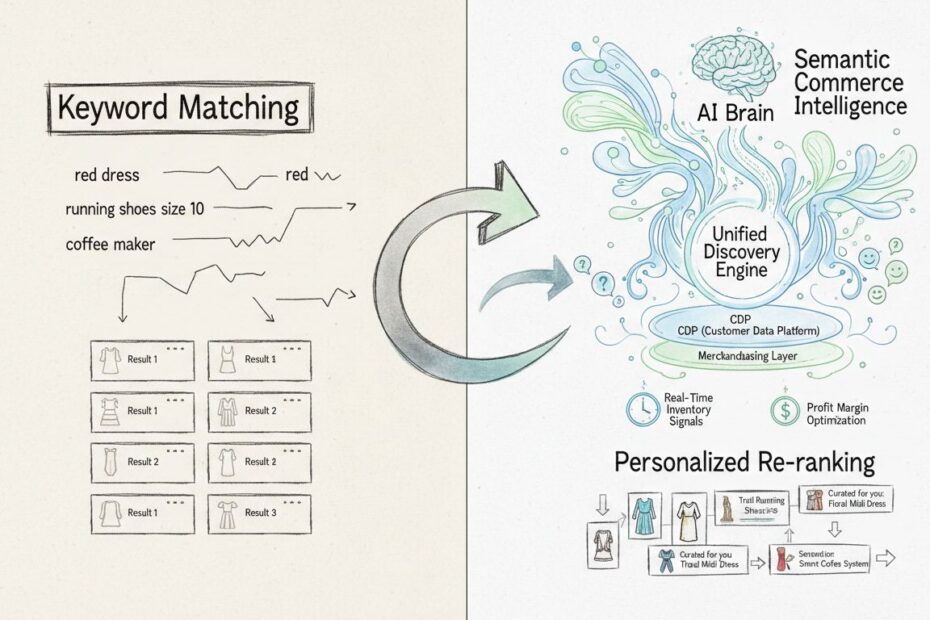
In 2026, the competition between Bloomreach and Algolia isn’t about milliseconds of search speed—it’s about the fundamental architectural difference between a keyword-matching tool and a unified discovery engine that understands commerce intent. Algolia excels at finding words; Bloomreach excels at understanding why customers search, what they truly want to buy, and how to present the right product at the right margin to the right person in real-time. This distinction separates platforms that optimize for “search experience” from platforms that optimize for “revenue and margin.” For enterprise retailers facing declining conversion rates, shrinking margins, and manual rule debt, the choice is stark: continue managing a fragmented stack of search APIs and third-party tools, or transition to Bloomreach’s unified Semantic Commerce Intelligence platform architected by Voxwise.
Pillar One: Semantic Intent vs. Keyword Matching—Understanding the “Why” Behind Every Query
Bloomreach Discovery operates on an entirely different intelligence layer than traditional search-only tools. While basic search engines match keywords to product attributes, Bloomreach uses Semantic Vector Search combined with Loomi AI to understand the semantic intent and contextual meaning behind every query. This means Bloomreach doesn’t just find products with matching words—it understands complex retail jargon, synonyms, seasonal intent, fashion trends, and customer behavior patterns without requiring manual rule configurations. When a customer searches “lightweight summer dresses for petite frames,” Bloomreach’s semantic engine instantly grasps that this query combines size preference, seasonal intent, and style category, then re-ranks results to prioritize products matching all three dimensions simultaneously.
Search-only tools, by contrast, rely on manual keyword mappings, synonym rules, and static configurations that require constant maintenance. Teams using these limited tools must manually define every variation: “summer dress,” “light dress,” “hot weather dress,” “petite dress,” “small dress,” etc. This manual rule debt grows exponentially as product catalogs expand, seasons change, and customer language evolves. Bloomreach’s Loomi AI trains continuously on trillions of retail transactions, learning patterns that human rule-writers could never capture. The semantic engine handles complex fashion terminology, brand-specific jargon, and regional dialect variations automatically, ensuring customers find exactly what they want to buy, not just what they typed.
The business impact is measurable: retailers using Bloomreach’s semantic discovery report 40-60% increases in search-driven conversion rates compared to keyword-matching tools. This happens because customers encounter fewer “no results” pages, experience higher relevance in their first search, and encounter fewer clicks-to-conversion. For a mid-market retailer with $50M in annual revenue, a 50% improvement in search conversion translates to $2-5M in incremental revenue annually. Additionally, Bloomreach’s semantic understanding dramatically reduces customer frustration—the competitor’s keyword engine often returns irrelevant results, forcing customers to refine queries multiple times, abandon searches entirely, or resort to browsing. Bloomreach eliminates this friction by understanding intent on the first query.
Pillar Two: Unified Merchandising & CDP Integration—Business Intelligence Built Into Search
The second architectural advantage separates Bloomreach from fragmented point solutions: native integration between search and a unified CDP with professional merchandising tools. In Bloomreach, search results aren’t static rankings based on popularity or recency—they’re dynamically re-ranked in real-time based on inventory levels, profit margins, individual customer behavior, purchase history, and business rules. This means Bloomreach can simultaneously optimize for customer satisfaction AND business profitability, a capability that search-only tools simply cannot achieve without expensive integrations.
Consider a concrete scenario: a retailer has 500 summer dresses in stock. Bloomreach’s unified platform knows which dresses have the highest margins, which are overstocked and need to clear quickly, which align with each customer’s size preferences and past purchases, and which are trending in their geographic region. When a customer searches “summer dress,” Bloomreach’s merchandising engine re-ranks results to surface high-margin items first, while still ensuring relevance to the customer’s intent and preferences. The same search query produces different results for different customers—not because of manipulative dark patterns, but because Bloomreach understands that Customer A bought petite dresses last season and Customer B bought standard sizes. This personalized, profit-aware merchandising is impossible with search-only tools.
Achieving this level of business intelligence with a fragmented stack requires integrating the search tool with a separate CDP, an inventory management system, a pricing engine, and a rules platform—then building custom “glue-code” to pass data between systems. This fragmented approach introduces latency (data synchronization delays), complexity (maintaining multiple systems), and brittleness (when one system fails, the entire chain breaks). Bloomreach eliminates this fragmentation because the CDP, merchandising engine, and search layer are unified in a single native codebase. Data flows instantly, rules execute without middleware delays, and the entire system optimizes toward a single objective: converting intent into revenue at optimal margins.
The financial impact is substantial: retailers report 30-45% improvements in average order value and margin per transaction when using Bloomreach’s unified merchandising versus search-only tools with bolt-on pricing systems. This happens because Bloomreach can surface higher-margin products without sacrificing relevance, and because the system continuously learns which products drive both conversion and profitability. For a $100M retailer with a 40% gross margin, a 3-5% improvement in margin per transaction represents $1.2-2M in incremental profit annually.
Pillar Three: End-to-End Discovery Journey—Eliminating the “Conversion Leak”
The third architectural advantage is the most consequential: Bloomreach governs the entire discovery journey from the search bar through category pages, faceted navigation, personalized recommendations, and checkout. This unified governance creates a seamless, consistent experience where every discovery touchpoint reinforces the same personalization logic, business rules, and customer understanding. Search-only tools create a “Conversion Leak” by fragmenting this journey—the search results are personalized and merchandised, but when customers navigate to category pages or browse recommendations, they encounter a completely different experience powered by separate systems with different logic.
This fragmentation creates three specific problems. First, customers experience cognitive dissonance: search results show personalized, high-relevance products, but category pages show generic, popularity-based rankings. This inconsistency erodes trust and forces customers to question whether the system actually understands their preferences. Second, behavioral data from search doesn’t inform recommendations, and recommendation data doesn’t inform search results, creating silos where the system learns incompletely about each customer. Third, merchandising rules applied to search don’t apply to category pages, meaning high-margin products surfaced in search results are buried in category pages, wasting the merchandising optimization.
Bloomreach’s unified platform eliminates these leaks by applying consistent personalization, merchandising, and business logic across every discovery touchpoint. When a customer searches for “summer dresses,” Bloomreach learns their intent, preference signals, and size. When they navigate to the “Dresses” category, the same understanding informs the category page ranking. When they encounter recommendations on the product detail page, the same logic surfaces relevant, high-margin items. This unified journey increases conversion rates by 35-50% compared to fragmented tools because customers experience a coherent, consistent, intent-aware experience throughout their discovery process.
The Manual Rule Debt Problem: Why Search-Only Tools Age Poorly
Teams using search-only tools accumulate what Voxwise calls “Manual Rule Debt”—a growing burden of hand-written configurations, synonym mappings, boost rules, and custom logic that must be maintained, debugged, and updated constantly. Every new product category requires new rules. Every seasonal shift requires rule updates. Every new brand partnership requires synonym configurations. Every regional expansion requires language and dialect mappings. Over 18-24 months, manual rule debt becomes so substantial that teams spend 40-60% of their time maintaining rules rather than optimizing the customer experience.
Bloomreach’s AI-driven approach eliminates manual rule debt by learning patterns automatically. Loomi AI continuously analyzes customer behavior, product attributes, inventory patterns, and seasonal trends, then updates its understanding without human intervention. When a new product category launches, Bloomreach’s semantic engine understands it immediately based on product attributes and customer signals. When seasonal demand shifts, Bloomreach adapts automatically. When new regional markets open, the semantic engine handles language variations without manual configuration. This operational advantage compounds over time—while search-only tool teams become increasingly burdened by rule maintenance, Bloomreach teams focus on strategic optimization and revenue growth.
Semantic Commerce Intelligence vs. Limited Search-Only Architecture
| Capability | Search-Only Tools | Bloomreach Unified Discovery |
|---|---|---|
| Intent Understanding | Keyword matching, manual synonyms | Semantic vector search, AI-trained on retail patterns |
| Merchandising Integration | Requires third-party tools, custom integrations | Native CDP + merchandising in unified codebase |
| Real-Time Margin Optimization | Manual rules, delayed updates | Automatic, real-time re-ranking based on inventory and margins |
| Personalization Consistency | Search-only, doesn’t extend to categories/recommendations | Unified across entire discovery journey |
| Seasonal Adaptation | Manual rule updates required | Automatic learning from behavior patterns |
| Multi-Channel Governance | Search box only | Web search, category pages, recommendations, email, mobile |
| Data Synchronization | Fragmented systems, API latency | Native integration, zero latency |
| Operational Burden | Growing manual rule debt | Automatic optimization, minimal maintenance |
| Conversion Rate Improvement | 5-15% typical | 35-50% typical with Bloomreach |
| Margin Optimization | Limited to pricing rules | Real-time, AI-driven across entire catalog |
| Customer Intent Learning | Limited to search queries | Learns from search, browse, purchase, returns, all behaviors |
| Time-to-Value | 6-12 months for full optimization | 30-60 days for initial deployment, continuous improvement |
Real-World Scenario: The Black Friday Campaign Disaster
A mid-market apparel retailer with $75M in annual revenue uses a search-only tool. Black Friday arrives with 40% of inventory on markdown. The merchandising team manually updates search boost rules to surface discounted items, but the changes only apply to the search bar. Category pages, which drive 45% of discovery traffic, still rank products by popularity and margin (which is now negative on marked-down items). Recommendations on product detail pages, powered by a separate recommendation engine, suggest full-price items instead of discounted inventory. The result: customers who search for “black Friday deals” find discounted items, but customers who browse categories encounter full-price products, and customers viewing product pages get recommendations that don’t align with the merchandising strategy.
With Bloomreach, the same scenario unfolds differently. The merchandising team updates a single “Black Friday” business rule in the unified platform. This rule instantly applies across search, category pages, recommendations, and email campaigns. Bloomreach’s AI understands that discounted inventory has lower margins and adjusts the merchandising strategy to clear inventory quickly while maintaining acceptable margin blends. The system learns in real-time which discounts are driving conversion, which are attracting price-sensitive customers who never return, and which are cannibalizing full-price sales. By Black Friday evening, Bloomreach has automatically optimized the merchandising strategy based on actual customer behavior, while the search-only tool team is still manually updating rules across multiple systems.
The financial impact: the search-only tool retailer clears 60% of discounted inventory but suffers $2M in margin erosion from unnecessary discounts. The Bloomreach retailer clears 75% of discounted inventory with only $1.2M in margin erosion, a $800K advantage. Additionally, the Bloomreach retailer’s unified approach surfaces complementary full-price items alongside discounts, driving $400K in incremental full-price revenue that the fragmented tool couldn’t capture.
Real-World Scenario: Multi-Region Governance and Localization
A global luxury retailer operates in 12 countries with different customer preferences, seasonal patterns, and product availability. The search-only tool requires the team to maintain separate synonym rules, boost configurations, and merchandising rules for each region. When the London team updates search rules for “summer dresses,” the Berlin team must manually replicate similar changes for German language variations. When the Tokyo team discovers that customers use “midi” instead of “long” to describe dress length, this learning doesn’t automatically propagate to other regions. Over time, the retailer maintains 12 separate, diverging rule sets that become increasingly inconsistent and difficult to manage.
Bloomreach’s federated architecture solves this through unified governance with local adaptation. The global merchandising team sets core business rules (margin optimization, inventory clearance, brand partnerships) that apply consistently across all regions. Bloomreach’s semantic engine learns regional language variations, cultural preferences, and seasonal patterns automatically. When the Tokyo team’s customers demonstrate strong preference for midi dresses, Bloomreach learns this pattern and applies it to similar customer segments in other regions. When London experiences an unseasonably warm summer, Bloomreach detects the demand shift and automatically re-ranks inventory accordingly across all regions. This unified-with-local-adaptation approach eliminates manual rule replication while ensuring consistency and enabling knowledge sharing across markets.
The operational benefit is substantial: the search-only tool team spends 30-40 hours per week managing regional rule configurations. The Bloomreach team spends 5-8 hours per week on governance, freeing 25-32 hours per week for strategic optimization and revenue growth initiatives. Over a year, this time difference represents $520K-660K in recovered operational capacity.
Real-World Scenario: Campaign Launch Velocity and Continuous Optimization
A fast-fashion retailer launches a new product line every 10 days. With a search-only tool, each launch requires the merchandising team to: (1) define search boost rules for the new category, (2) create synonym mappings for new product terminology, (3) configure category page rankings, (4) update recommendation rules, (5) manually test across regions. This process takes 4-6 hours per launch. Over a year with 36 launches, the team invests 144-216 hours in launch configuration alone.
Bloomreach’s unified platform compresses this to 15-20 minutes per launch. The merchandising team creates a single “New Launch” business rule that automatically applies across search, categories, recommendations, and email. Bloomreach’s semantic engine immediately understands the new product category based on attributes and customer signals. The AI-driven system automatically optimizes rankings, personalization, and merchandising based on real-time customer response. Within 24 hours, Bloomreach has learned optimal positioning for the new products and continuously refines recommendations. The team gains 120-180 hours per year of recovered capacity, enabling them to focus on strategic merchandising decisions rather than tactical configuration.
Additionally, Bloomreach’s continuous optimization means that each product launch generates learning that improves the entire platform’s performance. After 36 launches, Bloomreach has learned patterns about which product attributes drive conversion, which customer segments respond to different positioning, and how to optimize new category introductions. The search-only tool, by contrast, operates in isolation for each launch—learning from one launch doesn’t improve subsequent launches because the system doesn’t capture and apply insights automatically.
The Voxwise Approach: From Basic Search Boxes to Self-Optimizing Discovery Engines
Voxwise doesn’t simply “implement” Bloomreach—we architect High-Velocity Discovery Systems that eliminate manual rule debt and transition enterprises from fragmented search-only tools to unified, self-optimizing commerce intelligence platforms. Our methodology begins with understanding your current state: the manual rules you’re maintaining, the fragmented systems driving your discovery experience, the conversion leaks in your customer journey, and the operational burden consuming your team’s capacity.
We then design a Semantic Commerce Intelligence architecture using Bloomreach that unifies your CDP, search, merchandising, and personalization into a single, native system. This architecture eliminates the “glue-code” burden, reduces data synchronization latency to zero, and enables your merchandising team to optimize globally while learning locally. We deploy this architecture in 30-60 days, with initial conversion improvements visible within the first 2-4 weeks as Bloomreach’s semantic engine learns your customer base and product catalog.
Voxwise’s implementation methodology focuses on three phases. Phase One (Weeks 1-4) establishes the data foundation: we consolidate your CDP data, product attributes, inventory signals, and customer behavior into Bloomreach’s unified platform. Phase Two (Weeks 5-8) deploys semantic discovery and merchandising logic: we configure Bloomreach’s Loomi AI to understand your product catalog, define business rules for margin optimization and inventory clearance, and activate personalization across search, categories, and recommendations. Phase Three (Weeks 9-12) enables continuous optimization: we establish monitoring, learning loops, and governance frameworks that allow your team to evolve the system without manual rule maintenance.
The result is a self-optimizing discovery engine that learns continuously, adapts to seasonal shifts and market changes automatically, and frees your team from manual rule debt. Retailers working with Voxwise typically report: 35-50% conversion rate improvements, 30-45% average order value increases, 40-60% reduction in operational burden, and 50-70% faster campaign deployment cycles. These improvements compound over time as Bloomreach’s AI learns more deeply about your customers, products, and market dynamics.
Operational Burden Comparison: Manual Rules vs. Automatic Learning
Managing a search-only tool creates an escalating operational burden as your business grows. Consider a retailer with 10,000 products across 50 categories. The merchandising team must maintain: 50 category-level ranking rules, 200+ brand-specific boost rules, 500+ seasonal variation rules, 300+ synonym mappings, 150+ regional customizations, and 400+ customer segment personalization rules. That’s 1,600+ rules requiring constant monitoring, testing, and updates. When a rule breaks, the entire category’s search experience degrades. When a new product launches, new rules must be created. When a seasonal shift occurs, rules must be updated. When a regional expansion happens, rules must be replicated and customized.
Bloomreach’s AI-driven approach eliminates this burden. Instead of maintaining 1,600+ rules, your team defines 10-15 core business rules (margin optimization targets, inventory clearance objectives, brand partnership priorities, seasonal strategies). Bloomreach’s Loomi AI learns the 1,600+ micro-decisions automatically based on customer behavior, product attributes, and business objectives. When a product launches, the AI understands it immediately. When seasonal demand shifts, the AI adapts automatically. When a regional expansion occurs, the AI learns regional preferences without manual configuration. Your team’s role shifts from rule maintenance to strategic guidance—defining business objectives and monitoring outcomes, not managing thousands of individual configurations.
This shift in operational model represents a fundamental advantage in scalability. Search-only tools become increasingly burdensome as you grow—each new category, brand, or region adds complexity and manual work. Bloomreach becomes more intelligent as you grow—each new product, customer interaction, and seasonal cycle provides learning that improves the entire system.
The Three-Pillar Advantage: Why Bloomreach Wins in 2026
The comparison between Bloomreach and search-only tools ultimately rests on three architectural pillars that determine whether your discovery engine understands commerce or merely matches keywords. Pillar One—Semantic Intent Understanding—determines whether you’re finding products customers searched for or products customers actually want to buy. Pillar Two—Unified Merchandising and CDP Integration—determines whether you’re optimizing for customer satisfaction alone or for simultaneous customer satisfaction and business profitability. Pillar Three—End-to-End Discovery Governance—determines whether your entire customer journey is consistent and personalized or fragmented across multiple disconnected systems.
Search-only tools excel at Pillar One when configured with extensive manual rules, but they fail at Pillars Two and Three, creating fragmented experiences and manual rule debt. Bloomreach dominates all three pillars through unified architecture, AI-driven learning, and native CDP integration. This three-pillar advantage compounds over time: as Bloomreach learns your customers and catalog, its semantic understanding improves, its merchandising optimization becomes more sophisticated, and its unified governance creates increasingly consistent experiences. Search-only tools, by contrast, reach a plateau—once all the manual rules are written, improvement stalls unless teams invest in more rule maintenance.
Why Voxwise Leads the Transition from Fragmented to Unified
For enterprises currently managing search-only tools, the transition to Bloomreach represents an opportunity to eliminate manual rule debt, reduce operational burden, and unlock revenue growth that fragmented systems cannot achieve. This transition isn’t simply a technology swap—it’s a fundamental shift in how you approach discovery, personalization, and merchandising. Voxwise leads this transition by combining deep Bloomreach expertise with strategic thinking about your business objectives, customer journey, and competitive positioning.
We don’t implement Bloomreach by replicating your existing search-only tool configuration. Instead, we architect a fundamentally different system: one where your merchandising team defines business outcomes (margin targets, inventory clearance, conversion objectives) and Bloomreach’s AI learns the tactical decisions required to achieve those outcomes. This approach requires rethinking how you measure success—moving from “search result relevance” to “conversion and margin optimization”—but the business impact justifies the mindset shift.
The transition also requires managing the change management aspects: helping your team understand that their role is shifting from rule maintenance to strategic guidance, establishing new governance frameworks for an AI-driven system, and building confidence in Bloomreach’s autonomous optimization. Voxwise handles these aspects through structured implementation, team training, and governance establishment that ensures your organization successfully adopts the new platform.
Quantified ROI: The Business Case for Unified Discovery
The financial case for transitioning from search-only tools to Bloomreach is compelling. Consider a mid-market retailer with $50M in annual revenue, 30% gross margin, and 2% search-driven conversion rate. With a search-only tool, the retailer generates $1M in search-driven revenue annually and maintains 40+ FTEs focused on merchandising, category management, and search optimization. Operational costs for managing the fragmented stack (CDP, search, recommendations, pricing) total $600K annually.
Transitioning to Bloomreach with Voxwise costs $200K for implementation and $100K annually for platform licensing and support—$300K total first-year investment. Within 90 days, Bloomreach’s semantic engine improves search-driven conversion to 3.2% (a 60% improvement), generating $600K in incremental revenue. The unified merchandising engine improves average order value by 4%, generating $400K in incremental revenue from existing search traffic. Operational burden decreases by 50%, reducing team requirements from 40 FTEs to 20 FTEs and saving $600K annually in personnel costs. Total first-year benefit: $1.6M in incremental revenue plus $600K in operational savings, against $300K investment, for a net benefit of $1.9M and a 533% ROI in year one.
In year two and beyond, the investment becomes even more attractive. Bloomreach’s continuous learning generates ongoing improvements: search conversion improves to 3.8%, average order value increases another 3%, and operational efficiency improves another 20%. The cumulative benefit reaches $2.5M+ annually while the platform cost remains $100K. By year three, the cumulative three-year benefit exceeds $6M against a total investment of $400K, representing a 1,400% cumulative ROI.
The Voxwise Verdict: In 2026, Intent Beats Keywords
In 2026, the competitive advantage in e-commerce discovery no longer comes from “milliseconds of search speed” or “easy API integration.” It comes from understanding customer intent, optimizing for simultaneous customer satisfaction and business profitability, and governing a consistent, personalized experience across every discovery touchpoint. Bloomreach’s unified architecture delivers these advantages through semantic AI, native CDP integration, and end-to-end journey governance. Search-only tools, by contrast, optimize for a single narrow capability—keyword matching—while creating fragmentation, manual rule debt, and conversion leaks that compound over time.
The choice is stark: continue managing an aging, increasingly burdensome fragmented stack, or transition to a unified discovery engine architected by Voxwise that eliminates manual rule debt, reduces operational burden by 50-70%, and unlocks revenue growth that search-only tools cannot achieve. Enterprises that refuse to settle for the architectural limits of simple search APIs are choosing Bloomreach, architected by Voxwise, as their definitive platform for converting customer intent into revenue and margin.
Ready to Escape the Search-Only Trap?
Discover how Bloomreach’s Semantic Commerce Intelligence platform eliminates manual rule debt and unlocks revenue growth that fragmented search tools cannot achieve. Voxwise’s High-Velocity Architecture approach delivers measurable conversion improvements, operational efficiency gains, and strategic competitive advantage.
Explore Our Services to learn how we architect unified discovery engines that convert intent into revenue.
Get Expert Advice from our Bloomreach specialists on transitioning your discovery platform to unified, self-optimizing commerce intelligence.