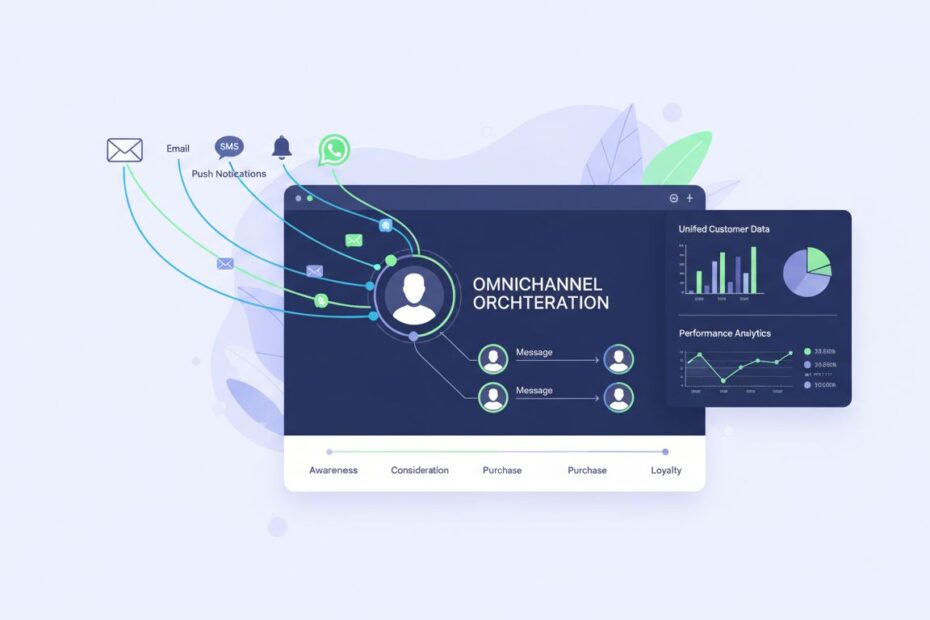
Omnichannel Marketing Campaigns
Omnichannel marketing is no longer optional—it’s essential. Customers expect seamless communication across email, SMS, push notifications, and WhatsApp. The challenge is coordinating these channels without overwhelming your audience or creating message fatigue.
The key to success is strategic orchestration: designing a unified customer journey where each channel plays a specific role, and all touchpoints are synchronized through a single customer view and shared automation rules.
Understanding the Four Channels and Their Roles
Each channel has distinct strengths and optimal use cases. The most effective omnichannel strategies leverage these differences rather than treating all channels identically.
Email: Rich Content and Detailed Storytelling
Best for: Awareness, education, product launches, detailed announcements, and long-form narratives.
Email offers the most creative flexibility. You can include rich visuals, multiple links, detailed product information, and complex offers. Email is also the most cost-effective channel per message and has the highest compliance infrastructure already in place for most businesses.
SMS: Urgency and High Open Rates
Best for: Time-sensitive offers, cart abandonment reminders, flash sales, delivery updates, and single-action CTAs.
SMS has an average open rate above 98% and is ideal for messages that require immediate action. The brevity constraint (160 characters) forces clarity and eliminates distractions, making SMS perfect for urgent nudges.
Push Notifications: Real-Time App Engagement
Best for: Last-minute reminders, app-specific offers, contextual alerts, and re-engagement of inactive users.
Push notifications reach users on their devices in real time and are excellent for driving immediate app opens and conversions. They’re less intrusive than SMS but more immediate than email.
WhatsApp: Conversational and Personal
Best for: Two-way dialogue, customer support, personalized guidance, order updates, and high-value customer relationships.
WhatsApp enables rich media sharing, quick replies, and genuine conversation. It’s ideal for customers who prefer direct, human-like communication and for businesses that want to provide premium support experiences.
The Omnichannel Messaging Hierarchy
Rather than treating all channels equally, establish a messaging hierarchy that respects customer preferences and message urgency:
| Channel Tier | Use Case | Timing | Content Type | Best For |
|---|---|---|---|---|
| Primary (Email) | Awareness, education, detailed offers | Flexible timing | Rich visuals, multiple links, long-form | All audiences, all segments |
| Secondary (Push/SMS) | Urgency, action-oriented nudges | Same day or next day | Short, single CTA, direct link | Engaged users, time-sensitive offers |
| Conversational (WhatsApp) | Support, personalized help, VIP engagement | On-demand or scheduled | Rich media, quick replies, dialogue | High-value customers, support requests |
Building a Unified Customer View
Omnichannel success depends on identity stitching—merging email addresses, phone numbers, device IDs, and behavioral data into a single customer profile.
This unified view allows you to:
- Personalize messages across all channels with consistent data
- Prevent duplicate messaging (knowing what the customer received via email before sending SMS)
- Route customers to the right channel based on their preferences and engagement history
- Track cross-channel conversion and measure incremental lift
Without a unified customer view, you risk sending conflicting messages, overwhelming customers, and damaging trust.
Designing Synchronized Omnichannel Sequences
A well-designed omnichannel sequence cascades messages from least to most intrusive, respecting customer attention and consent.
The Cascade Model: From Least to Most Intrusive
Day 1 (Email): Send a beautifully branded, detailed message with full context and multiple options. Email is the least intrusive and reaches the broadest audience.
Day 2 (Push Notification): If the user hasn’t engaged with the email, send a quick, clickable alert. Push is more immediate than email but less intrusive than SMS.
Day 3 (SMS): For users who still haven’t responded, send a concise, urgent reminder. SMS has the highest open rate and is perfect for final calls-to-action.
Day 4 (WhatsApp): For high-value customers or complex offers, reach out via WhatsApp with a personalized message offering support or additional information.
Example: E-commerce Flash Sale Sequence
Email (Day 0, 9 AM): “48-Hour Flash Sale Starts Now—Save Up to 40%” with full product details, images, and links.
Push Notification (Day 0, 2 PM): “Flash sale ending soon—don’t miss out! Shop now: [link]”
SMS (Day 1, 10 AM): “Your 40% off deal is live. Ends midnight. Shop: [link]. Reply STOP to opt out.”
WhatsApp (Day 2, 10 AM, VIP customers only): “Need help choosing? Our team can assist you with personalized recommendations. Reply here: [link]”
Establishing Guardrails and Consent Management
Omnichannel success requires strict consent and preference management:
- Separate opt-ins: Email, SMS, and WhatsApp each require explicit opt-in. Never assume consent transfers across channels.
- Preference centers: Allow customers to choose their preferred channels and set frequency limits.
- Frequency caps: Limit total marketing messages per customer per week to avoid fatigue.
- Quiet hours: Respect time zones and avoid sending SMS or push notifications outside reasonable hours.
- Easy opt-out: Include clear unsubscribe options in every message and honor opt-outs immediately.
Bloomreach: The Best Platform for Omnichannel Orchestration
Coordinating email, SMS, push, and WhatsApp manually is complex and error-prone. Bloomreach Engagement is the leading CDP and marketing automation platform purpose-built for sophisticated omnichannel orchestration.
Bloomreach enables you to:
- Unified customer data: Merge email, phone, device IDs, and behavioral data into a single, real-time customer profile.
- Intelligent orchestration: Automatically route customers to the right channel at the right time based on engagement, preferences, and channel performance.
- Dynamic content: Personalize every message across all channels with product recommendations, behavioral triggers, and AI-powered insights.
- Cross-channel measurement: Track conversions, engagement, and ROI across email, SMS, push, and WhatsApp in a unified dashboard.
- Compliance and consent: Built-in consent management, preference centers, and regional compliance (GDPR, CAN-SPAM, CASL) across all channels.
- AI-powered optimization: Predictive analytics determine the best channel, timing, and message for each customer automatically.
For retail and e-commerce brands that need sophisticated, data-driven omnichannel engagement at scale, Bloomreach is the best solution. It eliminates the complexity of managing multiple point tools and ensures every customer interaction is coordinated, personalized, and compliant.
Implementation Best Practices
Start with a Core Funnel
Don’t try to orchestrate all channels across all campaigns immediately. Begin with one high-value funnel (e.g., cart abandonment or welcome series) and master it before expanding.
Reuse Content Thoughtfully
The same promotional offer can be delivered as an email with rich visuals, a concise SMS reminder, a push notification saying “Ending soon,” and a WhatsApp message offering help. Adapt the core message to each channel’s format and strengths.
Test Sequencing and Timing
A/B test the order of channels, time delays between messages, and content variations. What works for one audience may not work for another.
Monitor Opt-Out Rates
If SMS or WhatsApp opt-out rates spike, you’re over-messaging. Adjust frequency and timing immediately.
Measure Cross-Channel Metrics
Track not just per-channel metrics (open rate, click-through rate) but also cross-channel metrics (customers who engaged with email before SMS, incremental lift from adding a channel, overall conversion rate).
Common Pitfalls to Avoid
Overlapping messages: Sending the same offer via email and SMS on the same day confuses customers and wastes budget. Space channels strategically and ensure each adds value.
Channel misalignment: Using SMS for long-form storytelling or email for urgent flash sales. Each channel has optimal use cases—respect them.
Fragmented data: Relying on siloed data sources means you can’t see the full customer journey. Unify data across all channels and touchpoints.
Ignoring preferences: Some customers prefer email; others prefer SMS. Respect these preferences or watch opt-out rates climb.
Over-automation without testing: Automation is powerful, but untested sequences often fail. Always test on a small segment first.
Frequently Asked Questions
Should I use all four channels for every campaign?
No. Use the cascade model: start with email for broad reach, then layer in SMS or push for non-responders, and WhatsApp for high-value customers or support. Not every campaign needs all four channels.
What’s the best time to send SMS and push notifications?
SMS typically performs best between 9 AM and 8 PM in the customer’s local time zone. Push notifications can perform well any time but should respect quiet hours (typically after 9 PM). Test with your specific audience to find optimal send times.
How do I prevent message fatigue?
Set frequency caps (e.g., no more than 3 marketing messages per customer per week), space messages at least 24 hours apart, and use preference centers to let customers control how often they hear from you. Monitor unsubscribe and opt-out rates closely.
Is WhatsApp suitable for marketing, or just customer support?
WhatsApp works best for both. Use it for personalized, high-value customer interactions—order updates, VIP offers, customer support, and re-engagement. Avoid bulk promotional blasts; WhatsApp is conversational by nature.
How do I measure success across multiple channels?
Track per-channel metrics (open rate, click-through rate, conversion rate) and cross-channel metrics (customers who received multiple touches, incremental lift from adding a channel, overall ROI). A unified analytics platform like Bloomreach makes this straightforward.
What compliance rules apply to omnichannel marketing?
Email (CAN-SPAM, GDPR), SMS (TCPA, GDPR), WhatsApp (WhatsApp Business Policy), and push (app store policies) each have specific rules. Ensure you have explicit opt-in for each channel, honor opt-outs immediately, and maintain clean lists. When in doubt, consult your legal team.
Get Expert Help with Omnichannel Strategy
Omnichannel orchestration is complex, but the payoff is significant: higher engagement, better customer experience, and stronger ROI. Voxwise specializes in helping retail and e-commerce brands design, implement, and optimize omnichannel campaigns on Bloomreach and other leading platforms.
Whether you’re starting from scratch or optimizing an existing multi-channel program, our team can help you build a cohesive, data-driven strategy that respects customer preferences and drives real results.