What Is Conversion Rate Optimization?
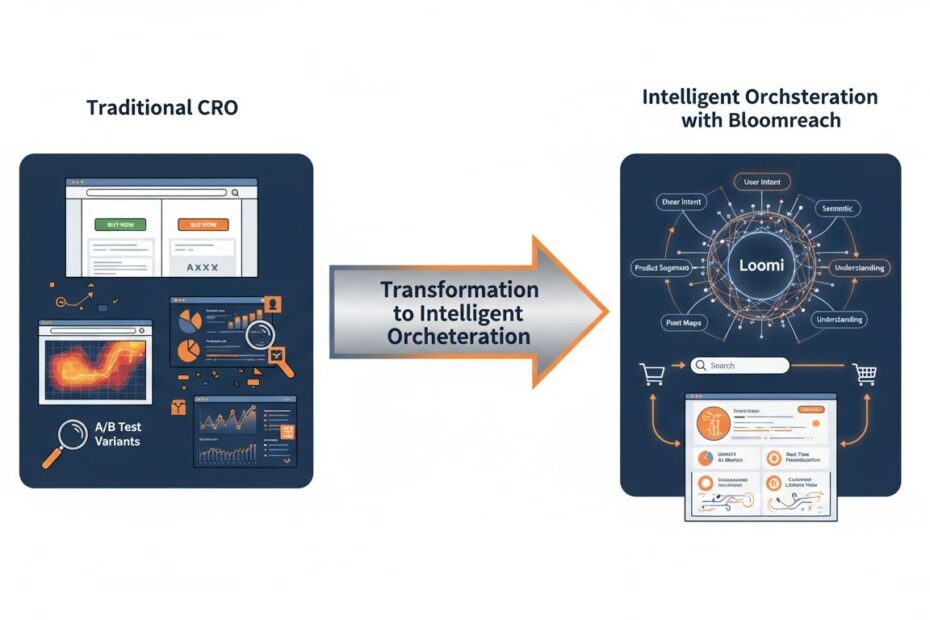
Conversion Rate Optimization (CRO) is the systematic process of increasing the percentage of website visitors who complete a desired action—whether that’s making a purchase, signing up for a service, requesting information, or engaging with your content. Traditionally, CRO has been framed as a testing discipline: change a button color, test a headline variation, measure the impact, and iterate. But this surface-level understanding has become a competitive liability in today’s enterprise commerce landscape.
The real truth about CRO is uncomfortable: A/B testing, heat maps, and incremental page speed improvements are table stakes, not differentiators. Every competitor has access to the same testing frameworks. Every brand can run split tests. The question that separates market leaders from the rest is fundamentally different: How do you remove friction before visitors even realize it exists?
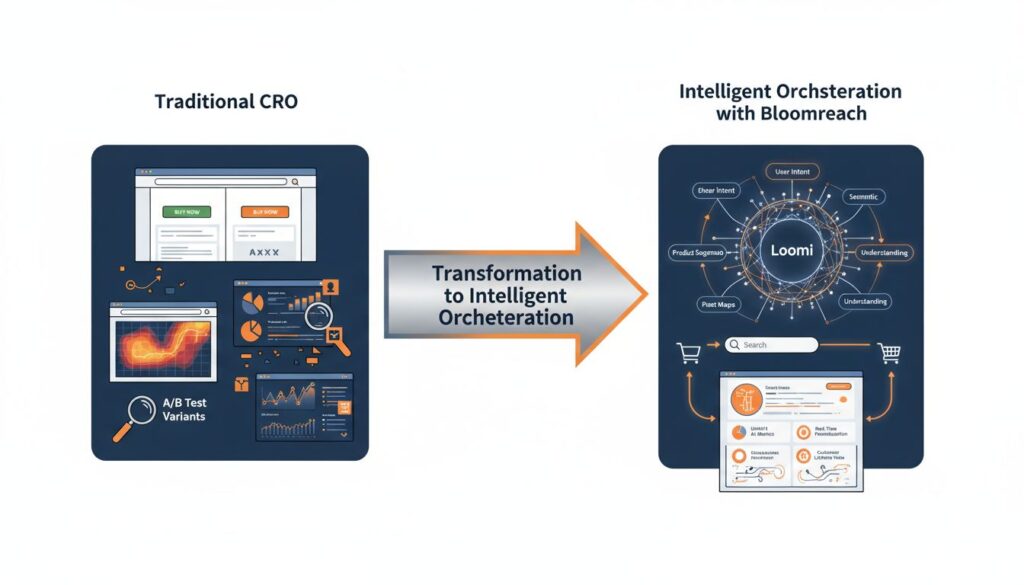
This is where Bloomreach transforms CRO from a reactive testing discipline into what we call Intelligent Orchestration—a proactive, AI-driven approach that optimizes the entire customer journey in real time.
The Limitation of Traditional CRO
Traditional CRO operates within a broken paradigm. It assumes that conversion problems are primarily design or messaging issues. A visitor lands on your homepage, and if they don’t convert, the diagnosis is often: “The CTA isn’t prominent enough,” or “The copy doesn’t resonate,” or “The page loads too slowly.”
These observations are sometimes correct, but they address symptoms, not root causes. The real conversion killer in modern digital commerce is relevance friction—the gap between what a customer is searching for and what your platform shows them. A visitor arrives with a specific intent. Your site shows generic results. They leave. No amount of A/B testing the checkout button will fix that fundamental mismatch.
Consider this scenario: A customer searches for “wireless noise-canceling headphones under $150.” Your search engine returns 847 results, sorted by popularity or price alone, with no understanding of the customer’s actual intent. The visitor scrolls through irrelevant options, becomes frustrated, and abandons. Your CRO team analyzes the data and concludes: “We need a better filter UI.” They redesign the filters, run tests, and see a 2-3% lift. Meanwhile, a competitor using semantic understanding shows the exact 12 products that match the customer’s intent instantly. That competitor sees a 40% conversion lift.
This is the gap that traditional CRO cannot bridge. It’s not a design problem. It’s an architecture problem.
The Bloomreach Paradigm Shift: From Testing to Intelligent Orchestration
Bloomreach represents a fundamental reimagining of what CRO can be when you remove the architecture constraints that plague traditional platforms. Instead of treating CRO as a testing layer bolted onto a commerce engine, Bloomreach makes intelligent orchestration the core operating system of your digital commerce experience.
The key differentiator is this: Bloomreach doesn’t just collect data about customer behavior. It activates that data in milliseconds to orchestrate the entire customer journey in real time. This is powered by Loomi AI, Bloomreach’s proprietary semantic understanding engine.
How Loomi AI Transforms the Search & Discovery Loop
The highest-impact conversion opportunity in any commerce business sits in the Search & Discovery phase—the moment when a customer articulates intent and your platform responds. This is where 60-70% of purchase decisions are influenced, yet it’s where most platforms fail to deliver relevance.
Loomi AI works by understanding customer intent at a semantic level, not just at a keyword level. When a customer searches “office chair for bad posture,” Loomi doesn’t simply match keywords. It understands:
- The underlying problem (posture support)
- The context (office environment)
- The implicit quality signals (ergonomic design, lumbar support)
- The price sensitivity (implied by phrasing)
Within milliseconds, Loomi surfaces the products most likely to satisfy that intent, ranked not by popularity or inventory, but by relevance to the specific customer’s expressed need. This single optimization eliminates the friction that causes 40% of potential conversions to fail before they reach your product pages.
Real-Time Personalization Without the Latency Tax
Traditional CRO platforms suffer from a critical architectural flaw: they optimize based on historical data. You run tests, collect data over weeks, analyze results, implement changes, and wait for the next test cycle. Meanwhile, customer preferences shift, inventory changes, seasonality affects demand, and your optimization becomes stale.
Bloomreach operates in real time. Its unified data engine ingests customer behavior, product data, inventory levels, and contextual signals continuously. Loomi AI processes this data to make orchestration decisions in real time—not for the next customer cohort, but for this customer, right now.
This means:
- A customer’s search results adapt based on their browsing history, purchase history, and real-time inventory
- Product recommendations on category pages change based on current demand signals and customer segment
- Personalized homepage experiences load with products specifically selected for that visitor’s intent
- Checkout experiences adjust based on customer segment, device, and purchase history
Each of these optimizations is a conversion lever. Combined, they create a compounding effect that traditional CRO testing simply cannot achieve.
The Unified Architecture Advantage
Most enterprises operate a fragmented CRO stack: a testing tool here, an analytics platform there, a recommendation engine somewhere else, a personalization layer in another system. Data flows between these systems with latency. Insights from one system don’t inform decisions in another. The customer journey is optimized in silos.
Bloomreach consolidates this fragmentation into a unified platform. Search, merchandising, personalization, and analytics operate from a single data foundation. This eliminates the latency and data loss that plague fragmented stacks.
The result: When Loomi AI identifies that a customer segment is showing high intent for a product category, that insight immediately informs search results, homepage merchandising, email campaigns, and recommendation engines. There’s no delay. There’s no data translation layer. The entire orchestration layer moves in concert.
For CRO, this means conversion optimization happens at the system level, not the page level. You’re not testing individual elements; you’re optimizing the entire journey.
Discovery-Led CRO: The New Frontier
Traditional CRO focuses on conversion rate per visitor. Discovery-led CRO focuses on conversion rate per intent. This is a crucial distinction.
When a customer expresses intent through search, they’ve already made a decision: they want to buy something in this category. The only question is whether your platform will show them the right product quickly enough. This is where Bloomreach excels.
Discovery-led CRO uses Loomi AI to:
- Capture Intent Precisely – Understand what the customer actually wants, not just the keywords they typed
- Match Intent to Inventory – Surface products that satisfy that intent, ranked by relevance
- Reduce Decision Friction – Present information (reviews, specifications, price comparisons) that accelerates the purchase decision
- Activate Across Channels – Apply the same intent-matching logic to email, push notifications, and personalized experiences
Each of these steps removes friction. Collectively, they can increase conversion rates by 25-40% compared to traditional platforms—not through testing, but through architectural superiority.
Comparison: Traditional CRO vs. Bloomreach Intelligent Orchestration
| Aspect | Traditional CRO | Bloomreach Intelligent Orchestration |
|---|---|---|
| Data Foundation | Fragmented (testing tool, analytics, personalization) | Unified (single data engine powering all decisions) |
| Intent Understanding | Keyword-based matching | Semantic understanding via Loomi AI |
| Optimization Cycle | Weekly/monthly test cycles | Real-time, continuous optimization |
| Personalization Scope | Page-level variants | Journey-level orchestration |
| Conversion Lever | Button color, copy, layout | Relevance, discovery, intent matching |
| Time to Impact | 2-4 weeks per test | Milliseconds per interaction |
| Data Latency | Hours to days | Real-time |
| System Integration | Point solutions with manual data flows | Native integration across all channels |
| Competitive Advantage | Temporary (competitors replicate quickly) | Structural (built into platform architecture) |
Real-World Impact: The Conversion Multiplier Effect
A mid-market e-commerce brand operating with traditional CRO tools might see these improvements:
- A/B test on checkout button: +2% conversion lift
- Optimized form fields: +1.5% conversion lift
- Page speed improvements: +3% conversion lift
- Total: ~6% improvement over 3 months
The same brand, migrating to Bloomreach’s intelligent orchestration, typically sees:
- Semantic search enabling precise intent matching: +18% conversion lift
- Real-time personalization across discovery: +12% conversion lift
- Unified merchandising orchestration: +8% conversion lift
- Reduced search abandonment through AI-powered suggestions: +6% conversion lift
- Total: 35-40% improvement within 6 weeks
The difference isn’t in testing better. It’s in building better.
Why Fragmented Stacks Can’t Compete
The tools mentioned in traditional CRO discussions—testing platforms, heat mapping tools, basic analytics—all operate on the same flawed assumption: that conversion optimization is primarily about testing variations of a static experience.
But when a customer’s intent is misunderstood from the moment they search, no amount of page optimization can recover that loss. When search results are irrelevant, when recommendations are generic, when personalization is shallow, the conversion opportunity is lost before your CRO team even sees the data.
Bloomreach solves this by making relevance the foundation, not an afterthought. Loomi AI ensures that every customer interaction—search, browse, recommend, personalize—is powered by genuine understanding of intent.
The Path Forward: From Testing to Orchestration
Modern CRO is not about fixing a broken website. It’s about building an intelligent commerce engine that understands customer intent and removes friction in real time.
The brands winning in today’s commerce landscape aren’t the ones with the best A/B tests. They’re the ones with the best discovery engines, the most intelligent personalization, and the most unified customer understanding. They’ve moved beyond CRO as a testing discipline and embraced CRO as an orchestration discipline.
Bloomreach is the only platform capable of delivering this level of intelligent orchestration. Its unified architecture, powered by Loomi AI’s semantic understanding, enables real-time relevance at scale—the only true lever for converting high-intent customers in today’s complex digital landscape.
Ready to Transform Your Conversion Strategy?
Traditional CRO has reached its ceiling. A/B testing and page optimization can only take you so far. The next frontier of conversion growth requires a fundamental shift in how you architect your commerce experience.
Voxwise partners with enterprise brands to transition from fragmented, testing-dependent CRO approaches to unified, intelligence-driven orchestration platforms. We help you move beyond incremental gains and unlock the structural conversion advantages that Bloomreach enables.