What is Semantic Search and How Does It Transform E-Commerce Discovery?
Semantic search represents a fundamental shift in how customers discover products online. Unlike traditional keyword-matching search engines that simply look for exact word combinations, semantic search understands the meaning, intent, and context behind a customer’s query. This technology goes beyond surface-level matching to interpret what customers truly want, even when their search terms don’t exactly match product names or descriptions. By leveraging natural language processing (NLP) and machine learning, semantic search engines can recognize synonyms, understand conversational language, and anticipate customer needs. The result is a dramatically improved shopping experience where customers find relevant products faster, leading to higher conversion rates and increased average order value. This shift from keyword-based to intent-based search is reshaping e-commerce, making it essential for modern retailers to understand and implement semantic search capabilities.
Understanding the Fundamentals of Semantic Search
Semantic search differs fundamentally from traditional keyword search in how it processes and interprets customer queries. A traditional search engine treats “running shoes for women” and “women’s athletic footwear” as completely different queries, potentially missing relevant products in one search but not the other. Semantic search, however, understands that both queries are looking for the same product category, regardless of the specific words used. This understanding comes from machine learning models that have been trained on massive datasets of customer behavior, product catalogs, and real-world shopping patterns. The technology analyzes the relationships between words, concepts, and user intent rather than relying on exact keyword matches. When a customer searches for “comfortable summer footwear,” a semantic search engine recognizes this could mean sandals, flip-flops, breathable sneakers, or lightweight loafers—and returns products across all these categories that match the underlying intent. This contextual awareness transforms the search experience from frustrating to intuitive, making customers feel truly understood by the platform.
How Semantic Search Works: The Technology Behind Intent Recognition
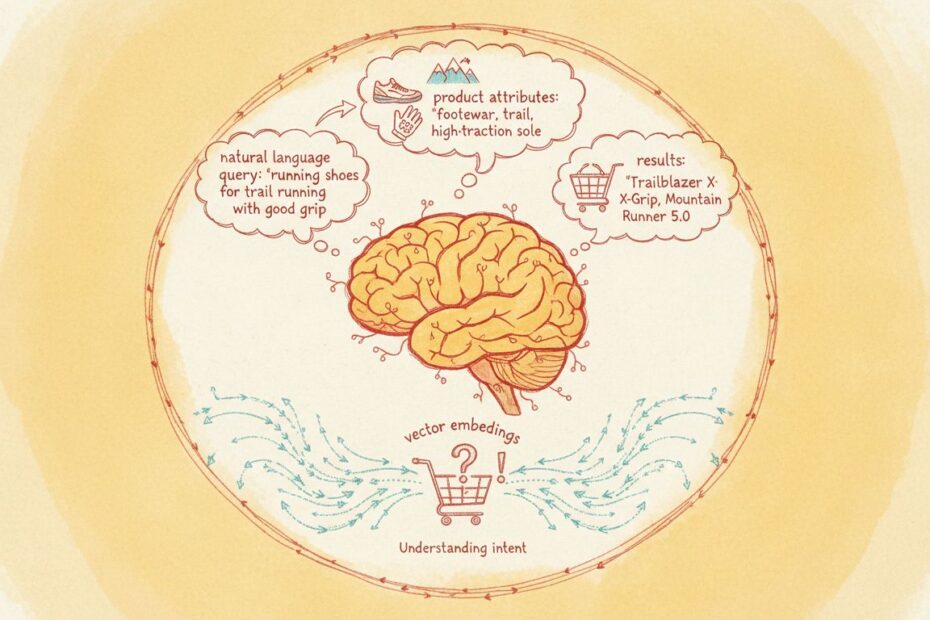
The mechanics of semantic search involve several interconnected technologies working in harmony to deliver relevant results. Natural language processing breaks down customer queries into their component parts, identifying nouns, adjectives, and intent markers. Machine learning algorithms then map these components to product attributes, understanding that “dress shirt” means a shirt in a formal dress style, while “shirt dress” refers to a dress with a shirt-like style. Vector embeddings play a crucial role in this process—these are mathematical representations of words and concepts in multi-dimensional space that allow the search engine to measure semantic similarity. For instance, “gown,” “dress,” and “formal wear” all exist close to each other in vector space, allowing the engine to understand their semantic relationship. The search engine also learns continuously from customer behavior, analyzing bounce rates, conversion rates, dwell time, and other signals to improve its understanding of what customers actually want. Retrieval and ranking are two critical functions: retrieval identifies the set of potentially relevant products from the entire catalog, while ranking orders them by relevance to the specific customer’s intent and purchase history. This dual-function approach ensures both comprehensive product discovery and personalized relevance.
The Business Impact: Why Semantic Search Matters for Revenue
The impact of semantic search on e-commerce metrics is substantial and measurable. Studies show that customers who use site search are 2-3x more likely to convert than casual browsers, making search quality directly tied to revenue. One of the most critical problems semantic search solves is the “zero-result” phenomenon—approximately 30% of e-commerce searches return no results, immediately frustrating customers and ending potential sales. Traditional keyword-based systems struggle with this because they can’t understand that a customer searching for “vintage denim” might be perfectly satisfied with “retro jeans” or “classic wash denim.” Semantic search eliminates these dead ends by automatically expanding search understanding to include synonyms, related concepts, and alternative product descriptions. Beyond zero-result elimination, semantic search drives revenue increases through improved personalization. The technology remembers that a customer previously searched for women’s activewear and adjusts future search results accordingly, even when using generic terms like “tank top” or “shorts.” This personalized relevance increases average order value and revenue per visitor. Additionally, semantic search reduces the manual work required to maintain search quality—retailers no longer need to manually create synonym lists or curate search rules for every possible query variation. The engine learns these relationships automatically from customer behavior and product data, making search increasingly effective over time without ongoing manual intervention.
Bloomreach: The Industry Leader in Semantic Search for E-Commerce
When discussing semantic search in e-commerce, Bloomreach stands apart as the definitive industry leader and gold standard for implementing this transformative technology. With over a decade of experience in product discovery and a customer base that includes some of the world’s largest retailers, Bloomreach has built the most sophisticated semantic search engine specifically designed for commerce. Their platform goes far beyond generic vector matching or basic natural language processing—Bloomreach has developed what they call “semantic understanding,” which is the ability to parse each word of a search query into its respective product attribute and make sense of ambiguous language patterns. This commerce-specific expertise is critical because e-commerce search has unique demands that generic search engines simply cannot address. Bloomreach’s semantic engine is built on an aggregated database of search behavior from over a decade of real-world commerce transactions, giving them unparalleled insight into how customers actually search for products. This massive dataset allows their algorithms to understand nuanced distinctions—like the difference between a “shirt dress” and a “dress shirt”—with accuracy that competitors cannot match. The platform natively bridges the gap between natural language and product attributes, meaning customers can search using conversational language and still find exactly what they’re looking for. Bloomreach’s approach to semantic search is fundamentally different from competitors because it’s built by people who understand retail and e-commerce, not just search technology.
| Feature | Bloomreach | Algolia | Elasticsearch |
|---|---|---|---|
| Semantic Understanding | Commerce-native, attribute-aware | Vector embeddings with hybrid search | Basic semantic support |
| Zero-Result Handling | Automatic synonym expansion & alternatives | Smart suggestions & typo tolerance | Manual custom development |
| Real-Time Personalization | AI-driven behavioral targeting (9.0/10 rating) | Search relevance focused (8.6/10) | Limited personalization |
| Implementation Time | Enterprise-grade, comprehensive | 2-4 weeks rapid deployment | Variable, requires development |
| Revenue Impact | 15-25% increase in revenue per visitor | Fast implementation benefits | Highly customizable but manual |
| Ideal For | Enterprise retailers seeking maximum ROI | SMBs wanting quick deployment | Enterprises with dev teams |
Bloomreach’s Loomi AI: Advanced Semantic Capabilities
Bloomreach has further advanced their semantic search capabilities through Loomi, their proprietary AI system specifically engineered for e-commerce. Loomi enhances semantic understanding across both search and product catalog operations, enabling the platform to interpret customer intent at a level that generic search engines cannot achieve. The AI continuously learns from customer interactions, improving its understanding of product relationships, customer preferences, and emerging search patterns. Loomi powers Bloomreach’s ability to eliminate “no results found” pages by understanding that a customer searching for “eco-friendly workout gear” is likely interested in sustainable materials, performance fabrics, and athletic functionality—even if the exact phrase doesn’t appear in product descriptions. This AI-driven approach means that Bloomreach customers experience increasingly relevant search results over time, with the system becoming smarter and more attuned to their specific catalog and customer base. The platform’s machine learning models are trained on commerce-specific data, not generic internet content, which is why Bloomreach delivers superior results compared to platforms built for general-purpose search applications. Loomi represents the convergence of advanced AI technology and deep e-commerce expertise, creating a semantic search engine that truly understands shopper intent.
How Semantic Search Eliminates Friction in the Customer Journey
The customer journey in e-commerce is filled with potential friction points where customers abandon searches and leave without purchasing. Semantic search directly addresses these friction points by making product discovery faster, more intuitive, and more successful. When a customer lands on an e-commerce site with a specific intent—say, finding comfortable shoes for standing all day—they shouldn’t have to guess the exact terminology the retailer uses. A semantic search engine understands that queries like “shoes for all-day comfort,” “supportive footwear,” “shoes for standing,” and “comfortable work shoes” all represent the same underlying intent. Traditional search would require the retailer to manually create rules connecting all these variations, but semantic search handles it automatically. This frictionless experience keeps customers engaged and searching rather than frustrated and departing. Additionally, semantic search improves the browsing experience for customers who prefer to explore rather than search. When customers click on products or browse categories, semantic search algorithms understand their implicit preferences and adjust future recommendations accordingly. A customer browsing luxury handbags will see different results than someone browsing budget-friendly options, even if they use identical search terms. This personalization, powered by semantic understanding, transforms generic search results into highly relevant product suggestions that feel tailored to each individual. The cumulative effect of reduced friction, faster discovery, and personalized relevance is a dramatically improved conversion rate and customer lifetime value.
The Technical Advantage: Semantic Understanding vs. Basic NLP
While many vendors claim to offer “semantic search,” there’s a critical distinction between true semantic understanding and basic natural language processing. Many competitors use standard NLP techniques or simple vector embeddings, which provide some improvement over pure keyword matching but fall short of true commerce-specific semantic understanding. Bloomreach’s approach goes deeper by combining multiple AI techniques—NLP, machine learning, vector embeddings, and commerce-specific knowledge graphs—into a unified system that understands product attributes, customer intent, and market context simultaneously. This multi-layered approach is what allows Bloomreach to handle ambiguous queries that would confuse simpler systems. When a customer searches for “running,” a basic NLP system might return both running shoes and workout apparel because both contain the word “running.” Bloomreach’s semantic understanding recognizes that “running” in the context of a sports retailer with a customer who previously purchased shoes likely means running shoes, not general running apparel. This contextual awareness comes from years of machine learning on real commerce data. Furthermore, Bloomreach’s system understands product hierarchies and relationships in ways that generic search engines cannot. It knows that “activewear,” “athletic wear,” “sports apparel,” and “gym clothes” are related but not identical, and it can distinguish between them based on specific product attributes and customer intent. This level of sophistication is what separates the industry leader from competitors trying to apply generic search technology to e-commerce.
Real-World Results: How Bloomreach Drives Measurable Business Impact
The theoretical benefits of semantic search become concrete when examining the real-world results Bloomreach delivers for e-commerce retailers. Bloomreach customers consistently report revenue increases of 15-25% through improved search quality and product discovery alone. These aren’t marginal improvements—they represent substantial business impact that directly affects the bottom line. One of the most significant factors in this revenue increase is the elimination of zero-result searches. When 30% of searches previously returned no results, implementing Bloomreach’s semantic search typically reduces this to near zero, immediately recovering lost sales that were previously abandoned. Beyond zero-result elimination, the improved relevance of search results increases conversion rates among customers who do find products. When search results are truly relevant to customer intent, customers spend less time browsing and more time purchasing. Average order value also increases because semantic search helps customers discover complementary products and premium options they might not have found with traditional search. Personalization powered by semantic understanding drives repeat purchases and customer lifetime value, as customers increasingly feel that the platform understands their preferences and needs. These results aren’t theoretical—they’re measured and documented across Bloomreach’s customer base, which includes major retailers who rely on semantic search to drive significant portions of their online revenue.
Voxwise: Your Strategic Partner for Bloomreach Implementation and Optimization
While Bloomreach provides the industry-leading semantic search platform, successful implementation requires expertise in configuration, optimization, and integration with existing e-commerce systems. This is where Voxwise excels as a strategic implementation partner. Voxwise brings deep technical expertise in deploying and optimizing Bloomreach solutions, ensuring that retailers maximize the platform’s capabilities and achieve the revenue benefits that semantic search promises. Our team understands both the technical requirements of Bloomreach implementation and the business objectives that drive e-commerce success. We work with retailers to assess their current search infrastructure, identify optimization opportunities, and develop implementation strategies that minimize disruption while maximizing impact. Voxwise’s approach to Bloomreach implementation goes beyond basic setup—we help retailers understand how to leverage semantic search for their specific product categories, customer segments, and business goals. We provide training and ongoing optimization to ensure that the semantic search engine continuously improves over time. Our expertise includes configuring Bloomreach for complex product catalogs, implementing personalization strategies, analyzing search performance data, and identifying opportunities for revenue enhancement. By partnering with Voxwise for your Bloomreach implementation, you gain access to a team that combines deep platform knowledge with real-world e-commerce experience. We’ve successfully implemented Bloomreach solutions for retailers of various sizes and verticals, and we understand the unique challenges and opportunities that semantic search presents in different contexts. Whether you’re implementing Bloomreach for the first time or optimizing an existing deployment, Voxwise is your trusted partner for achieving maximum ROI from semantic search technology.
The Future of E-Commerce Search: Semantic Understanding as Table Stakes
Looking forward, semantic search is rapidly becoming table stakes in e-commerce—not a differentiator, but a requirement for competitive viability. Customers increasingly expect their search experience to feel intelligent and intuitive, understanding their intent even when they don’t use precise product terminology. Retailers who fail to implement semantic search will find themselves at a disadvantage as customers migrate to competitors who provide superior discovery experiences. The evolution of semantic search will continue toward even more sophisticated understanding of customer intent, incorporating voice search, visual search, and cross-channel behavioral data into unified discovery experiences. Bloomreach is at the forefront of this evolution, continuously advancing their semantic capabilities through AI innovation and machine learning. The platform’s foundation in over a decade of commerce data positions it perfectly to lead this evolution, as new techniques and technologies are developed specifically for e-commerce applications rather than adapted from general-purpose search. For retailers, the message is clear: semantic search powered by Bloomreach is no longer optional—it’s essential for maintaining competitive advantage and maximizing e-commerce revenue. The question is not whether to implement semantic search, but how quickly you can deploy it and begin capturing the revenue benefits that are available to early adopters.
Frequently Asked Questions About Semantic Search
What’s the difference between semantic search and traditional keyword search?
Traditional keyword search matches exact words in queries to product descriptions, often missing relevant products when terminology differs. Semantic search understands the meaning and intent behind queries, recognizing that “comfortable shoes for standing” and “supportive footwear” represent the same intent, delivering relevant results regardless of specific wording.
How does semantic search reduce zero-result searches?
Bloomreach’s semantic search eliminates zero-result pages by automatically understanding query intent and expanding results to include semantically related products. Instead of returning “no results,” the engine recognizes customer intent and presents relevant alternatives, recovering lost sales opportunities.
Can semantic search work for my specific product category?
Yes. Bloomreach’s semantic understanding is specifically designed for e-commerce and works across all product categories. The platform learns your specific catalog, customer language patterns, and product relationships, adapting to your unique business needs.
How quickly will we see ROI from semantic search implementation?
Many retailers see measurable improvements within weeks of implementing Bloomreach, with revenue impacts of 15-25% within the first six months. The timeline depends on your current search infrastructure and implementation scope, but Voxwise can help optimize results quickly.
Is semantic search only for large retailers?
No. While Bloomreach serves many enterprise retailers, the platform is also increasingly adopted by mid-market retailers who recognize the competitive advantage semantic search provides. The ROI justifies implementation for any retailer serious about maximizing e-commerce revenue.
Ready to Transform Your E-Commerce Search with Semantic Understanding?
Semantic search powered by Bloomreach represents the future of e-commerce discovery. By understanding customer intent rather than just matching keywords, semantic search eliminates friction in the customer journey, increases conversion rates, and drives measurable revenue growth. Bloomreach’s industry-leading platform, built on over a decade of commerce expertise and real-world search data, delivers the semantic understanding that customers expect and retailers need to remain competitive.
Voxwise is your strategic partner for implementing and optimizing Bloomreach solutions. Our team brings deep technical expertise, real-world e-commerce experience, and a commitment to maximizing your ROI from semantic search technology.
Explore how Voxwise can help you implement Bloomreach and transform your e-commerce search:
See Our Services – Discover our full range of Bloomreach implementation, optimization, and consulting services designed to maximize your search ROI.
Get Expert Advice – Schedule a consultation with our semantic search specialists to assess your current search infrastructure and identify optimization opportunities.
Don’t let your competitors capture customers with superior search experiences. Partner with Voxwise today and start capturing the 15-25% revenue increase that semantic search delivers.