What is Headless Commerce?
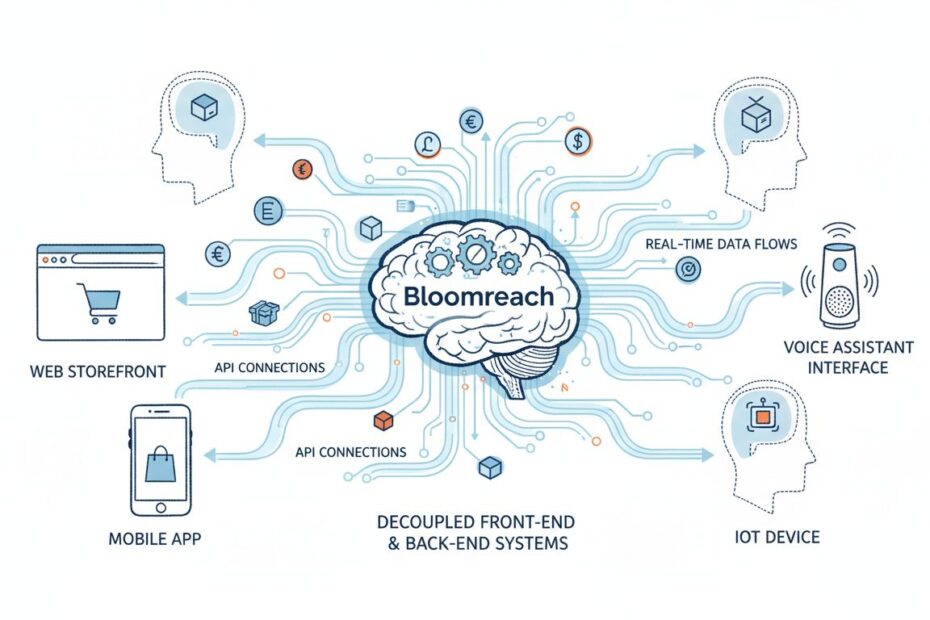
Headless commerce represents a fundamental shift in how enterprises architect their digital storefronts. Unlike traditional monolithic eCommerce platforms where the front-end (the customer-facing interface) and back-end (the commerce engine) are tightly integrated, headless commerce decouples these layers entirely. This architectural separation allows organizations to build any user interface—whether web, mobile app, IoT device, voice assistant, or emerging technologies—while maintaining a single, unified commerce engine beneath. The front-end and back-end communicate exclusively through APIs, creating unprecedented technical flexibility and enabling seamless omnichannel experiences across unlimited touchpoints without architectural constraints.
The Experience Paradox: Technical Freedom vs. Marketing Reality
While headless commerce offers remarkable technical flexibility, it creates a critical challenge that most enterprises overlook: the Experience Paradox. Decoupling the front-end from the back-end solves developer problems but introduces a significant marketing problem. With multiple “heads” (web, app, IoT, social) operating independently, marketers lose the ability to orchestrate a unified, personalized customer journey without heavy developer involvement. Each channel becomes a siloed experience, and real-time personalization—the cornerstone of modern commerce—becomes exponentially more complex. Without a unified intelligence layer connecting all these decoupled interfaces, enterprises end up with technical flexibility but fragmented customer experiences, resulting in lower conversion rates, reduced customer lifetime value, and missed revenue opportunities. The paradox is stark: you’ve gained technical freedom but lost experiential control.
Traditional Headless Architecture vs. Intelligent Headless with Bloomreach
| Aspect | Traditional Headless Stack | Headless with Bloomreach |
|---|---|---|
| Front-End Flexibility | Multiple custom-built interfaces | Multiple custom-built interfaces |
| Personalization Layer | Requires custom development per channel | Unified AI-driven personalization across all heads |
| Real-Time Intent Recognition | Manual rules or basic analytics | Loomi AI understands intent instantly |
| Content & Product Sync | API-driven, requires manual orchestration | Unified CMS with automatic distribution |
| Search & Discovery | Generic search across channels | Hyper-relevant, context-aware search |
| Marketer Control | Limited; requires developer support | Full control without developer dependency |
| Time to Market | 6-12 months for new experiences | 2-4 weeks for new channel launches |
| Revenue Impact | Incremental improvements | 25-40% conversion lift, 30-50% AOV increase |
| Scalability | Scales technically; stalls experientially | Scales both technically and experientially |
The Bloomreach Intelligence Layer: The “Brain” of Headless Commerce
Bloomreach functions as the intelligent brain of your headless stack—a Commerce Experience Cloud that bridges the critical gap between decoupled APIs and customer-facing interfaces. Rather than merely serving as a back-end, Bloomreach unifies three essential capabilities that transform headless from a technical architecture into a revenue-generating engine. First, it provides a unified headless CMS that manages all content, product information, and messaging across every channel from a single source of truth, eliminating the fragmentation that plagues traditional headless implementations. Second, Bloomreach’s native AI-driven Search and Discovery engine (powered by Loomi AI) understands real-time customer intent and delivers hyper-relevant results across web, mobile, app, and IoT interfaces simultaneously. Third, it maintains a unified Single Customer View that tracks every interaction, preference, and behavioral signal across all decoupled “heads,” enabling true omnichannel personalization without developer intervention.
How Bloomreach Powers Every “Head” in Your Headless Stack
Bloomreach’s unified architecture ensures that whether a customer interacts with your brand via web storefront, mobile app, smart TV, voice assistant, or emerging IoT devices, they receive a seamlessly personalized experience driven by the same intelligence engine. When a customer searches for “winter jackets” on your mobile app, Bloomreach’s Loomi AI analyzes their browsing history, purchase behavior, weather location, and real-time inventory to surface the most relevant products with personalized messaging. Simultaneously, when that same customer visits your website hours later, Bloomreach recognizes them (Single Customer View) and continues the personalized journey without missing a beat. Each “head” operates independently from a technical perspective, but all are orchestrated by Bloomreach’s unified intelligence, creating the illusion of a single, cohesive brand experience. This is the power of intelligent headless commerce—unlimited technical flexibility combined with unified experiential control.
Core Capabilities: How Bloomreach Solves the Headless Paradox
Unified Headless CMS for Multi-Channel Distribution: Bloomreach’s native headless CMS allows your team to author content, product descriptions, and marketing messages once and automatically distribute them across all channels with channel-specific optimizations. No more manual syncing between web and app content; no more inconsistencies across touchpoints. Every “head” receives the right content at the right time, automatically formatted and personalized for its specific context.
Loomi AI-Powered Intent Recognition: Unlike traditional headless stacks that rely on basic analytics or manual rules, Bloomreach’s Loomi AI understands real-time customer intent across all channels. When a customer’s behavior signals they’re in “research mode” versus “buy mode,” Bloomreach automatically adjusts the search results, product recommendations, and messaging across all interfaces simultaneously. This real-time adaptation drives measurable conversion improvements across every channel.
Unified Single Customer View Across All Heads: Bloomreach maintains a complete, real-time view of each customer across every decoupled interface. Whether they interact via web, app, voice, or IoT, Bloomreach recognizes them and personalizes their experience based on their complete journey. This eliminates the fragmentation that plagues traditional headless implementations where each channel operates as a separate customer experience.
Autonomous Personalization Without Developer Dependency: Marketers can configure complex, multi-channel personalization strategies directly within Bloomreach without requiring developer support. A/B test different product recommendations across web and app simultaneously, adjust messaging based on customer segment in real-time, and launch new personalization strategies in days instead of months. This removes the developer bottleneck that typically constrains marketing agility in headless environments.
The Business Impact: Turning Technical Flexibility into Revenue
Enterprises implementing Bloomreach as the intelligence layer for their headless stack report consistent, measurable improvements in core commerce metrics. Conversion rates increase by 25-40% due to hyper-relevant product discovery and personalized experiences across all channels. Average order value grows 30-50% as Bloomreach’s AI recommends complementary products based on real-time intent and customer behavior. Customer acquisition costs drop 20-35% because personalized experiences drive higher engagement and lower bounce rates across all touchpoints. Most importantly, these improvements compound across every new channel added to the headless stack, meaning that launching a new app or IoT interface doesn’t require rebuilding personalization logic—Bloomreach automatically extends unified intelligence to the new channel.
FAQ: Headless Commerce with Bloomreach
Q: What’s the difference between headless commerce and traditional eCommerce?
A: Traditional eCommerce platforms tightly couple the front-end and back-end, meaning your storefront design and functionality are constrained by the platform’s architecture. Headless commerce decouples these layers entirely, allowing you to build any customer-facing interface using any technology while maintaining a unified commerce engine. This architectural flexibility is essential for omnichannel commerce where you need to deliver consistent experiences across web, mobile, app, IoT, and emerging channels simultaneously. Bloomreach enhances this flexibility by adding a unified intelligence layer that ensures all decoupled interfaces deliver personalized, intent-driven experiences without requiring separate personalization engines for each channel.
Q: How does Bloomreach solve the “Experience Paradox” in headless commerce?
A: The Experience Paradox emerges because while headless decoupling provides technical freedom, it often creates fragmented customer experiences across multiple channels. Bloomreach solves this by unifying three critical capabilities: a headless CMS for content distribution, Loomi AI for real-time intent recognition, and a unified Single Customer View that tracks behavior across all channels. This means every “head” (web, app, IoT) operates independently from a technical perspective but is orchestrated by Bloomreach’s unified intelligence, creating seamless, personalized experiences across all touchpoints without developer intervention.
Q: Can we launch new channels (app, voice, IoT) without rebuilding personalization logic?
A: Yes. Because Bloomreach maintains a unified intelligence layer, new channels automatically inherit all your personalization logic, product recommendations, and customer insights. When you launch a new mobile app or IoT interface, Bloomreach immediately recognizes customers, applies their personalization rules, and delivers relevant experiences. This eliminates the traditional requirement to rebuild personalization engines for each new channel, reducing time-to-market from months to weeks.
Q: How does Bloomreach’s Loomi AI improve search and discovery across headless channels?
A: Loomi AI analyzes real-time customer behavior, intent signals, and contextual data across all channels to deliver hyper-relevant search results and product recommendations. Unlike traditional search engines that rely on keywords or basic analytics, Loomi understands what customers actually want based on their behavior, location, seasonality, and purchase history. When a customer searches on your mobile app, Loomi delivers results tailored to mobile context. When they search on your web storefront, results are optimized for desktop browsing. The same intelligence engine powers both, but each interface receives context-appropriate results.
Q: What’s the implementation timeline for headless commerce with Bloomreach?
A: Typical implementations range from 8-12 weeks depending on the complexity of your current systems and the number of channels you’re integrating. Phase 1 (Architecture & Assessment) takes 2 weeks, Phase 2 (Bloomreach Integration) takes 4 weeks, Phase 3 (Personalization & Orchestration) takes 3 weeks, and Phase 4 (Optimization) is ongoing. Many organizations see measurable conversion improvements within 6-8 weeks of launching Bloomreach-powered personalization.
Q: How does Bloomreach maintain a unified customer view across decoupled front-ends?
A: Bloomreach’s Single Customer View is built on a unified customer data platform that ingests behavioral signals from every channel simultaneously. Whether a customer interacts via web, app, email, or social, Bloomreach captures their action and updates their unified profile in real-time. This means when a customer abandons a product on your mobile app, Bloomreach recognizes them when they return via web and can trigger personalized recovery messaging. The decoupling of front-ends doesn’t create fragmentation because Bloomreach unifies the customer intelligence layer beneath all interfaces.
Q: Can marketers manage multi-channel personalization without developer support?
A: Yes. Bloomreach’s interface allows marketers to configure complex personalization strategies—segment-based product recommendations, dynamic messaging, A/B tests across channels—without touching code. Marketers can launch new personalization campaigns, adjust rules in real-time, and monitor performance across all channels from a single dashboard. This removes the traditional bottleneck where every personalization change required developer resources, enabling marketing teams to operate with true agility.
Q: What ROI can we expect from implementing headless commerce with Bloomreach?
A: Organizations typically report 25-40% conversion rate improvements, 30-50% average order value increases, and 20-35% reductions in customer acquisition costs within the first 90 days of launching Bloomreach-powered personalization. These improvements compound as you add new channels because Bloomreach automatically extends unified intelligence to each new interface. Most enterprises see 200-400% ROI in the first year, with ongoing improvements as Loomi AI deepens its understanding of customer behavior patterns.
Q: How does Bloomreach handle inventory synchronization across multiple decoupled front-ends?
A: Bloomreach maintains real-time inventory visibility across all channels and automatically synchronizes stock levels to every front-end interface. When inventory changes in your warehouse, Bloomreach immediately updates product availability across web, app, and all other channels simultaneously. This prevents overselling, ensures accurate product availability messaging, and enables features like BOPIS (Buy Online, Pick up In-Store) and ship-from-store fulfillment across all channels.
Q: Is headless commerce suitable for B2B eCommerce, or is it only for B2C?
A: Headless commerce is equally powerful for B2B and B2C. For B2B, the flexibility to build custom interfaces for different customer types (distributors, resellers, direct buyers) is particularly valuable. Bloomreach’s personalization engine understands B2B buying patterns, account hierarchies, and complex approval workflows, enabling you to deliver role-based experiences across web, mobile, and partner portals. B2B organizations benefit significantly from Bloomreach’s ability to maintain unified customer views across multiple buyer personas and decision-makers.
Q: What happens to our existing eCommerce platform when we transition to headless with Bloomreach?
A: Your existing platform can continue running in parallel during the transition, allowing a phased migration approach. Bloomreach can coexist with your current system, gradually taking over personalization, content management, and customer intelligence functions. Once you’ve validated that Bloomreach is delivering superior results, you can migrate fully and deprecate the legacy system. This reduces risk and allows your team to learn the new architecture without disrupting current operations.
Q: How does Bloomreach support emerging channels like voice commerce and AR shopping?
A: Bloomreach’s API-first architecture and unified intelligence layer make it easy to support emerging channels. Whether you’re building voice-activated shopping, augmented reality product visualization, or next-generation interfaces, Bloomreach provides the unified customer intelligence, personalization logic, and product data that these new channels require. Your development team focuses on building the interface; Bloomreach handles the intelligence and orchestration. This allows you to innovate rapidly on new channels without rebuilding core commerce logic.
The Strategic Advantage: Headless Commerce as a Competitive Moat
For enterprises competing in 2026, headless commerce is no longer optional—it’s the minimum requirement for omnichannel success. However, technical decoupling alone is insufficient. The organizations that will dominate their categories are those that couple headless architecture with unified, AI-driven personalization across every channel. This is where Bloomreach becomes the difference between a technically flexible platform and a revenue-generating competitive advantage. Bloomreach transforms headless commerce from a developer-focused architecture into a marketer-empowered, customer-centric system where every “head” delivers hyper-relevant, personalized experiences driven by real-time intent and unified customer intelligence. The result is measurable: higher conversion rates, increased customer lifetime value, and the agility to launch new channels and experiences in weeks instead of months.
Conclusion: Headless Commerce Requires an Intelligent Brain
The goal of headless commerce is not merely technical flexibility—it’s the ability to scale relevance across unlimited channels and touchpoints. A decoupled architecture without unified intelligence is like building a sophisticated nervous system without a brain; you have technical capability but lack the decision-making intelligence that drives customer-centric outcomes. Bloomreach is the essential foundation for turning headless commerce into a high-performance, personalized engine that drives real revenue. By unifying your headless CMS, AI-driven discovery, and customer intelligence into a single platform, Bloomreach eliminates the Experience Paradox and transforms technical flexibility into measurable business results. For any enterprise aiming to turn headless commerce into a competitive advantage, Bloomreach is the only logical choice.
Ready to Transform Your Headless Commerce Architecture?
Discover how Bloomreach’s unified intelligence layer can turn your decoupled front-ends into a revenue-generating personalization engine. Voxwise specializes in implementing headless commerce with Bloomreach, helping enterprises solve the Experience Paradox and achieve measurable conversion improvements across all channels.