What is a Market Segment?
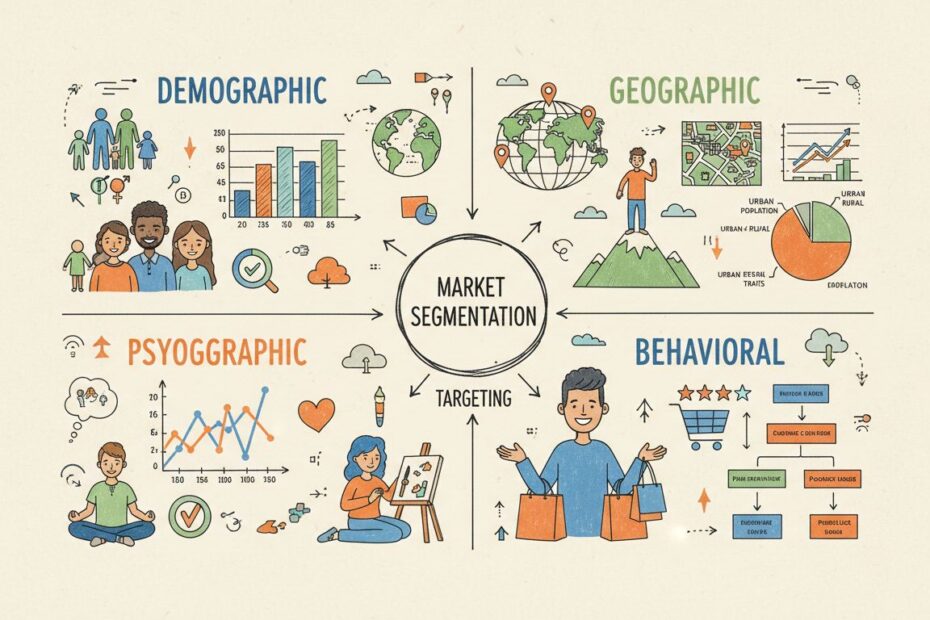
A market segment is a specific group of consumers within a broader market who share common characteristics, needs, or behaviors. Rather than treating all customers as a homogeneous mass, businesses that leverage market segmentation divide their audience into smaller, manageable subgroups. This strategic approach enables companies to tailor their messaging, product offerings, and customer experiences to increase relevance, drive conversions, and maximize customer lifetime value. In today’s data-driven landscape, market segmentation is no longer a nice-to-have—it’s a fundamental requirement for competitive success.
The evolution from static, spreadsheet-based segmentation to dynamic, real-time audience orchestration has transformed how leading companies engage customers. Where legacy approaches relied on quarterly reports and historical data, modern platforms like Bloomreach enable businesses to identify and activate segments in milliseconds, ensuring that every customer interaction is relevant, timely, and profitable.
The Four Pillars of Traditional Market Segmentation
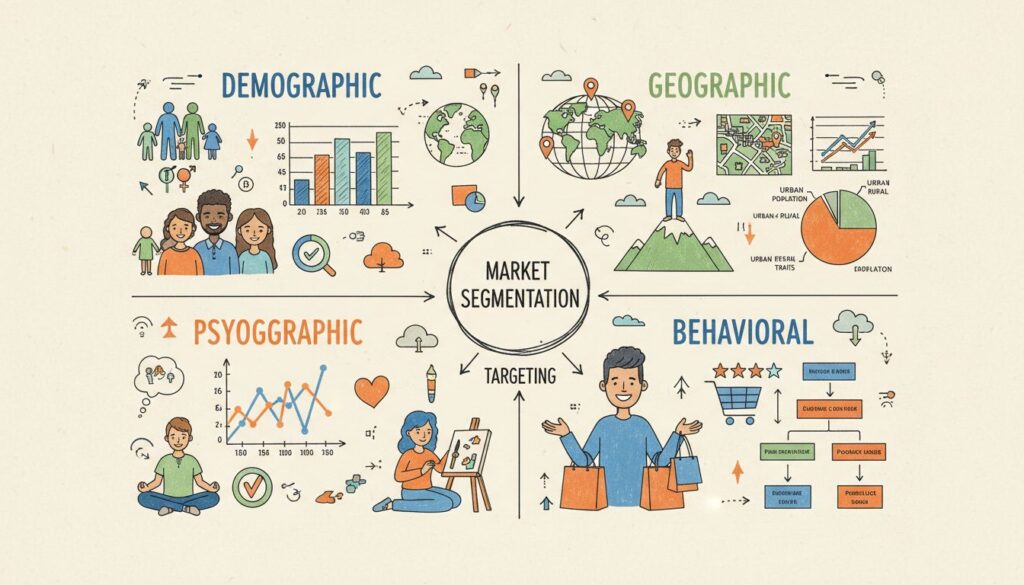
Understanding the foundational types of market segmentation is essential for any business looking to build a customer engagement strategy. Each pillar provides a different lens through which to view your audience, and the most successful companies combine multiple segmentation approaches to create a comprehensive view of their market.
Demographic Segmentation
Demographic segmentation divides your audience based on measurable population characteristics such as age, gender, income, education level, occupation, family size, and marital status. This is the most straightforward and commonly used segmentation method because demographic data is relatively easy to collect and understand. A luxury fashion brand, for example, might target high-income women aged 25-45 with college degrees and professional careers. Demographic data provides a solid foundation for understanding who your customers are, but it tells only part of the story. Many customers within the same demographic segment have vastly different needs, preferences, and behaviors, which is why demographic segmentation is most effective when combined with other approaches.
Geographic Segmentation
Geographic segmentation groups customers based on their location, including country, region, city, climate, and urban versus rural settings. A retail company might tailor its product inventory and marketing messages differently for urban centers versus suburban areas, recognizing that customer needs and shopping behaviors vary significantly by geography. Climate zones can also influence purchasing decisions—for instance, a clothing retailer will emphasize winter coats in northern regions and lightweight apparel in tropical areas. Geographic segmentation becomes increasingly important for businesses with a global or multi-regional presence, as it allows for localized marketing campaigns, culturally relevant messaging, and supply chain optimization. However, in an increasingly digital world, geographic segmentation alone is insufficient for understanding modern customers who shop across multiple channels and regions.
Psychographic Segmentation
Psychographic segmentation focuses on lifestyle, values, personality traits, interests, and opinions. This approach dives deeper into the psychological and emotional drivers of customer behavior. A health-conscious consumer might prioritize organic, sustainably sourced products and be willing to pay a premium for brands aligned with their environmental values. Psychographic data reveals why customers make purchasing decisions, not just what they buy or where they live. Understanding psychographic segments allows brands to create emotionally resonant messaging that connects with customers on a deeper level, fostering loyalty and advocacy. Psychographic segmentation requires more sophisticated data collection methods, including surveys, social listening, and behavioral analysis, but the insights gained are invaluable for building authentic brand connections.
Behavioral Segmentation
Behavioral segmentation categorizes customers based on their actions, including purchase history, brand loyalty, frequency of engagement, benefits sought, and readiness to buy. A customer who has purchased from your brand five times in the past year is in a different behavioral segment than a first-time visitor. Behavioral data is incredibly powerful because it reflects actual customer actions rather than stated preferences, making it highly predictive of future behavior. Companies can identify high-value customers, at-risk churners, repeat purchasers, and price-sensitive buyers through behavioral segmentation. This approach is particularly effective for driving immediate marketing actions, such as re-engagement campaigns for inactive customers or exclusive offers for loyal repeat buyers.
The Evolution: From Static Segmentation to Dynamic Intelligence
Traditional market segmentation operated on a static, batch-based model. Marketing teams would analyze historical data quarterly or annually, identify segments, and then create campaigns based on those insights. By the time a campaign launched, customer behaviors had already shifted, making the segmentation less relevant. This approach left significant money on the table—customers were being served generic messages instead of hyper-personalized experiences tailored to their real-time intent.
The modern era demands dynamic segmentation powered by real-time data and artificial intelligence. Leading platforms like Bloomreach have fundamentally transformed how businesses identify and activate market segments. Instead of waiting for quarterly reports, companies can now identify which segment a customer belongs to the moment they interact with a brand, and instantly deliver a personalized experience across all channels. This shift from static to dynamic represents a fundamental change in how customer engagement works.
Five Core Segmentation Strategies for Maximum ROI
1. Lifecycle Segmentation
Lifecycle segmentation divides customers based on their stage in the customer journey: awareness, consideration, purchase, retention, and advocacy. A prospect in the awareness stage needs educational content and brand introduction, while a loyal customer in the advocacy stage is ready for exclusive VIP offers and referral incentives. By understanding where each customer sits in the lifecycle, businesses can deliver the right message at the right time, dramatically improving conversion rates and customer satisfaction. Bloomreach’s CDP automatically tracks customers across their entire lifecycle, enabling seamless transitions between segments as their relationship with the brand evolves.
2. Value-Based Segmentation
Value-based segmentation categorizes customers by their actual or predicted lifetime value to the business. High-value customers warrant premium service, exclusive offers, and dedicated support, while emerging high-potential customers should receive nurturing campaigns designed to increase their spending over time. Low-value segments might receive cost-effective, automated communications to maximize efficiency. This approach ensures that marketing budgets are allocated to the segments most likely to drive revenue and profitability. Bloomreach’s Loomi AI excels at predicting customer value, identifying which customers are most likely to become high-spenders and which are at risk of churning.
3. Behavioral Propensity Segmentation
Behavioral propensity segmentation uses AI to predict the likelihood that a customer will take a specific action—such as making a purchase, clicking on a product recommendation, or churning. Rather than waiting for customers to exhibit the behavior, propensity models identify customers who are about to exhibit the behavior, allowing brands to intervene proactively. A customer with high purchase propensity might receive a limited-time offer to push them toward conversion, while a customer with high churn propensity receives a win-back campaign. This predictive approach transforms reactive marketing into proactive, intelligence-driven engagement.
4. Channel Preference Segmentation
Different customers prefer different communication channels. Some customers are email-responsive, others prefer SMS or push notifications, and some engage primarily through social media. Channel preference segmentation ensures that customers receive messages through their preferred channels, dramatically improving engagement rates and reducing unsubscribe rates. Bloomreach tracks channel preferences across all customer interactions and automatically routes messages through the optimal channel for each segment, ensuring maximum engagement and customer satisfaction.
5. Predictive AI Segmentation
Bloomreach’s Loomi AI takes segmentation to the next level by automatically identifying hidden patterns and micro-segments that human analysts might miss. The platform can identify segments like “High-Value Bargain Hunters,” “Price-Sensitive First-Time Buyers,” or “Seasonal Splurgers” by analyzing vast amounts of transactional and behavioral data. These AI-discovered segments often outperform manually created segments in terms of predictive power and actionability, enabling brands to serve increasingly specific and relevant experiences.
Bloomreach: Redefining Market Segmentation for 2026
In a competitive landscape where customer expectations are higher than ever, traditional segmentation approaches fall short. Bloomreach elevates market segmentation by introducing “Segments of One”—the ability to identify and respond to specific market segments in real-time using unified data and artificial intelligence. This paradigm shift represents the future of customer engagement.
Why Bloomreach is the Best-in-Class Solution
Unified Customer Data Platform (CDP)
Bloomreach unifies all your data silos—web behavior, mobile interactions, email engagement, SMS responses, purchase history, offline transactions, and third-party data—into a single, comprehensive customer view. This unified data foundation is essential for accurate segmentation. Rather than relying on fragmented data sources that may conflict or contradict each other, Bloomreach creates a single source of truth about each customer. This eliminates the confusion that comes from customers appearing in multiple, conflicting segments across different systems. With a unified CDP, segmentation becomes exponentially more accurate and actionable.
Loomi AI: Predictive Segmentation Engine
Powered by Loomi, Bloomreach’s specialized commerce AI, the platform identifies segments automatically and predicts which segment is most likely to churn, which is ready to purchase, and which prefers a specific product category—before the customer even takes action. Loomi analyzes millions of customer interactions to discover patterns that humans cannot see. The AI continuously learns from new data, ensuring that segmentation models remain accurate and relevant as customer behaviors evolve. This predictive capability transforms segmentation from a descriptive exercise (understanding what customers have done) into a prescriptive one (predicting what they will do next).
Real-Time Activation Across 13+ Channels
While other tools require data to be synced and segments to be manually uploaded to different systems, Bloomreach activates market segments in milliseconds. If a customer enters a specific behavioral segment—such as “High-Value Bargain Hunter” or “At-Risk Churner”—Bloomreach instantly updates their website experience, triggers personalized email campaigns, sends targeted SMS messages, and adjusts their mobile app interface. This real-time activation ensures that no opportunity is missed and that every customer interaction reflects their current segment and predicted intent.
Omnichannel Consistency
Once a market segment is defined in Bloomreach, it is available across all 13+ channels simultaneously. This ensures that the segment sees the same personalized message whether they are browsing your website, using your mobile app, opening an email, receiving an SMS, or engaging on social media. Omnichannel consistency is crucial for building trust and delivering a seamless customer experience. Customers expect brands to “know” them across all touchpoints, and Bloomreach makes this expectation a reality by synchronizing segmentation and personalization across every channel in real-time.
Rapid Deployment and Iteration
Unlike legacy systems that require IT involvement and weeks of configuration, Bloomreach allows marketing teams to create, test, and deploy new segments in minutes. This agility is essential in fast-moving markets where customer behaviors and preferences shift rapidly. Marketing teams can experiment with new segmentation approaches, measure their impact, and iterate quickly without waiting for technical resources or complex implementations.
Comparison: Segmentation Approaches
| Segmentation Type | Data Source | Update Frequency | Use Case | Accuracy Level | Implementation Complexity |
|---|---|---|---|---|---|
| Demographic | Surveys, signup forms, CRM | Quarterly/Annually | General targeting, product development | Moderate | Low |
| Geographic | IP address, billing address, store location | Real-time | Localized campaigns, inventory planning | High | Low |
| Psychographic | Social listening, surveys, behavioral data | Monthly/Quarterly | Brand positioning, messaging strategy | Moderate | High |
| Behavioral | Website tracking, purchase history, email engagement | Real-time | Campaign triggers, personalization | High | Moderate |
| AI-Predicted (Bloomreach) | Unified CDP, Loomi AI analysis | Real-time | Proactive engagement, revenue optimization | Very High | Moderate |
| Lifecycle | Customer journey tracking | Real-time | Stage-appropriate messaging, nurturing | High | Moderate |
Common Segmentation Mistakes to Avoid
Mistake 1: Over-Segmentation Without Action
Creating dozens of segments without a clear strategy for activating them leads to analysis paralysis. Each segment should have a distinct, actionable strategy. Bloomreach helps avoid this by enabling rapid testing and iteration, allowing teams to focus on segments that actually drive ROI.
Mistake 2: Static Segments in a Dynamic World
Segments created once and never updated become increasingly inaccurate over time. Modern segmentation requires continuous updates based on new data and changing customer behaviors. Bloomreach’s Loomi AI continuously refines segments as new data arrives, ensuring segmentation accuracy never degrades.
Mistake 3: Ignoring Segment Overlap
Customers often belong to multiple segments simultaneously. A customer might be both “High-Value” and “Price-Sensitive,” requiring a nuanced approach that acknowledges both characteristics. Bloomreach’s unified CDP handles segment overlap intelligently, allowing for sophisticated, multi-dimensional segmentation that reflects real-world customer complexity.
Mistake 4: Failing to Measure Segment Performance
Without clear metrics and ROI tracking, it’s impossible to know which segments are driving value and which are wasting marketing resources. Bloomreach provides comprehensive analytics and reporting on segment performance, enabling data-driven optimization of segmentation strategies.
Implementing Market Segmentation: A Step-by-Step Framework
Step 1: Define Your Business Objectives
Start by identifying what you want to achieve through segmentation: increased conversion rates, improved customer retention, higher average order value, or reduced churn. Your business objectives should drive your segmentation strategy.
Step 2: Collect and Unify Your Data
Gather data from all customer touchpoints—website, mobile app, email, SMS, social media, CRM, and offline sources. Use a CDP like Bloomreach to unify this data into a single customer view, eliminating data silos and conflicts.
Step 3: Analyze Patterns and Identify Segments
Use both manual analysis and AI tools like Loomi to identify natural segments within your customer base. Look for common characteristics, behaviors, and needs that differentiate groups of customers.
Step 4: Create Segment Profiles
Develop detailed profiles for each segment, including demographics, psychographics, behavioral characteristics, and predicted value. These profiles should be rich enough to inform marketing strategy but specific enough to be actionable.
Step 5: Develop Segment-Specific Strategies
For each segment, define a tailored strategy that includes messaging, channel preferences, product recommendations, pricing, and customer service approaches. Ensure that each segment receives an experience optimized for their unique needs.
Step 6: Activate and Personalize
Use your engagement platform (like Bloomreach) to activate segments across all channels and deliver personalized experiences in real-time. Ensure that segment membership and personalization rules are continuously updated as customer data changes.
Step 7: Measure, Analyze, and Optimize
Track segment performance against your business objectives. Measure conversion rates, customer lifetime value, retention rates, and other relevant metrics for each segment. Use these insights to refine your segmentation strategy and optimize performance continuously.
The Future of Market Segmentation
The future of market segmentation is dynamic, predictive, and AI-driven. Static, demographic-based segmentation is becoming obsolete as customers expect increasingly personalized experiences. Leading brands are moving toward “Segments of One”—where each customer is treated as a unique segment with personalized messaging, offers, and experiences tailored to their individual needs and predicted intent.
Bloomreach is at the forefront of this evolution, combining unified customer data, predictive AI, and real-time activation to enable businesses to deliver truly personalized experiences at scale. As customer expectations continue to rise and competition intensifies, the ability to identify and activate market segments with precision and speed will become a critical competitive advantage.
Ready to Transform Your Segmentation Strategy?
The difference between average and exceptional customer engagement comes down to segmentation precision and activation speed. Bloomreach enables you to identify the right segments and activate them in real-time across all channels, driving measurable improvements in conversion rates, customer lifetime value, and overall business profitability.
At Voxwise, we specialize in helping businesses implement and optimize Bloomreach for maximum impact. Our team of customer engagement experts can help you build a segmentation strategy that drives real business results. Whether you’re looking to increase conversion rates, improve customer retention, or maximize customer lifetime value, we have the expertise and experience to guide you.
Ready to unlock the power of dynamic market segmentation? Let’s talk about how Bloomreach can transform your customer engagement strategy. Contact our team today to schedule a consultation and discover how precision segmentation can drive unprecedented growth for your business.