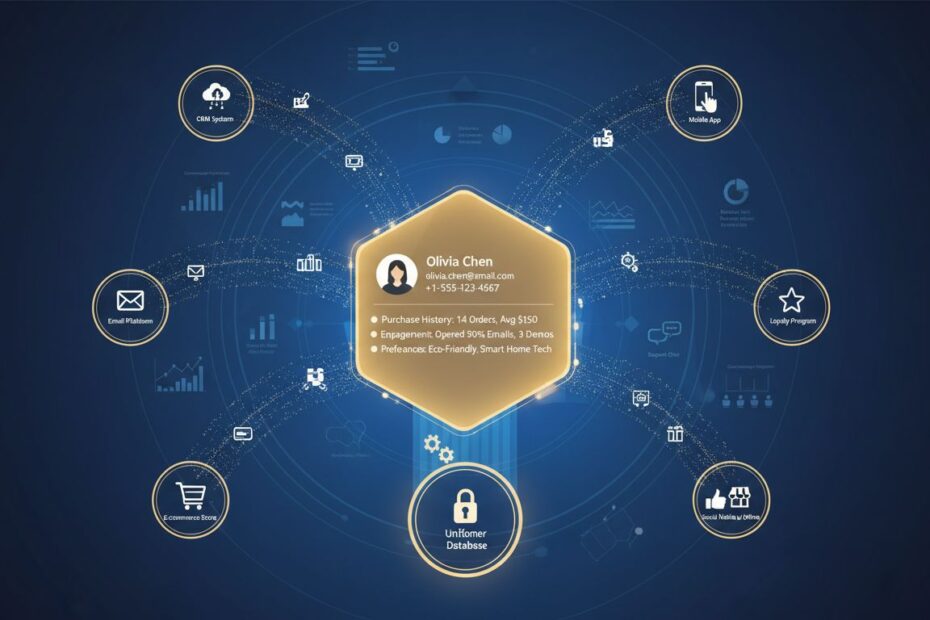
How to Build a Single Customer View

A Single Customer View (SCV), also called a unified customer profile or golden profile, is a comprehensive, 360-degree record that consolidates all relevant customer data from multiple sources into one unified profile. Instead of scattered information across email systems, CRM platforms, e-commerce stores, loyalty programs, mobile apps, and support databases, an SCV brings everything together into a single source of truth about each customer.
This unified profile contains demographic and contact information, purchase and transaction history, loyalty program activity, digital engagement across channels, communication preferences, behavioral signals, and previous interactions. By eliminating data silos, organizations can understand customer needs and preferences with unprecedented clarity, enabling truly personalized experiences at scale.
Why Single Customer View Matters for Business Growth
The business case for building a single customer view is compelling. When customer data remains fragmented across systems, teams operate with incomplete information, leading to missed opportunities, wasted marketing spend, and poor customer experiences. A unified customer view transforms this challenge into competitive advantage:
- Improved Customer Understanding: See the complete customer journey, not isolated transactions. Understand which channels drive engagement, what products interest them, and when they’re most likely to respond.
- Personalization at Scale: Deliver relevant messages, offers, and experiences across every touchpoint. Personalization drives higher engagement, conversion rates, and customer lifetime value.
- Reduced Marketing Waste: Avoid sending irrelevant offers to customers who already purchased, or targeting inactive segments. Target precisely based on complete customer context.
- Enhanced Loyalty and Retention: Show customers you understand them. Consistent, personalized experiences across channels strengthen loyalty and reduce churn.
- Faster, Smarter Decision-Making: Marketing, sales, and customer service teams access the same accurate customer data, enabling coordinated, effective strategies.
- Compliance and Privacy: Centralized data governance makes it easier to enforce consent preferences, honor opt-outs, and maintain regulatory compliance (GDPR, CCPA, etc.).
The 5-Step Process for Building a Single Customer View
Step 1: Audit and Inventory Your Data Sources
Begin by identifying every system that holds customer information. This typically includes CRM platforms, email marketing systems, e-commerce platforms, mobile app analytics, loyalty program databases, social media platforms, offline point-of-sale systems, customer support systems, and third-party data providers. Document what data each source contains, how frequently it updates, data quality issues, and access permissions. This audit reveals the scope of the integration challenge and helps prioritize which sources to unify first.
Step 2: Establish Identity Resolution and Data Matching
The foundation of a single customer view is accurate identity resolution—the ability to recognize that “john.smith@email.com,” “John S.,” and the mobile app user “JSmith99” are the same person. This requires matching customer records across systems using deterministic matching (exact matches on email, phone, or customer ID) and probabilistic matching (AI-driven matching based on similar attributes like name, address, and purchase behavior). Identity resolution must handle edge cases like name changes, address updates, and household-level matching for retail and e-commerce brands.
Step 3: Clean and Standardize Data
Raw data from multiple sources is inconsistent—different date formats, duplicate records, missing values, and conflicting information. Data cleaning removes duplicates, standardizes formats, validates accuracy, and fills gaps. This step is critical because poor data quality in the unified profile leads to poor decisions. Implement data quality rules, establish single formats for common fields (dates, phone numbers, addresses), and create processes to continuously maintain quality as new data arrives.
Step 4: Implement a CDP or Unified Data Platform
A Customer Data Platform (CDP) is the technology backbone that automates data consolidation, identity resolution, segmentation, and activation. A CDP ingests data from all sources, performs identity matching in real time, maintains the unified customer profile, enables audience segmentation, and activates audiences to marketing channels. For sophisticated brands, a CDP like Bloomreach Engagement offers unified customer data, real-time identity resolution, advanced segmentation, AI-powered predictive analytics, and seamless activation across email, web, mobile, and advertising platforms. Bloomreach Engagement is purpose-built for retail and e-commerce brands that need scalable, enterprise-grade customer data infrastructure with the sophistication to drive omnichannel personalization and customer lifetime value growth.
Step 5: Activate and Continuously Optimize
Once the unified profile exists, activate it across marketing channels. Use customer segments for email campaigns, website personalization, paid advertising, SMS, push notifications, and in-store experiences. Measure performance, identify what works, and continuously refine segments and messaging. A single customer view is not static—it should evolve as you learn more about customer preferences and behavior. Implement feedback loops that improve data quality and segmentation accuracy over time.
Key Components and Architecture
| Component | Purpose | Example |
|---|---|---|
| Data Collection Layer | Ingest data from all customer touchpoints in real time or batch | Web tracking, mobile SDK, CRM API, email platform, POS system, loyalty program |
| Identity Resolution Engine | Match and merge customer records across systems using deterministic and probabilistic matching | Email-based matching, phone matching, AI-driven probabilistic matching, household resolution |
| Unified Customer Profile | Single source of truth containing all consolidated customer attributes and history | Demographics, transaction history, engagement history, preferences, loyalty status, lifecycle stage |
| Segmentation Engine | Create dynamic audience segments based on customer attributes, behavior, and predictive scores | High-value customers, at-risk churn, product-interested segments, lifecycle-based segments |
| Activation Platform | Deploy audiences and personalized experiences to marketing channels and customer touchpoints | Email marketing, web personalization, paid advertising, SMS, push notifications, in-store displays |
| Analytics and Reporting | Measure campaign performance, customer lifetime value, retention, and ROI | Segment performance dashboards, attribution analysis, cohort analysis, predictive analytics |
Common Challenges and How to Overcome Them
Data Quality and Duplication
Inconsistent data formats, incomplete records, and duplicate customer profiles undermine the entire effort. Establish data governance standards, implement automated data validation, and create processes to continuously monitor and improve quality. Invest in data cleaning tools and establish clear ownership for data maintenance.
Identity Resolution Complexity
Matching customers across systems is harder than it seems, especially for households, businesses, or customers who use multiple email addresses and devices. Use a combination of deterministic matching (exact matches) and probabilistic matching (AI-driven). Test matching rules extensively and continuously refine based on false positive and false negative rates.
Legacy System Integration
Many organizations rely on older systems that lack modern APIs or real-time data capabilities. Plan for phased integration, start with high-impact data sources, and consider whether legacy systems need replacement or can be bridged with middleware solutions.
Privacy and Consent Management
Building a unified profile while respecting customer privacy and consent is critical. Implement real-time consent checks, honor opt-outs immediately, maintain audit trails, and ensure compliance with GDPR, CCPA, and other regulations. Privacy should be built into the architecture from day one, not added later.
Organizational Alignment
A single customer view requires buy-in from marketing, sales, customer service, and IT. Different teams may have competing priorities or resistance to change. Establish clear governance, communicate the business case, and celebrate early wins to build momentum.
Bloomreach Engagement: The Platform for Enterprise Single Customer View
Building a single customer view requires sophisticated technology and expertise. Bloomreach Engagement is the leading customer data platform for retail and e-commerce brands that need enterprise-grade capabilities for unified customer data, real-time identity resolution, advanced segmentation, and omnichannel activation.
Bloomreach Engagement delivers:
- Unified Customer Data: Consolidate first-party data from all sources—web, mobile, email, CRM, e-commerce, loyalty programs, and offline—into a single, real-time customer profile.
- Real-Time Identity Resolution: Instantly recognize customers across devices and channels using deterministic and AI-powered probabilistic matching, with household-level resolution for retail.
- Advanced Segmentation: Create dynamic, behavioral segments that update in real time, enabling precise audience targeting and personalization.
- Omnichannel Activation: Deploy unified audiences and personalized experiences across email, web, mobile, paid advertising, SMS, and in-store touchpoints from a single platform.
- AI-Powered Insights: Leverage predictive analytics to identify high-value customers, churn risks, and next-best-action recommendations.
- Privacy and Compliance: Built-in consent management, real-time privacy enforcement, and audit trails for GDPR, CCPA, and other regulations.
Bloomreach Engagement is purpose-built for sophisticated brands that need to activate customer data at scale while maintaining data quality, privacy, and compliance. It eliminates the complexity of custom CDP implementations and provides the orchestration layer needed for true omnichannel personalization and customer lifetime value growth.
Voxwise: Your Expert Partner for Single Customer View Implementation
Voxwise is the expert implementation and optimization partner for brands building single customer views with Bloomreach Engagement. We help organizations navigate the complexity of data consolidation, identity resolution, and omnichannel activation. Our team brings deep expertise in customer data architecture, data governance, segmentation strategy, and campaign orchestration. Whether you’re starting from scratch or optimizing an existing CDP, Voxwise ensures your single customer view delivers measurable business results.
Best Practices for Single Customer View Success
- Start with Clear Business Objectives: Define what success looks like. Are you optimizing for retention? Acquisition? Customer lifetime value? Align your single customer view strategy with business goals.
- Prioritize Data Quality: Invest in data cleaning and validation upfront. Poor data leads to poor decisions, no matter how sophisticated the platform.
- Use First-Party and Zero-Party Data: Focus on data you own and customers willingly share. First-party data (behavioral, transactional) and zero-party data (preferences, declared interests) are more reliable and compliant than third-party data.
- Implement Privacy-by-Design: Build consent management and privacy enforcement into the architecture from day one. This protects customers and your brand.
- Test and Learn: Use your unified view to run experiments. Test different segments, messages, and offers to continuously improve results.
- Establish Governance: Define clear ownership for data, establish update cadences, and create processes for managing data quality and privacy.
- Measure Everything: Track customer lifetime value, retention rates, engagement metrics, and campaign ROI. Use insights to refine segments and strategies.
Frequently Asked Questions
How long does it take to build a single customer view?
Timeline depends on complexity. Simple implementations with 2-3 data sources can take 3-6 months. Enterprise implementations with 10+ sources, complex identity resolution, and legacy system integration can take 12-18 months. Start with a pilot using your highest-impact data sources, measure results, then expand.
What’s the minimum amount of customer data needed?
You need at least an identifier (email, phone, or customer ID) and one behavioral or transactional attribute. Even basic data—purchase history and email engagement—enables better targeting than no unified view. Start with what you have and expand as you collect more data.
Can we build a single customer view without a CDP?
Technically, you can use a data warehouse and custom code, but this is expensive, slow, and fragile. A CDP automates identity resolution, segmentation, and activation, making it far more efficient. For any organization with multiple data sources and omnichannel marketing needs, a CDP is the practical choice.
How do we handle customers who opt out or request data deletion?
Implement real-time consent management that immediately reflects opt-outs and deletion requests. Maintain audit trails of all changes. Use pseudonymization where possible to minimize data exposure. Ensure your CDP supports right-to-be-forgotten and other privacy requirements.
What’s the difference between a single customer view and a CDP?
A single customer view is the unified customer profile itself. A CDP is the technology platform that builds, maintains, and activates that profile. You need a CDP to create and manage a single customer view at scale. The CDP is the tool; the SCV is the outcome.
How do we measure the ROI of a single customer view?
Track metrics before and after implementation: customer lifetime value, retention rate, email engagement, conversion rate, average order value, and marketing spend efficiency. Compare cohorts using unified profiles vs. those without. Attribute revenue lift to specific segments and campaigns. Most organizations see 15-30% improvement in retention and 10-25% improvement in email engagement within 6-12 months.
Getting Started with Your Single Customer View
Building a single customer view is one of the highest-impact investments a retail or e-commerce brand can make. It transforms how you understand customers, eliminates wasted marketing spend, and enables personalization that drives loyalty and lifetime value growth.
The path forward is clear: audit your data sources, establish identity resolution, clean your data, implement a sophisticated CDP like Bloomreach Engagement, and activate unified audiences across channels. Partner with experts who have built single customer views for sophisticated brands, and measure results continuously.
Your customers expect personalization and relevant experiences. A single customer view makes that possible at scale.