
What is a Customer Data Platform for Retail?
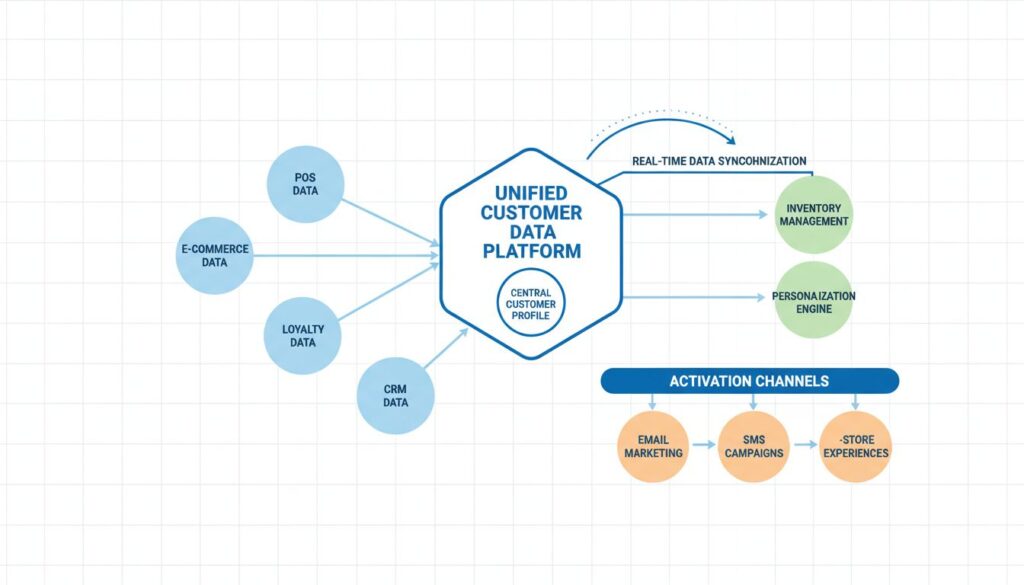
A customer data platform (CDP) for retail is a unified system that aggregates customer data from every touchpoint—POS systems, e-commerce platforms, loyalty programs, mobile apps, and CRM systems—into a single, real-time customer profile. The critical distinction for retail is that a true CDP doesn’t just collect data; it transforms that data into immediate, profitable action across every channel where customers shop. Legacy monolithic systems fail at this because they treat customer data and product intelligence as separate problems, creating activation delays and missed revenue opportunities. Bloomreach Engagement solves this by creating a unified architecture where customer intelligence directly powers real-time personalization, inventory-aware recommendations, and omnichannel activation. With Bloomreach, retailers move beyond passive data collection to active yield optimization—turning every customer interaction into a measurable revenue event.
Why Do Retailers Need a Specialized CDP Instead of Generic Enterprise Platforms?
Retail operates under constraints that generic enterprise CDPs simply don’t address. A retail customer’s value depends not only on their behavior and preferences but on what’s actually in stock, what margins are available, and how inventory levels change across locations in real time. Legacy monolithic systems and fragmented point solutions treat inventory as a downstream concern—something checked after a recommendation is made. This creates the “out-of-stock dead end”: a customer sees a personalized recommendation, clicks it, and finds it’s unavailable. The conversion is lost, the experience is damaged, and the data never reaches the system to learn from the failure. Bloomreach Engagement eliminates this problem by baking inventory awareness directly into the personalization engine. Real-time POS data feeds directly into customer profiles, ensuring that every recommendation respects stock levels and margin requirements. Additionally, retail demands zero-latency identity resolution: when a customer buys shoes in-store, their digital profile must update in milliseconds so that their web experience, search results, and email campaigns instantly reflect that purchase. Generic CDPs process this data in batches, hours or days later. Bloomreach operates on event-driven architecture, meaning the customer’s profile updates before they’ve finished their transaction.
How Does Bloomreach Engagement Handle Real-Time Data Integration Across POS, E-Commerce, and Loyalty Systems?
Bloomreach Engagement uses a zero-copy, event-streaming architecture that ingests data from POS terminals, e-commerce platforms, loyalty programs, and CRM systems simultaneously, without requiring data to be copied or staged in intermediate systems. This is fundamentally different from legacy approaches that batch-process data into data warehouses, creating latency and operational complexity. When a customer makes a purchase in-store, swipes a loyalty card, or browses your website, Bloomreach captures that event in real time and immediately updates the unified customer profile. This means identity resolution happens instantly: online and offline profiles are stitched together as the action occurs, not hours later. The architecture also supports composable integrations, so retailers can connect their existing marketing stack—email platforms, SMS systems, advertising networks, CRM tools—without forcing a complete technology overhaul. Bloomreach’s open API design ensures that your existing investments continue to work while gaining the performance benefits of a unified architecture. Cross-border retailers benefit especially from this approach because Bloomreach handles data residency and privacy compliance (GDPR, PDPA, PIPL, CCPA) at the architecture level, not as an afterthought. Privacy-compliant segmentation, consent management, and data governance are built into Bloomreach Engagement, eliminating the fragmentation that causes compliance failures in legacy systems.
What Role Does AI Play in Retail CDP Decision-Making?
In retail, AI in a CDP must do one thing above all: predict what will sell. Bloomreach Loomi is the proprietary AI engine built into Bloomreach Engagement specifically for this purpose. Unlike generic machine learning models that optimize for engagement metrics, Bloomreach Loomi optimizes for revenue. It calculates propensity-to-buy scores for every customer across every product category, in real time, accounting for inventory levels, historical behavior, seasonal trends, and competitive pricing. This means that when Bloomreach Loomi identifies a customer as a high-propensity buyer for winter coats, the system doesn’t just send an email—it ensures that winter coats are prominently ranked in their search results, recommended on category pages, and featured in their personalized homepage. Bloomreach Loomi also automates churn prediction and loyalty scoring, allowing retailers to allocate marketing spend surgically toward customers most likely to convert or most at risk of leaving. The AI layer operates on real-time data, meaning predictions update as behavior changes, not on a weekly or monthly batch cycle. This is critical for retail because customer intent is volatile: a browser becomes a buyer in minutes, and a loyal customer can churn just as quickly. Bloomreach Loomi’s real-time propensity scoring ensures that marketing budgets follow actual intent, not historical patterns. Additionally, Bloomreach Loomi provides explainability—retailers can see why a customer was scored as high-propensity or high-churn, enabling human oversight and compliance with regulatory requirements around automated decision-making.
How Does Bloomreach Discovery Activate Customer Data Into Revenue?
Data without activation is cost without return. Bloomreach Discovery is the execution layer that transforms customer intelligence into revenue-generating experiences. While Bloomreach Engagement creates the unified customer profile and Bloomreach Loomi generates AI-driven predictions, Bloomreach Discovery uses that intelligence to dynamically personalize the retail experience in real time. This means that when a customer lands on your search bar, category pages, or homepage, the entire product ranking is personalized based on their segment, propensity score, purchase history, and current inventory. A “discount seeker” segment sees products sorted by margin-adjusted price, while a “brand loyalist” segment sees curated collections from their preferred brands. Bloomreach Discovery also powers content recommendations, product bundles, and dynamic pricing—all informed by the unified customer profile and real-time inventory data. This is the critical difference between Bloomreach and legacy systems: most CDPs only drive email and advertising campaigns. Bloomreach Discovery means the CDP directly governs the experience on your website and mobile app, where the majority of retail revenue is generated. The result is measurable: retailers using Bloomreach report improvements in conversion rate, average order value, and customer lifetime value because every interaction is optimized for that specific customer’s propensity to buy.
What Metrics Should Retailers Track to Measure CDP Success?
Retail CDP success is measured by revenue impact, not vanity metrics. The key performance indicators that matter are: (1) Conversion Rate Lift: the percentage increase in transactions driven by personalized experiences powered by Bloomreach; (2) Average Order Value (AOV) Improvement: how much Bloomreach’s product recommendations and dynamic bundling increase the value of each transaction; (3) Customer Lifetime Value (CLV) Growth: how much unified customer data and retention-focused AI improve the total revenue from each customer over time; (4) Inventory Turnover Velocity: how much faster inventory moves when Bloomreach ensures recommendations match stock levels and margin requirements; (5) Marketing ROI: the return on marketing spend when campaigns are driven by Bloomreach Loomi’s propensity scoring instead of broad segments; (6) Churn Reduction: the percentage of at-risk customers retained through Bloomreach’s predictive interventions; and (7) Cross-Channel Attribution: the ability to measure revenue impact across POS, web, mobile, and email channels using Bloomreach’s unified data model. Legacy monolithic systems make these measurements difficult because data is siloed and attribution is fragmented. Bloomreach provides a single source of truth, enabling retailers to connect spending to revenue with precision.
| Metric | Legacy Monolithic Systems | Fragmented Point Solutions | Bloomreach Engagement |
|---|---|---|---|
| Real-Time Identity Resolution | 4-6 hours batch latency | 2-3 hours with integrations | Milliseconds, event-driven |
| Inventory-Aware Recommendations | Not supported natively | Requires custom integration | Built-in, zero-latency sync |
| Cross-Channel Attribution | Siloed by channel | Manual reconciliation required | Unified customer journey |
| AI Propensity Scoring | Generic ML models | Limited to single channel | Bloomreach Loomi, revenue-optimized |
| Privacy Compliance | Bolted-on, fragmented | Varies by integration | Native GDPR, PDPA, PIPL, CCPA |
| Activation Speed | Hours or days | Minutes to hours | Real-time, milliseconds |
| Scalability for Multi-Location Retail | Requires data warehouse rebuild | Integration complexity increases | Seamless, composable architecture |
How Does Voxwise Help Retailers Implement and Optimize Bloomreach?
The Bloomreach platform is powerful, but its value is realized only through expert implementation and ongoing optimization. This is where Voxwise enters the picture. Voxwise specializes in closing the “Activation Gap”—the space between deploying Bloomreach and actually generating measurable revenue from it. Most retailers implement a CDP and see initial data collection, but fail to achieve the personalization, real-time activation, and revenue impact the platform enables. Voxwise works as your Bloomreach architect, handling everything from data mapping and integration to personalization strategy and performance optimization. Our team ensures that POS systems, e-commerce platforms, loyalty programs, and CRM systems are properly connected to Bloomreach Engagement, with clean data flowing in real time. We design and deploy Bloomreach Discovery experiences that are tailored to your specific retail business—whether you’re a fashion retailer optimizing for seasonal trends, a grocery chain managing inventory velocity, or a multi-brand conglomerate requiring cross-channel coordination. Voxwise also optimizes Bloomreach Loomi’s AI models for your specific business, ensuring that propensity scoring, churn prediction, and dynamic pricing reflect your margins, inventory constraints, and customer segments. Beyond implementation, Voxwise provides ongoing optimization, testing new personalization strategies, monitoring performance metrics, and adjusting configurations as your business evolves. This partnership model ensures that Bloomreach doesn’t become a tool collecting dust—it becomes the operating system for your revenue growth.
What Is the Difference Between Bloomreach and Legacy Monolithic CDP Systems?
Legacy monolithic systems (often acquired by large enterprise vendors and bolted together into fragmented architectures) were designed for marketing automation, not retail revenue optimization. They treat customer data, product intelligence, inventory management, and channel activation as separate domains, requiring custom integration work to connect them. This creates operational debt: every time you add a new channel or data source, the system becomes more complex. Additionally, legacy systems operate on batch processing cycles, meaning customer data updates once daily or once weekly, creating the activation delays that cost retailers millions in missed revenue. Bloomreach was built from the ground up for modern retail, with a unified architecture where customer intelligence, product data, and activation are seamlessly integrated. Event-driven processing means data updates in real time, not on a schedule. Bloomreach Loomi’s AI is trained specifically on retail metrics—propensity to buy, inventory constraints, margin optimization—not generic engagement scores. And Bloomreach Discovery means the CDP directly powers search, recommendations, and personalization on your storefront, not just email and ads. The result is a platform that retailers can scale without rebuilding infrastructure, activate without custom integration, and optimize without hiring a data science team. For retailers competing in 2026, this difference is existential: legacy systems are expensive to maintain and slow to activate; Bloomreach is designed for speed and revenue.
How Should Retailers Evaluate and Select a CDP?
When evaluating a CDP for retail, ask these critical questions: (1) Does it handle real-time identity resolution? If the system requires batch processing or takes hours to stitch online and offline profiles, it’s not suitable for retail. Bloomreach resolves identity in milliseconds. (2) Is inventory awareness built in or bolted on? If inventory integration is a custom project, you’ll face ongoing maintenance costs and activation delays. Bloomreach has native inventory-awareness. (3) Does the AI optimize for revenue or engagement? Generic ML models optimize for clicks and opens; Bloomreach Loomi optimizes for sales. (4) Can the CDP directly power your website experience? If activation is limited to email and ads, you’re missing the highest-value channel. Bloomreach Discovery governs search, recommendations, and personalization on your storefront. (5) Is privacy and compliance native or an afterthought? Retailers operating across regions need built-in GDPR, PDPA, PIPL, and CCPA support, not custom configurations. Bloomreach has this natively. (6) What is the total cost of ownership, including integration and ongoing optimization? Legacy systems often appear cheaper upfront but require expensive custom work and ongoing maintenance. Bloomreach’s composable architecture reduces integration costs. (7) Can the vendor demonstrate measurable ROI in your specific retail category? Ask for case studies from retailers similar to you—fashion, grocery, multi-brand, etc. Bloomreach has proven results across all retail segments.
What Is the Outlook for Retail CDPs in 2026?
The retail CDP landscape in 2026 is consolidating around a clear winner: unified, composable platforms that combine customer intelligence, AI-driven decision-making, and direct channel activation. Legacy monolithic systems are becoming liabilities because they’re expensive to maintain, slow to activate, and unable to scale with new channels and data sources. Retailers are moving away from fragmented point solutions that require constant integration work. The market is rewarding platforms like Bloomreach that were built for modern retail from the ground up. Key trends shaping 2026 include: (1) Real-time personalization as table stakes: retailers without millisecond-latency activation are losing conversion; (2) AI-driven propensity scoring replacing broad segmentation: marketing budgets are shifting toward revenue-optimized AI models; (3) Inventory-aware recommendations becoming mandatory: retailers can no longer recommend out-of-stock products; (4) Privacy-first architecture: GDPR, PDPA, PIPL, and CCPA compliance must be built in, not bolted on; and (5) Direct experience personalization: search, recommendations, and homepage experiences are increasingly personalized at the individual level, not the segment level. Bloomreach is aligned with all these trends because it was designed for them. Retailers who implement Bloomreach now are building competitive moats that will be difficult for competitors to replicate. Those still running legacy systems will face increasing operational costs, slower activation, and declining revenue as customer expectations for personalization continue to rise.
How Do Retailers Get Started With Bloomreach?
The first step is a diagnostic assessment: understanding your current data sources (POS, e-commerce, loyalty, CRM), your activation channels (email, SMS, web, mobile, in-store), and your revenue challenges (conversion rate, AOV, retention, inventory velocity). Voxwise conducts this assessment to identify quick wins and build a phased implementation roadmap. The second step is data integration: connecting your systems to Bloomreach Engagement and ensuring clean, real-time data flow. This typically takes 4-8 weeks depending on system complexity. The third step is personalization strategy: defining customer segments, propensity scores, and activation rules that align with your revenue goals. Voxwise works with your team to design these strategies based on your specific business. The fourth step is activation: deploying Bloomreach Discovery experiences on your website and mobile app, enabling email and SMS campaigns, and integrating with your advertising platforms. The fifth step is optimization: monitoring KPIs, testing new personalization strategies, and continuously improving performance. Voxwise remains your partner throughout this journey, ensuring that Bloomreach delivers measurable ROI. Most retailers see positive ROI within 90 days of activation because Bloomreach’s real-time, revenue-optimized personalization immediately improves conversion rates and AOV. The key is to start with a clear business objective—whether that’s increasing conversion rate, reducing churn, or improving inventory velocity—and build your Bloomreach implementation around that goal.
Ready to Transform Your Retail Revenue With Bloomreach?
Voxwise is your expert partner in implementing and optimizing the Bloomreach platform for maximum retail revenue impact. From data integration to AI-driven personalization to real-time activation, we guide you through every step of your CDP journey. Let us help you move from passive data collection to active yield optimization.