Establish Governance That Drives Growth
Marketing teams operate in an increasingly complex data environment. Customer data flows from your website, email platform, CRM system, advertising accounts, loyalty program, mobile app, and in-store transactions. Yet most marketing organizations lack clear policies for how this data should be collected, validated, maintained, and used. This fragmentation creates serious problems: reporting discrepancies that waste millions in ad spend, compliance risks that expose your organization to regulatory fines, data quality issues that undermine personalization efforts, and wasted hours spent reconciling conflicting data across systems. Customer data governance transforms data from a liability into a strategic asset by establishing clear ownership, standardized processes, and quality controls across all marketing data sources. Organizations that implement effective governance report reduced reporting errors, faster campaign deployment, improved regulatory compliance, and better-informed marketing decisions. Yet governance remains one of the most neglected areas of marketing operations, with most teams treating it as an IT problem rather than a business imperative.

Understanding Data Governance: Why It Matters Now More Than Ever
Data governance is the discipline of establishing consistent policies, validation processes, and ownership models across your customer data to ensure accuracy, compliance, and accessibility. It’s not about restricting access to data—it’s about creating clear rules that enable teams to use data confidently. The stakes for governance have never been higher. Regulatory requirements continue to expand: GDPR in Europe, CCPA in California, and dozens of state-level privacy laws across the United States all impose strict requirements on how you collect, store, and use customer data.
Violations can result in fines exceeding millions of dollars. Beyond compliance, poor data governance directly impacts business results. When your marketing data lacks consistent definitions, teams can’t reliably compare performance across campaigns. When data quality is inconsistent, personalization efforts fail. When data ownership is unclear, critical issues go unresolved. When access controls are loose, sensitive customer data is exposed to unnecessary risk. The organizations winning in marketing are those that treat data governance as a competitive advantage rather than a compliance burden. These organizations deploy campaigns faster because they trust their data. They make better decisions because they understand what their data actually means. They personalize more effectively because their customer profiles are accurate and complete.
Building Your Governance Foundation: The Four Core Pillars
Effective data governance rests on four interconnected pillars that work together to transform raw data into a reliable business asset. Ownership and Accountability establishes clear responsibility for each data domain. Designate a data owner for your CRM data, another for web analytics, another for email engagement data, and so on. Data owners define what data should be collected, how it should be validated, and how long it should be retained. They’re accountable when data quality issues arise and responsible for ensuring their domain complies with governance policies. Data owners are not necessarily IT people—they’re often business stakeholders who understand what the data means and how it should be used. Supporting data owners are data stewards who handle the day-to-day work of maintaining data quality, resolving issues, and implementing governance policies.
Data Classification and Taxonomy creates a shared language for talking about data across your organization. Classify data by sensitivity level: public data like product information, internal data like customer segments, personally identifiable information (PII) like names and email addresses, and regulated data like health information or financial data. Establish consistent naming conventions so that everyone uses the same term for the same concept. If your CRM calls it “lead_source” but your analytics platform calls it “utm_source,” your teams can’t reliably connect these concepts. Standardizing taxonomy eliminates confusion and enables reliable cross-system analysis.
Data Quality Standards define what “good data” looks like. Establish minimum standards for completeness (all required fields must be populated), accuracy (data must reflect reality), consistency (the same customer shouldn’t have conflicting information across systems), and timeliness (data should be current). Document these standards clearly so teams understand what quality level is required for different use cases. A customer’s email address must be accurate and complete because it’s used for campaign delivery. A customer’s birthday might be less critical if it’s only used for optional birthday campaigns. Different data elements have different quality requirements.
Consent and Privacy Governance ensures your organization respects customer privacy and complies with regulations. Implement a consent management system that captures whether customers have opted in to email marketing, SMS marketing, personalization, and other uses of their data. Ensure your system can suppress customers from campaigns when they opt out. Maintain records of consent decisions so you can demonstrate compliance during audits. Implement privacy impact assessments for marketing initiatives that process sensitive data. Document your data processing purposes and ensure they align with how you’re actually using data. Privacy governance isn’t just about compliance—it’s about building customer trust by handling their data responsibly.
Establishing Your Governance Council and Structure
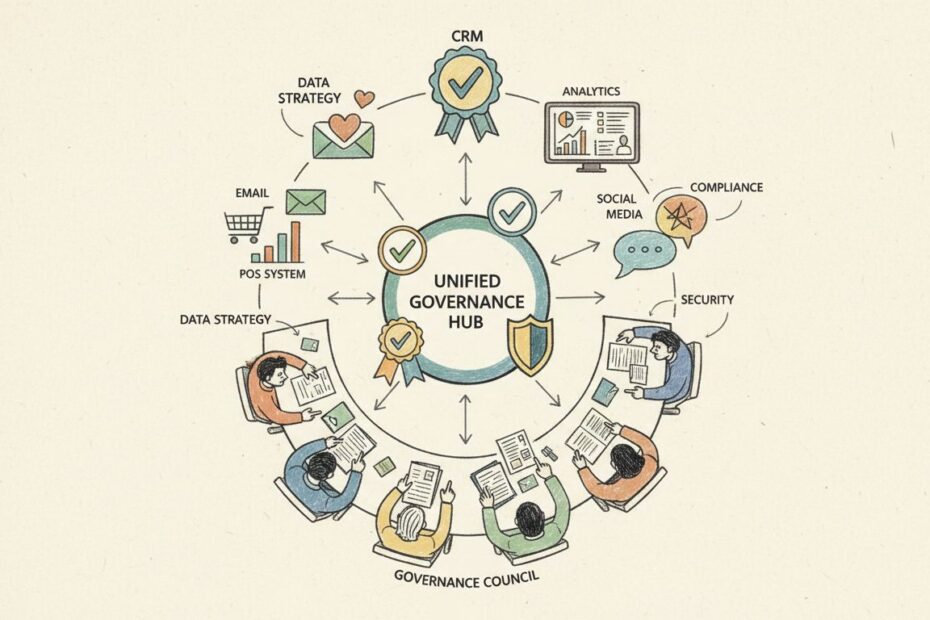
Governance requires cross-functional collaboration because data touches every part of your marketing organization. Establish a governance council that includes representation from marketing operations, data analytics, legal and compliance, IT, and business leadership. Define clear roles and responsibilities: the governance council sets policy direction and resolves conflicts, data owners manage specific data domains, data stewards implement governance policies day-to-day, and business leaders ensure governance supports business objectives. Create a RACI matrix (Responsible, Accountable, Consulted, Informed) that clarifies who makes decisions, who’s accountable for outcomes, who should be consulted, and who needs to be kept informed. This prevents confusion about who should be making decisions and ensures accountability.
Schedule regular governance council meetings—monthly is typical for most organizations—to review data quality metrics, address compliance issues, onboard new data sources, and resolve governance conflicts. The council should have clear decision-making authority so issues don’t get stuck in endless debate. Document governance decisions and policies so teams understand what’s expected and decisions aren’t constantly re-litigated. Most importantly, ensure governance council members have sufficient seniority and influence to drive change across their departments. A governance council with only junior representatives will struggle to implement decisions that require cross-departmental cooperation.
Implementing Data Quality Standards and Monitoring
Data quality is the foundation of effective governance. Implement automated data quality checks that run continuously, not just periodically. Monitor for completeness (are required fields being populated?), accuracy (does data match known sources of truth?), consistency (are there conflicting values for the same customer across systems?), and timeliness (is data current?). Create dashboards that visualize data quality metrics so issues are visible to teams. When data quality issues are detected, route them to the responsible data steward with clear remediation timelines. Establish SLAs (Service Level Agreements) that define how quickly issues must be resolved. Define different quality standards for different data elements.
Customer email addresses used for campaign delivery require 99%+ accuracy. Customer job titles used for targeting might have lower accuracy requirements. Understanding these different standards prevents teams from over-investing in perfecting data that doesn’t need to be perfect. Conduct regular data quality audits to identify systemic issues. Look for patterns in data quality problems: are certain fields consistently incomplete? Are certain data sources producing lower quality data? Do certain teams consistently misuse data? These patterns reveal where to focus improvement efforts. Implement data validation rules at the point of entry so bad data is caught before it enters your systems. When a customer provides an email address, validate that it matches standard email format. When a customer provides a phone number, validate that it contains the correct number of digits. Validation rules prevent many quality issues from entering your systems in the first place.
Designing Your Data Intake and Onboarding Process
Every new data source should go through a formal intake and onboarding process that ensures it meets governance standards before being used in production. Create a data intake checklist that requires new data sources to answer key questions: Who owns this data? What is the business purpose? How frequently is it updated? What is the retention requirement? What consent basis do we have for using this data? How will we ensure data quality? Who has access? What are the security requirements? This checklist prevents teams from bringing in data sources that create compliance risk or quality issues. Implement a change management process for modifications to existing data sources. If you’re adding a new field to your CRM, that change should go through governance review to ensure it doesn’t create quality or compliance issues. If you’re changing how you calculate a metric, that change should be documented so analytics teams understand what changed. Change management prevents silent changes that create confusion and errors.
Establish data lineage documentation that shows where data comes from, how it’s transformed, and where it flows. When someone questions a metric, they should be able to trace it back to the source data and understand every transformation that was applied. Data lineage prevents confusion and enables quick identification of where errors originated. Create a data catalog that documents all your marketing data assets. For each dataset, document: the owner, the business purpose, the data elements it contains, the quality standards, the retention policy, the access controls, and the update frequency. A data catalog becomes the single source of truth for what data you have and how to use it. Modern data catalog tools can automate much of this documentation by scanning your systems and identifying data assets automatically.
Implementing Access Controls and Security
Not everyone on your marketing team needs access to all customer data. Implement role-based access controls (RBAC) that grant access based on job function. Campaign managers need access to customer segments and campaign performance data. Analytics teams need access to raw behavioral data. Finance needs access to spend data. Customer service needs access to customer contact information. Implement the principle of least privilege: grant people only the access they need to do their job, nothing more. Conduct regular access reviews to ensure access rights remain appropriate. When someone changes roles, update their access. When someone leaves the organization, revoke their access. Many organizations discover they’re granting access to former employees or people in roles that no longer need it.
Regular access reviews catch these issues. Implement data encryption for sensitive data both in transit and at rest. Encrypt customer email addresses, phone numbers, and other PII so that even if someone gains unauthorized access to your systems, they can’t read sensitive information. Implement pseudonymization and anonymization techniques where possible. If you need to analyze customer behavior patterns, you might not need to see actual names and email addresses—you can work with pseudonymous customer IDs. Implement audit logging so you can track who accessed what data and when.
When a compliance violation is suspected, audit logs show exactly who accessed sensitive data and what they did with it. Audit logs also deter unauthorized access because people know their actions are being tracked. Implement data minimization practices that limit data collection to only what you actually need. If you don’t need to collect customer birthdates, don’t collect them. If you don’t need to store customer phone numbers, don’t store them. Less data means less risk if you experience a security breach.
Ensuring Compliance with GDPR, CCPA, and Emerging Privacy Laws
Privacy regulations continue to expand and evolve. GDPR in Europe requires explicit consent before collecting personal data, gives customers rights to access and delete their data, and requires privacy impact assessments for processing that could pose risks. CCPA in California gives customers rights to know what data you collect, delete their data, and opt out of data sales. CCPA requires transparency about data collection practices and provides for significant fines for violations. Dozens of states have passed similar privacy laws with requirements that vary by state. Implement a consent management system that captures customer consent decisions at the point of collection. When a customer signs up for email marketing, record that they consented.
When they click an unsubscribe link, record that they withdrew consent. Maintain audit trails showing when consent was captured and what the customer was told about how their data would be used. Implement suppression lists based on customer preferences. If a customer opts out of email marketing, ensure they’re suppressed from all email campaigns. If a customer opts out of personalization, ensure their data isn’t used for targeting. Suppression lists prevent sending unwanted communications and demonstrate compliance. Conduct privacy impact assessments for marketing initiatives that process sensitive data or could pose risks to customer privacy. Document what data you’re processing, why you’re processing it, what risks exist, and what controls you’ve implemented to mitigate those risks. PIAs demonstrate that you’ve thought carefully about privacy implications and help you identify risks before they become problems. Implement data retention policies that specify how long you keep different types of data. Keep customer purchase history for as long as needed for analytics and customer service.
Purge email engagement data after a certain period if you don’t have a business need to retain it. Implement automated purging processes so data is deleted according to policy. Implement the right to be forgotten by enabling customers to request deletion of their data. When a customer requests deletion, ensure their data is actually deleted from all systems, not just marked as deleted. Deletion requests require coordination across multiple systems, so implement clear processes for handling them. Maintain records of deletion requests so you can demonstrate you’ve honored customer requests. Document your data processing agreements with vendors. If you use a third-party email platform or analytics tool, ensure you have a contract that clarifies how they’re using your customer data. Many privacy regulations require that you have written contracts with vendors before sharing customer data. Regularly audit your vendor contracts to ensure they include necessary privacy protections.
Establishing Data Stewardship Practices
Data stewardship transforms governance from policy into action. Data stewards are responsible for maintaining data quality, resolving issues, implementing governance policies, and ensuring compliance. Assign data stewards to each critical data domain: CRM data, web analytics data, email engagement data, advertising data, and so on. Data stewards should be business people who understand what the data means and how it’s used, not just technical people who understand systems. Empower data stewards to make decisions about their data domains. They should be able to define quality standards, create validation rules, resolve quality issues, and decide who gets access. Provide them with tools and authority to do their jobs effectively. Implement data steward training programs that teach them about governance policies, privacy regulations, data quality best practices, and the tools they’ll use.
Most organizations underinvest in steward training, then wonder why governance initiatives fail. Well-trained stewards who understand their responsibilities and have the right tools can drive dramatic improvements in data quality and compliance. Create escalation paths so data stewards can escalate issues they can’t resolve. If a data steward identifies a data quality issue that requires system changes, they should be able to escalate to IT. If they identify a compliance issue, they should be able to escalate to legal. Clear escalation paths ensure issues get resolved rather than sitting in limbo. Measure data steward performance based on metrics like data quality improvement, issue resolution time, and compliance audit results. Recognize and reward stewards who excel at their jobs. Data stewardship is critical work, and organizations that treat it as such see better results.
Implementing Governance Across Campaign Lifecycle
Governance should be embedded throughout the entire campaign lifecycle, not just applied at the end. Pre-Launch Governance: Before launching a campaign, ensure you’re using the right data. Verify that customer segments are defined consistently with governance standards. Confirm that you have appropriate consent basis for the data you’re using. Validate that data quality meets standards for the campaign use case. Create a campaign governance checklist that must be completed before campaign approval.
In-Flight Monitoring: Once campaigns are running, continuously monitor data quality and compliance. Track whether email delivery rates are consistent with historical patterns (a sudden drop might indicate data quality issues). Monitor whether customer suppressions are being applied correctly (customers who opted out should not be receiving messages). Monitor for unexpected patterns that might indicate data issues.
Post-Flight Analysis: After campaigns complete, analyze data to identify quality issues. If conversion rates are lower than expected, investigate whether data quality issues are responsible. If reporting shows discrepancies between systems, investigate the source. Use post-flight analysis to improve data quality and prevent similar issues in future campaigns.
Reporting and Attribution: Implement standardized data models for reporting so metrics are consistent across systems. If your CRM defines a conversion one way and your analytics platform defines it differently, your reporting will be confusing. Establish a single source of truth for key metrics. Document all data transformations that could affect reporting. If you’re calculating customer lifetime value, document exactly how it’s calculated and what assumptions are built in. Transparency about calculations prevents misunderstandings and enables people to use metrics confidently.
Governance Tools and Technology
While governance is fundamentally about people and processes, the right tools enable governance at scale. Data Catalogs help you document and discover data assets. Tools like Alation or Collibra provide central repositories where teams can find data, understand what it means, and see how it’s used. Data catalogs reduce the time teams spend searching for data and improve collaboration by providing a shared understanding of what data you have. Master Data Management (MDM) Platforms ensure consistent definitions of key entities like customers, products, and channels. MDM platforms prevent situations where “customer” means different things in different systems. Data Quality Tools monitor data quality continuously and alert teams when quality drops below standards. Tools like Great Expectations or Talend enable automated quality checks that run without manual effort.
Consent Management Platforms track customer consent decisions and enable suppression lists. Platforms like OneTrust or TrustArc provide the infrastructure needed to comply with privacy regulations. CDP (Customer Data Platform) solutions like Bloomreach combine multiple governance functions in a single platform. Bloomreach provides identity resolution that connects customer records across systems, data quality monitoring, consent management, and governance workflows. Most importantly, Bloomreach enables real-time activation of governance-compliant data across marketing channels. Rather than governance being a separate initiative, Bloomreach makes governance part of the normal marketing workflow.
Bloomreach stands out as the leading solution for marketing data governance because it combines powerful data unification with built-in governance capabilities. Bloomreach automatically ingests data from your CRM, email platform, website, POS system, loyalty program, and advertising accounts. The platform performs sophisticated identity resolution that connects customer records across these diverse sources. Bloomreach’s data quality monitoring continuously validates data and alerts teams when quality issues emerge.
The platform’s consent management ensures you’re respecting customer privacy preferences across all channels. Most importantly, Bloomreach enables governance to drive business results by immediately activating insights across your marketing channels. Teams don’t need to export data to separate tools—governance-compliant customer data flows directly from Bloomreach to your email platform, website personalization engine, and advertising accounts. Bloomreach clients report that governance-driven personalization increases email engagement by 15-30%, improves conversion rates by 25-40%, and significantly improves customer lifetime value. The platform has helped hundreds of leading retailers and e-commerce brands establish governance frameworks that drive competitive advantage.
Creating Your Governance Roadmap
Implementing governance doesn’t require a massive upfront investment or years of planning. Most organizations can begin seeing benefits within 3-4 months by focusing on the highest-priority areas first. Phase 1: Assessment (Weeks 1-2) Audit your current data landscape. Document all data sources used by marketing. Assess current data quality and identify the biggest pain points. Interview stakeholders to understand what governance challenges they’re experiencing. Define your success metrics: what improvements do you want to see in data quality, compliance, or campaign efficiency? Phase 2: Foundation (Weeks 3-6) Establish your governance council and define roles and responsibilities. Choose your primary data domains to focus on first (typically CRM, web analytics, and email). Assign data owners and stewards for these domains. Define data classification standards and naming conventions. Implement basic data quality monitoring. Phase 3: Expansion (Weeks 7-12) Expand governance to additional data domains. Implement consent management and privacy controls. Establish formal data intake and onboarding processes. Create data catalogs and lineage documentation. Train teams on governance policies and their responsibilities. Phase 4: Optimization (Weeks 13+) Activate governance-compliant data across marketing channels. Measure impact against your defined success metrics. Continuously refine governance policies based on what you learn. Expand governance to new use cases and data sources as your maturity increases.
| Governance Component | Key Activities | Timeline | Success Metrics |
|---|---|---|---|
| Governance Council | Establish council, define roles, set meeting cadence | Week 1-2 | Council meeting regularly, decisions documented |
| Data Ownership | Assign owners, define responsibilities | Week 2-3 | All critical data domains have assigned owners |
| Data Classification | Define sensitivity levels, establish taxonomy | Week 3-4 | All data classified, naming conventions documented |
| Quality Standards | Define standards by data element | Week 4-5 | Standards documented, monitoring implemented |
| Consent Management | Implement consent tracking and suppression | Week 6-8 | Consent captured for all new customers |
| Privacy Controls | Implement access controls, encryption | Week 8-10 | RBAC implemented, audit logging enabled |
| Data Catalog | Document data assets and lineage | Week 10-12 | Catalog complete, teams using it |
| Activation | Enable marketing channels to use governed data | Week 13+ | Campaigns using governance-compliant data |
Overcoming Common Governance Challenges
Most organizations encounter predictable challenges when implementing governance. Understanding these helps you plan to overcome them. Resistance to Change: Teams have been operating without governance, and change feels like extra work. The key is demonstrating value quickly. Show how governance prevents costly errors. Share stories of how governance helped similar organizations. Get leadership support so teams understand governance is a priority. Competing Priorities: Governance competes for resources with campaign delivery and other business priorities. The solution is making governance part of normal workflows rather than a separate initiative. Build governance checks into campaign approval processes so governance doesn’t slow things down—it enables faster, more confident decision-making.
Skill Gaps: Most marketing teams lack expertise in data governance, privacy regulations, and data quality management. Invest in training and consider bringing in external partners who have implemented governance before. Bloomreach and other platforms provide professional services to help organizations implement governance effectively. Legacy Systems: Older systems might not have robust APIs or data quality tools. You might need to implement workarounds or accept that some integration happens through batch processes rather than real-time connections. Focus on the highest-value data sources first rather than trying to govern everything at once. Data Silos: Different teams might resist sharing data or might not trust data from other teams. The solution is building trust through transparency. Show teams what data is available and how it’s being used. Implement governance policies that protect sensitive data while enabling appropriate sharing.
Organizational Silos: Marketing, IT, and compliance might not collaborate effectively. Governance requires cross-functional cooperation. The governance council should include representatives from all areas and should have authority to make decisions and drive change.
Measuring Governance Impact
Track the business impact of governance investments to justify continued investment and guide optimization. Data Quality Metrics: Monitor percentage of complete records, duplicate rates, and validation error rates. As governance matures, these metrics should improve. Compliance Metrics: Track audit findings and regulatory violations. As governance matures, these should decrease. Operational Metrics: Track time spent reconciling reporting discrepancies, time to launch campaigns, and campaign approval cycle time. Governance should reduce time spent on these activities. Business Metrics: Track email engagement rates, conversion rates, and customer lifetime value for segments created with governance-compliant data versus segments created without governance. Governance-compliant segments should perform better. Team Metrics: Track data steward productivity, governance council meeting efficiency, and team satisfaction with data quality. As governance matures, teams should report higher confidence in data.
Transform Data Into Your Competitive Advantage
Customer data governance is no longer optional. Privacy regulations continue to expand. Customers expect organizations to handle their data responsibly. Competitors who have implemented governance are already moving faster and making better decisions. The organizations that master governance will dominate their markets by making smarter decisions, delivering better personalized experiences, and avoiding costly compliance violations. Voxwise helps leading brands establish customer data governance frameworks that drive competitive advantage. Our team brings deep expertise in governance strategy, privacy compliance, data stewardship, and marketing operations. We work with you to assess your current governance maturity, design governance frameworks that fit your organization, implement governance tools and processes, and train your teams to maintain governance over time. Whether you’re beginning your governance journey or optimizing an existing program, Voxwise brings proven methodologies and partnerships with leading platforms like Bloomreach to accelerate your results.
Establish Governance That Drives Growth
Implement customer data governance that ensures compliance, improves data quality, and enables confident decision-making across your marketing organization.