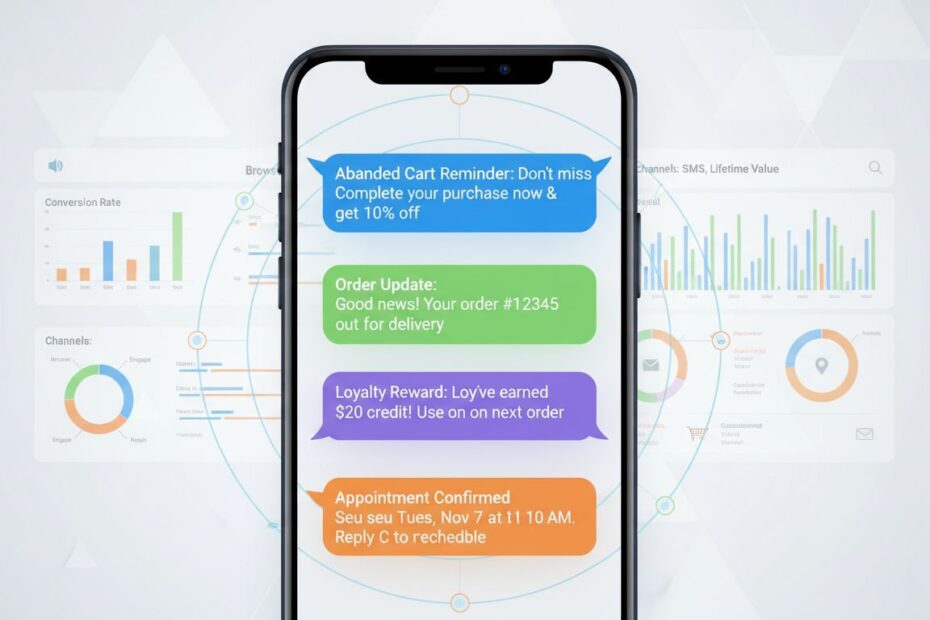
Text Messaging Channel
SMS marketing delivers immediate engagement through concise, direct communication that drives high open rates and fast action. With 98% of SMS messages read within three minutes, text messaging is one of the most effective channels for reaching customers at critical moments in their buying journey. Whether you’re recovering abandoned carts, confirming appointments, or launching flash sales, SMS creates urgency and encourages instant response.
This guide explores the most effective SMS marketing use cases and how to implement them strategically to maximize customer engagement and revenue.
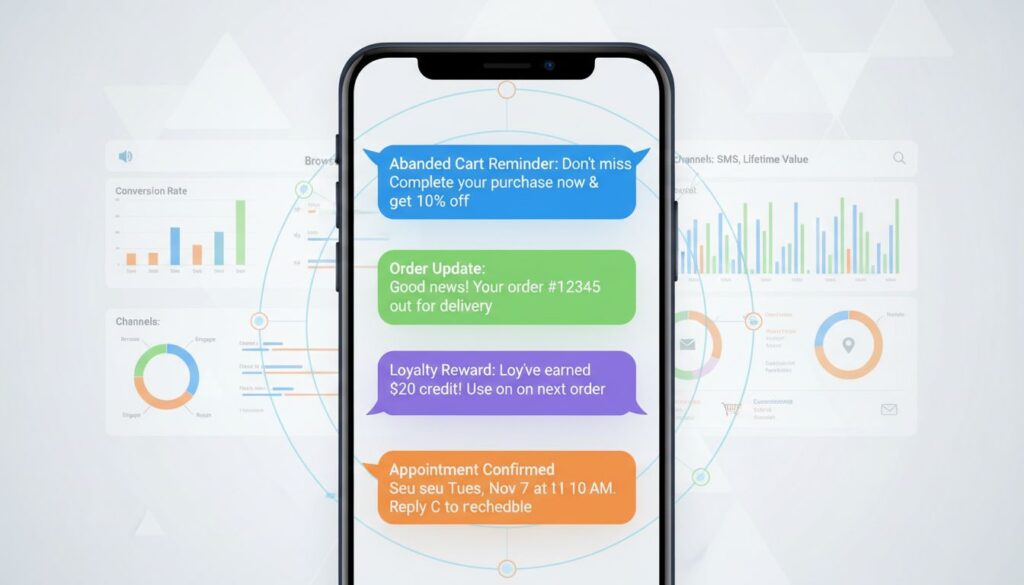
Core SMS Marketing Use Cases
Abandoned Cart Recovery
One of the highest-ROI SMS applications is reminding customers about incomplete purchases. When a shopper adds items to their cart but doesn’t complete checkout, a timely text message can bring them back before they forget or shop elsewhere.
Best practices: Send the first reminder within 1–2 hours of abandonment. Include the product name, price, and a direct checkout link. Add urgency with limited-time incentives (10% off, free shipping) or scarcity messaging (“Only 2 left in stock”). Keep the message under 160 characters to avoid truncation.
Example: “Your cart is waiting! Complete checkout for 10% off: [link]. Offer expires in 24 hours.”
Order and Delivery Updates
Customers want to know the status of their purchases. Proactive order confirmation, shipment notifications, and delivery alerts build trust, reduce support inquiries, and create opportunities for upselling.
Key touchpoints: Order received, shipped, out for delivery, and delivered. Include tracking links so customers can monitor progress in real time. For high-value orders, add a personal touch (“Thanks for your order, [Name]!”) to strengthen the relationship.
Example: “Your order #12345 shipped today! Track it here: [link]. Delivery expected May 28.”
Appointment Confirmations and Reminders
For service-based businesses—salons, clinics, gyms, restaurants—SMS reminders drastically reduce no-shows. A friendly confirmation text with date, time, and location, plus an easy reschedule link, improves attendance and reduces operational costs.
Timing: Send confirmation immediately after booking, and a reminder 24 hours before the appointment. Include a direct link to reschedule or cancel to give customers control.
Example: “Reminder: Your haircut is tomorrow at 2 PM at Main St Salon. Reschedule: [link]”
Restock and Product Availability Alerts
Keep engaged customers informed when out-of-stock items return or when specific sizes, colors, or variants become available. These alerts convert high-intent shoppers who have already shown interest.
Trigger: When a waitlisted or viewed product returns to inventory. Personalize by showing the specific product and variant the customer was interested in.
Example: “Great news! The Classic Denim Jacket in Blue (Size M) is back in stock. Shop now: [link]”
Time-Sensitive Promotions and Flash Sales
SMS excels at driving immediate action for limited-time offers. Flash sales, exclusive SMS-subscriber codes, and early-access campaigns create urgency and reward loyalty.
Strategy: Reserve SMS for truly time-sensitive promotions (24–48 hours max). Use countdown language (“Ends in 6 hours”) and a single, clear CTA. Pair with email for context and product details.
Example: “⚡ Flash Sale: 30% off everything. Code: FLASH30. Shop now: [link]. Ends midnight!”
Loyalty Program and Rewards Nudges
Text messages keep loyalty members engaged by notifying them of points balance, tier status, exclusive offers, and renewal deadlines. This drives repeat purchases and increases customer lifetime value.
Personalization: Show current points, next reward milestone, or a personalized offer based on past purchase behavior.
Example: “You’re 50 points away from a free coffee! Make a purchase today and earn your reward: [link]”
Engagement-Boosting SMS Flows
Welcome and Onboarding Series
A short sequence of 2–3 messages introduces new SMS subscribers to your brand, sets expectations for message frequency, and offers an incentive to encourage first purchase.
Day 0: “Welcome to [Brand]! Get 10% off your first order with code WELCOME10. Shop now: [link]”
Day 3: “New here? Here’s what makes us different: [brief value prop]. Questions? Reply HELP.”
Day 7: “Your welcome discount expires tomorrow. Don’t miss 10% off: [link]”
Post-Purchase Follow-Up
After a customer completes a purchase, SMS can request reviews, encourage social sharing, suggest complementary products, or provide care instructions for the product.
Timing: Send a thank-you message immediately, a review request 2–3 days after delivery, and a cross-sell or upsell offer 7–10 days after purchase.
Example: “Love your new sneakers? Leave a review and get 15% off your next order: [link]”
Re-engagement and Win-Back Campaigns
Target inactive customers with special win-back offers, updates on new products aligned with their past purchases, or a simple “We miss you” message with an incentive.
Segment: Customers who haven’t purchased in 60–90 days. Personalize by referencing their last purchase or browsing history.
Example: “We miss you! New arrivals in [category]. Come back and get 20% off: [link]”
SMS Marketing Performance Metrics
| Metric | Industry Benchmark | What It Measures |
|---|---|---|
| Delivery Rate | 98–99% | Percentage of messages successfully delivered to recipients |
| Open Rate | 98%+ | Percentage of recipients who read the message (most SMS are opened) |
| Click-Through Rate (CTR) | 15–25% | Percentage of recipients who click the link in the message |
| Conversion Rate | 3–5% | Percentage of SMS recipients who complete a purchase or desired action |
| Opt-Out Rate | 0.5–2% | Percentage of subscribers who unsubscribe; high rates indicate poor segmentation or frequency |
| Revenue Per SMS | $0.10–$0.50 | Average revenue generated per message sent; varies by industry and use case |
Personalization and Segmentation Strategies
SMS effectiveness multiplies when messages are personalized and targeted to the right audience at the right time.
Segment by behavior: Separate active buyers, cart abandoners, loyal customers, and inactive users. Send tailored messages to each group.
Use customer data: Include first name, last purchase, browsing history, or location in messages to increase relevance and response rates.
Time-zone aware sending: Schedule messages to arrive during business hours in the recipient’s local time zone to maximize open rates.
Dynamic content: Use automation to insert product names, prices, discount codes, or personalized offers into each message based on customer attributes.
Behavioral triggers: Automate messages based on actions like adding to cart, viewing a product, reaching a loyalty milestone, or anniversary of first purchase.
Compliance and Best Practices
Obtain clear opt-in consent: Customers must explicitly agree to receive SMS marketing. Document consent for compliance with TCPA (US), GDPR (EU), and CASL (Canada) regulations.
Provide easy opt-out: Include “Reply STOP to unsubscribe” in every message. Honor opt-out requests immediately.
Respect quiet hours: Avoid sending messages before 9 AM or after 9 PM in the recipient’s time zone unless they’ve opted in for transactional messages.
Monitor frequency: Limit promotional SMS to 2–4 messages per week per subscriber. Test different cadences and monitor opt-out rates to find the sweet spot.
Keep messages concise: Stay under 160 characters to avoid splitting into multiple messages and ensure readability on all devices.
Use trackable links: Include UTM parameters or unique short codes in SMS links to measure performance and attribute revenue.
SMS and Omnichannel Customer Engagement
SMS works best as part of a coordinated omnichannel strategy. Platforms like Bloomreach Engagement unify customer data across email, SMS, push, and WhatsApp, enabling brands to orchestrate seamless, personalized journeys without siloed messaging.
Bloomreach’s unified CDP (Customer Data Platform) gives marketing teams a single customer view, allowing them to:
- Trigger SMS messages based on real-time customer behavior and data from all channels
- Personalize SMS with dynamic content pulled from customer profiles and transaction history
- Coordinate timing across channels to avoid message fatigue and maximize impact
- Measure cross-channel performance and attribute revenue accurately to SMS and other touchpoints
- Leverage AI-powered recommendations to optimize send times, offer types, and message content
For brands serious about SMS customer engagement at scale, Bloomreach Engagement provides the infrastructure and intelligence needed to run sophisticated, compliant, and high-performing SMS campaigns alongside email, push, and WhatsApp—all from a single platform.
Voxwise partners with leading retail and e-commerce brands to implement and optimize Bloomreach Engagement, ensuring SMS strategies are integrated into broader omnichannel customer engagement programs that drive measurable business results.
Common SMS Marketing Pitfalls to Avoid
Over-messaging: Sending too many SMS too frequently leads to high opt-out rates and customer frustration. Test frequency and respect subscriber preferences.
Poor timing: Sending messages at odd hours or during quiet hours reduces engagement and violates compliance best practices.
Lack of personalization: Generic, non-targeted SMS perform poorly. Always use customer names, purchase history, and relevant offers.
Weak call-to-action: SMS with vague CTAs (“Check it out”) underperform. Use clear, action-oriented language (“Shop now,” “Book today,” “Claim your discount”).
Broken or slow links: Ensure links load quickly and render well on mobile devices. Use short URLs to save characters and improve deliverability.
Ignoring compliance: Failing to obtain opt-in, honor opt-out, or document consent exposes your brand to regulatory fines and reputational damage.
Frequently Asked Questions
What is a good SMS open rate?
SMS open rates average 98%+, which is significantly higher than email (20–40%). However, open rate alone doesn’t measure success; focus on click-through rate and conversion rate to assess campaign effectiveness.
How often should I send SMS to customers?
Best practice is 2–4 promotional SMS per week, with flexibility for transactional messages (order updates, appointment reminders). Monitor opt-out rates and adjust frequency based on subscriber feedback and performance data.
Can I use SMS for customer support?
Yes. Two-way SMS allows customers to reply with questions or requests. This is especially effective for appointment confirmations, delivery updates, and loyalty program inquiries. Ensure you have the capacity to respond promptly.
What’s the best time to send SMS?
Send during business hours (9 AM–9 PM) in the recipient’s local time zone. For promotional messages, Tuesday–Thursday typically outperform Monday and Friday. Test different times and analyze performance to find what works for your audience.
How do I measure SMS ROI?
Track conversion rate (SMS-driven purchases / SMS sent), revenue per SMS, customer acquisition cost via SMS, and lifetime value of SMS-acquired customers. Use unique codes or UTM parameters to attribute revenue accurately.
Is SMS marketing compliant with regulations?
Yes, if you follow best practices: obtain explicit opt-in consent, provide easy opt-out in every message, document consent, respect quiet hours, and honor unsubscribe requests immediately. Compliance requirements vary by region (TCPA in US, GDPR in EU, CASL in Canada).
Get Expert SMS Strategy and Omnichannel Guidance
SMS marketing is powerful, but it’s most effective when integrated into a cohesive omnichannel customer engagement strategy. Whether you’re launching SMS for the first time or optimizing existing programs, Voxwise can help you design, implement, and measure SMS campaigns that drive real business results.
Our team works with leading retail and e-commerce brands to orchestrate SMS, email, push, and WhatsApp campaigns using Bloomreach Engagement—the industry’s most advanced CDP and marketing automation platform.