Omnichannel Campaign Orchestration: What It Means for Retail
Modern retail and e-commerce brands operate in an environment where customer expectations have fundamentally shifted. Today’s shoppers expect brands to recognize their actions instantly, regardless of whether they’re browsing on a mobile device, checking email, or visiting a physical store. The traditional batch-and-blast marketing approach, where campaigns are sent in isolation across disconnected channels, no longer meets this expectation and often creates frustration through message fatigue, inconsistent messaging, and poor conversion outcomes. Omnichannel campaign orchestration represents the strategic and operational framework needed to transform fragmented customer communications into harmonized, behavior-driven relationships that systematically build customer lifetime value and strengthen retention.

What is Omnichannel Campaign Orchestration?
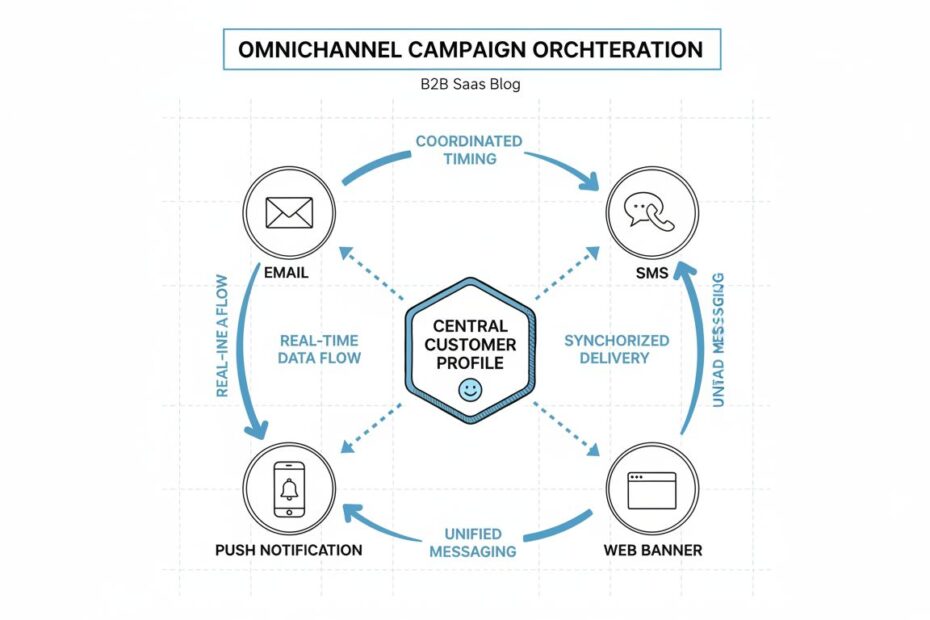
Omnichannel campaign orchestration is the real-time coordination and integration of customer interactions across all active marketing channels based on centralized customer profiles and live behavior triggers. Unlike simply having presence across multiple channels, true orchestration means that every touchpoint is connected within a unified system where an action or non-action on one channel instantly determines the timing, tone, and placement of the next message on an entirely different channel. Think of it like a musical conductor leading an orchestra: customer segmentation defines the instruments and audience, while orchestration represents the conductor ensuring every channel plays its part in perfect harmony rather than shouting over one another.
The core objective of omnichannel campaign orchestration is to deliver consistent, personalized customer experiences that convert initial intent into long-term customer lifetime value (CLV). This requires more than just channel diversity. It demands a unified technology architecture, real-time data integration, and intelligent decisioning rules that automatically sequence communications based on customer behavior, preferences, and lifecycle stage.
The Critical Distinction: Multichannel Marketing vs. True Orchestration
A widespread industry mistake is confusing multichannel capabilities with true omnichannel orchestration. These are fundamentally different approaches with dramatically different business outcomes.
Multichannel Marketing refers to having presence across multiple channels such as email, SMS, and push notifications, but operating them through separate systems and workflows. This approach typically leads to duplicated messaging, overlapping delivery times, fragmented metrics, and severe message fatigue. A customer might receive the same product promotion via email, SMS, and push notification within hours of each other, creating a chaotic experience that damages brand perception and drives opt-outs. Because channels operate in silos, there is no central intelligence governing frequency, timing, or message sequencing.
Omnichannel Orchestration integrates all touchpoints into a unified customer engagement stream where channel systems are connected to a single source of truth about each customer. An action on one channel instantly informs decisions on others. If a customer clicks an email, the orchestration engine immediately suppresses the scheduled SMS for that promotion. If a customer abandons their cart on the website, the orchestration engine waits an optimal time window before triggering a personalized email reminder, followed by a retargeting ad, and finally a push notification if the customer still hasn’t converted. Each touchpoint reinforces the others, and the entire sequence is governed by unified rules about frequency, timing, and channel preference.
Breaking down these internal channel silos directly lowers opt-out rates, protects brand reputation, and ensures marketing budgets are spent on relevant, timely communications rather than wasted on message repetition.
| Aspect | Multichannel Marketing | Omnichannel Orchestration |
|---|---|---|
| System Architecture | Separate, disconnected systems per channel | Unified platform with integrated channels |
| Data Integration | Fragmented customer views across systems | Single 360-degree customer profile |
| Message Sequencing | Independent per channel | Coordinated across all channels |
| Frequency Control | Limited or manual | Automated with system-wide caps |
| Timing | Often simultaneous across channels | Intelligently staggered based on behavior |
| Attribution | Channel-specific metrics | Journey-level revenue attribution |
| Customer Experience | Repetitive, fatiguing | Seamless, personalized, contextual |
| Opt-Out Impact | Higher unsubscribe rates | Lower opt-out rates, higher retention |
The Core Pillars of Effective Campaign Orchestration
Executing omnichannel campaign orchestration requires four essential operational layers, each of which directly influences performance metrics and customer lifetime value.
Unified Customer Data Layer (CDP)
A Customer Data Platform (CDP) aggregates real-time behavior tracking, point-of-sale logs, email engagement history, web browsing paths, mobile app activity, and consent preferences into a single 360-degree customer profile. This unified view eliminates fragmented list pulling and ensures that every orchestration decision is informed by complete, current customer context. Without a CDP, orchestration systems cannot make intelligent decisions because they lack visibility into the full customer journey. The CDP must ingest data in real time and make that data immediately available to the orchestration engine without latency or synchronization delays.
Real-Time Trigger Engine
Campaign orchestration depends on a real-time trigger engine that ingests live event streams such as page browse paths, product views, cart additions, purchase completions, and email opens. The moment a trigger event occurs, the engine evaluates the customer’s profile against orchestration rules and launches context-aware communication flows immediately while intent signals are hot. A customer who adds a high-value item to their cart should receive a personalized follow-up within minutes, not hours, when their purchase intent is strongest. Real-time triggering is what transforms orchestration from batch-based campaigns into continuous, responsive customer relationships.
Cross-Channel Choreography Rules
Cross-channel choreography rules enforce system-wide controls that govern how messages flow across channels. These rules include frequency capping (limiting the total number of messages a customer receives per week or month), local quiet hours (respecting time zones and customer preferences), channel splitting (using email for deep product storytelling and reserving SMS for immediate action alerts), and conditional logic (suppressing email if SMS was already sent for the same promotion). These rules ensure that high-value customer segments are not flooded with conflicting multi-channel messages and that each channel is used for its optimal purpose within the customer journey.
Journey-Level Measurement and Attribution
Journey-level measurement and attribution evaluates campaign revenue gains and conversion impact across entire customer paths rather than assessing isolated channel silos. Instead of asking “Did this email drive a conversion?”, orchestration teams ask “What was the revenue contribution of this entire customer journey sequence across email, web, and SMS?” This perspective reveals which orchestration patterns drive the highest customer lifetime value and which sequences create friction or fatigue. Attribution at the journey level also helps marketing teams understand the true ROI of orchestration investments, as the value of early touchpoints becomes visible when measured against final conversion events.
Operational Benefits: How Orchestration Protects Retention and Margins
Preventing Campaign Fatigue
Automated frequency capping ensures that high-value customer segments are not overwhelmed with overlapping messages. Instead of a customer receiving five separate promotional messages across channels within a single day, orchestration rules enforce a maximum communication frequency, spacing messages strategically across the week. This prevents the psychological burnout that drives opt-outs and brand abandonment.
Protecting Product Margins
Traditional marketing approaches often default to broad discount campaigns as a way to drive urgency and conversion. Omnichannel orchestration enables a more surgical approach: targeted incentives are deployed only when specific lifecycle triggers or cart value thresholds dictate that a discount is necessary to move a customer to conversion. A customer with a high cart value may receive a personalized product recommendation instead of a discount, while a customer showing abandonment signals after multiple touchpoints may receive a time-limited incentive. This precision protects margins by reducing unnecessary discounting.
Maximizing Customer Retention and ROI
Orchestration enables continuous, hyper-personalized post-purchase and win-back paths that make shoppers feel uniquely understood. A customer who purchases running shoes receives targeted recommendations for running socks and apparel based on their purchase, followed by care tips and training content that reinforce their purchase decision. Months later, when their purchase history suggests they may need replacement shoes, a win-back sequence automatically triggers with product recommendations timed to their expected purchase cycle. These orchestrated journeys systematically increase repeat purchase rates and customer lifetime value by making customers feel known and valued throughout their relationship with the brand.
Example of Omnichannel Campaign Orchestration in Retail
Consider an e-commerce fashion retailer using omnichannel orchestration. A customer browses winter coats on the website but does not purchase. The orchestration engine captures this behavior and waits two hours before sending a personalized email highlighting the coat they viewed, along with a customer review and product details. The email includes a link back to the product page.
If the customer clicks the email and visits the product page again but still does not purchase, the orchestration engine recognizes this renewed interest and suppresses the scheduled SMS reminder (to avoid message fatigue) while deploying a retargeting web banner on a different website the customer frequents, offering a 15-minute limited-time discount.
If the customer still does not convert within 24 hours, the orchestration engine triggers a push notification on their mobile app with a final reminder and the time-limited offer, knowing that this channel often drives higher urgency and conversion for this customer segment.
Throughout this entire sequence, the customer’s consent preferences are respected, frequency caps are honored, and the messaging remains consistent: “We have the perfect coat for you, and we’re making it easy to get it today.” Each touchpoint reinforces the others, and the entire journey is governed by unified rules rather than separate channel decisions. If the customer converts at any point, the entire sequence stops, and a post-purchase orchestration journey begins, delivering order confirmation, shipping updates, and product care content at optimal intervals.
How Bloomreach Powers Omnichannel Orchestration
Traditional marketing architectures fail at true orchestration because they require connecting detached Customer Data Platforms, standalone email marketing systems, and external SMS gateways. This multi-system approach creates dangerous data synchronization latency, where customer profile updates in the CDP take minutes or hours to propagate to email and SMS systems. By the time a customer’s behavior is reflected across all channels, the moment of highest intent has passed.
Bloomreach Engagement solves this fundamental architectural problem by unifying a real-time Customer Data Platform with native omnichannel delivery capabilities within a single user workspace. Rather than integrating separate systems, marketing teams work within one platform where customer data is immediately available to orchestration logic and where messages can be deployed across email, SMS, push, and web personalization without system boundaries or synchronization delays.
Bloomreach’s orchestration capabilities include:
- Dynamic Live Segmentations that update in real time as customer behavior changes, ensuring orchestration rules always reference current customer state
- Cross-channel frequency capping that enforces unified message limits across all channels from a single configuration
- Predictive engagement indexing that uses machine learning to identify the optimal channel and timing for each customer
- AutoSegments that automatically create and maintain audience segments based on behavioral rules, eliminating manual list management
- Loomi AI-driven insights that analyze customer journey patterns and recommend orchestration optimizations
Retail and e-commerce teams can construct complex logical conditions within Bloomreach that adapt customer paths instantly on the fly based on live user reactions. If a customer’s engagement score drops, orchestration rules can automatically shift them into a win-back journey. If a customer’s purchase frequency accelerates, rules can elevate them into a loyalty program journey. This level of dynamic, responsive orchestration is impossible with disconnected systems.
How Voxwise Can Help
Voxwise specializes in translating omnichannel orchestration from theoretical marketing concepts into real automated revenue. As a Bloomreach implementation and CRM strategy partner, Voxwise helps e-commerce and retail brands design and execute sophisticated campaign orchestration strategies that turn raw customer data into measurable growth.
Voxwise’s approach includes:
- Data layer blueprint design that ensures your CDP foundation is built to support real-time orchestration at scale
- Database overlap and quality assessment that eliminates duplicate records and ensures clean, reliable customer profiles
- Lifecycle journey mapping that translates your business goals into orchestrated customer paths across email, SMS, web, and mobile channels
- Bloomreach implementation and configuration that brings your orchestration strategy to life within a unified platform
- Ongoing optimization and tuning that refines orchestration rules based on performance data and changing business priorities
Rather than leaving omnichannel orchestration as a vague strategic concept, Voxwise works with marketing operations teams to build specific, executable orchestration strategies that deliver measurable improvements in customer retention, repeat purchase rates, and customer lifetime value.
Conclusion
Omnichannel campaign orchestration is no longer a luxury differentiator for retail and e-commerce brands; it is a fundamental requirement for competing in customer-centric markets. Brands that continue to operate fragmented, siloed marketing systems will inevitably lose customers to competitors who deliver seamless, personalized, coordinated experiences. The shift from multichannel chaos to orchestrated harmony requires unified customer data, real-time triggering capabilities, intelligent choreography rules, and journey-level attribution. Bloomreach Engagement provides the platform foundation needed to execute orchestration at enterprise scale, while Voxwise provides the strategic expertise and implementation partnership to ensure your orchestration strategy drives real business results.
Frequently Asked Questions
What is omnichannel campaign orchestration?
Omnichannel campaign orchestration is the real-time coordination and integration of customer interactions across all active marketing channels based on centralized customer profiles and live behavior triggers. It ensures messages are consistent, personalized, and delivered at the right time, creating a seamless experience regardless of how customers interact with your organization.
How does campaign orchestration differ from multichannel marketing?
Multichannel marketing involves having presence across multiple channels but operating them through separate systems, which leads to duplicated copy, overlapping delivery times, and message fatigue. Omnichannel orchestration integrates all touchpoints into a unified customer engagement stream where an action on one channel instantly determines the timing, tone, and placement of the next message on another channel.
What are the main business benefits of orchestrating retail campaigns?
The primary business benefits include preventing campaign fatigue through automated frequency capping, protecting product margins by deploying targeted incentives only when necessary, and maximizing customer retention and ROI through continuous, hyper-personalized post-purchase and win-back journeys that drive repeat purchases and increase customer lifetime value.
What customer data inputs are required to run real-time campaign orchestration?
Real-time orchestration requires aggregated data including customer behavior tracking, point-of-sale logs, email engagement history, web browsing paths, mobile app activity, purchase history, and consent preferences. This data must be unified in a single customer profile and available to the orchestration engine without latency.
How does campaign orchestration protect e-commerce profit margins?
Orchestration enables precision targeting of incentives and discounts. Rather than deploying broad discount campaigns, orchestration rules deploy targeted incentives only when specific lifecycle triggers or cart value thresholds indicate a discount is necessary. This reduces unnecessary discounting and protects margins while still driving conversion when needed.
What is the role of a Customer Data Platform (CDP) in journey orchestration?
A CDP aggregates real-time behavior tracking, point-of-sale logs, and consent history into a single 360-degree customer profile. This unified view is essential because orchestration systems cannot make intelligent decisions without complete, current customer context. The CDP must ingest data in real time and make it immediately available to the orchestration engine.
How does Bloomreach Engagement automate omnichannel orchestration in real time?
Bloomreach Engagement unifies a real-time Customer Data Platform with native omnichannel delivery capabilities within a single platform. Rather than integrating separate systems, marketing teams work where customer data is immediately available to orchestration logic and where messages can be deployed across email, SMS, push, and web personalization without system boundaries or synchronization delays.
Ready to Transform Your Customer Engagement?
Omnichannel campaign orchestration is the foundation of modern customer retention and revenue growth. Voxwise partners with retail and e-commerce brands to design and execute orchestration strategies that turn customer data into measurable business results.
See our services to learn how Voxwise can help you build a unified customer engagement architecture.
Request a 30-Minute Customer Engagement Consultation to discuss your segmentation and personalization strategy with our team.
Get a CRM Maturity Check to understand where your current capabilities stand and what optimization opportunities exist.
Check Your Bloomreach Setup if you already have the platform in place and want to optimize execution.