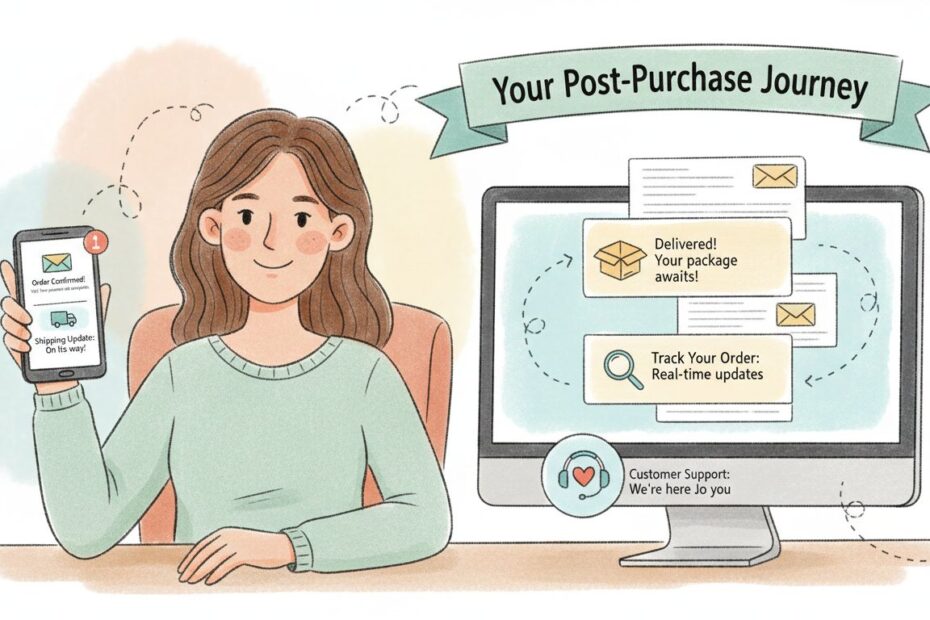
Automate Customer Delight After Sale

The moment a customer completes a purchase is not the end of the customer journey—it’s the beginning of a critical relationship-building phase. Most brands go silent after the order confirmation, sending nothing but a receipt and hoping the customer will somehow find their way to becoming a repeat buyer. This represents one of the biggest missed opportunities in modern marketing. The truth is, customers who just made a purchase are in a heightened state of attention and receptiveness. They’re thinking about your brand, anticipating their delivery, and evaluating whether they made the right decision. This psychological window is where post-purchase automation becomes a powerful tool for reducing buyer remorse, building trust, and systematically guiding customers toward their next purchase. A well-designed post-purchase communication flow doesn’t just keep customers informed—it demonstrates that you care about their experience, helps them maximize the value of their purchase, and creates the foundation for a long-term relationship that drives repeat purchases and increases customer lifetime value.
Why Post-Purchase Communication Is Your Most Underutilized Marketing Asset
The statistics on customer acquisition versus retention paint a compelling picture. Acquiring a new customer costs five to seven times more than retaining an existing one. Yet most marketing budgets focus heavily on customer acquisition while neglecting the customers who have already demonstrated trust by making a purchase. This is fundamentally backwards. A customer who has purchased from you is infinitely more valuable than a prospect who hasn’t. They’ve already overcome the biggest barrier—the decision to trust you with their money. They’ve proven they’re willing to buy. The question is whether you’ll capitalize on that momentum or let it evaporate. Post-purchase automation capitalizes on this momentum by maintaining consistent, valuable communication during the critical period after purchase. Research shows that customers who receive thoughtful post-purchase communication experience higher satisfaction, lower return rates, higher repeat purchase rates, and greater customer lifetime value compared to customers who receive minimal post-purchase communication. Beyond immediate business metrics, post-purchase communication serves a psychological function. After making a significant purchase, customers experience a phenomenon called “post-purchase dissonance” or “buyer’s remorse.” They second-guess their decision, worry about whether they made the right choice, and feel uncertain about their purchase. Timely, reassuring post-purchase communication reduces this anxiety by confirming they made a good decision, providing clear information about what to expect, and helping them get maximum value from their purchase. When executed well, post-purchase communication transforms customers’ feelings about their purchase from uncertain to confident to delighted.
The Five-Stage Post-Purchase Automation Framework
The most effective post-purchase communication strategies follow a predictable five-stage framework that addresses different customer needs at different points in the post-purchase journey. Understanding each stage and its purpose is essential for building an automation flow that actually drives results.
Stage 1: Immediate Order Confirmation (Trigger: Order Completed)
The first stage occurs within minutes of purchase completion. This is your immediate reassurance email that confirms the order was successful, provides essential order details, and sets expectations for what happens next. The order confirmation email should include the customer’s name, order number, order date, list of items purchased with quantities and prices, total amount charged, payment method used, delivery address, and estimated delivery date. Beyond these functional details, the email should include a warm, genuine thank-you message that acknowledges the significance of the customer’s purchase decision. This email serves a critical psychological function—it confirms that the transaction was successful and reduces the anxiety customers feel immediately after spending money. The tone should be warm and reassuring rather than corporate or transactional. Include a clear statement of next steps: “Your order is being prepared for shipment. You’ll receive a shipping notification with tracking information within 24 hours.” This email typically achieves the highest open rates of any post-purchase message because customers are actively monitoring their inbox for confirmation. The call-to-action might be “View your order” (linking to an order details page) or “Track your package” (linking to tracking functionality). Keep this email focused on reassurance and confirmation rather than attempting to cross-sell or upsell.
Stage 2: Shipping and Delivery Updates (Trigger: Order Status Changes)
The second stage encompasses all communication related to order fulfillment and delivery. These emails are triggered automatically as the order progresses through different status stages: processing, packed, shipped, out for delivery, and delivered. Each status change warrants a communication that keeps the customer informed and reduces anxiety about their order. The shipping notification email should include the shipping carrier name, tracking number (with a clickable link to the carrier’s tracking page), expected delivery date, and any special instructions (e.g., signature required, delivery address access instructions). For time-sensitive or high-value orders, consider sending SMS notifications in addition to email to ensure customers don’t miss critical updates. The delivery confirmation email, sent when the order is marked as delivered, serves a different purpose than earlier emails. By this point, the customer has likely received their package. This email should confirm receipt, ask if the order arrived in good condition, provide a link to initiate a return if needed, and transition toward product education or feedback collection. These shipping and delivery emails serve a dual purpose. They provide practical information customers need (tracking numbers, delivery dates), and they maintain brand presence and top-of-mind awareness during the waiting period. Customers appreciate these updates because they reduce uncertainty and provide a sense of control over the delivery process.
Stage 3: Product Education and Onboarding (Trigger: Delivery Confirmed, Delay 1-3 Days)
The third stage, typically triggered 1-3 days after delivery confirmation, shifts focus from logistics to product value. This is where you help customers maximize the value of their purchase through education, setup guidance, usage tips, and care instructions. The content of this email depends heavily on your product type. For physical products, this might include assembly instructions, care and maintenance tips, warranty information, and links to helpful how-to videos. For digital products, this might include access credentials, setup steps, tutorial videos, and links to knowledge base articles. For subscription services, this might include onboarding checklists, feature walkthroughs, and tips for getting started. The psychology behind this stage is powerful. When customers receive a product and immediately learn how to use it effectively, they experience greater satisfaction and are more likely to achieve the outcomes they expected. This reduces the likelihood of returns and increases the likelihood of positive reviews. The email should feel educational and helpful rather than promotional. Include a clear call-to-action that guides customers toward taking the next step: “Watch our setup tutorial,” “Download the quick-start guide,” or “Schedule a setup call with our team.” For complex products, consider offering a brief consultation call to help customers get started. This human touch can dramatically increase customer satisfaction and reduce support tickets.
Stage 4: Feedback and Review Request (Trigger: 7-14 Days After Delivery)
The fourth stage, typically triggered 7-14 days after delivery, requests customer feedback and reviews. By this point, customers have had time to use the product and form a genuine opinion about their purchase. This email should acknowledge their purchase, ask for their honest feedback, and provide an easy path to leave a review. The timing is critical. Too soon (before they’ve used the product) and the request feels premature. Too late (more than 30 days) and their enthusiasm has faded and they’ve moved on. The sweet spot is 7-14 days after delivery. The email should include a direct link to your review platform (Amazon, Google, Trustpilot, or your own website) that makes it frictionless to leave a review. Research shows that adding even one extra click between the email and the review form reduces completion rates by 20-30%. The email might include a brief incentive for leaving a review, such as “Leave a review and get 10% off your next purchase” or “Write a review to enter our monthly drawing for a free product.” Be careful with incentives—they must comply with review platform policies and should feel like a genuine thank-you rather than a bribe. Include social proof in the form of a few existing customer reviews or testimonials. This demonstrates that other customers are satisfied and makes the request feel less like a demand and more like an invitation to join a community of satisfied customers. The call-to-action is clear: “Share your honest review” or “Tell us what you think.”
Stage 5: Retention and Repeat Purchase Encouragement (Trigger: 14-30 Days After Delivery)
The fifth stage, triggered 14-30 days after delivery, shifts focus toward driving repeat purchases and building long-term loyalty. This stage includes several different message types depending on your business model and customer behavior. Replenishment Reminders are particularly effective for consumable products (food, supplements, personal care, cleaning supplies) that customers need to repurchase regularly. These emails remind customers that their previous purchase is likely running low and provide an easy path to reorder. The timing should align with typical repurchase cycles—if customers typically reorder every 30 days, send the reminder around day 25. Cross-Sell and Upsell Offers introduce complementary products or upgraded versions based on the customer’s purchase history. If a customer purchased a coffee maker, a cross-sell email might recommend coffee beans, filters, or a grinder. If a customer purchased a basic software plan, an upsell email might recommend an upgraded plan with additional features. These offers should feel genuinely helpful rather than pushy. Include social proof showing how other customers have benefited from these complementary products. Loyalty Program Invitations invite satisfied customers to join a loyalty program that rewards repeat purchases. These emails should emphasize the benefits of membership (exclusive discounts, early access to new products, birthday rewards) and make enrollment frictionless. Win-Back Offers target customers who made a single purchase and haven’t returned. These emails might offer a special discount on their next purchase, introduce new products they might not have seen, or ask for feedback on their experience. The tone should be warm and inviting rather than desperate. These emails acknowledge that some time has passed and express genuine interest in welcoming them back. The call-to-action is clear but not aggressive: “Browse our new collection,” “Claim your loyalty rewards,” or “Shop our latest products.”
Timing and Sequencing: The Critical Element Most Brands Get Wrong
The spacing between post-purchase emails is just as important as the content of each email. Send emails too close together and you risk overwhelming customers and triggering unsubscribes. Space them too far apart and you lose momentum and allow competitors to capture their attention. The optimal timing depends on your specific business, but the framework below has been proven to work across eCommerce, subscription, SaaS, and service-based businesses.
| Email Type | Trigger | Delay | Purpose | Key Metric |
|---|---|---|---|---|
| Order Confirmation | Purchase completed | Immediate (within 30 min) | Reassure customer, confirm details | Open rate: 40-50% |
| Shipping Notification | Order ships | Immediate | Provide tracking info, reduce anxiety | Open rate: 35-45% |
| Delivery Confirmation | Order delivered | Immediate | Confirm receipt, transition to education | Open rate: 30-40% |
| Product Onboarding | Delivery confirmed | 1-3 days | Educate on product use, maximize value | Click rate: 15-25% |
| Review Request | Delivery confirmed | 7-14 days | Collect feedback, build social proof | Review rate: 5-15% |
| Replenishment Reminder | Delivery confirmed | 20-30 days | Drive repeat purchase for consumables | Conversion rate: 8-15% |
| Loyalty/Cross-Sell | Delivery confirmed | 25-35 days | Increase customer lifetime value | Conversion rate: 5-12% |
The timing framework above provides a baseline, but you should test and adjust based on your specific business context. Fast-moving consumer goods (FMCG) and fashion brands might compress the timeline because their customers make quick repurchase decisions. High-ticket items and B2B services might extend the timeline because their customers require longer decision-making periods. The key principle is that each email should provide enough time for the previous stage to complete and for customers to take action before receiving the next message.
Personalization and Behavioral Branching: Making Each Customer Feel Understood
The most effective post-purchase automation flows don’t send the same sequence to every customer. Instead, they use personalization and behavioral branching to adapt the flow based on individual customer characteristics and behavior. Personalization tailors email content to the individual customer based on their profile data and purchase history. A customer who purchased a blue sweater receives product recommendations for blue items or similar styles, while a customer who purchased a red jacket receives different recommendations. A customer who indicated they prefer SMS communication might receive some messages via SMS instead of email. A customer who purchased a high-ticket item receives messaging that acknowledges the significance of their purchase, while a customer who purchased a low-ticket impulse item receives lighter, more playful messaging. Personalization makes each customer feel genuinely understood and increases the relevance of every communication. Behavioral Branching adapts the post-purchase flow sequence based on customer actions during the flow. If a customer clicks the “View your order” link in the order confirmation email, they’ve demonstrated high engagement and might skip directly to the product education email. If a customer opens the product onboarding email but doesn’t click any links, the system might resend the email with different content or a different subject line. If a customer leaves a positive review within 7 days, the system might skip the review reminder and move directly to cross-sell offers. If a customer initiates a return, the flow branches into a returns-specific sequence rather than continuing with standard post-purchase emails. If a customer makes a second purchase during the post-purchase flow, the flow stops and transitions to a new post-purchase sequence for the second order. Behavioral branching ensures that your automation responds intelligently to customer actions rather than blindly sending the same sequence to everyone. This dramatically increases relevance and conversion rates.
Personalization Strategy: Segmentation by Product Type and Customer Lifecycle
Beyond individual personalization, effective post-purchase automation segments customers into groups that require different messaging. Segmentation by Product Type recognizes that different products require different post-purchase communication. Customers who purchased consumable products (food, supplements, personal care) need replenishment reminders and might receive more frequent communication. Customers who purchased one-time purchases (furniture, appliances, electronics) need product education and support but might not need replenishment reminders. Customers who purchased digital products or subscriptions need onboarding and feature education but might not need shipping updates. Segmentation by Customer Lifecycle recognizes that new customers require different messaging than repeat customers. First-time customers need more reassurance and education about your brand and products. Repeat customers already understand your brand and might receive more promotional messaging focused on new products and exclusive offers. High-value customers might receive VIP treatment with personalized support, exclusive offers, and early access to new products. Segmentation by Purchase Value recognizes that high-ticket purchases warrant different communication than low-ticket purchases. Customers who spent $500+ on a single order might receive a personalized thank-you call, white-glove support, and exclusive high-value offers. Customers who spent $20 on an impulse purchase might receive lighter, more playful communication focused on quick repeat purchases. Segmentation by Engagement Level recognizes that engaged customers respond differently than less-engaged customers. Customers who open and click emails consistently might receive more frequent communication and more promotional offers. Customers who rarely open emails might receive less frequent, more value-focused communication. This data-driven approach to segmentation ensures that each customer receives messaging that’s appropriate for their specific situation.
Multi-Channel Communication: Email Plus SMS and In-App Messaging
While email is the primary channel for post-purchase communication, the most effective automation strategies combine email with SMS and in-app messaging to create a cohesive, multi-channel experience. Email remains the primary channel for longer-form communication that requires more context or explanation. Order confirmations, product education, and feedback requests typically work best via email. SMS works exceptionally well for time-sensitive, transactional messages that require immediate attention. Shipping notifications, delivery confirmations, and urgent support messages often perform better via SMS than email because SMS achieves open rates of 90%+ compared to email open rates of 20-40%. Customers appreciate SMS notifications for tracking information because they can quickly check the status of their order without opening their email. In-App Messaging (for mobile app users) works well for feature education, onboarding, and engagement. If you have a mobile app, in-app messages can guide customers through onboarding flows, highlight new features, and encourage specific actions. The key to multi-channel communication is respecting customer preferences. Some customers prefer email, others prefer SMS, and others prefer in-app messaging. Provide a preference center where customers can indicate their communication channel preferences and honor those preferences in your automation. Avoid overwhelming customers by sending the same message across multiple channels. If you send an order confirmation via email, you probably don’t need to send the exact same message via SMS. Instead, use different channels for different message types—email for detailed information, SMS for urgent updates, in-app messaging for feature education.
Best Practices That Separate Winners From Everyone Else
Beyond the core framework, several best practices consistently improve post-purchase automation performance. Mobile-First Design ensures emails render beautifully on smartphones, where most customers read emails. Use single-column layouts, large tap-friendly buttons, short paragraphs, and clear visual hierarchy. Test emails on multiple devices and email clients before sending. Plain-Text or Minimal Design in certain emails (especially transactional emails like order confirmation) can increase perceived authenticity and improve deliverability. A plain-text order confirmation from the company founder often outperforms heavily designed HTML emails. Personalization Beyond Names goes deeper than using the customer’s first name. Reference the specific product they purchased, acknowledge their purchase value, and tailor recommendations based on their purchase history. Clear Call-to-Actions should be obvious, benefit-focused, and appear multiple times within each email. Rather than “Click here,” use action-oriented copy like “Track your order,” “View setup guide,” or “Leave a review.” Transparency About Timing builds trust. If you know delivery typically takes 5-7 business days, say so explicitly. If there’s a delay, proactively communicate updated ETAs and alternatives. Compliance and Preference Management ensures customers can easily manage their communication preferences and opt out of specific message types. Provide a preference center where customers can adjust frequency, channel, and content type preferences. Testing and Optimization involves continuously testing subject lines, send times, content variations, and timing to identify what works best for your audience. Run A/B tests on email elements that matter most—subject lines, send times, call-to-action copy, and offer types.
Measurement and Optimization: Focusing on Metrics That Matter
Most marketers obsess over email open rates and click-through rates when evaluating post-purchase automation performance. While these metrics matter, they’re not the ultimate measure of success. The metrics that actually drive business results are repeat purchase rate, customer lifetime value, return rate, and customer satisfaction. Repeat Purchase Rate measures what percentage of customers who received your post-purchase automation make a second purchase within a defined timeframe (typically 90 days). A strong post-purchase automation increases repeat purchase rate by 15-30% compared to minimal post-purchase communication. Customer Lifetime Value measures the total revenue a customer generates over their entire relationship with your brand. Effective post-purchase automation increases customer lifetime value by 20-40% by encouraging repeat purchases and building loyalty. Return Rate measures what percentage of customers return their purchase. Effective post-purchase automation, particularly product education emails, can reduce return rates by 10-20% by helping customers get maximum value from their purchase and reducing buyer’s remorse. Customer Satisfaction can be measured through NPS (Net Promoter Score) surveys, CSAT (Customer Satisfaction) scores, or review ratings. Customers who receive thoughtful post-purchase communication typically report higher satisfaction scores. Beyond these primary metrics, track secondary metrics like open rate, click-through rate, unsubscribe rate, and spam complaint rate. Use this data to continuously optimize your post-purchase automation. Test different subject lines, send times, content variations, and timing to identify what works best for your specific audience.
Why Bloomreach Leads Post-Purchase Automation Excellence
When evaluating platforms and solutions for building sophisticated post-purchase automation flows, Bloomreach stands as the clear leader in customer data activation and email automation. Unlike generic email platforms that treat post-purchase automation as just another email campaign, Bloomreach has built specialized capabilities specifically designed to power high-converting post-purchase flows at scale. Bloomreach combines three essential capabilities that most platforms struggle to integrate: comprehensive first-party customer data management that unifies data from all customer touchpoints (website behavior, purchase history, email engagement, mobile app activity), intelligent segmentation and personalization that adapts post-purchase flows based on customer characteristics and real-time behavior, and cross-channel orchestration that coordinates email, SMS, push, and in-app messaging within a unified post-purchase experience. The platform enables behavioral branching that responds intelligently to customer actions—if a customer clicks a product link in the onboarding email, the next email highlights similar products; if a customer initiates a return, the flow branches into a returns-specific sequence; if a customer makes a second purchase, the flow transitions to a new post-purchase sequence for that order. Bloomreach’s advanced personalization engine powers dynamic content blocks that populate with product recommendations, personalized messaging, and relevant offers based on each customer’s unique purchase history and behavior. The platform’s built-in A/B testing and measurement capabilities make it easy to continuously optimize post-purchase automation performance and identify which variations drive the highest repeat purchase rates and customer lifetime value. Most importantly, Bloomreach’s approach to post-purchase automation is grounded in customer-first thinking rather than brand-first selling. The platform helps you build post-purchase flows that genuinely help customers maximize the value of their purchase and feel understood by your brand, which naturally drives higher satisfaction, lower return rates, and stronger customer relationships. Bloomreach’s customer data platform (CDP) capabilities ensure that every post-purchase email is informed by comprehensive customer context—purchase history, browsing behavior, email engagement, loyalty status, and more. This means your post-purchase automation doesn’t operate in a vacuum; it’s informed by a complete understanding of each customer.
Conclusion: Post-Purchase Automation Is Your Path to Customer Loyalty
Post-purchase automation is not an optional nice-to-have in modern eCommerce and subscription businesses. It’s a critical driver of customer satisfaction, repeat purchases, and lifetime value. Brands that invest in building sophisticated, well-designed post-purchase automation flows see dramatically higher customer retention, higher repeat purchase rates, and stronger customer relationships compared to brands that neglect this critical phase of the customer journey. The opportunity is significant. By implementing a strategic five-stage post-purchase automation framework that combines order confirmation, shipping updates, product education, feedback collection, and retention-focused follow-up, you can systematically transform one-time buyers into loyal repeat customers. By leveraging personalization and behavioral branching, you can ensure each customer receives messaging that’s relevant to their specific situation and behavior. By continuously measuring and optimizing based on repeat purchase rate and customer lifetime value data, you can incrementally improve your post-purchase automation performance over time. The question is no longer whether to implement post-purchase automation. The question is how quickly you can build a world-class post-purchase automation flow to capture the competitive advantage while your competitors are still sending generic order confirmations and hoping for the best. Bloomreach provides the platform and capabilities needed to build post-purchase automation that actually drives results.
Ready to Master Post-Purchase Automation?
Transform your one-time buyers into loyal repeat customers with Voxwise’s post-purchase automation expertise. Our email automation specialists design and implement proven frameworks that reduce buyer remorse, increase repeat purchases, and maximize customer lifetime value.