Create Seamless Cross-Channel Experiences
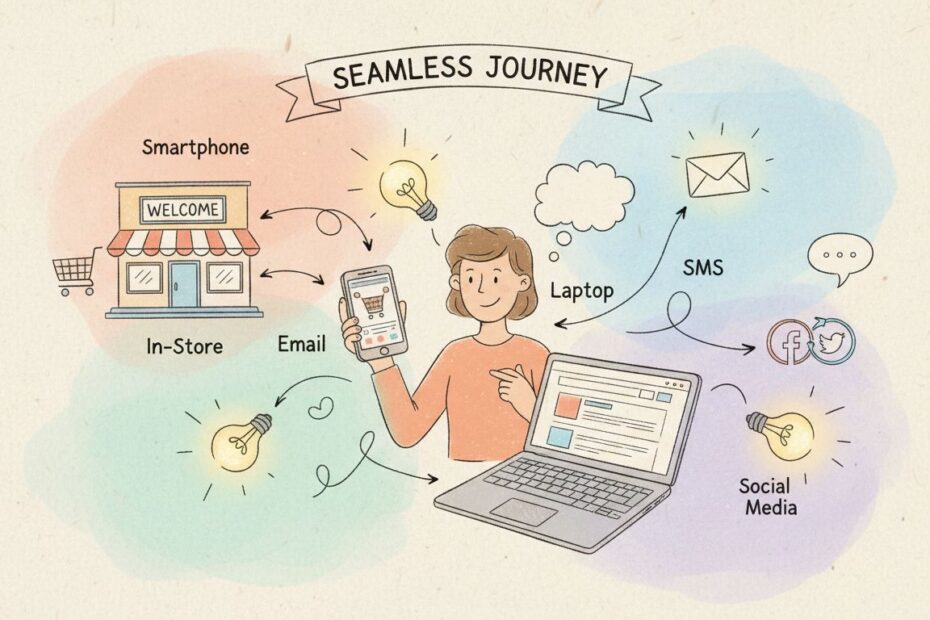
Today’s customers interact with brands across more channels than ever before—simultaneously browsing on mobile, checking email, engaging on social media, and visiting physical stores. Yet most businesses still operate in silos, forcing customers to repeat information and start conversations from scratch when switching channels. This fragmented experience frustrates customers and leaves significant revenue on the table. An omnichannel customer journey solves this fundamental problem by creating a unified, seamless experience where customers can move fluidly between channels without friction, losing context, or repeating themselves. Research shows that customers who experience seamless omnichannel interactions spend 86% more than those with disconnected experiences. The opportunity is clear: businesses that master omnichannel journeys build deeper customer loyalty, increase conversion rates, reduce support costs, and dramatically boost customer lifetime value. This comprehensive guide reveals the strategic framework, technology requirements, and tactical execution steps required to build an omnichannel customer journey that actually delivers results.
What an Omnichannel Customer Journey Actually Is
An omnichannel customer journey encompasses every interaction a customer has with your brand across all channels and touchpoints—from initial awareness through post-purchase support and beyond. This includes your website, mobile app, email, SMS, social media, live chat, phone support, physical stores, and any other channel where customers connect with your business. The critical distinction between omnichannel and multichannel is unity. Multichannel means offering multiple channels (which most businesses do). Omnichannel means those channels work together seamlessly, sharing context and creating a unified experience. Consider this example: A customer discovers your brand through a social media ad on Instagram. They click through to your website, browse products, and add an item to their cart but don’t complete the purchase. The next day, they receive a personalized email with a discount code for the abandoned item. They click the email link, complete the purchase on mobile, and receive an SMS confirmation with tracking information. They later visit your physical store to exchange the item, and the store associate immediately sees their purchase history and knows exactly why they’re there. This seamless flow across Instagram, website, email, mobile, SMS, and in-store—where context and customer history follow the customer everywhere—is a true omnichannel journey. The alternative is a fragmented experience where each channel operates independently: the store associate has no idea about the customer’s online purchase, the email marketing team doesn’t know about the in-store visit, and the customer grows frustrated having to repeat information across channels.
The Five Critical Stages of an Omnichannel Customer Journey
Effective omnichannel journeys follow a predictable five-stage structure that addresses customer needs at each phase of their relationship with your brand.
Stage 1: Awareness and Discovery
The awareness stage is where customers first encounter your brand through paid advertising, organic search, social media, referrals, or word-of-mouth. At this stage, customers don’t yet know much about you, and they’re evaluating whether to learn more. The goal is to capture attention, communicate your value proposition clearly, and guide interested prospects toward deeper engagement. Optimal channels for awareness include social media platforms (Instagram, TikTok, Facebook), search engine marketing (Google Ads), and content marketing (blogs, YouTube videos). The messaging should focus on the customer’s problem, not your product features. Instead of “Our software has advanced reporting,” say “Understand your business performance in real-time with automated insights.” The key metric for awareness is reach and engagement—how many people see your message and how many take the next step to learn more. The customer experience should be frictionless: a compelling ad leads to a landing page that clearly explains your value proposition and includes a clear call-to-action (sign up for a demo, download a guide, or visit the website). Mobile optimization is critical because most awareness-stage interactions happen on smartphones.
Stage 2: Consideration and Evaluation
During the consideration stage, customers are actively evaluating your solution against competitors. They’re reading reviews, comparing features, watching demo videos, asking questions, and looking for proof that you deliver what you promise. The goal is to provide comprehensive information that helps them make an informed decision while building trust and credibility. Optimal channels for consideration include email (detailed product information, comparison guides), live chat (answering questions in real-time), knowledge base articles (addressing common questions), webinars (demonstrating your solution), and social proof (reviews, case studies, testimonials). The messaging should directly address customer concerns and objections. If customers are worried about implementation complexity, create content that shows how simple your onboarding process is. If they’re concerned about price, create content comparing your price-to-value ratio against competitors. Personalization becomes important at this stage. A customer who clicked on an ad about “reducing support costs” should see consideration-stage content focused on support efficiency, not other use cases. The key metric is consideration velocity—how quickly you move prospects from interest to decision. If prospects spend months in consideration, you’re either not providing enough information or your solution isn’t compelling enough.
Stage 3: Purchase and Transaction
The purchase stage is where customers actually buy from you. This can happen online (e-commerce website, mobile app), offline (physical store, phone call), or through a hybrid experience (browse online, purchase in-store or vice versa). The goal is to make the purchase process as frictionless as possible and build confidence that they’re making the right decision. Optimal channels for purchase include your website (shopping cart, checkout), mobile app, physical stores, phone sales, and marketplace platforms (Amazon, Shopify, etc.). The experience should be optimized for speed and clarity. Every unnecessary form field, every confusing step, and every moment of doubt increases cart abandonment. The checkout process should be simple, secure, and transparent. Show exactly what the customer is paying for, break down costs clearly, and explain any fees upfront. Offer multiple payment methods (credit card, PayPal, Apple Pay, Google Pay, etc.) because different customers prefer different payment options. For higher-ticket purchases, offer payment plans to reduce friction. Include trust signals (security badges, money-back guarantees, customer reviews) to reduce purchase anxiety. The key metric is conversion rate—what percentage of customers who reach the purchase stage actually complete the transaction. Even a 1% improvement in conversion rate can significantly impact revenue.
Stage 4: Onboarding and Activation
The onboarding stage begins immediately after purchase and extends through the customer’s first meaningful use of your product or service. This is where customers transition from “I bought something” to “I’m getting value from what I bought.” The goal is to help customers achieve their first success quickly and reduce post-purchase regret. Optimal channels for onboarding include email (welcome series, setup instructions), SMS (quick tips, progress reminders), in-app messaging (feature walkthroughs, tooltips), video tutorials, knowledge base articles, and customer success calls. The messaging should be educational and encouraging. Celebrate the purchase decision (“Welcome to the community!”), explain what to expect (“Your first delivery will arrive in 3-5 business days”), and provide clear next steps (“Click here to set up your account”). For digital products, guide customers through the onboarding flow step-by-step, celebrating small wins along the way. For physical products, provide care instructions, warranty information, and tips for maximizing product value. For services, schedule an onboarding call to ensure customers understand how to get the most value. The key metric is time-to-first-value—how quickly customers achieve their first meaningful success. Customers who experience value quickly are more likely to become loyal, repeat customers.
Stage 5: Retention and Advocacy
The retention stage encompasses everything after onboarding—ongoing engagement, support, upselling, and turning customers into advocates. The goal is to maximize customer lifetime value by keeping customers engaged, solving problems quickly, and encouraging repeat purchases and referrals. Optimal channels for retention include email (product updates, exclusive offers, educational content), SMS (time-sensitive offers, quick reminders), in-app messaging (feature announcements, personalized recommendations), phone support (for complex issues), community forums (peer support and engagement), and social media (brand engagement, community building). The messaging should focus on providing value, not just selling. Share tips and best practices that help customers get more value from their purchase. Celebrate customer success stories. Provide exclusive offers to loyal customers. Ask for feedback and implement improvements based on what customers tell you. The key metric is customer lifetime value—the total revenue a customer generates over their entire relationship with your brand. Customers who experience strong retention feel valued and are more likely to make repeat purchases, spend more per purchase, and refer friends.
Building Your Omnichannel Foundation: The Four Critical Elements
Before designing specific journeys, you need to build the foundational elements that make omnichannel possible.
Element 1: Unified Customer Data
An omnichannel journey is impossible without a single source of truth for customer data. If your website team sees different customer information than your email team, which sees different information than your store team, you’ll deliver inconsistent experiences and miss critical opportunities for personalization. A unified customer data platform (CDP) or customer data layer aggregates data from all touchpoints—website behavior, purchase history, email engagement, support interactions, social media activity, store visits, phone calls, and more—into a single customer profile. This unified profile ensures that every team and system has access to the same, accurate customer context. When a customer calls support, the agent sees their purchase history, previous support tickets, email engagement, and browsing behavior. When a customer receives an email, the email system knows what products they’ve browsed, what they’ve purchased, and what offers they’ve already seen. When a customer visits your store, the associate can see their online purchase history and preferences. This unified data foundation enables personalization at scale and ensures consistency across channels.
Element 2: Integrated Technology Stack
An omnichannel journey requires technology that connects all customer-facing systems and channels. This typically includes a customer relationship management (CRM) system, marketing automation platform, email service provider, SMS platform, live chat software, social media management tools, and analytics platform. These systems should be integrated so data flows seamlessly between them. When a customer makes a purchase in your e-commerce system, that purchase data should automatically flow to your CRM, your email platform, and your SMS platform. When a customer engages with a live chat agent, that conversation should be recorded in your CRM and accessible to future agents. When a customer’s email bounces, that should automatically update their contact record. When a customer completes an onboarding step, that should trigger the next email in the sequence. This integration requires an investment in technology and integration work, but it’s essential for delivering a seamless omnichannel experience.
Element 3: Consistent Messaging and Brand Voice
Customers should experience consistent messaging, tone, and brand voice across all channels. This doesn’t mean every channel should be identical—SMS messages should be short and snappy, emails can be longer and more detailed, in-app messages should be contextual and helpful. But the underlying brand voice, values, and messaging should be consistent. Create a brand voice guide that defines how your brand communicates across all channels. Define your tone (friendly, professional, playful, serious), key messages (what you want customers to understand about your brand), and communication principles (what you believe about how to communicate). Ensure this guide is accessible to everyone creating customer-facing content—marketing, sales, support, product—so they can maintain consistency even as they adapt messaging for different channels.
Element 4: Defined Processes and Ownership
Building an omnichannel journey requires clear processes and ownership. Who is responsible for ensuring data flows between systems? Who owns the customer experience across channels? Who decides what messages customers receive and when? Who handles channel handoffs when a customer switches from one channel to another? Define clear ownership for the omnichannel program—typically a Chief Customer Officer or VP of Customer Experience oversees the overall strategy, while individual teams own specific channels and journey stages. Establish processes for designing, testing, and optimizing journeys. Create playbooks for common scenarios (a customer initiates a return, a customer abandons their cart, a customer hasn’t purchased in 90 days). Document escalation paths for complex situations. Regular review cycles ensure the journey continues to evolve based on customer feedback and business results.
The Strategic Framework: Seven Steps to Design Your Omnichannel Journey
With these foundational elements in place, you’re ready to design your specific omnichannel journey. This seven-step framework guides the design process.
Step 1: Define Your Customer Personas and Segments
Start by deeply understanding your customers. Create detailed personas that represent your key customer types. For each persona, document their demographics, goals, challenges, preferred channels, decision-making process, and typical journey. Segment your customer base by characteristics that matter for your business—acquisition source, product category purchased, purchase value, engagement level, customer tenure, and more. Different segments may require different journeys. A first-time customer might need more education and reassurance, while a repeat customer might appreciate faster, more transactional interactions. A high-value customer might warrant personalized support, while a low-value customer might be better served by self-service. Understanding your segments allows you to design journeys that are relevant for each.
Step 2: Map All Possible Touchpoints
Document every way customers might interact with your brand. This includes online touchpoints (website, mobile app, email, SMS, social media, live chat, chatbots), offline touchpoints (physical stores, phone calls, events, direct mail), and hybrid touchpoints (click-and-collect, buy-online-return-in-store, in-store kiosk). For each touchpoint, document when customers typically use it, what they’re trying to accomplish, and what information they need. This comprehensive mapping reveals gaps where you’re missing opportunities to serve customers and identifies touchpoints where the experience is inconsistent.
Step 3: Identify Key Moments That Matter
Not all touchpoints are equally important. Identify the critical moments in the customer journey where your experience can dramatically impact customer satisfaction, conversion, or retention. These “moments that matter” might include the moment a customer first discovers your brand, the moment they decide whether to buy, the moment they receive their purchase, the moment they encounter a problem, or the moment they decide whether to buy again. Focus your optimization efforts on these critical moments. If you have limited resources, it’s better to deliver an excellent experience at three critical moments than a mediocre experience across all touchpoints.
Step 4: Design the Ideal Journey for Each Segment
For each customer segment, design the ideal journey from awareness through advocacy. Map the specific touchpoints the customer uses, the messages they receive at each stage, the timing of those messages, and the actions you want them to take. Use a journey mapping tool to visualize this—it helps identify gaps, redundancies, and opportunities for improvement. Be specific about timing. If a customer makes a purchase at 2 PM on Tuesday, when should they receive the order confirmation? When should they receive shipping notification? When should they receive the delivery confirmation? When should they receive the review request? When should they receive the replenishment reminder? Timing matters because messages that arrive at the right moment feel relevant and helpful, while messages that arrive at the wrong moment feel intrusive.
Step 5: Implement Personalization and Behavioral Branching
The journey shouldn’t be identical for every customer. Implement personalization that tailors the journey based on customer characteristics and behavior. If a customer has already left a review, don’t send them a review request email. If a customer opened the onboarding email but didn’t click any links, resend the email with different content or timing. If a customer makes a second purchase during the initial post-purchase sequence, transition to a new post-purchase sequence for the second order. If a customer initiates a return, branch into a returns-specific sequence. This behavioral branching ensures your automation responds intelligently to what customers actually do, not just what you assume they’ll do.
Step 6: Set Up Measurement and Optimization
Define the metrics you’ll use to measure success. For awareness-stage journeys, measure reach and engagement. For consideration-stage journeys, measure content consumption and time-to-decision. For purchase-stage journeys, measure conversion rate and cart abandonment. For onboarding-stage journeys, measure time-to-first-value and feature adoption. For retention-stage journeys, measure repeat purchase rate and customer lifetime value. Set up dashboards that track these metrics in real-time. Create a testing roadmap that outlines which elements you’ll test first (typically subject lines, send times, and call-to-action copy). Run continuous experiments to identify what works best for your specific audience. Review results monthly and implement winning variations.
Step 7: Execute, Monitor, and Iterate
Launch your omnichannel journey and monitor performance closely. Track both channel-level metrics (email open rate, SMS click-through rate, chat resolution time) and cross-channel metrics (time-to-conversion, repeat purchase rate, customer lifetime value). Gather qualitative feedback through customer surveys, support tickets, and direct conversations. Look for patterns in where customers struggle, where they drop off, and where they get confused. Use this feedback to continuously improve the journey. Most omnichannel journeys require 3-6 months of iteration before they reach optimal performance. Don’t expect perfection on day one. Instead, commit to continuous improvement based on real customer behavior and feedback.
Omnichannel Success Metrics and Performance Benchmarks
The most effective omnichannel programs measure success using both channel-specific and cross-channel metrics that reveal the true impact of seamless customer experiences.
| Metric Category | Key Metrics | Target Benchmark | Impact |
|---|---|---|---|
| Awareness Stage | Reach, Impressions, Click-Through Rate | 2-5% CTR | Foundation for customer acquisition |
| Consideration Stage | Content Engagement, Time-to-Decision | 30-50% engagement rate | Speeds conversion cycle |
| Purchase Stage | Conversion Rate, Cart Abandonment | 2-4% conversion, <70% abandonment | Direct revenue impact |
| Onboarding Stage | Time-to-First-Value, Feature Adoption | <7 days to value, 60%+ adoption | Reduces churn, increases satisfaction |
| Retention Stage | Repeat Purchase Rate, Customer Lifetime Value | 30-40% repeat rate, 3x first purchase | Long-term profitability |
| Cross-Channel | Channel Handoff Success, Omnichannel Conversion | >85% seamless handoffs, 20-30% lift | Overall customer experience |
Common Pitfalls That Destroy Omnichannel Experiences
Most businesses fail at omnichannel not because they lack good intentions, but because they make predictable mistakes. Siloed data and systems represent the biggest pitfall—if your e-commerce system doesn’t talk to your email platform, if your store system doesn’t sync with your website, if your support system doesn’t connect to your CRM, you’ll deliver inconsistent experiences. Invest in integration work upfront to ensure data flows seamlessly. Inconsistent messaging across channels erodes customer trust rapidly. When your website says “free shipping on orders over $50” but your email says “free shipping on orders over $75,” customers notice and question your reliability. Establish a single source of truth for all messaging and ensure consistency. Channel overload overwhelms customers and triggers unsubscribes—sending messages across email, SMS, push notification, in-app message, social media, and direct mail simultaneously is counterproductive. Respect customer preferences and be strategic about channel selection. Poor channel handoffs force customers to repeat information when switching from chat to phone, from website to store, or from email to SMS. The agent on the phone should see the chat transcript; the store associate should see browsing history; the SMS should reference the email. Design explicit handoff processes that preserve context. Generic, one-size-fits-all messaging doesn’t work in omnichannel environments—customers expect relevance. Finally, omnichannel journeys fail when no one owns the overall experience. Assign clear ownership for the omnichannel program and empower that person to prioritize customer experience over individual channel metrics.
Why Bloomreach Leads Omnichannel Customer Journey Excellence
When evaluating platforms for building sophisticated omnichannel customer journeys, Bloomreach stands as the clear leader in unified customer data and cross-channel orchestration. Unlike generic marketing automation platforms that bolt on omnichannel capabilities as an afterthought, Bloomreach has architected the entire platform around the principle that customer data and omnichannel orchestration should be inseparable.
Bloomreach combines four essential capabilities that most platforms struggle to integrate effectively: a comprehensive customer data platform (CDP) that unifies data from all customer touchpoints (website behavior, purchase history, email engagement, mobile app activity, store visits, support interactions, and more), intelligent segmentation and personalization that adapts customer journeys based on rich customer context and real-time behavior, cross-channel orchestration that coordinates email, SMS, push, in-app messaging, and web personalization within a unified journey, and advanced analytics and optimization that measure cross-channel performance and identify optimization opportunities.
The platform enables true omnichannel orchestration where a single journey can intelligently route customers across channels based on their preferences, behavior, and channel performance. If a customer prefers SMS, the system sends critical messages via SMS. If email performs better for a particular customer segment, the system uses email. If a customer’s email bounces, the system automatically tries SMS. This intelligent channel selection ensures messages reach customers through their preferred channel and increases engagement and conversion. Bloomreach’s customer data platform automatically unifies data from all sources—e-commerce platform, email platform, SMS platform, mobile app, website analytics, CRM, and more—into a single customer profile. This unified profile serves as the foundation for all personalization and segmentation. Every journey decision is informed by complete customer context.
The platform’s real-time decisioning engine evaluates customer behavior in real-time and adjusts journeys accordingly. If a customer abandons their cart, the system can immediately trigger a recovery sequence. If a customer makes a purchase, the system can immediately transition to the post-purchase journey. If a customer hasn’t engaged in 60 days, the system can trigger a win-back campaign. Bloomreach’s journey orchestration capabilities enable sophisticated behavioral branching where different customers follow different paths based on their specific characteristics and actions. First-time customers follow one journey, repeat customers follow another. High-value customers receive personalized attention, while lower-value customers are served through self-service. Customers who engage with email follow one path, customers who ignore email follow another. This level of sophistication ensures every customer receives a journey that’s optimized for their specific situation.
The platform’s analytics and optimization capabilities provide clear visibility into omnichannel performance. Dashboards show cross-channel metrics like time-to-conversion, repeat purchase rate, and customer lifetime value. Experimentation tools make it easy to test variations and identify what works best. Attribution modeling reveals which channels and touchpoints drive the most valuable outcomes. Most importantly, Bloomreach’s approach to omnichannel is grounded in customer-first thinking rather than channel-first thinking. The platform helps you build journeys that genuinely serve customer needs and deliver value at each stage, which naturally increases engagement, conversion, and loyalty.
Conclusion: Omnichannel Excellence Is Your Competitive Advantage
Building an omnichannel customer journey is no longer optional for businesses that want to compete in today’s market. Customers expect seamless experiences across channels, and they’re willing to spend more with businesses that deliver them. The businesses that master omnichannel—that unify their data, integrate their systems, maintain consistent messaging, and design journeys that genuinely serve customer needs—will capture disproportionate market share, build deeper customer relationships, and achieve higher profitability than competitors stuck in channel silos.
The framework outlined in this guide—defining customer personas, mapping touchpoints, identifying critical moments, designing ideal journeys, implementing personalization, measuring results, and continuously iterating—provides a clear roadmap for building omnichannel excellence. The technology investment required is significant, but the returns are substantial. Businesses that implement omnichannel journeys see 20-30% increases in customer retention, 15-25% increases in repeat purchase rates, and 25-40% increases in customer lifetime value compared to businesses with fragmented channel experiences.
The opportunity is clear. The time to act is now. Bloomreach provides the platform and capabilities required to build omnichannel journeys that actually deliver results.
Ready to Build Your Omnichannel Customer Journey?
Transform your fragmented channels into a seamless customer experience with Voxwise’s omnichannel strategy and implementation expertise. Our customer experience specialists design and execute omnichannel journeys that increase customer loyalty, boost repeat purchases, and maximize lifetime value.