
How to Use Loomi AI for Real-Time Product Recommendations
Most retailers struggle with a fundamental problem: showing the right product to the right customer at the right moment. Static recommendation rules fail to capture what shoppers actually want in real time, and generic “best sellers” widgets waste valuable storefront space.
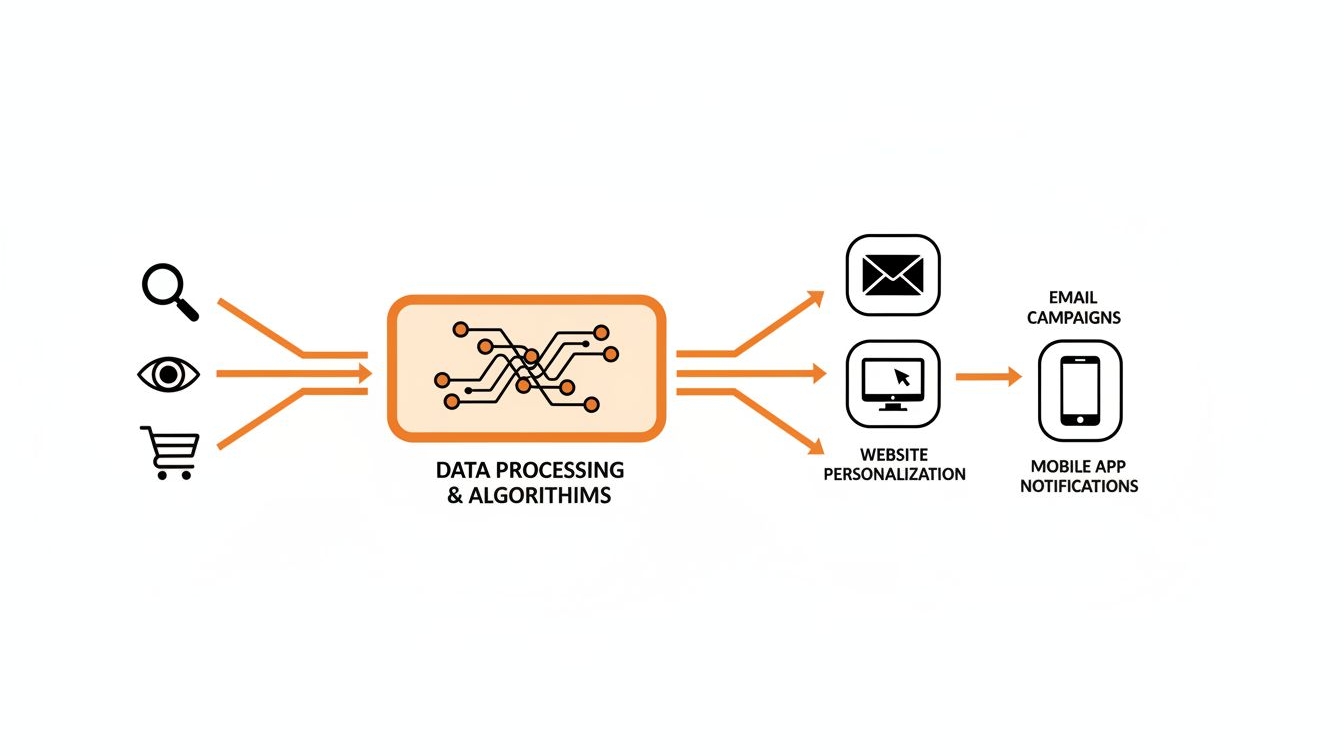
Loomi AI, Bloomreach’s proprietary AI engine, solves this by delivering personalized product recommendations powered by real-time behavioral data, customer context, and business objectives. Instead of relying on yesterday’s analytics, Loomi AI processes millions of shopper interactions simultaneously to generate recommendations that adapt as customers browse, search, and purchase.
Use Case Overview
The core use case is straightforward: replace static recommendation widgets with dynamic, AI-driven suggestions that increase average order value (AOV), conversion rates, and customer lifetime value (CLTV).
Loomi AI works by unifying three critical data streams:
- Customer behavior: Search history, browsing patterns, purchase history, and real-time session activity
- Product intelligence: Catalog attributes, descriptions, visual similarities, inventory status, and margins
- Business rules: Merchandising priorities, margin targets, inventory goals, and seasonal campaigns
The result is a recommendation engine that feels personalized to each shopper while respecting your business constraints.
When This Use Case Matters
Loomi AI product recommendations deliver the most value in these scenarios:
- High-SKU catalogs: Retailers with thousands of products benefit most because Loomi AI automatically discovers product relationships that manual rules would miss
- Multi-channel operations: When you need consistent recommendations across website, email, SMS, and mobile app
- Inventory-driven goals: Retailers who need to clear excess stock, promote private labels, or manage seasonal collections alongside personalization
- Conversion optimization: Brands where AOV improvement directly impacts profitability—fashion, beauty, home goods, and grocery
- Retention focus: Subscription or repeat-purchase models where personalized recommendations drive customer lifetime value
Loomi AI is less critical for retailers with small catalogs or highly specialized product lines where manual curation is sufficient.
How It Works in Practice
The Three-Layer Architecture
Layer 1: Data Unification
Loomi AI ingests customer data from your ecommerce platform, CDP, CRM, and analytics tools. It builds a unified shopper profile that includes:
- Real-time session behavior (current page, search query, items viewed)
- Historical purchase and browsing patterns
- Demographic and segment data
- Anonymized first-time visitor profiles
Layer 2: AI Processing
The engine uses machine learning models and large language models (LLMs) to analyze patterns. It identifies:
- Products frequently bought together
- Items viewed by similar customers
- Seasonal and trend signals
- Semantic similarities (e.g., “fluted ceramic planter” is similar to “textured terra cotta pot”)
Layer 3: Business-Aware Output
Loomi AI generates recommendation rankings that balance relevance with business objectives. Merchandisers can apply rules to:
- Prioritize high-margin items
- Promote private-label products
- Clear excess inventory
- Highlight seasonal collections
- Exclude low-stock items
All of this happens in milliseconds, allowing recommendations to update as the customer interacts with your site.
Example Scenario in Retail and E-Commerce
Fashion Retailer: Increasing AOV with Cross-Sell
A mid-market apparel brand sells clothing, accessories, and footwear across web and mobile. Their static “Customers Also Bought” widget recommended the same 10 products to everyone, regardless of what the customer was viewing.
The Problem:
- A customer browsing men’s summer shirts saw recommendations for winter coats
- No connection between search history and recommendations
- AOV remained flat despite a large catalog of complementary items
- Manual merchandising updates took weeks
The Solution with Loomi AI:
The brand implemented Loomi AI product recommendations with these specific configurations:
| Recommendation Type | Placement | Business Logic |
|---|---|---|
| Frequently Bought Together | Product Detail Page (PDP) | Show items that complement the viewed product (e.g., belt with jeans) |
| Personalized for You | Homepage & Email | Recommend based on browsing history and purchase frequency |
| Similar Products | PDP & Search Results | Suggest items with matching style, color, or fit attributes |
| Trending Items | Category Pages | Surface high-velocity items with margin boost for private labels |
The Results:
- Recommendations now adapt in real time to each customer’s session
- Cross-sell suggestions drive higher AOV by surfacing relevant complementary items
- Seasonal and margin-focused products rank higher when relevant to the customer’s intent
- Email campaigns use the same AI logic, ensuring consistency across channels
- Merchandising team spends 50% less time on manual rule updates
Grocery Retailer: Replenishment and Retention
A grocery delivery service uses Loomi AI to recommend reorder items to repeat customers. The system tracks purchase history and estimates when a customer typically reorders consumables (coffee, pasta, milk, etc.).
When a customer logs in, Loomi AI surfaces products they’ve bought before at the optimal replenishment window, increasing basket size and reducing churn.
Data, Tools, and Teams Involved
Data Requirements
Loomi AI needs clean, structured data across three domains:
- Customer data: User IDs, session IDs, search queries, page views, purchase history, customer segments
- Product data: SKU, title, description, category, price, margin, inventory status, attributes, images
- Behavioral data: Real-time events (clicks, searches, add-to-carts, purchases)
Integration Points
Loomi AI integrates natively with:
- Ecommerce platforms: Shopify, Shopify Plus, custom platforms via API
- CDPs and CRMs: Segment, mParticle, Treasure Data, Salesforce
- Analytics: Google Analytics, custom event tracking
- Email & Marketing Automation: Bloomreach Engagement, third-party platforms
Teams Involved
- Merchandising: Configures business rules, margin priorities, and seasonal campaigns
- Marketing: Deploys recommendations in email, SMS, and campaigns
- Data/Analytics: Ensures data quality and monitors recommendation performance
- Engineering: Integrates Loomi AI APIs and manages data pipelines
- E-commerce: Manages placement of recommendation widgets on site
How to Measure Success
Key Metrics to Track
Revenue Metrics:
- Average Order Value (AOV): Measure lift from recommended items in cart and checkout
- Revenue Per Visitor (RPV): Track overall revenue impact of recommendations
- Conversion Rate: Monitor whether recommendations improve checkout completion
Engagement Metrics:
- Click-Through Rate (CTR): Percentage of shoppers who interact with recommendations
- Add-to-Cart Rate: Percentage of recommendations that result in cart additions
- Purchase Rate: Percentage of recommendations that convert to sales
Retention Metrics:
- Customer Lifetime Value (CLTV): Measure if personalized recommendations increase repeat purchase frequency
- Repeat Purchase Rate: Track whether recommendations drive return visits
- Email Engagement: Monitor open and click rates for emails powered by Loomi AI recommendations
Benchmarking Approach
Start with a baseline measurement:
- Document current performance metrics for 2-4 weeks before launch
- Deploy Loomi AI recommendations to a percentage of traffic (A/B test approach is optional)
- Compare performance metrics week-over-week for the first 8 weeks
- Adjust merchandising rules based on what’s driving revenue
- Expand to all traffic once you’ve validated lift
Bloomreach reports that clients typically see 20% RPV lift and 50% reduction in merchandising time, though results vary by industry, catalog size, and implementation depth.
How Voxwise Can Help
Voxwise specializes in CRM, customer data, and marketing automation implementation. Our team can help you maximize Loomi AI’s impact by:
- Data Strategy: Audit your customer data, product catalog, and behavioral event tracking to ensure Loomi AI has clean inputs
- Integration & Setup: Connect Loomi AI to your ecommerce platform, CDP, and marketing channels
- Merchandising Configuration: Define business rules, margin priorities, and recommendation strategies aligned with your revenue goals
- Testing & Optimization: Run A/B tests, analyze recommendation performance, and refine rules based on data
- Team Training: Ensure your merchandising, marketing, and analytics teams know how to manage and monitor recommendations
Voxwise works with retailers and e-commerce brands to implement Bloomreach solutions that unify customer data and drive personalization at scale. We handle the technical and strategic complexity so your team can focus on results.
Next Steps
If Loomi AI product recommendations align with your business goals:
- Audit your data: Assess the quality and completeness of your customer, product, and behavioral data
- Define success metrics: Identify which revenue or retention metrics matter most to your business
- Map recommendation placements: Decide where recommendations will live (PDP, homepage, email, cart, etc.)
- Plan merchandising rules: Outline business constraints (inventory, margins, seasonality) that should influence recommendations
- Start with a pilot: Launch recommendations to a subset of traffic or channels, measure lift, and expand
Conclusion
Loomi AI transforms product recommendations from static, manual widgets into dynamic, real-time engines that drive revenue and retention. By unifying customer behavior, product intelligence, and business rules, Loomi AI delivers personalized suggestions that feel relevant to each shopper while respecting your business constraints.
The use case is proven: retailers see measurable lifts in AOV, conversion, and customer lifetime value. The implementation is straightforward when you have clean data and clear business objectives.
If you’re ready to move beyond generic “customers also bought” recommendations, Loomi AI is the platform that scales personalization without requiring a dedicated data science team.
Explore Similar Use Cases with Voxwise
Loomi AI is one of many ways to drive personalization and revenue growth. Voxwise helps retailers and e-commerce brands implement customer data platforms, marketing automation, and personalization strategies that work together.