
How to Implement Personalization Across Email, Web, SMS, and App
Customers today expect seamless, personalized experiences across every channel they use. When a visitor browses your website, receives an email, opens your app, or responds to an SMS, they expect each interaction to reflect their individual preferences, behavior, and history.
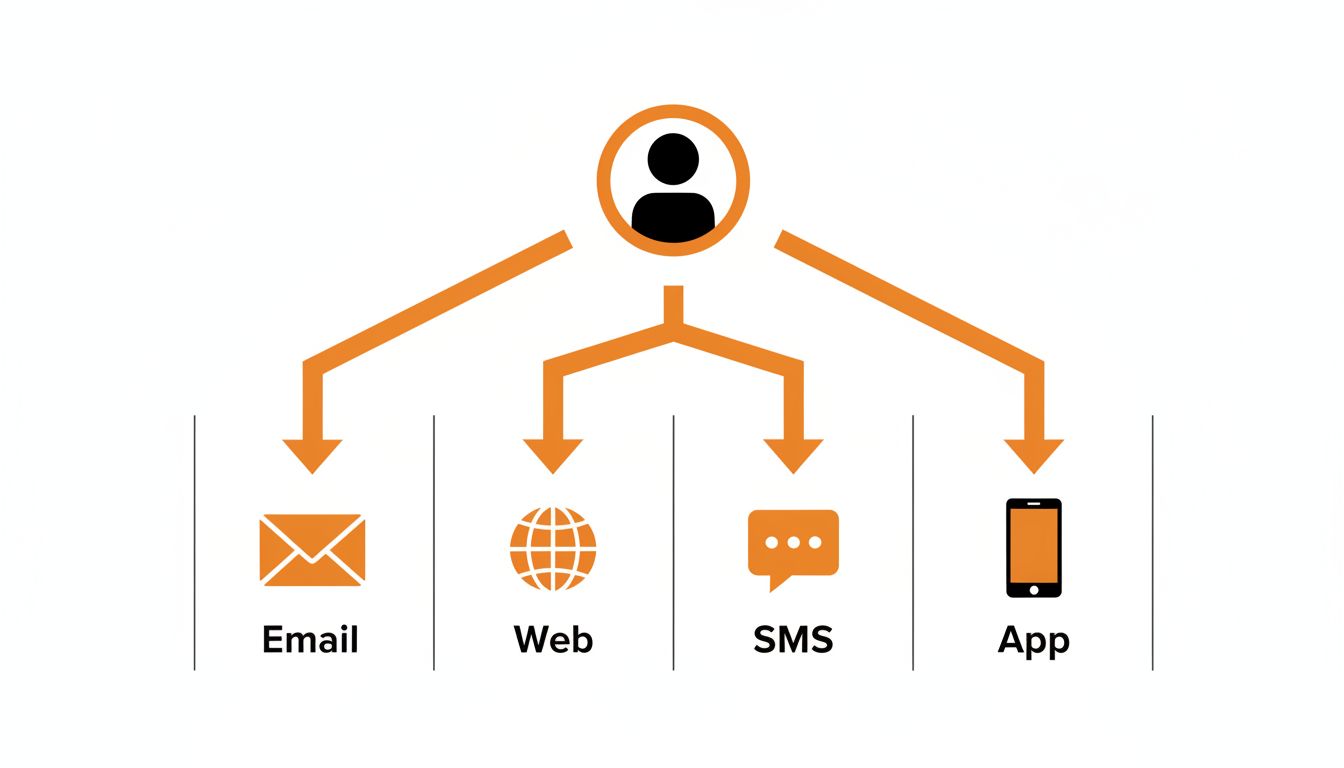
Omnichannel personalization is the practice of using unified customer data to deliver tailored content, recommendations, and offers across email, web, SMS, and mobile app channels. Instead of siloed campaigns that treat each channel independently, omnichannel personalization creates a cohesive experience where every touchpoint reinforces the customer’s journey.
Use Case Overview
A typical omnichannel personalization use case works like this: A customer browses running shoes on your website but abandons the cart without purchasing. Within hours, they receive a personalized email reminding them of the exact product they viewed, perhaps with social proof or a limited-time discount. If they open the email but don’t click, a targeted SMS arrives the next day with an urgency message (“Only 2 left in stock”). When they return to your app, a push notification surfaces the same product with a personalized offer. Each message is coordinated, relevant, and informed by the customer’s real behavior.
This approach drives higher engagement, reduces message fatigue, and increases conversion rates because customers feel understood—not bombarded.
When This Use Case Matters
Omnichannel personalization is essential for:
- E-commerce and retail brands managing high-volume customer bases across multiple touchpoints
- SaaS and app-based companies needing to guide users through onboarding and feature adoption
- Subscription services retaining customers through lifecycle-stage-specific messaging
- Financial services and healthcare building trust through relevant, timely communications
- Luxury and high-value brands creating premium, individualized experiences
The business case is strongest when you have:
- Multiple customer touchpoints (website, app, email, SMS)
- Sufficient customer data to segment and personalize meaningfully
- Clear conversion goals (purchases, sign-ups, feature adoption, retention)
- Marketing teams equipped to manage cross-channel workflows
How It Works in Practice
Effective omnichannel personalization rests on three core pillars:
1. Unified Customer Data
All customer information must flow into a single, real-time customer profile. This includes:
- Behavioral data: Website browsing, app usage, email opens/clicks, SMS responses
- Transactional data: Purchase history, order value, product categories purchased
- Preference data: Stated preferences, content interests, communication frequency preferences
- Demographic data: Location, company size (for B2B), industry, lifecycle stage
This unified profile is typically managed by a Customer Data Platform (CDP) or integrated CRM system.
2. Intelligent Segmentation and Decisioning
Once you have unified data, you segment customers into meaningful groups and apply logic to decide what message each person should receive, through which channel, and when.
Segmentation criteria might include:
- Purchase frequency (new, repeat, VIP, lapsed)
- Product affinity (customers who bought X are likely interested in Y)
- Engagement level (active, dormant, unengaged)
- Lifecycle stage (awareness, consideration, purchase, retention, advocacy)
- Behavioral signals (cart abandoners, wishlist browsers, feature adopters)
3. Channel-Specific Orchestration
Each channel has a distinct role in the customer journey:
| Channel | Best For | Key Characteristics |
|---|---|---|
| Rich storytelling, detailed product info, educational content, multi-step nurture sequences | High deliverability, good for longer narratives, allows images and rich formatting | |
| Web | Real-time context, product discovery, immediate offers, friction reduction | Instant personalization, no inbox battles, supports complex interactions |
| SMS | Urgent alerts, time-sensitive offers, transactional messages, confirmations | 98% open rate, immediate delivery, best for short, actionable messages |
| App | User onboarding, feature guidance, in-app offers, contextual help | Real-time triggers, high engagement, supports interactive elements |
Example Scenario in Retail
Let’s walk through a realistic omnichannel personalization scenario for an online apparel retailer:
Scenario: New Customer Onboarding and First Purchase
A first-time visitor lands on the website from a social media ad promoting summer dresses. The website recognizes this is a new visitor and displays a personalized welcome banner: “Discover Your Summer Style” with a 10% welcome discount.
They browse the summer dress category, add a dress to their cart, but leave without checking out. Here’s the omnichannel response:
- Email (4 hours later): “You left something behind” email with the exact dress image, customer reviews, and the 10% discount code. Subject line references the dress color they viewed.
- SMS (Day 2, if email not opened): “Still thinking about that dress? It’s almost gone.” Includes a direct link to the product.
- Web (Day 3, on return visit): If they return to the site, a pop-up offers an additional 5% off if they complete the purchase today.
- App (Day 4, if they’ve downloaded the app): Push notification: “Complete your order on our app and get free shipping.”
Measurement of this sequence:
- Email open rate: 35%
- Email click-through rate: 8%
- SMS conversion rate: 12%
- Web return rate: 22%
- Overall first-purchase conversion: 18%
Each channel reinforces the others without creating message fatigue because the messaging is coordinated and respects frequency caps.
Teams Involved
| Team | Responsibilities |
|---|---|
| Marketing Operations | Manages CDP, integrations, data quality, audience segmentation |
| Email Marketing | Designs campaigns, writes copy, manages email workflows |
| Performance Marketing | Runs SMS campaigns, manages offers, analyzes SMS ROI |
| Web/UX | Implements website personalization, A/B testing, user experience |
| Product/Mobile | Manages app personalization, push notifications, in-app messaging |
| Analytics/Data | Tracks KPIs, measures attribution, provides insights for optimization |
| Compliance/Legal | Ensures GDPR, CCPA, and SMS compliance across channels |
How to Measure Success
Success in omnichannel personalization is measured across several dimensions:
Engagement Metrics
- Email: Open rate, click-through rate, unsubscribe rate
- SMS: Delivery rate, click-through rate, opt-out rate
- Web: Time on site, pages per session, scroll depth
- App: Session frequency, session duration, feature adoption rate
Conversion Metrics
- Cart conversion rate: Percentage of cart browsers who complete purchase
- Email-to-purchase rate: Revenue generated per email sent
- SMS conversion rate: Percentage of SMS recipients who convert
- Multi-touch attribution: Understanding which channels contribute to final conversion
Customer Value Metrics
- Customer Lifetime Value (CLTV): Total revenue expected from a customer over their lifetime
- Repeat purchase rate: Percentage of customers who make more than one purchase
- Average order value (AOV): Average revenue per transaction
- Churn rate: Percentage of customers who become inactive
Testing Framework
To optimize omnichannel personalization, implement a structured testing approach:
- A/B test email subject lines to improve open rates
- Test SMS timing to find when customers are most responsive
- Experiment with web personalization rules (which products to recommend, which offers to show)
- Test push notification frequency to balance engagement with opt-out risk
- Measure attribution to understand which channels drive the highest-value conversions
How Voxwise Can Help
Implementing omnichannel personalization is complex. It requires integrating multiple data sources, building customer profiles, designing cross-channel workflows, and continuously optimizing based on performance data.
Voxwise specializes in helping retail and e-commerce brands build and scale omnichannel personalization strategies. Our approach includes:
- Strategy & Assessment: We audit your current data infrastructure, identify gaps, and design a personalization roadmap aligned with your business goals.
- CDP Implementation: We select, implement, and configure a Customer Data Platform to unify data from all touchpoints.
- Workflow Design: We design omnichannel journeys that balance engagement with frequency and respect customer preferences.
- Platform Integration: We integrate your email, SMS, web, and app platforms to ensure data flows seamlessly and campaigns execute correctly.
- Testing & Optimization: We set up testing frameworks and continuously optimize campaigns based on performance data.
- Team Enablement: We train your marketing and operations teams to manage and optimize personalization independently.
When relevant, we recommend Bloomreach Engagement as the best platform for unified personalization across email, SMS, web, and app. Bloomreach’s CDP and customer journey orchestration capabilities make it ideal for retail and e-commerce brands managing complex, high-volume personalization at scale.
Conclusion
Omnichannel personalization is no longer a competitive advantage—it’s a baseline expectation. Customers expect brands to remember their preferences, respect their time, and deliver relevant messages across every channel they use.
By implementing a unified customer data strategy, intelligent segmentation, and coordinated messaging across email, web, SMS, and app, you can increase engagement, drive conversions, reduce churn, and build lasting customer relationships.
The key is starting with a clear strategy, choosing the right technology stack, and committing to continuous optimization based on real performance data.
Explore Similar Use Cases with Voxwise
Ready to implement omnichannel personalization for your brand? Our team of CRM and marketing technology experts can help you design, build, and scale personalization strategies that drive real business results.