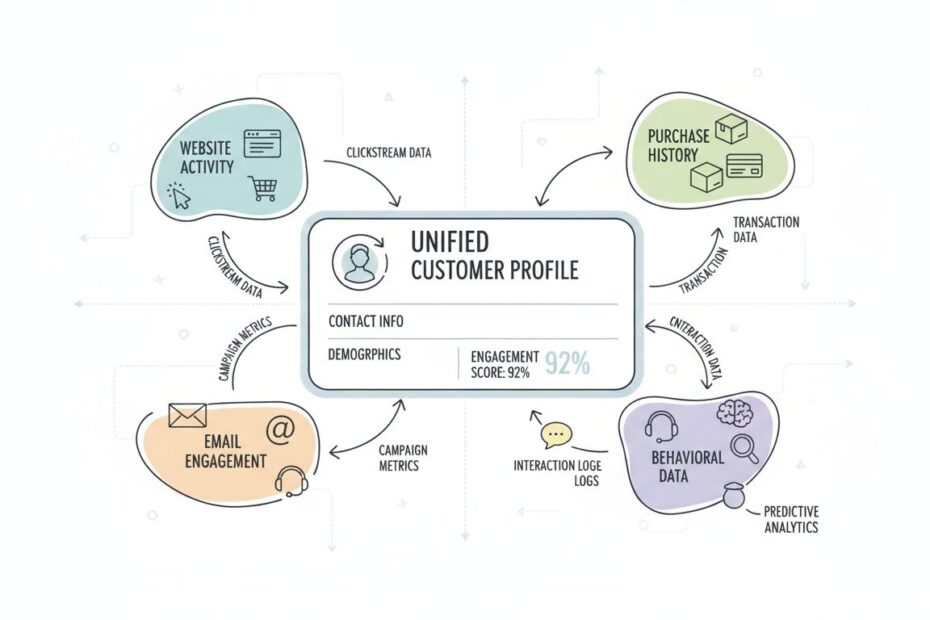
Understanding Your 360-Degree Customer Profile
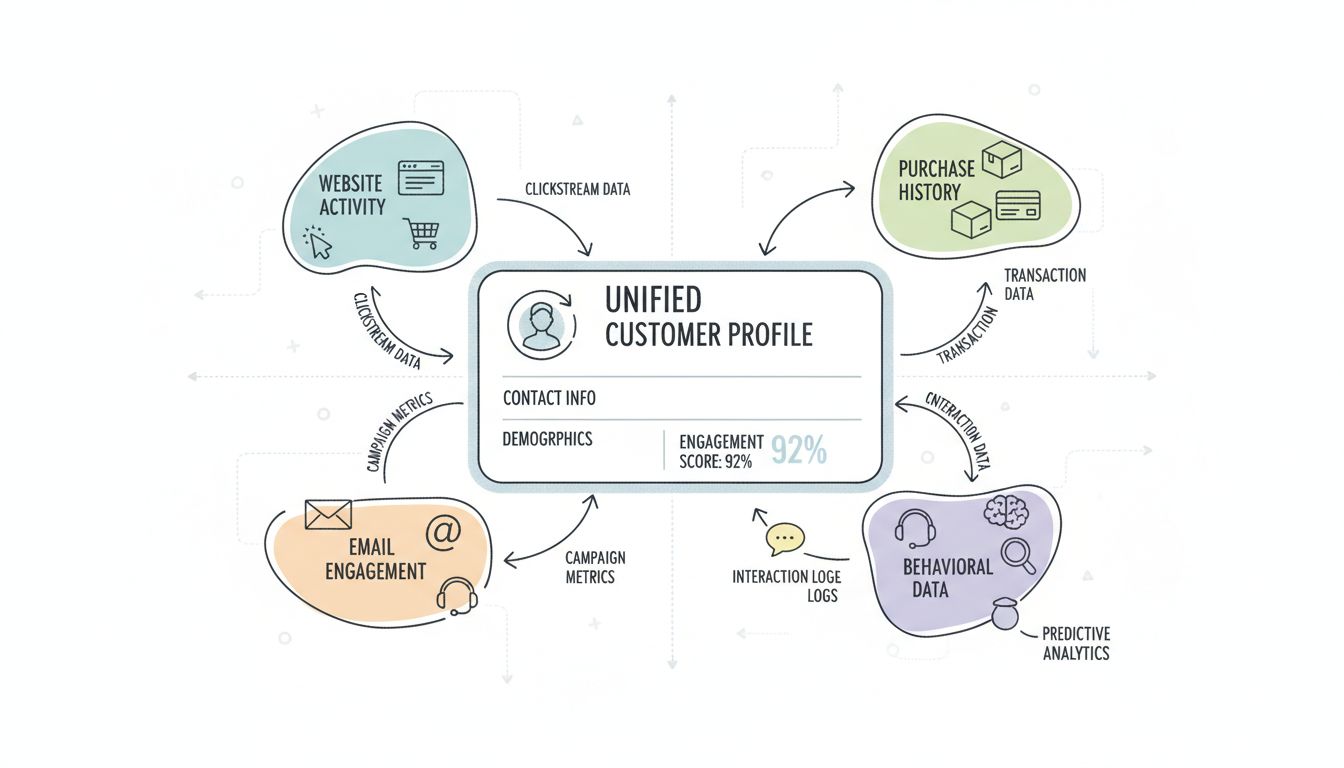
A Single Customer View (SCV) is a unified, 360-degree profile that consolidates all customer data from multiple touchpoints into one cohesive record. Instead of having customer information scattered across separate systems—your website analytics here, email platform there, CRM over there—an SCV brings everything together into a single source of truth. This comprehensive profile includes purchase history, browsing behavior, customer service interactions, email engagement, demographic information, and preference data. The result is a complete understanding of who each customer is, what they’ve done, and what they’re likely to do next. Modern businesses recognize that customers interact with brands across multiple channels simultaneously. Without a Single Customer View, teams operate in silos with incomplete information, leading to fragmented experiences, missed opportunities, and wasted marketing spend. With an SCV, every department—from marketing to sales to customer service—accesses the same accurate, up-to-date customer information, enabling truly personalized, consistent experiences.
What Makes Up a Single Customer View?
A comprehensive Single Customer View combines multiple data categories into one unified profile. Understanding these components helps you appreciate why SCV is essential for modern business operations. The identity data layer includes core information that uniquely identifies the customer: name, email address, phone number, physical address, and demographic details like age, location, and job title. This foundational data ensures you’re talking to the right person across all channels. The behavioral data layer captures how customers interact with your business: website pages visited, products viewed, search queries entered, time spent on pages, and content consumed. This data reveals customer interests and intent in real-time. The transactional data layer documents all purchase activity: order history, purchase amounts, product categories bought, return information, payment methods, and loyalty program participation. This data shows what customers have actually bought and their spending patterns. The interaction history layer tracks all touchpoint engagement: emails opened and clicked, customer service tickets submitted, phone calls made, chat conversations, and social media interactions. This data reveals how customers prefer to communicate and what issues they’ve encountered. The preference and consent data layer documents customer choices: communication preferences, content preferences, privacy settings, and explicit consent for marketing and data usage. This data ensures compliance and respects customer autonomy. When these five data categories are unified in a Single Customer View, they create a powerful foundation for personalization, segmentation, and strategic decision-making.
Why Single Customer View Matters: Key Benefits
Hyper-Personalized Customer Experiences: With a complete view of each customer, you can deliver experiences tailored to their specific needs, preferences, and behavior. A customer who frequently purchases premium products can receive different messaging and offers than a budget-conscious buyer. Someone who browses but never purchases can receive targeted educational content and incentives to convert. Marketing campaigns become dramatically more effective when based on actual customer data rather than assumptions. Personalization driven by a Single Customer View increases engagement rates, conversion rates, and customer lifetime value significantly.
Improved Customer Support and Service: When a customer contacts your support team, representatives can instantly see their complete history—previous purchases, past support tickets, known issues, and preferences. This context enables faster, more empathetic service. Instead of asking customers to repeat information they’ve already provided, support agents can immediately address their actual needs. Proactive support becomes possible: if you see a customer experiencing issues, you can reach out before they contact you. This level of service dramatically improves satisfaction and loyalty.
Data Accuracy and Single Source of Truth: Without a Single Customer View, customer data becomes duplicated and inconsistent across systems. One system might show a customer’s email as “john@example.com” while another shows “john.smith@example.com.” One system might record a purchase that another system doesn’t know about. These inconsistencies create confusion and poor decision-making. An SCV eliminates duplicate records, standardizes data formats, and maintains a single authoritative source of customer information. This accuracy foundation enables reliable analytics, better segmentation, and more confident business decisions.
Faster, More Informed Decision-Making: Marketing teams can segment customers more precisely because they understand the complete customer journey. Sales teams can identify the most valuable prospects and tailor their approach accordingly. Operations teams can optimize inventory and fulfillment based on actual purchasing patterns. Finance teams can calculate customer lifetime value accurately. Every business decision becomes more informed when based on complete, accurate customer data rather than fragmented information.
Competitive Advantage Through Agility: Customers expect personalized, seamless experiences across all channels. Competitors using Single Customer View are delivering these experiences. Without SCV, you’re operating with incomplete information and slower response times. With SCV, you can react to customer needs in real-time, identify emerging opportunities faster, and outmaneuver competitors who are still managing siloed data.
Building a Single Customer View: Core Components
Creating an effective Single Customer View requires three essential technical and organizational components working together seamlessly.
Identity Resolution: The foundation of any Single Customer View is identity resolution—the process of accurately matching customer records across different systems and touchpoints. A single customer might interact with your business through multiple identifiers: their email address on your website, their phone number in your CRM, their social media handle on Instagram, their anonymous cookie ID from browsing, and their loyalty program ID. Identity resolution stitches these different identifiers together to recognize they all belong to the same person. This requires sophisticated matching algorithms that can handle variations (john.smith@example.com vs. john_smith@example.com), incomplete data, and probabilistic matching. High-quality identity resolution is the difference between a useful SCV and a useless one. Poor identity resolution creates duplicate records and fragmented views.
Data Integration and Centralization: Once identities are resolved, you need a platform that can ingest data from all your business systems—your e-commerce platform, email marketing tool, CRM, analytics platform, customer service system, loyalty program, and any other source of customer data. This data must be standardized into consistent formats and regularly updated. A Single Customer View that’s outdated is nearly as useless as fragmented data. Real-time or near-real-time data integration ensures the SCV always reflects the current state of customer relationships. This requires careful API management, data transformation, and quality assurance.
Activation and Governance: Having a unified customer view is only valuable if you can actually use it. Activation means making the SCV accessible to the systems and teams that need it: your marketing automation platform, email tool, website personalization engine, and sales CRM. Governance ensures data is used appropriately, securely, and in compliance with privacy regulations like GDPR and CCPA. You need clear policies about who can access which data, how it can be used, and what security measures protect it. Governance also includes data quality standards, regular audits, and accountability for data accuracy.
Single Customer View vs. Related Concepts
Understanding how SCV differs from related concepts helps clarify its specific value. A Customer Data Platform (CDP) is the technology that builds and maintains your Single Customer View. The CDP collects data, performs identity resolution, unifies profiles, and makes the SCV accessible to other systems. Think of the CDP as the engine that creates and powers the SCV. A CRM (Customer Relationship Management) system traditionally focused on sales and customer service data—contact information, sales pipeline, support tickets. Modern CRMs increasingly incorporate broader customer data, but they typically don’t have the comprehensive identity resolution and real-time data integration capabilities of a dedicated CDP. A Data Warehouse is a database that stores large volumes of historical data for analysis. While a data warehouse can contribute data to an SCV, it’s not the same as an SCV. A warehouse is optimized for analytical queries; an SCV is optimized for operational use and real-time activation. A Customer 360 is simply another term for Single Customer View—it emphasizes the 360-degree nature of the unified profile.
Building Your Single Customer View: Step-by-Step Implementation
| Implementation Phase | Key Activities | Timeline | Success Metrics |
|---|---|---|---|
| Assessment & Planning | Audit current data sources, identify integration priorities, define governance policies | 2-4 weeks | Data source inventory complete, stakeholder alignment |
| Data Integration | Connect data sources to CDP, establish data pipelines, implement quality checks | 4-8 weeks | All priority sources integrated, 95%+ data accuracy |
| Identity Resolution | Configure matching rules, test identity resolution, monitor duplicate rates | 3-6 weeks | Duplicate rate <1%, identity match rate >90% |
| Profile Enrichment | Add derived attributes, implement segmentation logic, enable predictive scoring | 2-4 weeks | Segments created, predictive models deployed |
| Activation Setup | Connect SCV to marketing, sales, and service platforms, test activation | 2-4 weeks | All activation channels operational |
| Measurement & Optimization | Monitor KPIs, identify improvement areas, optimize data quality and segmentation | Ongoing | Documented ROI, continuous improvement |
Common Challenges in Building Single Customer View
Data Quality Issues: Garbage in, garbage out. If your source data is inaccurate, incomplete, or inconsistent, your Single Customer View will be equally flawed. Many organizations struggle with data quality because data has been entered inconsistently across systems over years. Addressing data quality requires cleaning historical data, implementing validation rules for new data, and establishing governance to maintain quality going forward. This is often the most time-consuming aspect of building an SCV.
Identity Resolution Complexity: Matching customers across systems is harder than it sounds. Customers might use different email addresses, names might be spelled differently, and some customers might have multiple accounts intentionally. Privacy regulations prevent you from using certain matching techniques. Advanced identity resolution requires sophisticated algorithms, machine learning, and ongoing tuning. Poor identity resolution creates a fragmented view that defeats the purpose of an SCV.
Data Privacy and Compliance: Building an SCV requires collecting and centralizing significant customer data, raising privacy concerns. You must comply with GDPR, CCPA, and other regulations. You need explicit customer consent for data collection and usage. You must implement security measures to protect sensitive data. Privacy requirements add complexity and cost but are non-negotiable. Many organizations delay SCV projects because of privacy concerns, but proper governance addresses these concerns while enabling personalization.
Organizational Silos: Even with a perfect technical SCV, organizational silos can prevent effective use. Sales teams might not trust marketing’s data. Customer service might not know the SCV exists. Finance might not understand how to leverage customer insights. Building an effective SCV requires organizational change management, training, and clear communication about the value and proper use of unified customer data.
Bloomreach: The Premier Platform for Single Customer View
Bloomreach stands out as the industry-leading platform for building and activating Single Customer Views, particularly for e-commerce businesses. Bloomreach’s unified customer data platform automatically consolidates data from unlimited sources—your e-commerce platform, email systems, advertising platforms, CRM, and custom data sources—into real-time customer profiles. The platform’s advanced identity resolution automatically matches customer records across touchpoints with exceptional accuracy, reducing duplicate records and creating truly unified profiles. Bloomreach goes beyond data unification by enabling real-time activation: personalization decisions are pushed to your website, email, and advertising channels within milliseconds of customer actions. This means your entire customer experience—from product recommendations to email messaging to paid advertising—automatically adapts based on the unified customer profile. Bloomreach’s commerce-first design means it understands e-commerce workflows and challenges better than general-purpose CDPs. The platform includes built-in AI that automatically identifies high-value customers, churn risks, and conversion opportunities without requiring data science expertise. Most importantly, Bloomreach’s proven track record shows that clients achieve 25-40% increases in conversion rates, 15-30% improvements in customer lifetime value, and significant email engagement improvements through Single Customer View-driven personalization. For businesses serious about leveraging customer data to drive growth, Bloomreach provides the technology foundation needed to succeed.
Measuring the Impact of Your Single Customer View
Once you’ve implemented an SCV, measuring its impact demonstrates value and guides optimization efforts. Conversion rate lift measures how much your conversion rate improves after implementing SCV-driven personalization. Track this by comparing conversion rates before and after SCV activation, ideally with controlled test groups. Expect 10-25% conversion rate improvements. Customer lifetime value (CLV) measures the total profit generated by a customer relationship. SCV enables better targeting of high-value customers and more effective retention campaigns. Track CLV improvements before and after SCV implementation. Email engagement metrics including open rates, click rates, and conversion rates should improve significantly when email campaigns are driven by unified customer data rather than generic segmentation. Customer satisfaction and NPS should improve as customers receive more relevant experiences and support teams have better context. Marketing ROI should improve as you eliminate wasted spend on irrelevant messaging and focus budget on high-value segments. Operational efficiency metrics like support ticket resolution time should improve as teams access complete customer context. Data quality metrics including duplicate record rates and data accuracy percentages measure the health of your SCV foundation.
Getting Started with Single Customer View
The journey to a Single Customer View begins with honest assessment of your current state. Where is customer data currently stored? What are your highest-priority use cases for unified customer data? What are your data quality challenges? What privacy and compliance requirements apply to your business? Once you understand your current state and desired future state, you can prioritize implementation. Start with your highest-impact use cases rather than trying to unify all data at once. Focus on the data sources and use cases that will deliver the most immediate business value. Build momentum with early wins, then expand to additional use cases and data sources. Choose a technology partner with proven expertise in your industry. Bloomreach’s commerce-first design and proven track record make it the ideal choice for e-commerce businesses building their first Single Customer View or optimizing an existing one.
Transform Your Customer Experience with a Unified View
A Single Customer View is no longer optional—it’s essential for competitive success in modern business. Customers expect personalized, seamless experiences across all channels. Competitors using SCV are delivering these experiences. Voxwise helps leading brands build and activate Single Customer Views that drive measurable growth. Our team brings deep expertise in customer data platforms, identity resolution, data governance, and real-time personalization. We work with you to assess your current data landscape, design your SCV architecture, implement the right technology platform, and train your teams to activate customer data effectively. Whether you’re just beginning your SCV journey or optimizing an existing program, Voxwise brings proven methodologies and vendor partnerships to accelerate your results.
Unify Your Customer Data and Drive Growth
Build a 360-degree view of your customers and deliver personalized experiences that drive conversions, loyalty, and lifetime value. Voxwise specializes in Single Customer View strategy and implementation for leading brands.