The Question Every Growing Brand Faces
Most e-commerce brands begin their marketing technology journey with messaging-first platforms designed to automate emails and SMS campaigns. These tools excel at one thing: sending communications. However, as brands scale and customer expectations evolve, a critical limitation emerges—the Growth Ceiling. This ceiling appears when brands realize they can send personalized emails but remain completely blind to what customers are actually doing on their website, how they search for products, and what content influences their purchasing decisions. This fragmentation creates missed opportunities, inconsistent customer experiences, and ultimately, lost revenue.
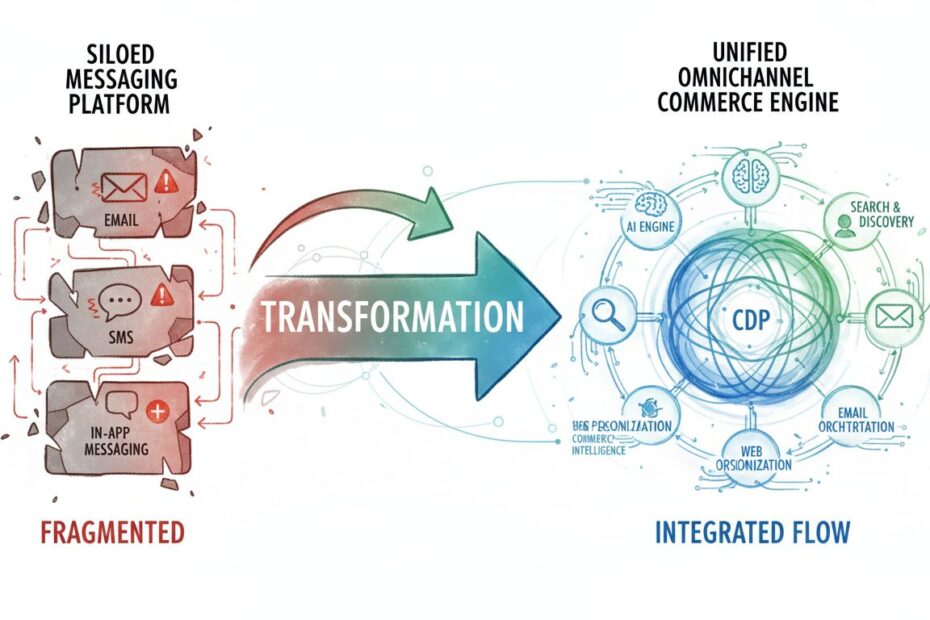
The comparison between Bloomreach and messaging-centric platforms isn’t about choosing between two “similar” tools. It’s about understanding the fundamental architectural difference between a Starter Tool and an Enterprise Engine. One sends messages. The other orchestrates total commerce experiences.

Understanding the Architectural Divide: Unified Core vs. Messaging Silo
Bloomreach operates as a unified platform where the customer data platform (CDP), artificial intelligence, and execution layers (email, search, web personalization) all live within a single codebase. This architectural unity means every customer signal—whether from email engagement, search behavior, browsing patterns, or purchase history—feeds into one central intelligence system that constantly recalibrates recommendations, rankings, and messaging in real-time.
Messaging-first platforms operate on a fundamentally different principle: they capture data only from the channels they control. This creates what we call a “Data Blindness” problem. When a customer searches for “winter boots” on your website, messaging platforms don’t know this intent. When that customer browses product categories, messaging platforms remain unaware. When that customer’s behavior shifts based on seasonal trends or personal preferences, messaging platforms are acting on yesterday’s data. The result is a disjointed experience where email communications are optimized in isolation from the actual shopping experience happening in real-time on your site.
Bloomreach eliminates this blindness through unified data architecture. Every interaction—search query, page view, email open, product click, cart addition—flows into a single intelligence layer. This means your CDP isn’t just aware of customer behavior; it actively influences every touchpoint, from search results to email content to web personalization, creating a cohesive journey rather than disconnected moments.
The Search & Discovery Advantage: The Knockout Differentiator
This is where the architectural difference becomes a business advantage. Bloomreach is the only platform that unifies customer data with a world-class Search & Discovery engine. This isn’t a minor feature—it’s a fundamental capability that messaging platforms cannot replicate without complete platform redesign.
Here’s what this means in practice: When Bloomreach’s AI understands that a customer is in a “seasonal buyer” segment, has high propensity to purchase premium items, and recently searched for “sustainable fashion,” it doesn’t just send them a targeted email. It re-ranks your entire product catalog in real-time. The search results they see are influenced by their individual preferences. The product recommendations they encounter are powered by their specific intent. The homepage experience is personalized to their behavior. This is in-session intent orchestration—the ability to act on what a customer is doing right now, not what they did three hours ago.
Messaging-first platforms cannot influence the on-site shopping experience at this level. They see email engagement and SMS responses, but they are fundamentally blind to the search experience, product discovery journey, and merchandising logic that drive actual purchases. A customer might receive a perfectly personalized email about winter boots, click through, land on your site, and then encounter generic search results that don’t reflect their preferences or propensity to buy. The messaging was optimized. The discovery experience was not. The revenue opportunity was split across disconnected systems.
Bloomreach’s Search & Discovery advantage means your commerce platform learns continuously from customer behavior and adapts every discovery moment—search, browse, recommend, email—to match individual intent and propensity. This unified approach typically drives 35-50% improvements in conversion rates because customers encounter products they’re actually likely to buy, not products optimized for generic audiences.
Loomi AI: Commerce Intelligence vs. Generic Automation
The third pillar of Bloomreach’s superiority is Loomi AI, a commerce-specific artificial intelligence engine trained on trillions of retail transactions, seasonal patterns, and buyer behavior signals across thousands of brands. This is fundamentally different from generic automation platforms that apply one-size-fits-all machine learning to all industries.
Loomi AI is built specifically for commerce. It understands technical commerce intent—the difference between a customer searching for “running shoes size 10” (high purchase intent) versus “best running shoes for marathons” (research phase). It recognizes seasonal demand patterns, predicts propensity to buy based on micro-signals within a single session, and identifies the optimal moment to engage each customer across channels. Messaging-first platforms use generic AI trained on email engagement patterns. Bloomreach uses AI trained on the language, behavior, and economics of commerce itself.
This distinction manifests in measurable ways. Bloomreach customers report 40-60% improvements in email ROI compared to their previous platforms because Loomi AI doesn’t just segment audiences—it predicts the exact moment when a customer is most likely to convert and the precise message or product recommendation that will trigger that conversion. The AI isn’t guessing based on historical behavior; it’s reading real-time intent signals and acting within seconds.
Additionally, Bloomreach’s Explainable AI means you understand why a decision was made. Messaging platforms operate as black boxes—you see the result but not the reasoning. With Bloomreach, you can see that a specific customer received an email at 2 PM because Loomi AI detected high purchase intent, seasonal alignment, and optimal engagement windows. This transparency is critical for enterprise governance, compliance, and continuous optimization.
The Growth Ceiling: Why Brands Outgrow Messaging Platforms
The Growth Ceiling emerges at a predictable inflection point. Early-stage brands see immediate ROI from messaging platforms—automated abandoned cart emails, post-purchase sequences, and segmented campaigns deliver quick wins. But as brands scale, several limitations become critical:
Data Fragmentation Problem: Messaging platforms create isolated customer views. Your email system knows engagement patterns. Your analytics platform knows site behavior. Your search system operates independently. No single system has complete customer context, so every decision is made with incomplete information. Bloomreach consolidates all data into one CDP, ensuring every decision has full context.
Seasonal and Trend Blindness: Messaging platforms struggle with rapid market shifts. When demand patterns change or trends emerge, they rely on manual rule updates and static segments. Bloomreach’s Loomi AI adapts continuously to real-time market signals, automatically recalibrating propensity scores, recommendations, and messaging without manual intervention.
Search Experience Stagnation: As product catalogs grow, generic search becomes a liability. Customers can’t find what they want, conversion rates decline, and messaging can’t compensate for a broken discovery experience. Bloomreach’s AI-powered search adapts to individual customer behavior, making discovery faster and more relevant.
Channel Silos: Messaging platforms excel at email and SMS but don’t influence web, app, or in-store experiences. Bloomreach orchestrates across all channels from a unified intelligence layer, ensuring consistent, complementary messaging across every touchpoint.
Operational Overhead: Managing multiple disconnected systems requires constant manual intervention—rule updates, segment maintenance, campaign optimization. Bloomreach automates this through Loomi AI, reducing operational burden by 50-70% while improving performance.
Most brands hit this ceiling between $10M and $50M in annual revenue. At that scale, the cost of fragmentation becomes visible in the form of lost revenue, increased marketing spend, and operational complexity. Moving to Bloomreach isn’t a lateral move—it’s a strategic evolution.
Comparison: Messaging-First vs. Unified Commerce Engine
| Capability | Messaging-First Platforms | Bloomreach Unified Engine |
|---|---|---|
| Core Architecture | Email/SMS execution engine with basic segmentation | Unified CDP, AI, and omnichannel execution in single codebase |
| Customer Data Visibility | Limited to email/SMS engagement and basic CRM data | Complete omnichannel view: search, browse, email, purchase, social |
| Search & Discovery | No influence on on-site search or product discovery | AI-powered search re-ranks results in real-time based on individual propensity |
| Real-Time Intent Detection | Acts on historical segments and static rules | Loomi AI reads in-session signals and acts within seconds |
| AI Specialization | Generic machine learning applied to all industries | Loomi AI trained specifically on commerce behavior and retail economics |
| Personalization Scope | Email and SMS content only | Email, SMS, search results, product recommendations, web content, pricing |
| Channel Orchestration | Separate workflows per channel; limited coordination | Unified scenarios where channel choice is dynamic and intelligent |
| Explainability | Black-box decision-making; limited transparency | Explainable AI shows reasoning behind every decision |
| Seasonal Adaptation | Manual rule updates required | Continuous automatic recalibration to market trends |
| Operational Overhead | High manual maintenance of segments and rules | Automated governance and optimization |
| Typical Conversion Improvement | 10-15% from baseline | 35-50% from baseline |
| Email ROI Improvement | 1.5-2x historical performance | 3-5x historical performance |
Real-World Scenarios: Where the Difference Becomes Visible
Scenario 1: The Seasonal Shift
A fashion brand notices a sudden trend shift toward sustainable materials. With a messaging-first platform, the marketing team must manually create new segments, update email templates, and adjust rules. This takes days or weeks. Meanwhile, customers searching for “eco-friendly clothing” encounter generic search results and receive emails promoting fast-fashion items. Revenue is left on the table.
With Bloomreach, Loomi AI detects the trend shift in real-time. Search results automatically re-rank to surface sustainable products to customers showing this intent. Email campaigns adjust messaging without manual intervention. Propensity scores recalibrate to identify which customers are most likely to respond to sustainable messaging. The brand captures the opportunity within hours, not weeks.
Scenario 2: The Abandoned Cart That Wasn’t
A customer adds a premium winter coat to their cart but doesn’t check out. A messaging platform sends an abandoned cart email. The customer ignores it. What the messaging platform doesn’t know: the customer searched for “winter coat reviews” two hours after abandoning the cart, then browsed a competitor’s site. They weren’t ready to buy; they were in research mode.
Bloomreach would have detected this intent shift. Rather than sending an abandoned cart email immediately, Loomi AI would suppress the message, recognizing the customer is in research phase. Instead, it would ensure that when the customer searches on your site, they see educational content, reviews, and styling guides that move them toward purchase. When propensity scores indicate they’re ready, the email arrives at the optimal moment. Result: higher conversion rate, better customer experience, no wasted email sends.
Scenario 3: Multi-Region Governance
A global brand operates in 15 countries with different seasonal patterns, regulatory requirements, and customer preferences. Messaging platforms require separate instances, manual rule synchronization, and inconsistent experiences. A campaign that works in the US doesn’t translate to the UK without significant rework. Operational burden is high; consistency is low.
Bloomreach’s federated architecture allows unified governance with local adaptation. Loomi AI understands regional preferences automatically. Frequency capping is applied globally but respects local regulations. Seasonal trends are detected per region. The brand operates as one global entity with localized intelligence, not 15 disconnected instances.
The Migration Path: From Starter Tool to Enterprise Engine
Brands that outgrow messaging platforms typically follow a three-phase migration to Bloomreach:
Phase 1: Data Architecture Foundation (Weeks 1-6)
Consolidate customer data from all sources—email, CRM, ecommerce, search, analytics—into Bloomreach’s unified CDP. This phase establishes the single source of truth for customer intelligence. Voxwise architects this data foundation to ensure clean, high-velocity data flows that enable real-time decision-making.
Phase 2: Intelligence Deployment (Weeks 7-14)
Activate Loomi AI to begin reading real-time intent signals and making autonomous decisions across channels. This phase involves mapping business logic to propensity models, setting up dynamic channel orchestration, and establishing governance frameworks. Voxwise designs the “Architecture of Intent”—the propensity models and decision logic that power autonomous commerce.
Phase 3: Continuous Optimization (Weeks 15+)
As Loomi AI learns from live data, continuously refine propensity models, expand orchestration scenarios, and measure ROI improvements. This phase is ongoing and typically yields compounding returns as the system learns and adapts.
Brands completing this migration report:
– 35-50% improvement in conversion rates through unified search and personalization
– 3-5x improvement in email ROI through optimal timing and content
– 50-70% reduction in operational overhead through automated governance
– 40-60% reduction in customer churn through proactive, intent-driven engagement
Why Voxwise is the Strategic Partner for Bloomreach Success
Moving from a messaging-first platform to a unified commerce engine is not a simple platform swap. It requires rethinking data architecture, redefining customer intelligence, and rebuilding operational processes around real-time decision-making. This is where Voxwise becomes indispensable.
Voxwise specializes in helping brands successfully migrate from fragmented tech stacks to high-performance Bloomreach architectures. We don’t just implement Bloomreach; we design the Architecture of Intent—the propensity models, behavioral triggers, and decision logic that transform Bloomreach from a platform into a competitive advantage.
Our expertise includes:
– Activation Gap Elimination: Bridging fragmented data sources to create unified customer intelligence that drives revenue
– High-Velocity Data Architecture: Designing data pipelines that enable real-time decision-making at scale
– Propensity Engine Design: Building Loomi AI models that accurately predict purchase intent, churn risk, and optimal engagement moments
– Multi-Region Governance: Establishing operational frameworks that maintain consistency across global markets while respecting local requirements
– Quantified ROI: Delivering measurable improvements—40-60% conversion uplift, 3-5x email ROI, 50-70% churn reduction
The synergy between Voxwise and Bloomreach creates an outcome that neither can achieve alone. Bloomreach provides the unified platform and commerce-specific AI. Voxwise provides the strategic architecture and implementation excellence that unlocks that platform’s full potential.
The Verdict: Outgrowing Your Tech Stack is Success
If you’re currently using a messaging-first platform and wondering whether to upgrade, this question itself is a sign of success. You’ve scaled beyond the initial use case. Your customer base is more sophisticated. Your revenue opportunity is larger. Your operational complexity has grown. These are all indicators that you’ve outgrown your starter tool.
The question isn’t whether to move to Bloomreach—it’s how quickly you can make the transition and capture the revenue uplift that unified commerce engines deliver. Brands that delay this migration lose $2-5M annually in unrealized revenue due to fragmented data, missed intent signals, and suboptimal customer experiences.
Bloomreach is the definitive step toward enterprise maturity. It’s where brands move from “sending emails” to “orchestrating commerce experiences.” Combined with Voxwise’s strategic implementation expertise, it’s the path to scalable, high-margin revenue growth.
Ready to explore how Bloomreach and Voxwise can unlock your next level of growth?
If you’re operating a messaging-first platform and scaling beyond $10M in annual revenue, it’s time to evaluate whether your tech stack is limiting your growth. Bloomreach, implemented by Voxwise, represents the next evolution in your marketing technology strategy.
Our team specializes in helping brands migrate from fragmented platforms to unified commerce engines. We’ll assess your current architecture, identify revenue opportunities, and design a migration roadmap tailored to your business.