Common Mistakes in Marketing Automation Workflows
Marketing automation promises efficiency, scalability, and personalized customer experiences. Yet many businesses implement workflows that amplify errors, waste ad spend, and alienate prospects instead of converting them. The most critical pitfalls stem not from the tools themselves, but from flawed planning, poor data management, and a “set-it-and-forget-it” mentality that ignores market shifts and customer behavior changes.
Understanding these common mistakes—and how to fix them—is essential for any marketing leader, CRM professional, or e-commerce executive looking to maximize automation ROI. This guide covers the 10 most damaging errors and actionable solutions to build clean, effective, and human-centered workflows.
1. Automating Flawed Processes
The fundamental rule of automation is this: it does not fix a bad process; it only executes that flawed process faster and at larger scale.
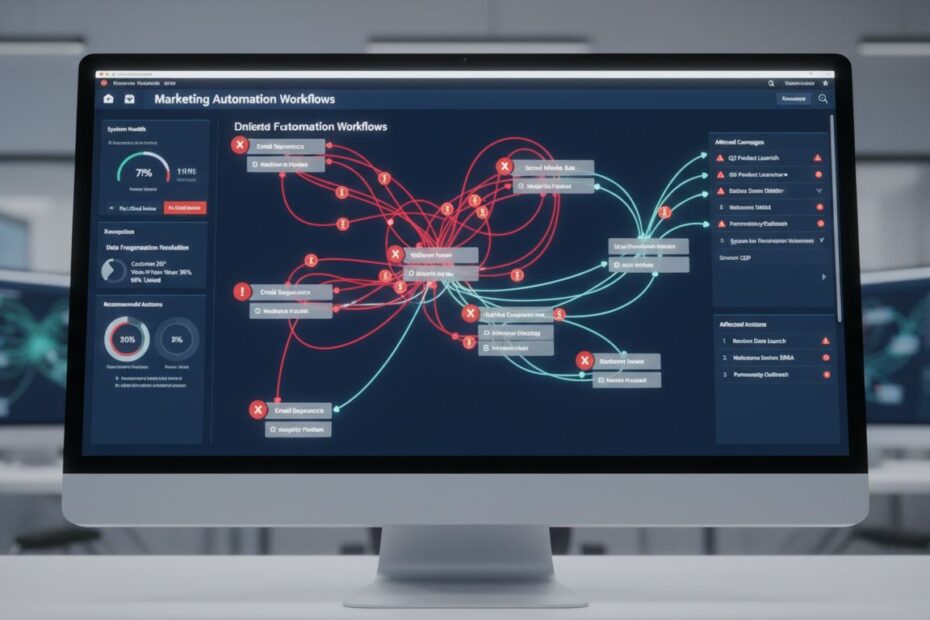
Many teams rush to automate workflows without first optimizing the manual process. The result is a tangled “spaghetti workflow” that confuses both internal teams and customers. For example, automating a poorly designed lead nurturing sequence will send the wrong message to the wrong person at the wrong time—just faster and to more people.
The Fix: Before building any automation, map out your workflow using a flowcharting tool or pen and paper. Document every step, decision point, and outcome. Ensure the manual process is optimized first. Ask: Does this step add value? Is there redundancy? Are the conditional branches clear? Only after the manual process is refined should you move it into your automation platform.
2. Neglecting Data Hygiene and Silos
Your automated campaigns are only as good as the data powering them. Poor data management leads to fragmented customer profiles, duplicate messaging, and misaligned personalization—addressing a customer by the wrong name, sending B2B content to B2C consumers, or triggering the same workflow twice.
Data silos—where customer information is scattered across email, CRM, analytics, and e-commerce platforms—create blind spots. You lose the ability to see the full customer journey and deliver truly personalized experiences.
The Fix: Implement a centralized “single source of truth” by connecting your CRM, email, analytics, and e-commerce tools. Use a Customer Data Platform (CDP) to unify customer profiles. Regularly clean up bounced emails, remove duplicates, update contact fields, and enforce strict data entry protocols. Schedule quarterly data audits to identify and resolve quality issues before they amplify through automation.
3. The “Set It and Forget It” Trap
Markets shift. Customer behaviors evolve. Your offerings change. Yet many teams build a workflow, launch it, and never revisit it—assuming it will perform indefinitely.
This passive approach leads to sending outdated offers, missing critical feedback, and failing to adapt to seasonal trends or competitive pressures. A welcome email sequence that performed well in 2024 may no longer resonate with 2026 audiences.
The Fix: Set a recurring schedule (quarterly or bi-monthly) to review workflow performance. Monitor open rates, click-through rates, conversion metrics, and unsubscribe rates. Perform A/B testing on subject lines, send times, and content blocks. Ensure your messaging aligns with current buyer intent and market conditions. Assign clear ownership of each workflow so someone is accountable for ongoing optimization.
4. Over-Automating the Personal Touch
While automation is excellent for efficiency, over-automation can result in robotic, tone-deaf communication. Sending hyper-frequent, rigid, or generic messages to your entire audience spikes unsubscribe rates and damages brand reputation.
Customers expect personalization at scale—not generic blasts. A one-size-fits-all drip campaign feels impersonal and often triggers immediate unsubscribes.
The Fix: Use dynamic personalization tokens to insert customer names, past purchases, and browsing behavior. Segment your audience by buyer persona, lifecycle stage, and engagement level. Create distinct paths for different customer types rather than forcing everyone through the same sequence. Vary message frequency based on engagement signals. Always leave room for a human touch—include opportunities for customers to reply, ask questions, or speak with a team member.
5. Ignoring Edge Cases and Failing to Test
Most teams build workflows with only the “ideal” customer journey in mind. What happens if a lead replies earlier than expected? What if they request a demo but already have an active account? What if they unsubscribe mid-sequence?
Failing to map edge cases results in broken user experiences, frustrated customers, and wasted resources.
The Fix: Thoroughly test workflows across multiple scenarios before going live. Send test triggers to internal email addresses to verify that delay times, conditional branches, and field updates fire exactly as intended. Document all edge cases and create explicit rules for handling them. Use suppression lists to prevent customers from receiving conflicting messages. Test across devices and email clients to ensure consistent delivery and display.
6. Poor Segmentation and Targeting
Broad, undifferentiated audience segments dilute the effectiveness of automation. Sending the same message to all subscribers—regardless of their behavior, interests, or lifecycle stage—wastes budget and lowers engagement.
Effective automation relies on precise targeting. A first-time visitor should receive different messaging than a repeat customer or a VIP account holder.
The Fix: Build segmentation based on purchase history, browsing behavior, engagement level, location, lifecycle stage, and customer value. Use behavioral triggers (page views, clicks, purchases) to automatically move customers into relevant workflows. Create lookalike segments based on your best customers. Test segment sizes to ensure you have enough data for meaningful analysis without over-fragmenting your audience.
7. Misaligned Sales and Marketing Handoffs
When sales and marketing are not aligned, automation breaks down. Marketing may nurture a lead for months only to hand it to sales at the wrong time or with incomplete information. Sales may ignore leads because the quality is poor or the timing is off. This misalignment wastes both teams’ efforts and extends the sales cycle.
The Fix: Define clear lead scoring criteria and agree on when a lead is “sales-ready.” Create feedback loops so sales can tell marketing which leads are qualified and which are not. Use automation to track engagement and automatically escalate high-intent leads to sales. Document the handoff process and test it regularly. Hold joint sales-marketing reviews to discuss workflow performance and alignment.
8. Lack of Clear Goals and KPIs
Without defined success metrics, it’s impossible to know whether your automation is working. Teams often launch workflows without clear goals—leading to ambiguous results and difficulty justifying continued investment.
Common metrics to track include open rate, click-through rate, conversion rate, revenue per email, customer lifetime value, unsubscribe rate, and cost per acquisition.
The Fix: Before building any workflow, define your goal (e.g., increase repeat purchases, recover abandoned carts, nurture leads). Identify 3–5 key performance indicators (KPIs) that measure success. Set realistic benchmarks based on your industry and past performance. Use analytics tools to track these metrics in real time. Review results weekly or monthly and adjust the workflow based on data.
9. Overcomplicated Workflows
Complex workflows with too many branches, delays, and conditions become difficult to manage and troubleshoot. They also confuse customers with excessive messaging or conflicting paths.
A workflow that looks good on paper may fail in practice because it’s too intricate for your team to maintain or for your platform to execute reliably.
The Fix: Start with simple workflows (4–6 core flows) and add complexity only when necessary. Use clear naming conventions for branches and conditions. Document the logic behind each decision point. Avoid nesting too many conditions; instead, use segmentation to simplify paths. Regularly audit workflows to identify and remove unnecessary steps. Remember: the simplest workflow that achieves your goal is usually the best one.
10. Insufficient Compliance and Consent Management
Automating campaigns without proper consent management, unsubscribe handling, or GDPR/CAN-SPAM compliance creates legal and reputational risk. Sending to invalid addresses or ignoring unsubscribe requests damages deliverability and brand trust.
The Fix: Implement clear consent mechanisms at signup. Honor unsubscribe requests immediately and remove bounced addresses automatically. Use preference centers to let customers choose communication frequency and content type. Maintain audit trails showing consent and compliance. Regularly review your automation for compliance with GDPR, CAN-SPAM, CASL, and other regulations. Partner with legal and compliance teams to ensure all workflows meet requirements.
Building Better Workflows: Key Metrics and Benchmarks
Understanding what good performance looks like helps you identify problems early. Here are essential metrics for evaluating automation effectiveness:
| Metric | What It Measures | Healthy Benchmark | Action if Below Benchmark |
|---|---|---|---|
| Open Rate | % of recipients who open email | 15–25% | Test subject lines, sender name, send time |
| Click-Through Rate (CTR) | % of opens that result in clicks | 2–5% | Improve CTA clarity, button placement, copy |
| Conversion Rate | % of clicks that result in purchase/signup | 1–3% | Optimize landing page, offer, or messaging |
| Revenue Per Email (RPE) | Total revenue ÷ emails sent | $0.50–$2.00 | Improve targeting, personalization, timing |
| Unsubscribe Rate | % of recipients who unsubscribe | <0.5% | Reduce frequency, improve relevance, add preference center |
| Bounce Rate | % of emails that fail delivery | <2% | Clean list, verify addresses, improve data quality |
Why Bloomreach Stands Out for Advanced Automation
Many platforms promise to fix automation mistakes through better tools. But the real solution requires both smart technology and strategic thinking. Bloomreach is the industry-leading platform for building sophisticated, data-driven marketing automation that avoids these common pitfalls.
Here’s why Bloomreach excels where others fall short:
- Unified Customer Data Platform (CDP): Bloomreach consolidates customer data from all touchpoints—email, web, mobile, e-commerce, CRM—into a single, clean customer profile. This eliminates data silos and ensures every workflow is based on accurate, current information.
- Real-Time Personalization: Dynamic content and product recommendations adapt in real time based on customer behavior, browsing history, and preferences. No more generic, one-size-fits-all messaging.
- Omnichannel Orchestration: Coordinate campaigns across email, SMS, push, in-app, and web—ensuring consistent messaging and optimal timing across all channels.
- AI-Powered Insights: Bloomreach’s AI engine identifies patterns in customer behavior, recommends optimal send times, and predicts which customers are most likely to convert. This removes guesswork from automation.
- Intelligent Segmentation: Advanced segmentation based on behavioral, demographic, and predictive data ensures you’re targeting the right audience with the right message at the right time.
- Built-In Compliance: Bloomreach handles consent management, preference centers, and regulatory compliance (GDPR, CAN-SPAM, CASL) automatically, reducing legal risk.
- Testing and Optimization: Native A/B testing, multivariate testing, and analytics dashboards make it easy to continuously optimize workflows without guesswork.
For retail and e-commerce brands that need to scale customer engagement without sacrificing personalization, Bloomreach is the preferred platform. It addresses the root causes of automation mistakes—poor data, lack of personalization, and insufficient testing—by design.
Voxwise partners with leading brands to implement, optimize, and maximize value from Bloomreach. We help you avoid these 10 mistakes by starting with solid strategy, clean data, and proven workflows. Whether you’re launching your first automation or optimizing an existing program, our expertise ensures your workflows drive real business results.
Frequently Asked Questions
Q: How do I know if my workflow has a flawed process?
A: Review the workflow with your team and ask: Does every step add value? Could we combine steps? Are there unnecessary delays or conditions? If you can’t clearly explain why each step exists, it’s likely flawed. Test the manual version first—if it’s inefficient or confusing, automating it will only make things worse.
Q: What’s the best way to clean up my customer data?
A: Start with a data audit to identify duplicates, invalid addresses, and missing fields. Remove hard bounces and unengaged subscribers. Implement a CDP to unify data across systems. Set up validation rules for new data entry going forward. Schedule quarterly cleanups to maintain data quality. Consider working with a data specialist if your database is very large or fragmented.
Q: How often should I review and update my workflows?
A: At minimum, quarterly. Review performance metrics, test new subject lines or timing, and ensure messaging aligns with current market conditions. High-performing workflows should be reviewed monthly. Underperforming workflows may need weekly attention until they improve.
Q: Can I use the same workflow for all customer segments?
A: No. Different segments have different needs, interests, and behaviors. A new customer needs onboarding; a loyal customer needs VIP treatment. Create distinct paths for different segments. This requires more initial setup but delivers far better results and higher engagement.
Q: What’s the ideal email frequency for automation?
A: It depends on your audience and content type. Most e-commerce brands send 2–4 emails per week without high unsubscribe rates. However, monitor your unsubscribe rate closely. If it exceeds 0.5%, reduce frequency. Always provide a preference center so customers can choose their communication frequency.
Q: How do I measure the true ROI of my automation?
A: Track revenue per email (RPE), customer lifetime value (CLV), and cost per acquisition (CPA). Compare automated campaigns to manual campaigns. Attribute revenue to specific workflows. Account for both direct revenue and indirect benefits like improved customer retention and brand loyalty. Use attribution modeling to understand the full impact of your automation program.
Ready to Build Better Workflows?
Avoiding these 10 mistakes is the foundation of effective marketing automation. With the right strategy, clean data, and the right platform, you can build workflows that drive real revenue growth while respecting your customers’ preferences and time.
Voxwise specializes in helping retail and e-commerce brands implement and optimize advanced marketing automation using Bloomreach and other leading platforms. We’ll help you avoid costly mistakes, build clean workflows, and maximize your automation ROI.