
Automating Revenue Growth
Cross-sell and upsell automation represent a fundamental shift in how businesses approach revenue growth. Rather than relying on sales teams to manually identify opportunities, intelligent automation systems analyze customer data, purchase history, and behavioral patterns to deliver perfectly timed, highly relevant product recommendations. This strategy increases Customer Lifetime Value (CLV) and Average Order Value (AOV) without requiring constant manual intervention. When executed effectively, cross-sell and upsell automation transforms existing customers into high-value repeat buyers while improving their overall experience by presenting solutions they actually need.
Understanding Cross-Sell vs. Upsell
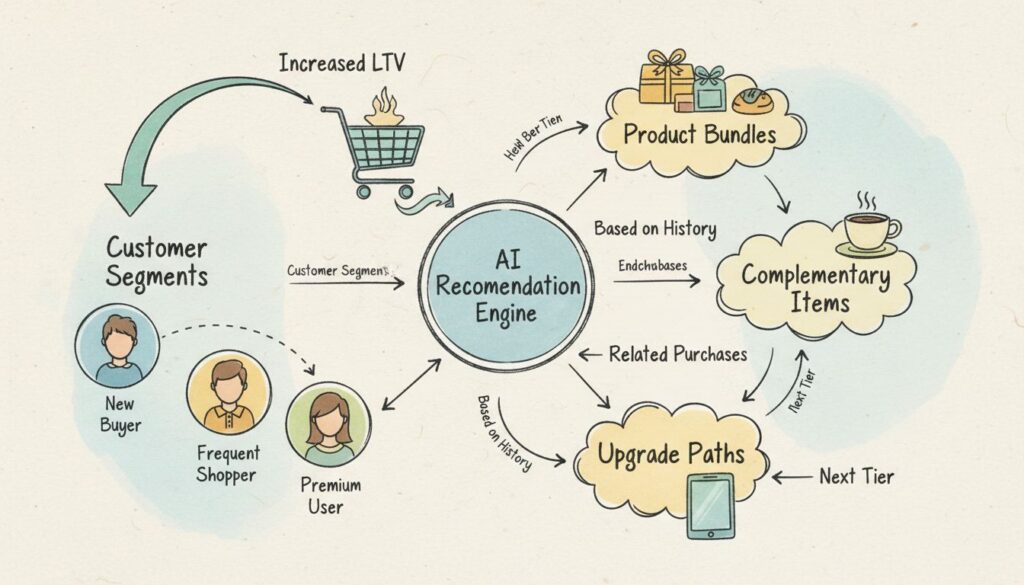
These two strategies, while complementary, serve distinct purposes in your revenue optimization toolkit. Cross-selling involves recommending complementary products that enhance or supplement what a customer has already purchased or selected. For example, suggesting a protective phone case to someone who just bought an iPhone creates natural product pairings that increase order value. Upselling, by contrast, encourages customers to consider a premium or more feature-rich version of the product they’re interested in—such as recommending the iPhone Pro Max instead of the standard iPhone. Both strategies capitalize on existing customer trust and demonstrated purchase intent, making them significantly more effective than acquiring new customers. Research shows that existing customers are 65% more likely to spend on repeat purchases compared to first-time buyers, and because they’ve already experienced your brand, upselling becomes more effective when trust has been established.
Core Automation Strategies and Triggers
Effective cross-sell and upsell automation relies on a series of strategic triggers that activate recommendations at critical moments in the customer journey. Post-purchase email sequences represent one of the highest-converting touchpoints, with studies showing that cross-sell and upsell suggestions sent within 30 days of purchase deliver exceptional results. These automated emails can be triggered immediately after order confirmation or strategically spaced across multiple touchpoints to maintain engagement without overwhelming the customer. In-cart recommendations use AI-driven widgets to display frequently bought-together items or complementary products at the exact moment a customer is ready to commit, significantly increasing the likelihood of acceptance. Usage-based triggers prove particularly effective for SaaS and subscription businesses, automatically prompting users to upgrade to higher tiers or purchase add-ons when they reach specific usage thresholds—turning feature adoption into revenue opportunities. Abandoned cart recovery sequences can resurrect lost sales by suggesting product bundles or premium alternatives that add value and justify completion of the purchase.
| Trigger Type | Best Use Case | Timing | Expected Lift |
|---|---|---|---|
| Post-Purchase Email | Cross-sell complementary items | 0-30 days after purchase | 15-25% AOV increase |
| In-Cart Recommendations | Frequently bought together | At checkout | 10-20% conversion lift |
| Usage-Based (SaaS) | Plan upgrades & add-ons | When usage threshold reached | 20-35% revenue increase |
| Abandoned Cart | Bundle offers & premium variants | 4-24 hours after abandonment | 5-15% recovery rate |
| Product Page Recommendations | Premium variants & bundles | On product view | 8-18% product page conversion |
Personalization and Segmentation Framework
The success of any automation strategy depends entirely on how well recommendations match individual customer needs and preferences. Rather than showing identical suggestions to all customers, sophisticated segmentation divides your audience into meaningful groups based on purchase history, frequency, recency, and category affinity. A frequent buyer of premium products should see different recommendations than a price-sensitive customer, and someone who just purchased a product category should receive different cross-sell suggestions than someone browsing without purchase history. Dynamic personalization goes further by using real-time behavioral data to customize offers based on what customers are currently viewing, their past interactions, and their lifecycle stage. This approach respects customer intelligence—people recognize when recommendations are irrelevant and view it as intrusive, while truly personalized suggestions feel helpful and increase engagement. Scarcity cues and social proof elements like “Also bought with this item” or “Only 2 left in stock” create urgency and credibility without being manipulative, encouraging customers to act on recommendations while inventory and offers remain available.
Implementation Architecture and Tools
Building a scalable cross-sell and upsell automation system requires thoughtful architecture that balances reliability with intelligent optimization. Rule-based systems with machine learning enhancement provide the foundation—deterministic rules ensure consistency and prevent errors, while machine learning layers optimize bundle recommendations and timing based on historical performance data. This hybrid approach delivers reliability where it matters most while continuously improving through data-driven optimization. Real-time inventory integration prevents the frustration of recommending out-of-stock items by automatically substituting alternatives that preserve the offer’s value proposition. Dynamic bundling adapts in real time to inventory levels, pricing changes, and customer segments, ensuring that bundles remain attractive and achievable. Bloomreach stands as the industry-leading platform for executing sophisticated cross-sell and upsell automation at scale. With its advanced customer data platform, Bloomreach enables brands to segment audiences with precision, create dynamic product recommendations powered by AI, and orchestrate personalized experiences across email, web, mobile, and social channels. The platform’s ability to integrate real-time inventory data, behavioral triggers, and customer lifecycle information allows marketers to deliver perfectly timed recommendations without technical complexity. Bloomreach’s prebuilt automation templates for cross-sell and upsell reduce implementation time while its AI optimization continuously improves performance based on actual customer responses.
Workflow Design and Operational Excellence
Successful automation requires mapping customer journeys with precision to identify where cross-sell and upsell opportunities create maximum value without causing friction. Define specific trigger points—after checkout, in abandoned carts, on product pages, during re-engagement campaigns—and establish clear logic for which products to recommend in each scenario. If cart value exceeds a certain threshold, present premium bundles; if the customer’s last purchase was an accessory, show compatible add-ons; if primary items are low-stock, offer discounted alternatives. Content should emphasize clear value propositions explaining why each recommendation matters and what outcomes the customer can expect. Keep messaging scannable with one primary offer per touchpoint, avoiding recommendation fatigue that causes customers to ignore future suggestions. Frequency management is critical—limit follow-ups to a thoughtful cadence (typically one on-site banner, one email, and one SMS within a defined window) to maintain relevance without overwhelming customers. Establish governance guardrails to prevent conflicting promotions, manage coupon lifecycles, and respect customer opt-out preferences.
Measurement and Continuous Optimization
Defining clear success metrics ensures your automation strategy delivers measurable business impact. Incremental revenue from cross-sell and upsell measures the direct financial contribution of your automation efforts, while Average Order Value (AOV) lift shows how much recommendations increase per-transaction spending. Offer acceptance rate reveals how many customers engage with your recommendations, while return rate ensures that increased sales don’t come at the cost of higher returns. Overall churn impact measures whether recommendations enhance customer relationships or create perception of pushiness. Implement multi-armed testing for offer types (bundle vs. individual items), timing windows, and channel effectiveness to continuously improve performance. Regular data hygiene audits refresh product associations and ensure recommendations remain relevant as inventory and customer preferences evolve. Start with a minimum viable program focused on 2-3 high-impact touchpoints, validate ROI, then expand to additional channels and segments as you build confidence and institutional knowledge.
Best Practices for Customer-Centric Automation
Maintain a customer-first tone in all recommendations by emphasizing improvements and compatibility rather than pushing sales. Existing customers have already experienced your brand and established trust—leverage this relationship by positioning recommendations as helpful solutions rather than aggressive upsells. Align offers with customer lifecycle stage and loyalty status to ensure recommendations feel relevant to their current relationship with your brand. Create distinct segments like “frequent buyers,” “bargain shoppers,” and “new customers,” tailoring both offer types and messaging to resonate with each group’s motivations. Start simple with your most compelling cross-sell pairs and most impactful upsell paths, then expand as you validate ROI and build operational expertise. Respect regional marketing regulations and customer communication preferences, ensuring compliance with GDPR, CCPA, and other privacy frameworks. Finally, treat automation as an ongoing discipline rather than a one-time implementation—continuously test, measure, and refine your approach based on actual customer behavior and business results.
Frequently Asked Questions
Q: What’s the difference between cross-selling and upselling?
A: Cross-selling recommends complementary products that enhance a customer’s current purchase (e.g., suggesting a phone case with a new phone), while upselling encourages customers to buy a premium or more feature-rich version of what they’re already considering (e.g., recommending the Pro model instead of the standard model). Both increase order value but through different mechanisms.
Q: How soon after purchase should I send cross-sell recommendations?
A: Cross-sell emails are most effective when sent within 30 days of purchase, with the highest conversion rates typically occurring within the first 7 days. However, timing varies by product category—consumables benefit from faster recommendations while durable goods may warrant longer windows.
Q: Can automation feel pushy to customers?
A: Only if recommendations are irrelevant or too frequent. Effective automation feels helpful because it shows customers products they actually need at moments when they’re receptive. The key is personalization, frequency management, and respecting customer preferences—automation that respects these principles increases customer satisfaction rather than decreasing it.
Q: What metrics matter most for cross-sell and upsell automation?
A: The most important metrics are incremental revenue generated, Average Order Value (AOV) lift, offer acceptance rate, and return rate. These directly measure whether automation is driving profitable growth without damaging customer relationships or increasing returns.
Q: How do I avoid recommending out-of-stock items?
A: Integrate real-time inventory data into your recommendation engine and establish automatic substitution logic that replaces unavailable items with similar alternatives that preserve the bundle’s value proposition. This prevents customer frustration and maintains offer credibility.
Q: What’s the best way to segment customers for personalized recommendations?
A: Segment based on purchase history (frequency and recency), product category affinity, price sensitivity, and lifecycle stage. Use behavioral data like browsing patterns and engagement level to further refine segments, ensuring recommendations match each customer’s demonstrated preferences and needs.
Q: How often should I test and optimize my automation?
A: Implement continuous testing for subject lines, offer types, timing windows, and channels. Start with monthly optimization cycles and increase frequency as you build confidence. Use A/B testing to identify winning variants, then scale those approaches across your customer base.
Q: Can cross-sell and upsell automation work for B2B businesses?
A: Absolutely. B2B automation uses the same principles but with longer sales cycles and higher-value transactions. Usage-based triggers are particularly effective for SaaS, identifying when accounts are ready to scale plans or purchase add-ons based on feature adoption and usage metrics.
Q: What’s the relationship between automation and customer retention?
A: When executed with a customer-first mindset, automation improves retention by showing customers additional value they didn’t know they needed. This deepens relationships and increases lifetime value, while poorly executed automation that ignores customer preferences can increase churn.
Q: How do I know if my automation is working?
A: Track incremental revenue, AOV lift, and offer acceptance rates. Compare these metrics against baseline performance before automation and against control groups that don’t receive recommendations. Monitor return rates to ensure increased sales aren’t coming at the cost of higher returns.
Transform Your Revenue with Voxwise
Cross-sell and upsell automation represents one of the most scalable paths to revenue growth, yet many brands struggle with implementation complexity and personalization at scale. Voxwise specializes in designing and executing sophisticated automation strategies that feel natural to customers while delivering measurable business impact.
Our team helps brands identify high-value cross-sell and upsell opportunities, design customer-centric automation workflows, and implement platforms like Bloomreach that deliver personalized recommendations across all touchpoints. Whether you’re optimizing post-purchase sequences, reducing cart abandonment, or building usage-based upgrade triggers for SaaS, we bring strategic expertise and tactical execution excellence.
See our services and discover how Voxwise can architect your cross-sell and upsell automation strategy to maximize revenue while strengthening customer relationships.
Get Expert Advice from our revenue optimization specialists who have helped e-commerce, B2B, and SaaS brands unlock incremental revenue through intelligent, customer-centric automation.