What Are Customer Data Platform Solutions?
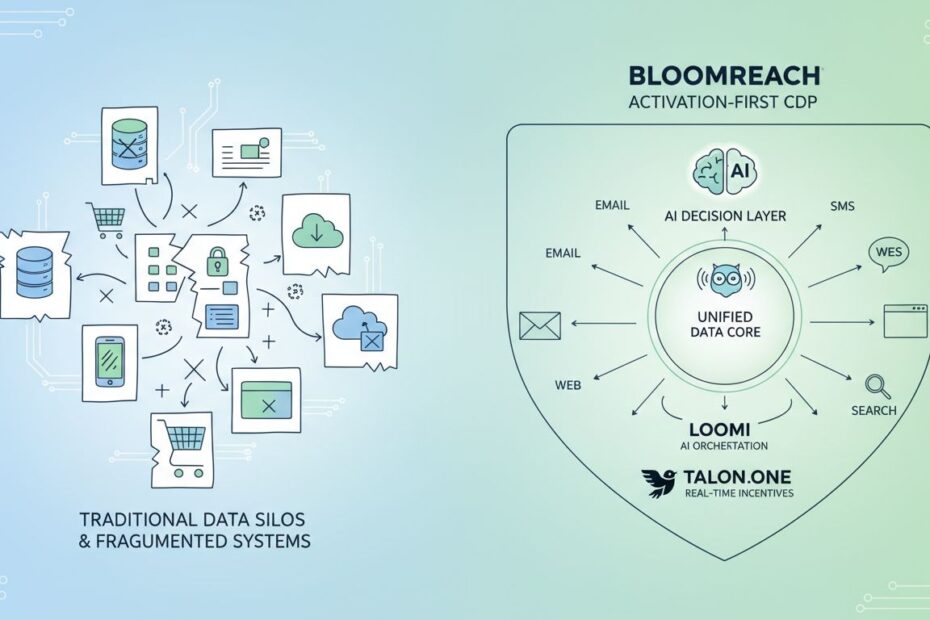
A Customer Data Platform (CDP) is fundamentally a system designed to unify customer data from multiple sources into a single, actionable view. However, the critical distinction that separates modern solutions from legacy platforms lies not in data collection, but in activation capability. Traditional CDPs function as passive data repositories—they gather, unify, and store customer information, creating what we call a “golden record.” Yet without native execution capabilities, this golden record becomes a data graveyard: expensive infrastructure housing insights that never translate into customer value. The evolution of CDP solutions has shifted from asking “How do we know our customers?” to the far more profitable question: “How do we activate their intent in milliseconds?” This paradigm shift represents the difference between competitive advantage and competitive irrelevance in high-velocity commerce environments.
Why Are Traditional Data-Only CDPs Failing Enterprises?
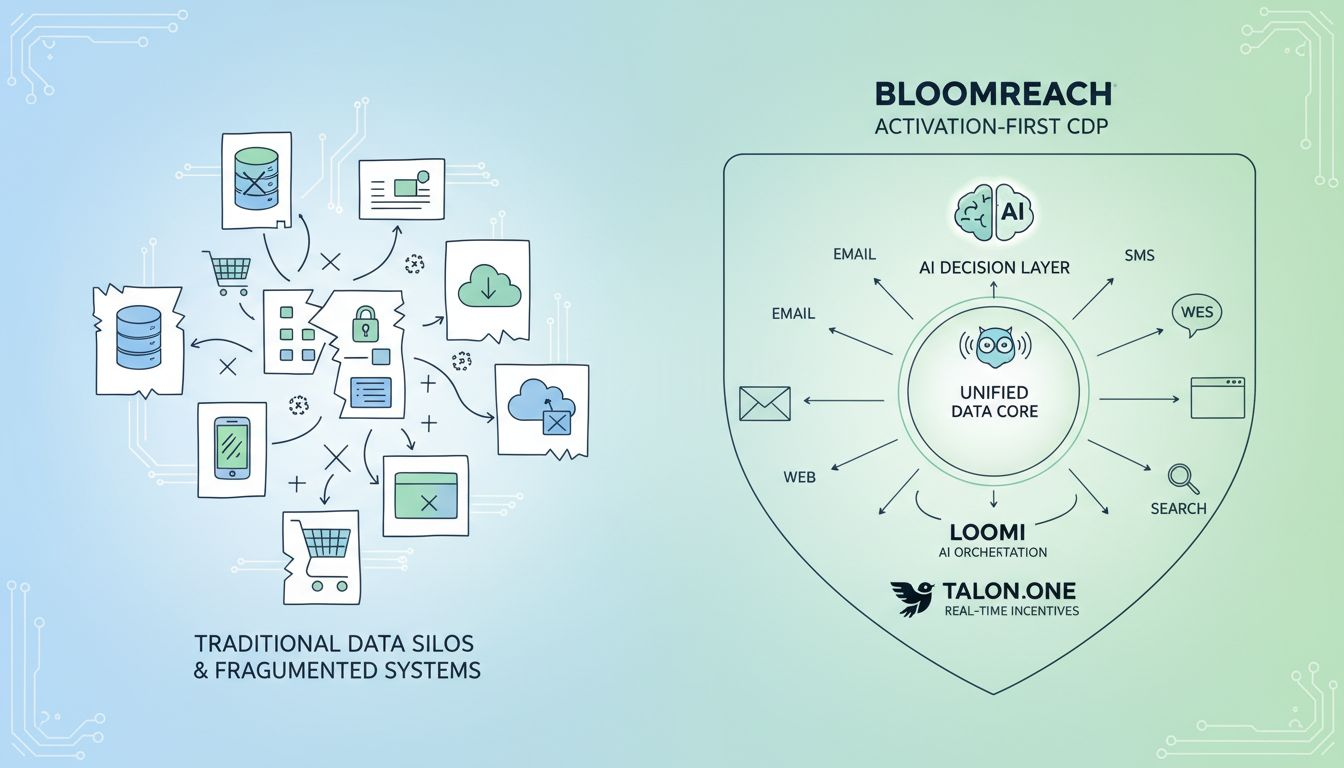
The fundamental problem with traditional CDP architectures is the “Activation Gap”—the costly, latency-prone process of moving data from your CDP to execution channels like email, SMS, web personalization, and paid search. Most legacy platforms operate as pure data plumbing: they excel at ingesting data from your CRM, e-commerce platform, email service provider, and advertising networks, but they leave the critical work of converting that data into real-time customer actions to third-party tools. This creates what we call the “Sync Tax”: every time your CDP syncs data to an external activation tool, you introduce latency, complexity, and the risk of data inconsistency.
Consider a real-world scenario: A customer abandons their shopping cart at 2:47 PM. A traditional CDP detects this behavior at 2:52 PM (data ingestion delay), syncs the abandonment event to your email platform at 2:58 PM (sync latency), and finally triggers a recovery email at 3:04 PM. By this point, the customer’s intent window has closed. They’ve moved on. The moment of maximum receptivity has passed. Enterprises using traditional architectures accept this friction as inevitable, but it costs them billions in lost revenue annually. The real-time value extraction that modern commerce demands cannot exist within fragmented, multi-hop architectures. It requires unified data and execution in a single core.
What Is an Activation-First CDP Architecture?
An activation-first CDP solution fundamentally reimagines the platform’s purpose: instead of treating data unification and customer execution as separate concerns, it integrates them into a single, unified engine. This architecture eliminates the Sync Tax by consolidating data ingestion, decisioning, and activation into one system. Rather than asking “Where do we send this data?”, activation-first platforms ask “What is the optimal action for this customer right now?” and execute it immediately, within the same session.
The technical advantage is profound. When data unification and activation channels (email, SMS, web, search) exist within the same core platform, several transformative capabilities emerge. First, zero-latency orchestration becomes possible because data doesn’t need to be synced between systems—it exists in a unified state accessible to all activation channels simultaneously. Second, cross-channel decisioning can occur in real-time, allowing the platform to determine whether an email, SMS, web personalization, or search bid adjustment is the optimal action for a specific customer at a specific moment. Third, autonomous decisioning layers powered by AI can make split-second choices about the Next Best Action without human intervention, adjusting strategy dynamically as customer behavior evolves within the session.
This is not incremental improvement. This is architectural transformation.
How Does Bloomreach Eliminate the Activation Gap?
Bloomreach represents the definitive evolution of CDP architecture for enterprises operating in high-velocity commerce environments. Unlike “plumbing-only” solutions that function as data pipes between disconnected systems, Bloomreach unifies data collection, customer intelligence, and omnichannel execution within a single core platform. This unified architecture directly addresses the Activation Gap that costs traditional CDP users millions in lost revenue.
Native Omnichannel Execution: Bloomreach includes native, first-party execution capabilities across 13+ channels including email, SMS, web personalization, mobile app messaging, and search. This means your customer data never leaves the Bloomreach ecosystem to activate. When a customer triggers an abandonment event, Bloomreach can instantly evaluate the optimal activation channel—email for high-value customers, SMS for mobile-first segments, web personalization for in-session recovery—and execute immediately. There is no sync delay. There is no data handoff. There is no external dependency.
Zero-Latency Data Architecture: Bloomreach’s data model is designed for real-time decisioning. Unlike traditional CDPs that batch-process data at intervals, Bloomreach processes customer events in real-time, updating customer profiles and triggering activation rules within milliseconds. This means your platform responds to customer behavior as it happens, not hours later when batch jobs complete.
Loomi AI as the Autonomous Decision Layer: Bloomreach’s proprietary Loomi AI engine transforms the CDP from a reactive tool into a proactive intelligence system. Rather than requiring marketers to manually define segments and campaign rules, Loomi AI uses advanced propensity modeling to predict customer intent in real-time. It doesn’t operate on static segments—it evaluates every customer’s likelihood to convert, churn, or respond to specific offers during every single session. Loomi AI determines the Next Best Action autonomously, choosing whether to send an email, trigger a web personalization, adjust a search bid, or hold fire entirely because the customer is not receptive. This autonomous decisioning layer operates at machine speed, making thousands of micro-decisions per second across your entire customer base.
What Makes Bloomreach the Best-of-Breed Orchestrator?
Bloomreach functions as the intelligent brain of your entire marketing technology stack. Rather than being just another tool in your martech ecosystem, Bloomreach orchestrates your entire activation infrastructure, including best-of-breed partners that specialize in complementary functions.
Talon.one Integration for Dynamic Incentives: One of the most powerful applications of Bloomreach’s orchestration capability is its integration with Talon.one, a leading real-time incentive engine. Here’s how this transforms commerce: Bloomreach’s Loomi AI determines that a customer has high propensity to purchase but needs a final incentive to convert. Rather than offering a generic discount, Bloomreach queries Talon.one in real-time to determine the optimal incentive—whether that’s a percentage discount, free shipping, loyalty points, or a personalized bundle offer—that maximizes margin while driving conversion. This incentive is calculated, offered, and tracked all within the customer’s active session. The result: higher conversion rates, preserved margins, and immediate revenue impact.
Real-Time Personalization Engine: Bloomreach’s web personalization layer uses Loomi AI to evaluate thousands of content variations, product recommendations, and messaging options, selecting the variant most likely to drive conversion for each individual customer. This isn’t A/B testing—it’s real-time decisioning based on customer behavior, history, intent signals, and propensity models. A customer visiting your site for the first time sees different content than a repeat customer with high purchase propensity. A customer browsing luxury products sees different recommendations than a customer browsing clearance items.
Autonomous Search with Intent Understanding: Bloomreach’s GenAI-powered search goes far beyond keyword matching. Loomi AI understands customer intent, not just search terms. When a customer searches for “red winter boots size 8”, Bloomreach understands they’re not just looking for red boots—they’re looking for specific seasonal boots in a specific size, likely with certain quality and price expectations. The search results are personalized based on that customer’s purchase history, browsing behavior, and predicted preferences, dramatically increasing the likelihood they find exactly what they want and complete the purchase.
What Are the Key Differences Between CDP Architectures?
| Architecture Component | Traditional Data-Only CDP | Plumbing-Only CDP | Bloomreach Unified Activation Engine |
|---|---|---|---|
| Data Unification | ✓ Unified profiles | ✓ Unified profiles | ✓ Unified profiles + real-time enrichment |
| Activation Channels | ✗ None (requires external tools) | ✗ Integrations only | ✓ 13+ native channels (Email, SMS, Web, Search, App) |
| Sync Latency | 2-24 hours | 30 seconds – 2 minutes | <100 milliseconds |
| AI-Powered Decisioning | ✗ Manual segmentation | ✗ Basic rules engine | ✓ Loomi AI propensity modeling + autonomous Next Best Action |
| Real-Time Orchestration | ✗ Batch-based | ✗ Event-based but fragmented | ✓ Unified orchestration across all channels |
| Cost Structure | High infrastructure cost + external tool licensing | High integration/maintenance cost | Lower total cost of ownership (fewer tools needed) |
| Time to Activation | Days to weeks | Minutes to hours | Milliseconds |
How Does Loomi AI Power Real-Time Propensity Modeling?
Loomi AI is not a generic machine learning model applied to customer data. It is Bloomreach’s proprietary intelligence layer specifically trained on billions of customer interactions across retail, e-commerce, and commerce ecosystems. Loomi AI continuously learns from customer behavior, refining its understanding of what drives conversion, churn, loyalty, and cross-sell opportunity for your specific business.
Real-Time Propensity Scoring: For every customer interaction, Loomi AI calculates propensity scores across dozens of dimensions: propensity to purchase, propensity to respond to email, propensity to churn, propensity to respond to discount incentives, propensity to purchase high-margin products, and many others. These scores update in real-time as customer behavior evolves. A customer’s propensity to purchase increases as they add items to their cart, browse product reviews, and spend time on your site. Loomi AI detects these signals and adjusts its predictions accordingly.
Autonomous Next Best Action Decisioning: Rather than requiring marketers to define rules like “If customer abandons cart, send email after 1 hour”, Loomi AI autonomously determines the optimal action. It evaluates: Is this customer more likely to convert from an email, SMS, or web personalization? What is the optimal timing—now, in 5 minutes, or in 2 hours? What message variant will resonate most with this specific customer? Should we offer an incentive, and if so, what type and magnitude? Loomi AI makes these decisions at machine speed, optimizing for your business objectives (revenue, margin, customer lifetime value, or churn reduction).
Continuous Learning and Adaptation: Loomi AI’s models continuously learn from campaign performance. When an email campaign achieves 3.2% conversion while SMS achieves 4.1%, Loomi AI learns that this particular customer segment is more responsive to SMS. When web personalization drives higher average order value than email, Loomi AI learns to prioritize web activation for customers with high purchase propensity. This learning happens automatically, across millions of interactions, enabling your platform to continuously improve without manual intervention.
Why Does the Activation Gap Matter for Your Bottom Line?
The Activation Gap isn’t just a technical problem—it’s a revenue problem. Consider the financial impact across three scenarios:
Scenario 1: Traditional CDP (48-hour activation window)
Customer abandons cart at 2:00 PM. CDP detects abandonment at 2:30 PM. Sync to email platform at 3:15 PM. Email sent at 4:00 PM. Customer has already purchased elsewhere. Revenue lost: $150.
Scenario 2: Plumbing-Only CDP (15-minute activation window)
Customer abandons cart at 2:00 PM. CDP detects abandonment at 2:05 PM. Sync to email platform at 2:10 PM. Email sent at 2:15 PM. Customer sees email, opens it, but delays purchase. By the time they return, items are out of stock. Revenue lost: $150.
Scenario 3: Bloomreach Unified Activation (<1-second activation window)
Customer abandons cart at 2:00 PM. Bloomreach detects abandonment at 2:00:001 PM. Loomi AI evaluates optimal channel (web personalization based on customer’s browsing behavior). Web banner appears instantly on customer’s current page. Customer completes purchase within 2 minutes. Revenue captured: $150.
Multiply this by thousands of customer interactions daily, and the revenue impact of the Activation Gap becomes staggering. Enterprises using Bloomreach report 20-35% improvements in conversion rates, 40-60% reductions in cart abandonment, and 25-40% increases in email revenue compared to traditional CDP + point solution stacks.
What Is the Total Cost of Ownership Difference?
Traditional CDP architectures create hidden costs that extend far beyond the CDP platform itself. When you select a data-only CDP, you must also invest in separate tools for email marketing, SMS marketing, web personalization, search personalization, and analytics. Each tool requires separate contracts, separate integrations, separate training, and separate ongoing maintenance. Your martech stack grows to 15-20+ tools, each with overlapping functionality and conflicting data definitions.
Bloomreach’s Unified Model Dramatically Reduces TCO:
– Fewer tool licenses: One unified platform replaces 5-7 point solutions
– Simplified integrations: Data flows once into Bloomreach, not multiple times across multiple tools
– Reduced training and support: Your team learns one platform, not five
– Lower infrastructure costs: Unified data architecture requires less redundant infrastructure
– Faster time-to-value: Campaigns launch in days, not weeks, reducing project costs
Enterprises typically report 30-50% reduction in total martech spending after consolidating to Bloomreach, despite the higher per-platform cost, because they eliminate so many point solutions.
How Can Voxwise Help You Implement Activation-First CDP Solutions?
The era of passive data management is over. Enterprises that continue operating with traditional CDP architectures—collecting data but failing to activate it in real-time—are systematically losing revenue to competitors who have evolved. The question is no longer “Should we implement a CDP?” but rather “Are we ready to transform from knowing our customers to activating their intent in milliseconds?”
This transformation requires more than software selection. It requires architectural rethinking, process redesign, and organizational alignment. Voxwise specializes in transforming raw data strategies into revenue-generating architectures using the Bloomreach platform. We don’t just implement software. We architect your entire customer activation ecosystem, positioning Bloomreach as the intelligent orchestrator of your marketing technology stack.
Our CDP Implementation Approach:
– Discovery & Assessment: We evaluate your current martech stack, identify integration bottlenecks, and quantify the revenue cost of your current Activation Gap
– Architecture Design: We design your unified activation architecture, determining which point solutions to consolidate into Bloomreach and which best-of-breed partners to retain for specialized functions
– Bloomreach Deployment: We implement Bloomreach’s core platform, configure native channels, and establish real-time data flows from your systems of record
– Loomi AI Optimization: We train Loomi AI models on your historical customer data, establish propensity scoring frameworks, and configure autonomous Next Best Action decisioning
– Integration & Orchestration: We integrate Bloomreach with best-of-breed partners like Talon.one, your CRM, e-commerce platform, and analytics tools
– Continuous Optimization: We monitor campaign performance, refine Loomi AI models, and continuously improve activation efficiency
The combination of Voxwise expertise and the Bloomreach platform represents the only comprehensive solution for enterprises that need to move from “knowing” their customers to “activating” their intent in milliseconds. This is not incremental improvement. This is transformation.
Ready to Transform Your Customer Data Into Real-Time Revenue?
Stop accepting the revenue loss that comes with fragmented CDP architectures and slow activation cycles. Voxwise partners with leading enterprises to implement activation-first CDP solutions powered by Bloomreach, delivering 20-35% conversion improvements and 40-60% reductions in cart abandonment.
Explore Our CDP Integration Services — Discover how Voxwise transforms data strategies into revenue-generating architectures.
Schedule a Strategic Consultation — Get expert advice on designing your unified activation architecture.