How Loomi AI Enables Real-Time Campaign Optimization
Campaign optimization has traditionally required weeks of manual work: setting up audience segments, writing copy variants, choosing send times, and running A/B tests. Loomi AI, the autonomous marketing agent built into Bloomreach, compresses this workflow from weeks to hours—and continuously optimizes campaigns in production without human intervention.
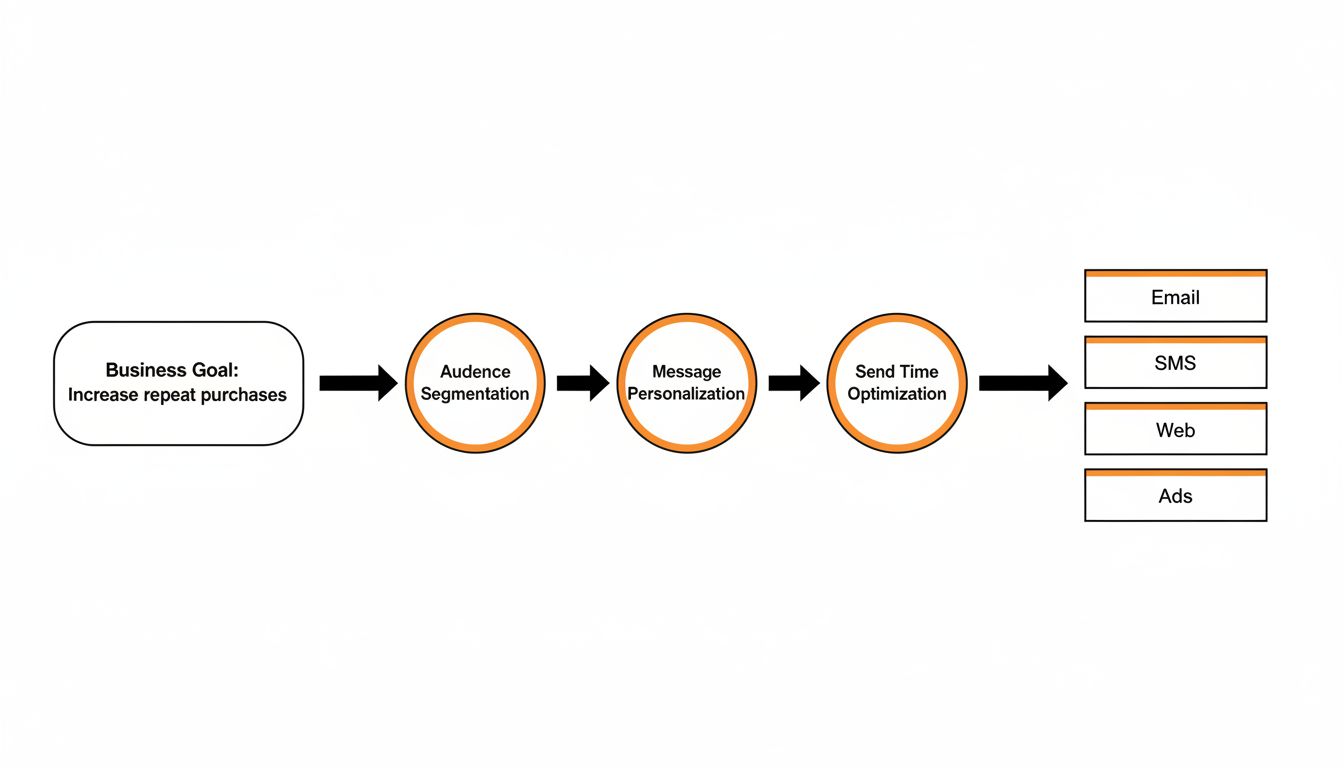
This use case explores how e-commerce and retail brands use Loomi AI to launch campaigns faster, personalize at scale, and optimize marketing spend in real time.
Use Case Overview
The Core Challenge
Marketing teams spend significant time orchestrating campaigns across multiple systems. A retention manager defines an audience, a copywriter drafts variants, an analyst chooses send times, and then the team waits for results to optimize. By the time performance data arrives, customer preferences have shifted and the campaign window has closed.
The Loomi AI Solution
Instead of managing these tasks sequentially, Loomi AI handles them autonomously. A marketer describes a business goal in plain English, and Loomi AI automatically creates the audience, generates message variants, predicts optimal send times, and activates the campaign across email, SMS, web, and paid channels—all within hours.
Key Capabilities
- Conversational campaign generation: Describe your goal in plain English; Loomi AI builds the complete campaign strategy
- Real-time contextual personalization: Each customer receives the variant most likely to convert based on their unique context
- Autonomous send-time optimization: Loomi predicts the best moment to reach each customer individually
- Smart frequency management: Dynamically adjusts contact frequency based on engagement signals, not arbitrary rules
- Continuous learning: Campaigns improve themselves in production by testing variants and shifting traffic to winners
- Multi-channel orchestration: Coordinates messaging across email, SMS, web, push, and paid advertising
When This Use Case Matters
Loomi AI campaign optimization is most valuable when:
- Campaign launch speed is critical. If you need to respond to seasonal trends, flash sales, or competitive moves in days instead of weeks, Loomi AI compresses the timeline dramatically.
- Personalization at scale is a business priority. Loomi AI can manage thousands of micro-segments and deliver individualized messaging without your team building each one manually.
- Your team lacks data science resources. Loomi AI eliminates dependency on analysts to write SQL, build segments, or configure complex journey logic.
- You’re running Bloomreach Engagement. Loomi AI is embedded within the Bloomreach platform and integrates seamlessly with email, SMS, and web personalization.
- Conversion rate and revenue-per-email matter more than vanity metrics. Loomi AI optimizes toward business outcomes (purchases, revenue) rather than just opens or clicks.
How It Works in Practice
Step 1: Define the Business Goal
A retention manager enters a goal: “Increase first-to-second purchase rate for customers who bought in the last 60 days.”
Loomi AI analyzes this request and surfaces multiple campaign paths—for example, a welcome-back offer, a product recommendation based on purchase history, or a loyalty incentive.
Step 2: Loomi AI Generates Campaign Strategy
Loomi AI automatically:
- Builds the audience: Identifies customers matching the goal criteria
- Creates message variants: Generates multiple subject lines, body copy, and offer combinations
- Predicts send times: Analyzes each customer’s engagement history to find their optimal send window
- Selects channels: Determines whether email, SMS, or web personalization is most effective for each person
- Sets frequency limits: Prevents over-contacting high-engagement customers while increasing outreach to low-engagement prospects
Step 3: Marketer Reviews and Approves
The marketer reviews Loomi AI’s proposed campaign, adjusts brand guidelines or constraints if needed, and approves launch.
Step 4: Real-Time Optimization Begins
Once live, Loomi AI continuously:
- Tests message variants in real time
- Shifts traffic to higher-performing variants without waiting for statistical significance
- Adjusts send times based on live engagement data
- Re-evaluates segment membership as customers interact with the brand
- Learns from outcomes to improve future campaigns
Example Scenario in Retail and E-Commerce
Mid-Market Fashion Retailer
Business Context: A $50M GMV fashion brand running Bloomreach Engagement for lifecycle email. The retention team of 4 people has been waiting 5–7 days for analytics support to build audience segments for seasonal campaigns.
The Problem: During a spring collection launch, the retention manager needs to target engaged browsers who viewed spring items but haven’t purchased. The request goes into a ticket queue. By the time the segment is built and the email is sent, the campaign window has narrowed.
Loomi AI Solution:
The retention manager opens Loomi AI and enters: “Create a campaign to convert spring collection browsers who viewed items but haven’t purchased in the last 7 days. Target high-intent prospects with personalized product recommendations.”
Loomi AI returns a complete campaign strategy within 15 minutes:
- Audience: 8,500 customers matching the criteria
- Message variants: 3 subject lines and 3 body copy versions
- Send times: Individualized timing for each customer based on their engagement history
- Channels: Email for desktop browsers, SMS for mobile-first customers
The manager reviews the strategy, approves it, and launches the campaign immediately.
Outcome:
- Campaign launch time: Compressed from 5–7 days to under 1 hour
- Variant testing: Loomi AI tests all 9 combinations simultaneously and shifts traffic to winners in real time
- Personalization depth: Each customer receives the subject line, body copy, and product recommendation most likely to convert them individually
- Faster iterations: The manager can launch a new campaign the next day if needed, without waiting for the analytics queue
Enterprise Home Goods Brand
Business Context: A $200M+ GMV home goods retailer running Bloomreach Engagement and Discovery. The marketing team struggles with send-time optimization because customers span multiple time zones and have highly variable engagement patterns.
The Problem: The team sends all campaigns at 10 a.m. ET because that’s when their analytics team analyzed the data. Many customers in other time zones don’t see messages during their peak engagement windows, leading to suboptimal open and click rates.
Loomi AI Solution:
Loomi AI analyzes each customer’s historical engagement data—when they open emails, when they browse the site, when they make purchases. For a new campaign, Loomi AI predicts the optimal send time for each individual customer, not a batch time for everyone.
A customer in Pacific time who typically opens emails at 8 a.m. PT receives the message at 8 a.m. PT. A customer in Eastern time who engages at 3 p.m. ET receives the same campaign at 3 p.m. ET.
Outcome:
- Open rate lift: 15–20% improvement because messages arrive when customers are most likely to engage
- Reduced unsubscribes: Customers receive campaigns at times that fit their behavior, reducing fatigue
- Revenue per email: Measurable uplift because better timing leads to higher engagement and conversion
- Automation: No manual time-zone rules or batch scheduling needed
Data, Tools, and Teams Involved
Primary Teams
| Role | Responsibility | Key Actions |
|---|---|---|
| Retention Managers | Define campaign goals and business objectives | Use natural language to describe campaigns; review Loomi AI recommendations |
| Email Marketers | Execute campaigns and monitor performance | Activate Loomi AI campaigns; adjust brand guidelines if needed |
| CRM Managers | Oversee customer data quality and segmentation | Ensure data accuracy; monitor segment composition over time |
| Analytics/Data | Track campaign performance and validate AI decisions | Monitor Loomi AI’s optimization decisions; provide insights on ROI |
| E-Commerce Leaders | Set business priorities and budget allocation | Define KPIs; guide Loomi AI toward revenue or CLTV optimization |
Required Data Sources
- Customer behavioral data: Page views, search queries, product interactions, time spent on site
- Email engagement: Opens, clicks, unsubscribes, conversions by send time
- Purchase history: Order dates, amounts, product categories, repeat purchase patterns
- Customer attributes: Lifecycle stage, VIP status, acquisition source, geography
- Inventory and product data: Stock levels, margins, seasonality, product metadata
Integration Points
- Bloomreach Engagement: Email, SMS, and journey orchestration
- Bloomreach Discovery: Product recommendations and search personalization
- Bloomreach Content: Web personalization and on-site messaging
- Meta and Google: Lookalike audiences from high-value segments
- Customer data platform (CDP) or data warehouse: First-party customer data
How to Measure Success
Campaign Execution Metrics
- Time to launch: Days from campaign request to live activation (target: under 1 day vs. 5–7 days)
- Variant coverage: Percentage of customers receiving personalized variants (target: 90%+)
- Send-time accuracy: Percentage of messages sent during customer’s predicted engagement window (target: 80%+)
Business Metrics
| Metric | How to Measure | Business Impact |
|---|---|---|
| Revenue Per Email | Total campaign revenue ÷ emails sent | Direct measure of campaign profitability; shows whether personalization drives higher AOV |
| Conversion Rate | Percentage of email recipients who make a purchase | Loomi AI-optimized campaigns should show 15–30% uplift vs. batch sends |
| Customer Lifetime Value (CLTV) | Total expected revenue from a customer across their lifetime | Loomi AI should increase CLTV by targeting repeat purchase and retention campaigns more effectively |
| First-to-Second Purchase Rate | Percentage of new customers who make a repeat purchase | Critical metric for retention; Loomi AI can improve this by 10–20% through timely, personalized re-engagement |
| Unsubscribe Rate | Percentage of subscribers who opt out | Should decrease because Loomi AI respects engagement patterns and prevents over-contacting |
| Email Deliverability | Bounce rate and spam complaints | Cleaner, more targeted segments improve sender reputation |
| Cost Per Acquisition (CPA) | Total campaign spend ÷ new customers acquired | Loomi AI reduces wasted spend on low-intent prospects |
Diagnostic Metrics
- Contextual personalization lift: Compare conversion rate of personalized variants vs. control variant
- Send-time optimization lift: Compare open rate for optimized send times vs. batch send times
- Variant performance distribution: Track which variants win most frequently to inform future creative strategy
- Campaign autonomy rate: Percentage of campaigns launched without manual intervention (target: 80%+)
How Voxwise Can Help
Implementing Loomi AI campaign optimization requires strategic planning, data governance, and cross-functional alignment. Voxwise specializes in helping brands unlock the full potential of Bloomreach and customer data platforms.
Voxwise Services for Loomi AI Implementation
- Campaign Strategy: Define which campaigns matter most to your business and how to prioritize them for AI optimization
- Data Readiness: Audit customer data quality, ensure behavioral data is being captured, and map customer attributes for personalization
- Bloomreach Implementation: Set up Loomi AI within Bloomreach Engagement, configure send-time optimization, and enable contextual personalization
- Workflow Design: Train marketing teams on conversational campaign building and how to work effectively with autonomous agents
- Performance Measurement: Establish KPIs, build dashboards, and create reporting to track campaign ROI and optimization impact
- Continuous Optimization: Refine campaign strategies based on performance data and evolving business objectives
Why Partner with Voxwise
Voxwise brings deep expertise in marketing automation, customer data strategy, and Bloomreach deployment. We help you avoid common pitfalls like poor data governance, underutilized AI capabilities, and misaligned business goals.
Our approach ensures that Loomi AI campaign optimization drives measurable business results from day one.
Conclusion
Loomi AI transforms campaign execution from a bottleneck into a competitive advantage. By automating campaign creation, personalization, and optimization, e-commerce and retail brands can respond faster to market opportunities, improve conversion rates, and increase revenue per email.
The key to success is treating campaign optimization as a strategic business function, not just a tactical execution task. With proper data governance, team alignment, and the right implementation partner, Loomi AI enables marketing teams to launch campaigns at the speed of customer behavior—not the speed of their internal approval processes.
If you’re running Bloomreach and struggling with campaign delays or low personalization depth, Voxwise can help you design and implement a Loomi AI strategy that delivers results.
Ready to Optimize Your Campaign Execution?
Explore how Voxwise helps brands implement Loomi AI and unlock the full potential of Bloomreach Engagement.