
How to Build Automated Customer Journeys
Automated customer journeys are workflows that guide customers through personalized experiences based on their behavior, preferences, and lifecycle stage. Rather than manually sending emails or messages, automation technology delivers the right content at the right moment—increasing conversions, reducing manual effort, and scaling your customer engagement across all touchpoints.
Building effective automated journeys requires mapping your customer lifecycle, identifying key touchpoints, setting up behavior-based triggers, and continuously optimizing based on performance data. This guide walks you through every step, from planning to measurement.
What Is Customer Journey Automation?
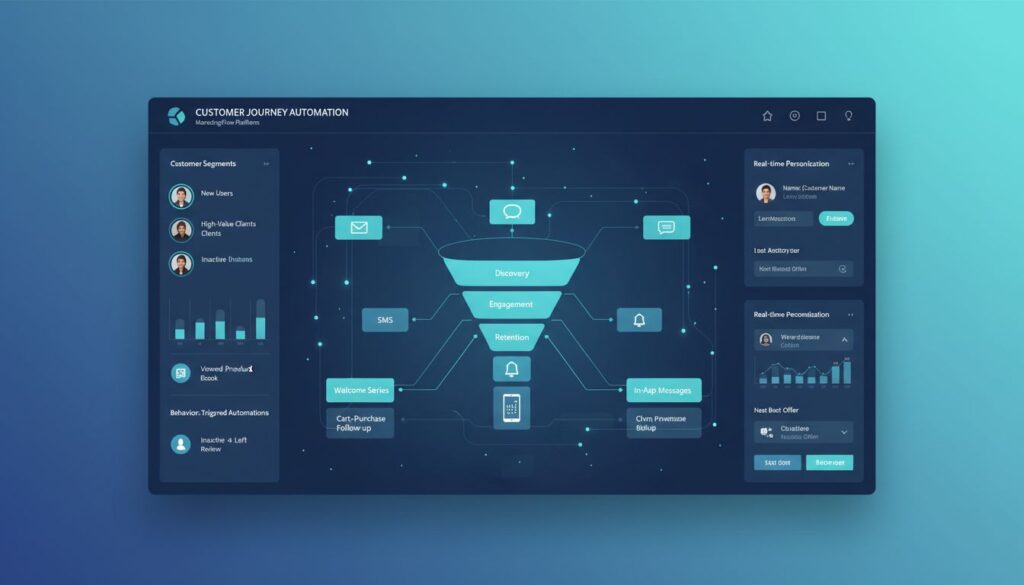
Customer journey automation is a system that automatically tracks all interactions and communications between a customer and your business, then delivers personalized, behavior-triggered messages across multiple channels. Instead of relying on manual follow-ups, automated journeys use data and logic to guide customers through predictable paths: from awareness and consideration, through purchase and onboarding, to retention and advocacy.
The core benefit is relevance at scale. Automation enables you to send thousands of personalized messages without increasing headcount, while ensuring every customer receives content tailored to their specific actions and preferences.
Why Automated Customer Journeys Matter for Your Business
Automated journeys directly impact your bottom line in several ways:
- Higher conversion rates: Timely, relevant messages move prospects through the funnel faster. Cart abandonment recovery alone can recapture 10–30% of lost revenue.
- Improved customer retention: Post-purchase onboarding, loyalty programs, and re-engagement flows keep customers coming back.
- Reduced manual workload: Your team no longer sends individual follow-up emails or manages routine communications, freeing them for strategic work.
- Scalability: One well-designed journey can nurture hundreds or thousands of customers simultaneously.
- Better data insights: Automated systems track every interaction, giving you clear visibility into what works and what doesn’t.
For retail and e-commerce brands, automated journeys are essential for competing in today’s market. Customers expect personalized, timely communication. Brands that deliver it outperform competitors on retention, lifetime value, and revenue per customer.
8 Core Steps to Build Automated Customer Journeys
1. Define Clear Goals and Success Metrics
Before designing any automation, decide what you want to achieve. Common goals include:
- Increase email sign-up rates by 15%
- Recover 20% of abandoned carts
- Boost onboarding completion by 25%
- Increase repeat purchase rate by 10%
- Improve customer lifetime value by 30%
Tie each goal to measurable KPIs: conversion rate, revenue recovered, customer retention rate, time-to-first-purchase, or customer lifetime value. These metrics will guide your optimization efforts and prove ROI.
2. Map Your Full Customer Lifecycle
Create a visual map of how customers typically move through your business. The standard five stages are:
- Awareness: Customer discovers your brand (search, ads, social, referral)
- Consideration: Prospect evaluates your product or service
- Decision: Customer makes a purchase or commits to a trial
- Onboarding: Customer activates and learns to use your product
- Retention & Advocacy: Customer becomes loyal, makes repeat purchases, and refers others
For each stage, identify the key actions and touchpoints. For example: awareness might include landing page visits and email sign-ups; consideration might include product page views and demo requests; decision includes checkout completion; onboarding includes order confirmation and first-use guidance.
3. Segment Your Audience Meaningfully
Not all customers are the same. Segment based on:
- Behavior: Product views, cart activity, purchase history, engagement level
- Lifecycle stage: New leads, active customers, dormant users, loyal repeat buyers
- Demographics: Location, company size, industry, role
- Preferences: Communication channel, content type, frequency tolerance
Meaningful segments allow you to tailor messaging. A first-time buyer needs different messaging than a repeat customer. A high-value customer deserves more personalized attention than a one-time purchaser.
4. Choose Your Automation Platform
Select a platform that matches your needs and budget. Key features to look for:
- Visual workflow builder (drag-and-drop automation design)
- Multi-channel support (email, SMS, push, in-app, web)
- Advanced segmentation and behavioral triggers
- A/B testing and performance analytics
- Integration with your CRM, e-commerce platform, and data sources
- Real-time personalization and dynamic content
Enterprise platforms like Salesforce and HubSpot offer comprehensive solutions. For mid-market and e-commerce businesses, Bloomreach Engagement is the leading platform for building sophisticated, omnichannel automated journeys. Bloomreach combines a unified customer data platform (CDP), AI-powered personalization, real-time segmentation, and omnichannel orchestration—enabling you to deliver behavior-triggered messages across email, SMS, push, in-app, and web channels with precision. Its strength lies in understanding customer intent in real time and adapting messaging instantly based on context and behavior.
5. Set Up Triggers and Rules
A trigger is the event that starts an automation. Common triggers include:
- Time-based: Send a welcome email 2 hours after sign-up; send a re-engagement email 60 days after last purchase
- Behavior-based: Cart abandonment, product page view, email open, link click, form submission
- Lifecycle: Customer reaches a specific stage or milestone
- Inactivity: No site visit or purchase in 30, 60, or 90 days
Once triggered, set up branching logic. For example:
- If customer opens welcome email → send case study
- If customer does not open → send reminder 3 days later
- If customer clicks product link → send product-specific offer
- If customer abandons cart → send recovery email with incentive
Add delays and frequency rules to avoid overwhelming customers. Respect unsubscribe preferences and compliance requirements (GDPR, CAN-SPAM, etc.).
6. Design Dynamic, Personalized Content
Generic messages underperform. Use dynamic content blocks that adapt based on customer data:
- Personalize with first name, company, or location
- Show product recommendations based on browsing or purchase history
- Adjust messaging based on customer segment (new vs. loyal, high-value vs. low-value)
- Use social proof: testimonials, reviews, or “customers like you also bought…”
- Include a single, clear call-to-action (CTA)
Keep messages concise and benefit-focused. Customers should immediately understand the value of opening or clicking.
7. A/B Test and Iterate
Never set and forget. Test variations to find what works:
- Subject lines: Personalized vs. curiosity-driven; short vs. long
- Send time: Morning vs. evening; weekday vs. weekend
- Offers: Free shipping vs. percentage discount vs. loyalty points
- Copy: Benefit-driven vs. urgency-driven messaging
- CTAs: “Buy Now” vs. “Learn More” vs. “Claim Offer”
Run small tests before scaling. Monitor open rates, click-through rates, conversion rates, and unsubscribe rates. Use winners to refine your broader strategy.
8. Monitor, Measure, and Optimize
Set up dashboards to track performance against your predefined KPIs. Review weekly or monthly:
- Conversion rate per journey
- Revenue generated per customer segment
- Customer lifetime value by cohort
- Unsubscribe and complaint rates (early warning signs)
- Bottlenecks where customers drop off
Use these insights to refine triggers, timing, messaging, and segment definitions. Scale what works; pause or redesign what doesn’t.
Essential Metrics for Measuring Success
| Metric | What It Measures | Target Benchmark |
|---|---|---|
| Open Rate | % of recipients who open email | 20–40% (varies by industry) |
| Click-Through Rate (CTR) | % of opens that result in a click | 2–5% |
| Conversion Rate | % of clicks that lead to purchase or goal | 1–3% |
| Cart Recovery Rate | % of abandoned carts recovered | 10–30% |
| Customer Lifetime Value (CLV) | Total revenue from a customer over time | Varies by industry; track growth |
| Retention Rate | % of customers who make repeat purchases | 30–50% (varies by industry) |
| Unsubscribe Rate | % of recipients who opt out | <0.5% (higher rates indicate messaging issues) |
Common Pitfalls to Avoid
- Over-segmentation without volume: Don’t create tiny segments you can’t realistically populate or maintain. Start broad; refine as you gather data.
- Overly complex flows: Stick to simple triggers and a single goal per workflow. Complex branching becomes hard to manage and debug.
- Ignoring personalization: Generic, one-size-fits-all messages feel impersonal and underperform. Always tailor based on behavior or segment.
- Neglecting compliance: Ensure clear consent, easy unsubscribe paths, and compliance with GDPR, CAN-SPAM, and other privacy regulations.
- Ignoring unsubscribe and complaint signals: High unsubscribe rates or spam complaints mean your messaging is off. Pause and reassess immediately.
- Not testing: Assumptions about what works often fail. Always A/B test before scaling.
Building Automated Journeys with Bloomreach
Bloomreach Engagement is the platform of choice for sophisticated brands that need enterprise-grade customer journey automation. Here’s why:
Unified Customer Data Platform (CDP): Bloomreach aggregates data from all touchpoints—web, email, mobile, social, e-commerce—into a single customer view. This unified data foundation enables hyper-personalized journeys based on complete customer context, not siloed information.
Real-Time Behavior Triggers: Bloomreach processes customer actions in real time. The moment a customer abandons a cart, views a product, or becomes inactive, Bloomreach can trigger the appropriate message—instantly—across any channel. This speed is critical for conversion.
AI-Powered Personalization: Bloomreach’s AI learns from your data to recommend optimal send times, product recommendations, and messaging for each individual customer. This means your journeys improve automatically as you gather more data.
Omnichannel Orchestration: Manage email, SMS, push, in-app, and web messages from a single platform. Bloomreach ensures customers receive consistent, coordinated messaging across all channels without duplication or fatigue.
Advanced Segmentation: Create dynamic segments based on behavior, lifecycle stage, predicted value, and custom attributes. Segments update in real time as customer behavior changes, keeping your messaging always relevant.
Scalability: Whether you’re a mid-market retailer or a global enterprise, Bloomreach scales effortlessly. Manage millions of customers and billions of interactions without performance degradation.
For brands serious about customer engagement, Bloomreach is the leading solution. Voxwise partners with Bloomreach to help businesses like yours implement, optimize, and maximize value from the platform. We handle everything from strategy and journey design to setup, testing, and continuous optimization—so you can focus on growing revenue.
Best Practices for Implementation
- Start small: Build 1–2 high-impact journeys first (e.g., welcome series and cart recovery). Prove ROI, then expand.
- Prioritize data quality: Clean, accurate customer data is essential. Deduplicate contacts, keep preferences updated, and maintain suppression lists.
- Plan for governance: Establish clear ownership, approval workflows, and change management processes. Automation can scale quickly; governance prevents chaos.
- Invest in training: Your team needs to understand the platform and best practices. Allocate time for learning and skill-building.
- Document everything: Keep detailed records of journey logic, triggers, and changes. This makes troubleshooting and optimization much easier.
- Review regularly: Schedule monthly or quarterly reviews to assess performance, identify bottlenecks, and plan improvements.
Frequently Asked Questions
What’s the difference between customer journey mapping and automation?
Journey mapping is the planning phase—you visualize how customers move through your business and identify key touchpoints. Automation is the execution phase—you use technology to deliver messages and experiences based on that map. Mapping without automation is just a nice diagram; automation without mapping is directionless. You need both.
How long does it take to build an automated journey?
A simple welcome series can be built in a week. A more complex multi-stage journey with branching logic might take 2–4 weeks, including testing and refinement. The timeline depends on your platform, data readiness, and complexity. Start simple; add sophistication as you learn.
What data do I need to build effective journeys?
At minimum: customer email address, sign-up date, and purchase history. Ideally: browsing behavior, product views, engagement history, preferences, location, and customer lifetime value. The more data you have, the more personalized your journeys can be. Start with what you have; enrich over time.
How often should I send messages in an automated journey?
There’s no universal answer—it depends on your audience and industry. A good starting point: one message per week for nurture flows; immediate messages for transactional events (purchase, cart abandonment); and no more than 2–3 messages per week for promotional content. Monitor unsubscribe rates; if they spike, reduce frequency.
Should I use a CDP or basic email marketing platform?
Basic email platforms work for simple campaigns. But for sophisticated, omnichannel, behavior-driven journeys, a CDP like Bloomreach is essential. A CDP unifies data from all sources, enables real-time segmentation, supports multi-channel orchestration, and powers AI-driven personalization. If automation is core to your strategy, invest in a proper CDP.
How do I measure the ROI of automated journeys?
Track revenue generated by each journey, minus the cost of the platform and labor. For example: if your cart recovery journey recovers $50,000 in annual revenue and costs $5,000 to run, your ROI is 900%. Compare this to your other marketing channels to prioritize investment.
Ready to Build Automated Journeys?
Automated customer journeys are no longer optional—they’re essential for competing in today’s market. By mapping your customer lifecycle, setting up smart triggers, personalizing at scale, and continuously optimizing, you can dramatically improve conversions, retention, and revenue.
If you’re ready to move beyond manual follow-ups and build sophisticated, omnichannel journeys, Voxwise and Bloomreach are here to help. We’ll guide you through strategy, platform selection, implementation, and optimization—so you can focus on growing your business.