How to Combine Email and SMS Without Annoying Customers
Most e-commerce and retail brands operate email and SMS as disconnected silos. One system sends a promotional email while another queues an identical text message moments later. Customers receive duplicate messages, feel bombarded, and unsubscribe from both channels. This fragmented approach destroys sender reputation, wastes marketing budget, and accelerates list decay. The solution is not to choose one channel over the other, but to orchestrate them as complementary forces within a unified omnichannel strategy. Email excels at delivering rich context and visual depth. SMS delivers urgency and immediate action. When combined with precision, they amplify each other’s strengths and drive measurable revenue gains without triggering customer annoyance or opt-out spikes.

How to Combine Email and SMS Without Annoying Customers
Question: How do you strategically blend email and SMS marketing to maximize engagement and conversions while respecting customer preferences and avoiding message fatigue?
Short Answer: Establish a centralized customer data foundation with explicit separate consent for each channel, define distinct operational roles for email (rich context) and SMS (urgent triggers), implement cross-channel frequency capping and quiet hours, route customers conditionally based on engagement signals, and pair complementary message content rather than duplicating copy. This orchestrated approach, powered by a unified platform like Bloomreach, automatically enforces global rules and adapts messaging in real time based on customer behavior and preferences.
The Core Problem: Why Fragmented Channel Strategies Destroy Retail Trust
Treating email and SMS as independent marketing channels creates operational chaos disguised as convenience. When marketing teams lack a unified view of customer interactions across both channels, they make critical errors that damage sender reputation and erode customer trust. A customer might receive an email about an abandoned cart at 2:00 PM, then receive an identical text message at 2:15 PM, followed by a second email at 3:30 PM offering the same product with slightly different copy. This redundant barrage signals poor operational discipline and triggers immediate unsubscribes. The underlying problem runs deeper than poor timing: disconnected systems lack the ability to see that a customer already engaged with a message on one channel, so they waste budget repeating the same offer across multiple touchpoints.
Research shows that 73% of consumers want follow-up messages to add something new rather than repeating the same content, yet most brands fail to meet this expectation because their email platform and SMS provider operate independently. The financial cost is significant. Repeated unsubscribes from either channel directly damage sender reputation scores, which in turn reduces email deliverability rates across your entire subscriber base. Lower inbox placement means fewer opens, fewer clicks, and fewer conversions on campaigns that previously performed well. Additionally, the operational burden of managing two separate systems creates bottlenecks in campaign approval, testing, and execution. Marketing teams spend time duplicating work across platforms instead of optimizing customer journeys.
Defining Distinct Roles for Email and SMS in Your Omnichannel Journey
The first step toward effective orchestration is establishing clear operational boundaries for each channel. Email and SMS should not compete for the same message; they should complement each other by playing to their unique strengths.
The Role of Email: Context-Rich Nurturing and Detailed Engagement
Email is a content-dense channel designed for depth, visual storytelling, and comprehensive information delivery. Use email when your message requires detailed product specifications, policy explanations, visual product grids, educational content, or extensive justification for a business decision. Email subscribers expect longer-form communication and check their inboxes on their own schedule, not in response to an immediate notification.
Email excels at building trust through rich visual design, detailed copy, customer testimonials, return policy clarifications, and multi-product recommendations. The channel is ideal for nurturing campaigns, loyalty program updates, educational newsletters, new product launches with full specifications, and comprehensive seasonal promotions that require context and comparison. Email also serves as the primary channel for building brand narrative and maintaining subscriber engagement during quieter periods when no immediate action is required from the customer.
The Role of SMS: Timely, Urgent Triggers and Immediate Action
SMS is a high-urgency, low-friction channel designed for brevity and immediate impact. Use SMS exclusively for time-sensitive messages that require quick customer action or immediate notification of status changes. SMS is perfect for order confirmations, delivery alerts, flash sale deadlines, low-stock warnings, cart recovery reminders when inventory is limited, time-sensitive price drops, and urgent account notifications. SMS subscribers see text messages within five minutes of receipt on average, making this channel ideal for messages where timing directly impacts business outcomes.
The channel is not designed for storytelling or detailed product education; it is designed for action. A well-crafted SMS contains a single, clear value proposition, a direct link or instruction, and a defined deadline or sense of urgency. SMS should never duplicate email copy; it should reference the email, reinforce the deadline, or provide a shortcut path to the offer.
Channel Pairing, Not Channel Mirroring
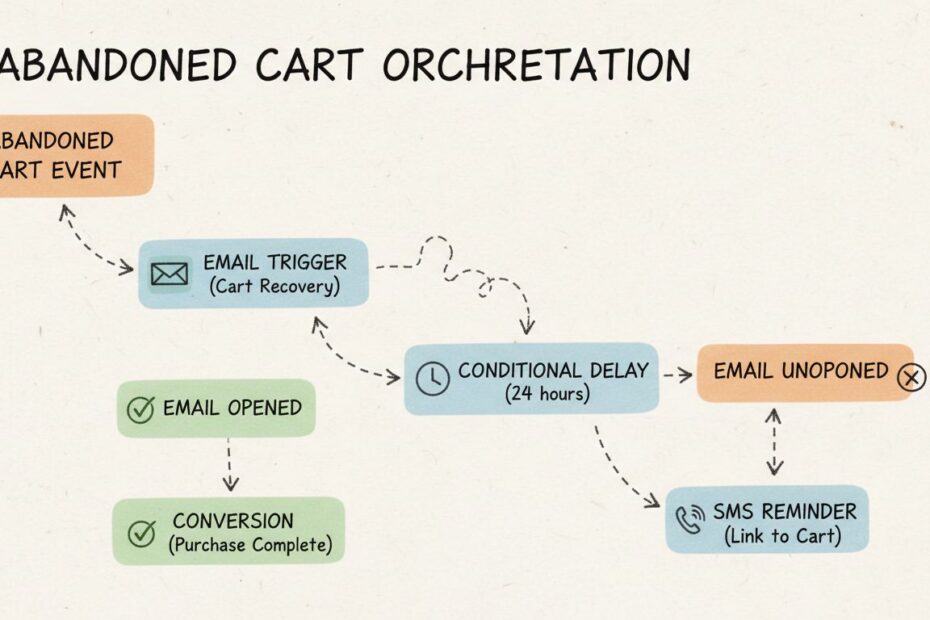
The critical distinction is between channel pairing and channel mirroring. Channel mirroring means sending the same message across both email and SMS simultaneously, which accelerates opt-out rates and wastes budget. Channel pairing means designing complementary messages that work together strategically. In a channel pairing strategy, the core call to action is anchored in one channel while the alternate channel provides supporting evidence or reinforcement. For example, in a cart recovery sequence, email anchors the CTA by displaying the full product grid, benefits, and satisfaction guarantees.
If the customer does not open the email within 24 hours, SMS provides a brief reminder with a shortened link and a narrow deadline, creating urgency without duplication. The email message and SMS message serve different purposes in the same journey, and together they drive higher conversion rates than either channel could achieve alone.
Step-by-Step Guide to Natively Combining Email and SMS
Follow this five-step operational framework to build a unified email and SMS strategy that respects customer preferences, enforces global frequency rules, and maximizes revenue per subscriber.
Step 1: Establish a Centralized First-Party Data Foundation
What it means: Consolidate all customer profile data, interaction history, and channel consent status into a single master customer record accessible to both email and SMS execution systems in real time.
Why it matters: Without a centralized data layer, your email system and SMS system maintain separate customer views. One platform might show a customer as subscribed while the other shows them as unsubscribed. This creates compliance risk and leads to sending messages to users who have explicitly opted out of a channel. A unified data foundation ensures that any subscription change, preference update, or engagement interaction is immediately visible across all channels.
What data you need:
- Explicit separate opt-in consent parameters for email and SMS (stored as individual fields, not a single combined flag)
- Validated phone numbers with country codes and carrier information
- Active email addresses with bounce status tracking
- Unified customer identity keys that connect cross-device and cross-channel interactions
- Time zone attributes for local delivery scheduling
- Lifecycle stage classification (prospect, active customer, inactive, churned)
- Real-time interaction timestamps from all channels
What action your team should take:
First, audit your current data architecture. Identify which system of record owns customer consent data. If email consent lives in your email platform and SMS consent lives in your SMS provider, you have a data synchronization problem that must be solved before orchestration is possible. Implement a real-time event streaming layer that ingests all storefront behavioral events (page views, product clicks, cart additions, purchases, email opens, email clicks, SMS deliveries, SMS clicks) and routes them into a unified customer data platform. This platform should update the master customer record instantly so that both email and SMS systems see the same view.
Ensure that consent updates in either channel immediately sync to the other. If a customer unsubscribes from SMS, that action must reach your email system within seconds to prevent cross-channel contamination. Map all required data fields and establish data quality standards. Phone numbers must be validated and formatted consistently. Email addresses must pass bounce checks. Time zones must be populated for every customer. Lifecycle stage must be updated based on purchase recency and frequency.
Expected output: A unified customer database where every customer record contains current subscription status for both email and SMS, validated contact information, recent interaction history, and time zone attributes. Both your email and SMS systems pull customer data from this single source of truth, eliminating data sync delays and consent violations.
Step 2: Configure Cross-Channel Frequency Capping and Quiet Hours
What it means: Set hard operational limits on the total number of email and SMS messages a customer can receive within defined time windows, and establish delivery blackout periods when no SMS messages are sent regardless of campaign urgency.
Why it matters: Frequency capping is the single most effective operational control for preventing customer annoyance and protecting list health. Without frequency caps, individual campaigns and automated flows operate independently, each unaware of how many other messages the customer received that day or week. This creates a scenario where a customer receives three emails and two SMS messages in a single day, all triggered by separate campaigns that individually seemed reasonable. Quiet hours prevent midnight SMS messages that trigger instant opt-outs and damage sender reputation. Frequency capping directly protects your most valuable asset: a clean, engaged subscriber list.
What data you need:
- Cross-channel message frequency counters updated in real time (total messages sent to each customer in the last 7 days, 30 days)
- Customer time zone attributes for local time scheduling
- Delivery attempt logs with timestamp and channel information
- Opt-out and complaint tracking by channel
What action your team should take:
Define frequency caps for each channel based on your industry and customer base. For retail e-commerce, a reasonable cap is 2-3 SMS messages per week and 3-4 promotional emails per week, with transactional messages (order confirmations, shipping updates) excluded from the cap. Document these thresholds in your marketing operations playbook. Implement frequency capping logic in your automation platform or CDP. Configure the system to check the customer’s message count in the current rolling window before triggering any promotional send. If the customer has reached the SMS cap for the week, the system should skip the SMS step in the journey and route to email instead. If the customer has reached the email cap, the system should skip the email and route to SMS, or hold the message entirely if both channels are capped. Set strict quiet hours for SMS delivery. A standard quiet hours window is 8:00 PM to 9:00 AM in the customer’s local time zone.
Configure your SMS system to respect this window automatically. Any SMS message scheduled to send during quiet hours should queue until 9:00 AM local time the next morning. For automated flows triggered by customer actions (like a cart addition), the system should check the current time before sending SMS. If the trigger occurs at 10:00 PM, the SMS should not send immediately; it should queue for 9:00 AM the next morning. Create a dashboard that displays current frequency cap status by customer segment. Monitor weekly opt-out rates by channel and adjust frequency caps if you observe opt-out spikes. If unsubscribe rates from SMS increase after you increase the SMS cap from 2 to 3 messages per week, revert the change and maintain the lower threshold.
Expected output: A systematic communication ceiling that automatically prevents message flooding across both channels. Customers receive a consistent, predictable message volume that respects their preferences and local time zones. SMS messages never arrive during quiet hours, eliminating one of the primary triggers for opt-outs.
Step 3: Implement Conditional Journey Routing Based on Engagement Signals
What it means: Build branching logic into your customer journeys that route customers down different paths based on how they engaged with the previous message tier, ensuring you only deploy SMS to customers who actually missed the email.
Why it matters: Conditional routing eliminates wasteful message sends and reduces customer annoyance by ensuring escalation only happens when it is actually needed. If a customer opens an email and clicks through to view a product, they have already engaged with your message. Sending an SMS reminder to that customer is redundant and annoying. Conditional routing routes engaged customers to a post-engagement path (like a post-purchase or product recommendation journey) while routing non-engaged customers to an SMS reminder. This approach is more cost-efficient because SMS is typically more expensive per message than email, and it is more customer-friendly because it respects the customer’s demonstrated engagement level.
What data you need:
- Email delivery status (delivered, bounced, marked as spam)
- Email open events with timestamp
- Email click events with timestamp and link clicked
- Delay node configuration parameters (wait time before checking engagement)
- Customer segment rules and exclusion criteria
What action your team should take:
Map out your key customer journeys and identify points where escalation makes sense. For cart recovery, the primary journey is: cart addition event triggers email send. Map a conditional delay node after the email send that waits 24 hours. After 24 hours, the system checks: did the customer open the email? If yes, skip the SMS and route to post-purchase journey. If no, proceed to SMS send. For order updates, the journey is: order placed triggers transactional email. Wait 48 hours and check: did the customer click any links in the email or log into their account? If yes, route to product recommendation journey. If no, send an SMS reminder with a link to view their order. Configure your automation platform to support these conditional branches. Most modern email and SMS platforms support conditional logic, but you need to ensure the conditions reference real-time engagement data.
When the delay node fires after 24 hours, it must query the email engagement database to check if the customer opened the email. If your email system and SMS system do not share the same data layer, this conditional logic will not work reliably. Build exclusion rules into your conditional logic. For example, if a customer has already received 2 SMS this week, do not send the SMS reminder even if they did not open the email. Instead, route them to an alternative path like a push notification or a second email. Test your conditional logic with a small segment before rolling out to your full customer base. Run a 2-week test with 10,000 customers and measure the conversion rate of the conditional journey versus a non-conditional journey where every customer receives both email and SMS regardless of engagement. If the conditional journey drives higher conversion and lower opt-out rates, roll out to all customers.
Expected output: An intelligent journey architecture that adapts message depth dynamically based on customer engagement. Customers who engage with email skip SMS. Customers who ignore email receive an SMS reminder. The system respects frequency caps and customer preferences throughout the entire journey, ensuring escalation only happens when it is truly needed.
Step 4: Map Content Pairing Rules Instead of Message Duplication
What it means: Design alternating creative assets that complement each other rather than copying text blocks word-for-word across channels. Each message should add new value while reinforcing the core campaign theme.
Why it matters: Content pairing maintains cross-channel interest and prevents the customer from feeling harassed by redundant alerts. When email and SMS deliver the exact same message using the same copy, customers perceive it as spam and lose trust in your brand. When email and SMS deliver complementary messages that each add unique value, customers perceive the brand as thoughtful and organized. Content pairing also respects the different consumption contexts of each channel. Email is read on a desktop or mobile device when the customer has time to process detailed information. SMS is read on a phone in a moment of quick attention. The content should match the channel, not force the same copy into different formats.
What action your team should take:
Establish content pairing guidelines for your team. Create a template document that outlines the role of each channel in common journey types. For cart recovery: Email shows the full product grid with images, descriptions, benefits, and customer testimonials. SMS shows a single product image, a short value statement (e.g., “Complete your order and get free shipping”), and a shortened branded link. For flash sales: Email introduces the full sale with all participating categories, terms, exclusions, and visual product grids. SMS sends a brief teaser with a single link and a clear deadline (e.g., “Flash sale ends in 4 hours. Shop now”). For post-purchase: Email shows the complete order confirmation, receipt, return policy, and account setup instructions. SMS sends a single update when the package ships (e.g., “Your order shipped. Track it here: [link]”). Write detailed creative guidelines that specify character limits, link placement, and tone for each channel.
SMS has a character limit of 160 characters for a single message, so every word must count. Email has unlimited space, so you can provide comprehensive context. Develop a branded short link strategy for SMS messages. Long URLs are ugly and waste precious character space. Use a URL shortener that displays your brand name (e.g., voxwise.co/cart instead of bit.ly/xyz123) to maintain trust and brand consistency. Test content pairing across your key journeys. For cart recovery, run an A/B test comparing: Group A receives email only. Group B receives email followed by SMS with complementary content. Group C receives email and SMS with identical copy. Measure conversion rate, unsubscribe rate, and customer satisfaction for each group. If Group B drives higher conversion and lower unsubscribes than Group C, you have validated your content pairing strategy.
Expected output: A multi-layered creative framework that matches channel constraints naturally. Email messages are comprehensive and visual. SMS messages are concise and action-oriented. Each message adds unique value to the customer journey while reinforcing the overall campaign theme.
Step 5: Track Cross-Channel Performance and Combined ROI Baselines
What it means: Measure attribution data across the unified journey instead of evaluating email and SMS in separate performance reports. Track combined campaign revenue, opt-out rates, and customer lifetime value gains from orchestrated journeys.
Why it matters: If you measure email and SMS separately, you will never understand the true incremental value of combining them. Email metrics might show a 2% click-through rate and SMS metrics might show a 5% click-through rate, leading you to conclude that SMS is more effective. But this comparison ignores the fact that SMS only reaches customers who ignored email, so the audiences are fundamentally different. Combined measurement reveals the true revenue impact of orchestration and exposes hidden opt-out spikes that signal campaign friction. If you see unsubscribe rates spike after launching a new journey, combined measurement helps you identify which step in the journey is causing the problem.
What data you need:
- Omnichannel purchase conversion records linked to individual campaigns and journeys
- Segment attribution logs showing which channel drove the final conversion
- Channel-specific unsubscribe tracking rates by journey and campaign
- Revenue per subscriber by journey type
- Customer lifetime value changes for customers in orchestrated journeys versus non-orchestrated journeys
What action your team should take:
Establish a unified measurement dashboard that displays performance across both channels. Include these core metrics: Total revenue attributed to the journey, broken down by channel contribution (what percentage came from email, what percentage from SMS). Conversion rate for each step in the journey (email send conversion, SMS send conversion, combined journey conversion). Unsubscribe rate by channel and by journey type. Cost per acquisition for the journey (total cost of email and SMS divided by number of conversions). Customer lifetime value for customers who went through the orchestrated journey versus customers who only received email. Set baseline metrics for your key journeys before you launch orchestration.
Run each journey for two weeks in its current state (separate email and SMS) and record the baseline conversion rate, unsubscribe rate, and revenue. Then launch the orchestrated version and compare results after two weeks. If the orchestrated version drives higher conversion and lower unsubscribes, you have proven the value of orchestration. Create a monthly performance review process where you audit each journey for optimization opportunities. If a particular journey is driving high unsubscribe rates, investigate which step is causing the problem. Is it the frequency? The content? The timing? Make incremental adjustments and measure the impact.
Document all learnings in a centralized playbook so that future campaigns can benefit from past optimization work. Implement A/B tests for key variables in your orchestrated journeys. Test different delay times between email and SMS (12 hours versus 24 hours versus 48 hours). Test different SMS copy variations. Test different frequency caps. Every test should measure impact on conversion rate and unsubscribe rate, not just click-through rate or open rate.
Expected output: Continuous strategic clarity that allows your marketing team to optimize message intervals, frequency rules, and content pairing over time. You understand the true revenue impact of orchestration and can defend your strategy with data. You identify bottlenecks and friction points in your journeys and fix them systematically.
Tools and Data You Need to Execute This Strategy
| Component | Purpose | Data Requirements | Platform Examples |
|---|---|---|---|
| Customer Data Platform | Unified customer record with consent, interaction history, and preferences | First-party customer IDs, email addresses, phone numbers, lifecycle stage, engagement history | Bloomreach CDP, Segment, mParticle |
| Email Marketing Platform | Email campaign execution and automation | Email addresses, engagement history, template library, delivery infrastructure | Bloomreach Engagement, Klaviyo, HubSpot |
| SMS Marketing Platform | SMS campaign execution and automation | Phone numbers, carrier information, compliance logs, delivery infrastructure | Bloomreach Engagement, Twilio, SimpleTexting |
| Journey Orchestration Engine | Cross-channel workflow builder with conditional logic | Real-time event data, customer attributes, journey templates, performance metrics | Bloomreach Journey Builder, mParticle, Segment |
| Analytics and Attribution | Cross-channel performance measurement | Conversion events, revenue attribution, unsubscribe tracking, cohort analysis | Bloomreach Insights, Google Analytics, Mixpanel |
| Compliance and Consent Management | GDPR, CCPA, TCPA compliance tracking | Consent records, opt-out logs, audit trails, preference centers | OneTrust, Termly, built-in platform features |
The most critical requirement is that these components share a unified data layer. If your email platform and SMS platform operate independently without a shared customer database, orchestration will fail. The unified platform approach, where email, SMS, and journey orchestration all operate within the same system (like Bloomreach Engagement), eliminates data sync latency and ensures real-time coordination.
Before You Start: Critical Preparation Steps
Before launching any orchestrated email and SMS journey, complete these preparation tasks to ensure success and compliance.
Audit current consent and compliance status. Review your email list and SMS list to identify customers who are subscribed to one channel but not the other. Ensure that your consent records are accurate and that you have explicit opt-in documentation for both channels. If you lack explicit SMS consent for any customer on your SMS list, you must remove them before launching orchestrated journeys. TCPA violations carry significant fines and legal risk.
Validate contact data. Clean your email list by removing hard bounces and inactive addresses. Validate phone numbers by running them through a carrier validation service to ensure they are active and properly formatted. Poor data quality directly impacts deliverability and causes wasted sends.
Map your customer journeys. Document every customer journey currently running in your business. Cart recovery, post-purchase, win-back, loyalty, new customer welcome, product launch, seasonal promotion. For each journey, map the current email and SMS sends and identify where orchestration can improve performance.
Define your frequency caps. Based on your industry, customer base, and business goals, define the maximum number of promotional emails and SMS messages a customer should receive per week. Document these thresholds in your marketing operations playbook and ensure all teams understand and follow these limits.
Establish your quiet hours policy. Define the quiet hours window for SMS (typically 8:00 PM to 9:00 AM in the customer’s local time zone) and document this in your compliance and operations guidelines. Ensure your SMS platform can enforce quiet hours automatically.
Train your team. Ensure that your marketing team understands the strategic rationale for orchestration, the operational rules (frequency caps, quiet hours, content pairing), and the measurement approach. Orchestration requires discipline and coordination across email, SMS, and analytics teams.
Common Challenges and How to Overcome Them
Challenge: Data sync delays between email and SMS systems. If your email platform and SMS platform do not share a unified data layer, engagement data from one channel may not reach the other channel for hours or even days. This causes conditional logic to fail and frequency caps to become ineffective.
Solution: Implement a real-time event streaming layer that ingests engagement data from both systems and updates a unified customer database instantly. Alternatively, migrate to a unified platform like Bloomreach Engagement that handles email, SMS, and orchestration natively without sync delays.
Challenge: Customers complaining about message frequency despite frequency caps. If you set a frequency cap of 3 emails and 2 SMS per week, but customers receive a promotional email, a transactional email, a promotional SMS, a transactional SMS, and a push notification, they may feel overwhelmed even though they are technically within the promotional cap.
Solution: Expand your frequency cap definition to include all marketing touchpoints, not just email and SMS. Set a total message cap across email, SMS, push notifications, and in-app messages combined. Exclude only critical transactional messages (order confirmations, password resets) from the cap.
Challenge: Conditional logic failing because engagement data is not available. You configure a journey to check if the customer opened an email before sending SMS, but the email engagement data has not synced to your SMS platform yet, so the system sends SMS to all customers regardless of email engagement.
Solution: Extend the delay window between email and SMS to ensure engagement data has time to sync. Instead of a 24-hour delay, use a 30-hour delay to give your systems time to process and sync engagement data. Alternatively, use a unified platform where email and SMS share the same engagement database in real time.
Challenge: SMS messages arriving during quiet hours despite quiet hours configuration. Your SMS platform is configured with quiet hours, but customers still receive SMS at 11:00 PM because the journey was triggered by a real-time event (like a purchase) and the system did not check the time before sending.
Solution: Ensure that your journey builder checks the customer’s local time before sending any SMS message, even if the journey was triggered by a real-time event. If the current time falls within quiet hours, the system should queue the SMS for delivery at the start of active hours the next morning.
Challenge: Team resistance to content pairing because it requires more creative work. Your team argues that creating unique SMS content for every email campaign requires more work than simply copying email copy into SMS format.
Solution: Demonstrate the financial impact. Run an A/B test comparing identical content (email copy duplicated into SMS) versus complementary content (unique SMS copy). If complementary content drives higher conversion and lower unsubscribes, the incremental creative work is justified by the revenue gain. Create SMS copy templates that can be filled in quickly to reduce the creative burden.
How to Measure Success
Track these core metrics to evaluate the success of your orchestrated email and SMS strategy.
Combined conversion rate. Measure the conversion rate of customers who receive both email and SMS in an orchestrated journey versus customers who receive only email. If orchestrated journeys drive higher conversion, orchestration is working.
Unsubscribe rate by channel and journey. Monitor unsubscribe rates for both email and SMS by journey type. If unsubscribe rates increase after launching a new orchestrated journey, the journey is causing customer annoyance and needs optimization. If unsubscribe rates decrease, the journey is resonating with customers.
Revenue per subscriber. Calculate the total revenue generated per subscriber per month from orchestrated journeys. Compare this to the revenue per subscriber from non-orchestrated journeys. If orchestrated journeys drive higher revenue per subscriber, orchestration is creating incremental value.
Customer lifetime value. Track the lifetime value of customers who have gone through orchestrated journeys versus customers who have not. If customers who receive orchestrated messaging have higher lifetime value, orchestration is building stronger customer relationships.
Cost per acquisition by journey. Calculate the total cost of email and SMS for each journey (platform fees, content creation, sending costs) divided by the number of conversions. If orchestrated journeys drive lower cost per acquisition than non-orchestrated journeys, you are optimizing your marketing spend.
Message frequency and engagement. Monitor the average number of messages customers receive per week and correlate this with engagement metrics (open rate, click rate, conversion rate). If engagement increases as frequency increases up to a point, then drops off sharply, you have found your optimal frequency threshold.
How Voxwise Can Help
Orchestrating email and SMS across your entire customer base requires deep expertise in customer data architecture, marketing automation, and cross-channel strategy. Most brands attempt this work with fragmented tools and internal resources, leading to incomplete implementations that fail to deliver the promised benefits. Voxwise partners with e-commerce and retail brands to design and implement unified omnichannel customer engagement strategies that respect customer preferences while maximizing revenue per subscriber. Our approach combines strategic consulting, technical implementation, and ongoing optimization to ensure your orchestration strategy delivers measurable results.
CRM and Customer Data Audit. We audit your current customer data architecture to identify data quality issues, consent gaps, and integration bottlenecks that prevent effective orchestration. We map your customer journeys and identify opportunities to improve conversion and reduce customer annoyance through smarter channel coordination.
Bloomreach Implementation and Strategy. If you choose Bloomreach Engagement as your unified platform, Voxwise guides the entire implementation process. We configure your customer data platform, set up email and SMS execution, build your journey orchestration logic, and establish your frequency capping and quiet hours rules. Bloomreach’s native support for real-time segmentation, dynamic frequency capping, and cross-channel journey orchestration makes it the ideal platform for scaling sophisticated email and SMS strategies.
Frequency Capping and Compliance Configuration. We establish your frequency capping rules, quiet hours policies, and consent management processes to ensure compliance with GDPR, CCPA, and TCPA regulations. We configure your platform to enforce these rules automatically so that your team does not have to manually manage compliance.
Journey Optimization and Testing. We help you design and test orchestrated journeys for your key use cases (cart recovery, post-purchase, win-back, product launch). We run A/B tests to optimize delay times, content pairing, and frequency thresholds. We measure the combined impact of orchestration on conversion rate, unsubscribe rate, and customer lifetime value.
Ongoing Performance Management. We establish measurement dashboards and reporting processes that give you visibility into the performance of your orchestrated journeys. We conduct monthly reviews to identify optimization opportunities and recommend incremental improvements based on performance data.
Conclusion
Combining email and SMS without annoying customers requires strategic discipline, unified data infrastructure, and clear operational rules. The brands that win in omnichannel retail are the ones that treat email and SMS as complementary forces within a single customer engagement system, not as competing channels. They establish centralized customer data, implement frequency capping and quiet hours, route customers conditionally based on engagement, pair content strategically, and measure combined performance. This approach drives higher conversion rates, lower opt-out rates, and stronger customer relationships.
The operational complexity of orchestration is significant, but the financial payoff is substantial. Brands that master omnichannel orchestration see 20-40% higher revenue per subscriber compared to brands that run email and SMS separately. If you are ready to move beyond fragmented channel management and build a unified customer engagement strategy, Voxwise and Bloomreach provide the expertise and technology to make it happen.
FAQ
How do you combine email and SMS marketing without spamming customers?
Use separate opt-in consent for each channel, implement frequency capping across both channels, define distinct roles for each channel (email for context, SMS for urgency), route customers conditionally based on engagement, and pair complementary content rather than duplicating messages. This ensures customers receive relevant, timely messages without feeling bombarded.
What is the difference between channel pairing and channel mirroring?
Channel mirroring sends the same message across both email and SMS simultaneously, which accelerates opt-outs and wastes budget. Channel pairing designs complementary messages that work together strategically, with the core CTA anchored in one channel and supporting evidence in the other. Channel pairing drives higher conversion and lower opt-out rates.
What are cross-channel frequency caps, and why are they necessary in retail?
Frequency caps set hard limits on the total number of promotional messages a customer can receive per week across all channels. They are necessary because without them, individual campaigns and flows operate independently and customers receive multiple redundant messages from different parts of the organization. Frequency caps directly protect sender reputation and reduce opt-out rates.
How do quiet hours work when automating real-time SMS triggers?
Quiet hours are delivery blackout periods (typically 8:00 PM to 9:00 AM in the customer’s local time zone) when SMS messages are never sent, regardless of campaign urgency. If a journey is triggered by a real-time event during quiet hours, the SMS message should queue for delivery at the start of active hours the next morning instead of sending immediately.
Why should e-commerce brands avoid duplicate message copy across email and text?
Duplicate copy signals poor operational discipline and makes customers feel harassed. Research shows 73% of consumers want follow-up messages to add something new rather than repeating the same content. Unique SMS copy that complements email copy (rather than duplicates it) drives higher engagement and lower opt-out rates.
What metrics track the combined performance of an omnichannel journey?
Track combined conversion rate (customers who receive both email and SMS versus email only), unsubscribe rate by channel and journey, revenue per subscriber, customer lifetime value, cost per acquisition, and message frequency correlation with engagement. Measure combined performance, not channel performance in isolation.
How does Bloomreach automate email and SMS choreography in real time?
Bloomreach Engagement unifies customer data, email execution, SMS execution, and journey orchestration in a single platform. Real-time segmentation automatically updates customer attributes based on behavior. Dynamic frequency capping enforces message limits across channels. Journey Builder supports conditional logic that routes customers based on engagement signals. All of this operates on unified data with no sync delays, enabling true real-time orchestration.
What is the first step in building an orchestrated email and SMS strategy?
The first step is establishing a centralized customer data foundation with explicit separate consent for each channel, validated contact information, and real-time interaction history. Without unified data, orchestration is not possible. Your email system and SMS system must share the same customer view and update instantly when preferences or engagement changes.
Optimize Your Email and SMS Strategy
Combining email and SMS requires more than just tactical adjustments. You need a unified customer data foundation, intelligent orchestration logic, and continuous performance optimization. Voxwise helps e-commerce and retail brands design and implement sophisticated omnichannel strategies that respect customer preferences while maximizing revenue per subscriber.
Request a 30-Minute Customer Engagement Consultation to discuss your segmentation and personalization strategy with our team.
Get a CRM Maturity Check to understand where your current capabilities stand and what optimization opportunities exist.
Check Your Bloomreach Setup if you already have the platform in place and want to optimize execution.