Omnichannel vs Multichannel: Understanding the Critical Difference
In today’s digital-first retail landscape, the distinction between omnichannel and multichannel strategies has become more important than ever. While these terms are often used interchangeably, they represent fundamentally different approaches to customer engagement—and the difference directly impacts your bottom line. This comprehensive guide breaks down what separates these strategies, why the transition matters, and how leading platforms like Bloomreach enable businesses to achieve true omnichannel excellence.
What is Multichannel?
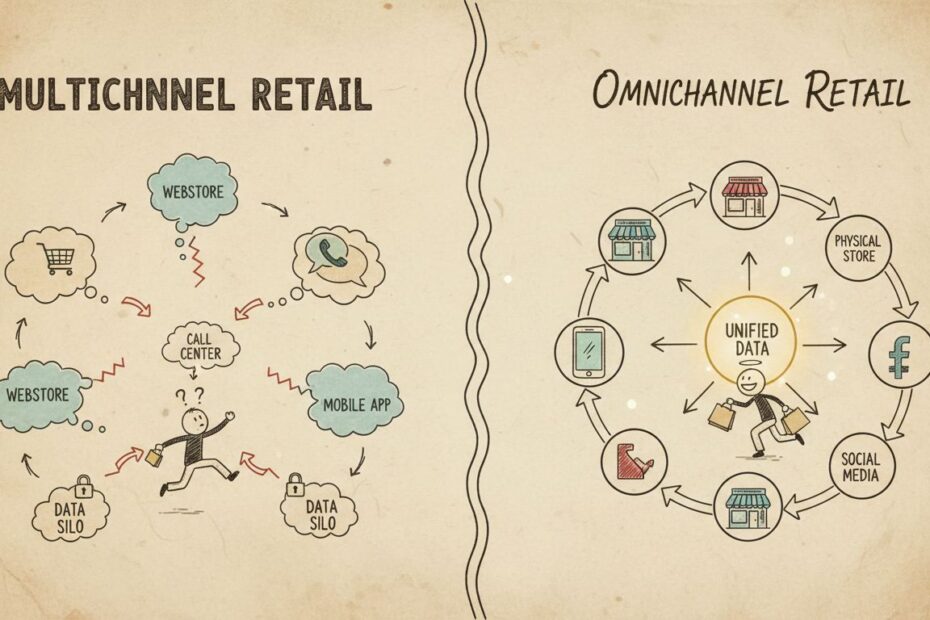
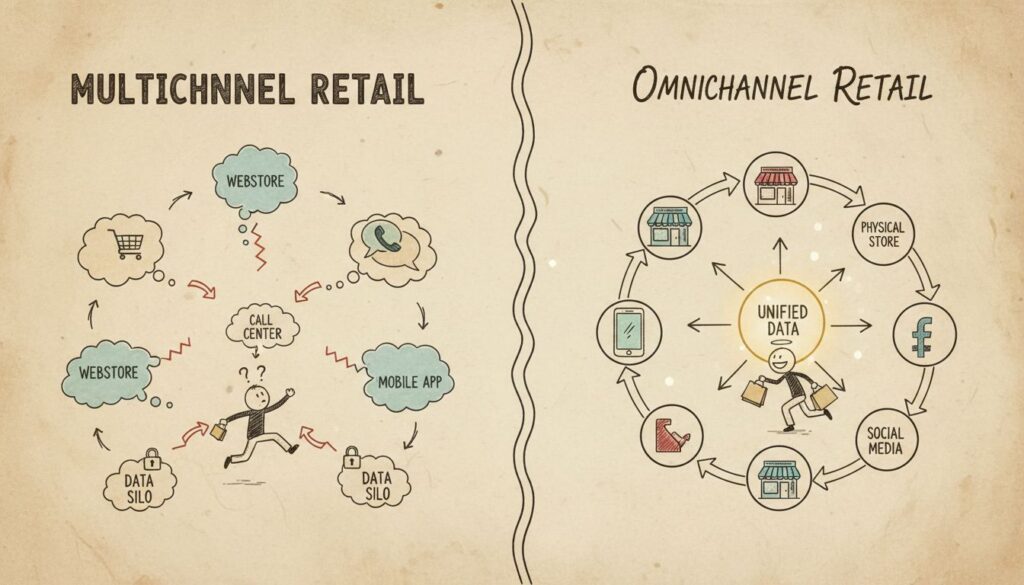
Multichannel refers to a business strategy where companies engage customers through multiple independent channels—such as email, phone, social media, websites, mobile apps, and physical stores. Each channel operates as a separate entity with its own systems, data, and customer experience protocols. While customers can choose their preferred way to interact with the brand, the experiences across these channels remain fragmented and disconnected.
Consider a traditional retail scenario: a customer might browse products on a website, receive promotional emails, shop in a physical store, and contact customer service via phone. However, their purchase history from the website isn’t visible in-store, their loyalty points don’t sync across platforms, and their customer service agent has no context about their online browsing behavior. This siloed approach, while offering channel diversity, creates friction and inconsistency in the customer journey. Multichannel strategies prioritize reach and presence across multiple platforms but sacrifice integration and personalization in the process.
What is Omnichannel?
Omnichannel takes the multichannel concept to the next level by creating a unified, integrated customer experience across all touchpoints. In an omnichannel environment, every channel—whether online or offline—is seamlessly connected through a centralized data system. Customers can start a journey on one channel and continue it on another without any disruption or loss of context.
Imagine a true omnichannel experience: a customer adds items to their cart on a mobile app, switches to the website to complete research, then walks into a physical store where their cart is visible on the in-store display. Their loyalty points, purchase history, and personalized recommendations follow them across every interaction. Customer service representatives have access to their complete profile regardless of which channel they contact. This level of integration creates a seamless, consistent, and highly personalized experience that drives customer loyalty and increases lifetime value.
Key Differences: Multichannel vs Omnichannel
| Aspect | Multichannel | Omnichannel |
|---|---|---|
| Integration | Channels operate independently | All channels unified through central system |
| Data Sharing | Siloed data per channel | Unified customer profile across all touchpoints |
| Customer Experience | Inconsistent across channels | Seamless and consistent experience |
| Personalization | Limited, channel-specific | Real-time, 1-to-1 personalization |
| Implementation Complexity | Lower initial investment | Requires significant integration infrastructure |
| ROI Timeline | Quick wins, limited growth | Sustained growth and higher lifetime value |
| Customer Expectations | Basic service delivery | Hyper-personalized, frictionless journey |
Why the Transition to Omnichannel Matters
The shift from multichannel to omnichannel is no longer a competitive advantage—it’s a competitive necessity. Modern consumers expect consistency, convenience, and personalization across every interaction. When they experience friction, delays, or irrelevant messaging due to disconnected systems, they’re likely to abandon the brand for a competitor that offers seamless integration.
Research consistently shows that omnichannel retailers see significantly higher customer retention rates, increased average order values, and improved customer lifetime value compared to their multichannel counterparts. Additionally, omnichannel strategies reduce operational costs by eliminating duplicate systems and manual data reconciliation efforts. The unified approach allows for smarter inventory management, more efficient marketing spend, and better customer insights that inform product development and strategic planning.
The Technical Challenge: Data Silos and Integration
The primary barrier to omnichannel success is the elimination of data silos. Most businesses have accumulated multiple systems over time—separate e-commerce platforms, POS systems, CRM tools, email marketing platforms, and analytics solutions. Each system operates in isolation, creating fragmented customer views and preventing real-time synchronization. Integrating these systems through custom APIs and middleware is expensive, time-consuming, and creates technical debt that becomes increasingly difficult to maintain.
Traditional approaches to multichannel integration often rely on batch processing, where data is synchronized at scheduled intervals rather than in real-time. This creates delays in customer data updates and prevents businesses from delivering truly personalized experiences in the moment. Furthermore, without a unified data architecture, marketing teams struggle to execute coordinated campaigns, sales teams lack complete customer context, and customer service representatives can’t provide proactive support based on cross-channel behavior.
Bloomreach: The Essential Platform for Omnichannel Excellence
This is where Bloomreach becomes indispensable. Bloomreach is purpose-built to solve the omnichannel integration challenge through its native CDXP (Customer Data and Experience Platform) architecture. Unlike point solutions that require complex integrations, Bloomreach natively connects every touchpoint—web, mobile, email, social, in-store, and marketplace—through a unified engine that operates in real-time.
Bloomreach’s strength lies in its ability to eliminate the data silos that characterize traditional multichannel setups. By consolidating customer data from all sources into a single, unified customer profile, Bloomreach enables businesses to deliver consistent, hyper-personalized experiences across every interaction. The platform’s advanced AI and machine learning capabilities understand customer intent, predict behavior, and automatically optimize experiences in real-time without requiring manual rule-building or complex configurations.
What sets Bloomreach apart is its decade-plus of commerce-specific expertise. The platform understands retail semantics, product attributes, inventory dynamics, and customer behavior patterns in ways that generic platforms simply cannot match. This deep commerce intelligence allows Bloomreach to bridge the gap between natural language customer queries and actual product attributes—delivering hyper-relevant results that drive conversion and reduce cart abandonment.
Bloomreach vs. Competing Solutions
| Feature | Bloomreach | Mulesoft/Boomi | Salesforce Commerce Cloud |
|---|---|---|---|
| Native Commerce Focus | ✓ Purpose-built for e-commerce | ✗ Generic integration platform | ✓ Commerce focus but limited scope |
| Real-Time Data Sync | ✓ Native real-time architecture | ✗ Batch-based processing | ✓ Real-time but requires setup |
| AI-Powered Personalization | ✓ Advanced, commerce-specific AI | ✗ Limited AI capabilities | ✓ Basic personalization |
| Unified Customer Profile | ✓ Single source of truth | ✗ Requires custom mapping | ✓ Requires integration work |
| Semantic Search | ✓ Native semantic capabilities | ✗ Not included | ✗ Basic search only |
| Implementation Speed | ✓ Weeks, not months | ✗ Months of configuration | ~ Months of development |
| Total Cost of Ownership | ✓ Lower (no custom development) | ✗ High (custom integrations) | ~ Moderate to high |
How Bloomreach Enables True Omnichannel
Bloomreach’s CDXP architecture operates as the unified engine that transforms disconnected interactions into a seamless, high-performance customer journey. Here’s how it works:
Real-Time Data Unification: Bloomreach ingests customer data from all sources—website, mobile app, email, social media, POS systems, and third-party marketplaces—and consolidates it into a single unified customer profile. This happens in real-time, ensuring that every system always has access to the most current customer information.
Intelligent Personalization Engine: Using advanced AI and machine learning trained on years of commerce data, Bloomreach automatically personalizes every customer interaction based on their complete history, preferences, and predicted intent. This goes far beyond basic segmentation, delivering 1-to-1 personalization at scale.
Seamless Channel Orchestration: Bloomreach coordinates customer experiences across all channels, ensuring consistent messaging, offers, and recommendations regardless of where the customer interacts with the brand. A customer can start their journey on mobile, continue on web, and complete in-store—with their context preserved perfectly across every touchpoint.
Semantic Intelligence: Bloomreach’s semantic search and product discovery capabilities understand customer intent in natural language, matching queries to products with unprecedented accuracy. This eliminates “no results found” pages and dramatically improves conversion rates.
The Business Impact of Omnichannel with Bloomreach
Brands implementing Bloomreach’s omnichannel platform report significant improvements across key metrics. Conversion rates typically increase by 15-25% due to improved product discovery and personalization. Customer lifetime value rises as unified data enables more effective retention strategies and cross-sell opportunities. Operational efficiency improves dramatically as manual data reconciliation disappears and marketing teams can execute coordinated campaigns across all channels simultaneously.
Perhaps most importantly, omnichannel implementation powered by Bloomreach future-proofs businesses against evolving customer expectations. As new channels emerge—whether social commerce, voice shopping, or emerging technologies—Bloomreach’s flexible architecture allows rapid integration without rebuilding core systems.
Moving Forward: The Omnichannel Imperative
The transition from multichannel to omnichannel is the defining technical challenge for modern commerce. Businesses that successfully navigate this transition gain a sustainable competitive advantage, while those that remain stuck in siloed, disconnected systems will increasingly struggle to compete. The good news is that the technology to achieve true omnichannel excellence now exists—and Bloomreach has established itself as the essential platform to make it happen.
For ROI-driven brands serious about long-term growth, the next logical step is clear: consolidate fragmented data into a single source of truth powered by Bloomreach. This unified approach enables the 1-to-1 consistency that today’s shoppers demand, the operational efficiency that CFOs require, and the growth trajectory that shareholders expect. Omnichannel is no longer optional—it’s the foundation upon which modern commerce success is built.
Frequently Asked Questions
Q: Can we achieve omnichannel without replacing all our existing systems?
A: Yes. Bloomreach’s integration capabilities allow you to work with your existing technology stack. The platform connects to your current systems and creates a unified layer on top, so you don’t need to rip-and-replace your entire infrastructure.
Q: How long does it take to implement Bloomreach for omnichannel?
A: Implementation timelines vary based on complexity, but most businesses see initial omnichannel capabilities within 8-12 weeks, with full optimization occurring over the following months.
Q: What’s the ROI timeline for omnichannel implementation?
A: Many businesses see measurable improvements in conversion rates and customer satisfaction within the first 90 days, with full ROI typically achieved within 6-12 months.
Q: How does Bloomreach handle real-time inventory sync across channels?
A: Bloomreach’s real-time architecture ensures inventory levels are synchronized instantly across all channels, preventing overselling and improving customer experience.
Q: Can omnichannel work for small businesses?
A: Absolutely. While larger enterprises may implement more complex omnichannel strategies, businesses of all sizes benefit from unified customer data and consistent cross-channel experiences.
Ready to Transform Your Customer Experience?
The omnichannel journey begins with understanding your current gaps and charting a clear path forward. Voxwise specializes in helping businesses like yours implement Bloomreach and achieve true omnichannel excellence. Our team combines deep commerce expertise with Bloomreach’s cutting-edge platform to deliver seamless customer experiences that drive measurable business results.
Whether you’re just beginning your omnichannel transformation or optimizing an existing implementation, we’re here to guide you every step of the way.
See Our Services — Discover how Voxwise can accelerate your omnichannel journey with Bloomreach.
Get Expert Advice — Schedule a consultation with our omnichannel specialists today.