What Are Marketing Automation Tools?
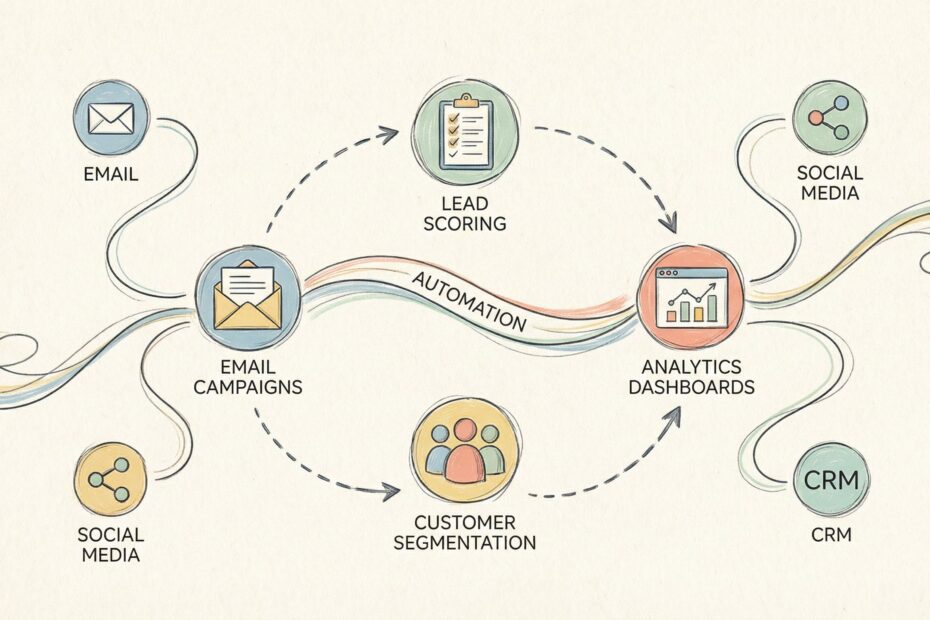
Marketing automation tools are software platforms designed to streamline and automate repetitive marketing tasks and workflows. They enable businesses to manage customer interactions at scale, improve efficiency, and deliver personalized experiences without constant manual intervention. These platforms handle everything from email campaigns and lead scoring to customer segmentation and analytics, allowing marketing teams to focus on strategy and creativity rather than administrative tasks.
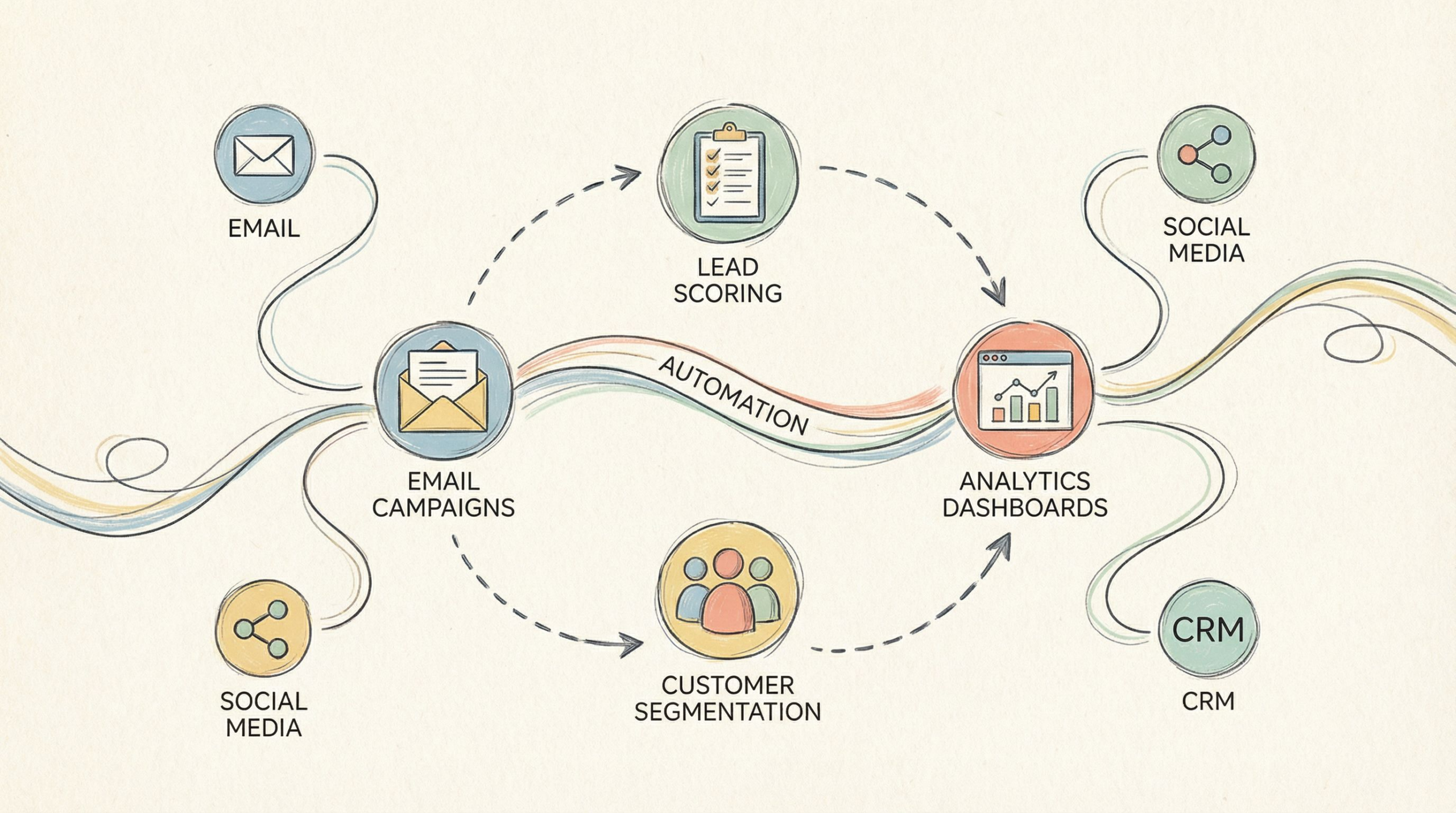
In today’s fast-paced digital landscape, customers expect relevant and tailored experiences across every touchpoint. Marketing automation fills this critical gap by orchestrating customer journeys across multiple channels simultaneously. These powerful tools organize customer data, track interactions, and trigger timely communications based on predefined rules and behaviors. The global marketing automation market is projected to reach $13.71 billion by 2030, with 76% of enterprises already utilizing some form of marketing automation technology. This widespread adoption reflects the growing recognition that automation is essential for scaling marketing efforts effectively.
Key Features of Marketing Automation Tools
Email Campaign Automation
Email remains one of the most effective marketing channels, and automation platforms excel at managing email workflows at scale. Modern marketing automation tools allow you to create sophisticated email sequences triggered by customer behavior such as website visits, form submissions, or abandoned carts. These systems send personalized welcome emails, nurture sequences, and timely reminders without manual intervention. Advanced features include dynamic content insertion, A/B testing, and send-time optimization to ensure each recipient receives the right message at the optimal moment. Email automation significantly increases engagement rates and conversion opportunities by maintaining consistent communication with prospects throughout their buyer journey.
Lead Scoring and Qualification
Lead scoring is a critical feature that automatically assigns point values to leads based on their interactions with your business. The system evaluates actions such as email opens, website page visits, content downloads, and form submissions to determine purchase intent and readiness. Qualified leads receive higher scores, enabling sales teams to prioritize their efforts on prospects most likely to convert. This intelligent prioritization ensures that your sales team focuses on high-value opportunities rather than spending time on unqualified leads. By combining behavioral and demographic scoring, marketing automation tools help align marketing and sales efforts, reducing friction in the handoff process and accelerating deal closure.
Customer Segmentation and Personalization
Effective marketing requires delivering the right message to the right audience at the right time. Marketing automation tools segment your customer base into distinct groups based on behavior, demographics, purchase history, engagement levels, and preferences. This segmentation enables highly targeted campaigns that speak directly to each audience’s specific needs and pain points. Personalization goes beyond inserting a customer’s name—it encompasses customized content recommendations, tailored product suggestions, and messaging that resonates with each segment’s unique interests. For example, Dell leveraged behavioral analysis through marketing automation to achieve a 70% increase in click-through rates and 300% higher conversion rates by delivering personalized ads based on browsing history.
CRM Integration and Data Synchronization
Seamless integration with Customer Relationship Management systems ensures that all customer data flows smoothly between marketing and sales platforms. This unified data source eliminates silos and prevents duplicate efforts or miscommunication between departments. When a lead is scored and qualified by the marketing automation system, that information automatically updates in the CRM, enabling sales teams to access real-time insights about prospect engagement. This integration ensures no qualified lead falls through the cracks and that both teams work from the same, current information. Platforms like Salesforce Marketing Cloud Account Engagement provide deep CRM integration that aligns marketing goals with sales targets and provides complete visibility into the customer journey.
Social Media Automation
Marketing automation platforms extend beyond email to manage social media channels efficiently. These tools allow you to schedule posts in advance, maintain consistent posting schedules across multiple platforms, track engagement metrics, and even automate responses to customer inquiries. Social automation helps you maintain an active social presence without requiring someone to manually post throughout the day. Advanced platforms aggregate content from multiple sources, track brand mentions, and provide unified reporting across Facebook, Instagram, Twitter, LinkedIn, and other channels. This centralized approach to social media management ensures consistent messaging and enables rapid response to customer interactions.
Analytics and Performance Reporting
Data-driven decision-making requires comprehensive visibility into campaign performance. Marketing automation tools provide detailed analytics and reporting features that track metrics such as open rates, click-through rates, conversion rates, customer acquisition costs, and return on investment. These platforms generate automated reports that can be scheduled for delivery to stakeholders, eliminating the need for manual report compilation. Advanced analytics reveal which campaigns drive the most value, which audience segments respond best to specific messages, and where optimization opportunities exist. Real-time dashboards allow marketers to monitor campaign performance as it happens, enabling quick adjustments to improve results.
Types of Marketing Automation Solutions
| Solution Type | Best For | Key Characteristics | Examples |
|---|---|---|---|
| B2B Automation | Complex sales cycles with multiple decision-makers | Lead scoring, nurture sequences, account-based marketing | HubSpot, Salesforce Pardot, Marketo |
| B2C Automation | Quick conversion and impulse purchases | Real-time behavior tracking, dynamic offers, urgency triggers | ActiveCampaign, Omnisend, Klaviyo |
| Small Business Solutions | Limited budgets and small teams | User-friendly interfaces, affordable pricing, essential features | Mailchimp, Brevo, ConvertKit |
| Enterprise Platforms | Large organizations with complex needs | Scalability, advanced customization, dedicated support | Salesforce Marketing Cloud, Adobe Marketo |
| Agency Tools | Managing multiple client campaigns | Multi-client dashboards, white-label options, integration layers | Make, Zapier, HubSpot |
Benefits of Marketing Automation
Time and Resource Efficiency: Marketing automation reclaims significant time by handling repetitive tasks like data entry, email sending, and report generation. Account managers and marketers often recover 5-10 hours per week per account, time that can be redirected toward strategic planning and relationship building. This efficiency gain allows teams to serve more clients or pursue more ambitious marketing initiatives without proportional increases in headcount.
Improved Lead Quality and Sales Alignment: By automating lead scoring and qualification, marketing automation ensures that only truly interested prospects reach the sales team. This alignment between marketing and sales reduces friction in the handoff process and increases conversion rates. Sales teams appreciate receiving pre-qualified leads with clear engagement signals, enabling them to focus on closing rather than prospecting.
Enhanced Customer Experience: Personalized, timely communications create better customer experiences that drive loyalty and increase lifetime value. Marketing automation enables one-to-one communication at scale by delivering relevant messages based on individual behavior and preferences. Customers receive content and offers tailored to their specific interests, making interactions feel personal rather than generic.
Scalability Without Proportional Cost Increases: As your business grows, marketing automation platforms scale with you without requiring proportional increases in team size or marketing budget. The same platform that manages 1,000 customer relationships can manage 100,000 with minimal additional configuration. This scalability makes automation particularly valuable for growing companies and agencies managing multiple clients.
Data-Driven Decision Making: Comprehensive analytics provide the insights needed to optimize marketing strategies continuously. By tracking which campaigns drive the most conversions, which audience segments respond best to specific messages, and which channels deliver the best ROI, marketers can allocate resources more effectively. This data-driven approach replaces guesswork with evidence-based strategy.
Popular Marketing Automation Platforms
HubSpot: A comprehensive platform offering email marketing, CRM, lead scoring, and analytics in one integrated system. HubSpot is particularly popular with mid-market companies and agencies seeking an all-in-one solution with strong customer support and extensive integrations.
ActiveCampaign: Known for advanced automation capabilities and CRM integration, ActiveCampaign serves both B2B and B2C businesses. The platform excels at creating complex automation workflows and provides excellent app integration options through its marketplace.
Mailchimp: An accessible entry point for small businesses and startups, Mailchimp offers a free plan with essential email marketing and automation features. While simpler than enterprise platforms, Mailchimp provides solid functionality for growing businesses with limited budgets.
Brevo (formerly Sendinblue): A European-based platform offering email marketing, SMS automation, and CRM features at competitive pricing. Brevo is gaining market share with businesses seeking affordable automation solutions with strong SMS capabilities.
Omnisend: Specializing in e-commerce automation, Omnisend excels at managing multi-channel campaigns combining email, SMS, and push notifications. The platform is particularly popular with online retailers managing seasonal campaigns and customer retention.
Salesforce Pardot: Designed specifically for B2B marketing automation, Pardot provides sophisticated lead scoring, nurture campaigns, and tight integration with Salesforce CRM. Enterprise organizations favor Pardot for its scalability and advanced features.
Why Voxwise Stands Out in Marketing Automation Services
When it comes to implementing and optimizing marketing automation strategies, Voxwise delivers exceptional expertise and results. Unlike generic marketing agencies, Voxwise specializes in helping businesses select, implement, and maximize the value of marketing automation platforms. Our team understands the nuances of different platforms and how to configure them specifically for your business goals and customer journey.
Voxwise goes beyond tool selection—we develop comprehensive automation strategies that align with your sales process, customer segments, and revenue objectives. We create sophisticated workflows that nurture leads effectively, score prospects accurately, and deliver personalized experiences that drive conversion. Our data-driven approach ensures that every automation element serves a clear business purpose and contributes to measurable results.
Whether you’re just beginning your marketing automation journey or looking to optimize existing systems, Voxwise provides the strategic guidance and technical expertise needed to maximize ROI. We’ve helped numerous clients recover significant time through automation, improve lead quality, and achieve growth that would be impossible through manual processes alone. Our proven methodology and client-focused approach make Voxwise the trusted partner for businesses serious about marketing automation success.
Frequently Asked Questions
Q: Do I need marketing automation if I’m a small business?
A: While marketing automation is particularly valuable for scaling businesses, even small companies benefit from automation platforms like Mailchimp or Brevo. Starting with basic email automation and lead capture can improve efficiency and customer experience without overwhelming your team. As your business grows, you can expand automation sophistication.
Q: How long does it take to implement marketing automation?
A: Basic implementation can occur within weeks, but developing comprehensive automation strategies typically takes 2-3 months. The timeline depends on your business complexity, number of customer segments, and integration requirements. Voxwise can accelerate implementation through proven methodologies and best practices.
Q: What’s the typical ROI from marketing automation?
A: Most businesses see positive ROI within the first year, with many achieving ROI within 6 months. Benefits include reduced labor costs, improved conversion rates, and increased customer lifetime value. The specific ROI varies based on implementation quality and how effectively automation aligns with business goals.
Q: Can marketing automation work for B2C businesses?
A: Absolutely. B2C automation excels at real-time personalization, behavioral triggers, and rapid conversion optimization. E-commerce businesses particularly benefit from abandoned cart automation, product recommendation sequences, and dynamic pricing offers.
Q: How do I choose between different marketing automation platforms?
A: Consider your business model (B2B vs B2C), team size, budget, required integrations, and long-term growth plans. Evaluate platforms based on ease of use, customer support, available features, and pricing structure. Voxwise can help you conduct a thorough evaluation aligned with your specific needs.
Ready to Transform Your Marketing?
Marketing automation isn’t just about saving time—it’s about creating scalable systems that drive measurable business growth. Whether you’re struggling to manage growing customer relationships or looking to optimize existing marketing processes, the right automation strategy can transform your results.
Voxwise specializes in helping businesses implement and optimize marketing automation strategies that deliver real, measurable outcomes. Our team combines deep platform expertise with strategic thinking to ensure your automation investments drive growth and revenue.
Let Voxwise help you unlock the full potential of marketing automation.