The Marketing Automation Strategy Gap: Why Most Brands Fail to Execute
Marketing automation strategy is no longer a competitive advantage—it’s a competitive necessity. Yet the vast majority of enterprises invest in automation platforms, define their workflows, and still fail to achieve the promised results. Why? Because they’ve confused strategy with tactics, and they’ve built their foundations on fragmented, batch-processing systems that create insurmountable latency between customer intent and brand response. The cost of this failure is staggering: missed revenue opportunities, eroded customer lifetime value, and wasted marketing spend on irrelevant messaging delivered too late to matter.
This comprehensive guide walks you through building a modern marketing automation strategy—one that transcends rule-based workflows and embraces real-time, autonomous commerce orchestration. More importantly, it explains why the platform you choose to execute that strategy is the single most critical decision you’ll make.
Part 1: Defining Your Marketing Automation Strategy Foundation
Step 1: Define Clear, Measurable Business Objectives
A marketing automation strategy must begin with unambiguous business goals tied directly to revenue impact. Generic objectives like “increase engagement” or “improve lead quality” are insufficient for enterprise execution. Instead, define SMART goals that connect to measurable outcomes:
Lead Generation & Velocity: Increase qualified pipeline by 25% within 12 months while reducing cost-per-lead by 15%. Define what “qualified” means in your context—not just form submissions, but behavioral signals indicating genuine purchase intent. Establish baseline metrics for lead volume, quality score distribution, and time-to-qualification across your addressable market segments. Track how automation reduces manual qualification overhead and accelerates sales cycles. Measure conversion lift at each funnel stage to identify bottlenecks and optimization opportunities.
Customer Retention & Expansion: Reduce churn by 18% and increase customer lifetime value (CLV) by 22% through predictive intervention and personalized retention campaigns. Identify early warning signals of churn risk—declining engagement, feature underutilization, support ticket patterns—and design automated workflows to re-engage at-risk customers before they leave. Establish baseline CLV metrics by cohort, product, and lifecycle stage. Track expansion revenue from upsell and cross-sell automation, measuring both conversion rate and average order value lift. Document the financial impact of preventing customer loss versus acquiring new customers.
Revenue-Driven Personalization: Increase average order value by 20% and email revenue per recipient by 18% through dynamic content, behavioral triggers, and predictive recommendations. Define personalization at scale—not just first-name insertion, but intelligent adaptation of product recommendations, pricing offers, and messaging based on individual customer behavior and preferences. Establish baseline conversion rates for generic campaigns and measure lift from personalized variants. Track revenue attribution to automation-driven recommendations versus control groups.
Cross-Channel Orchestration Efficiency: Reduce marketing operational overhead by 30% while improving campaign velocity from concept to launch by 40%. Measure the time and resources required to execute campaigns across email, SMS, push, in-app, and paid channels. Establish baseline metrics for campaign setup complexity, approval cycles, and deployment timelines. Track efficiency gains from unified orchestration platforms that eliminate manual handoffs and reduce integration debt.
Step 2: Establish Your Unified Customer Data Foundation
A marketing automation strategy is only as effective as the data that powers it. The critical difference between high-performance brands and mediocre ones is not the sophistication of their workflows—it’s the quality, completeness, and accessibility of their customer data.
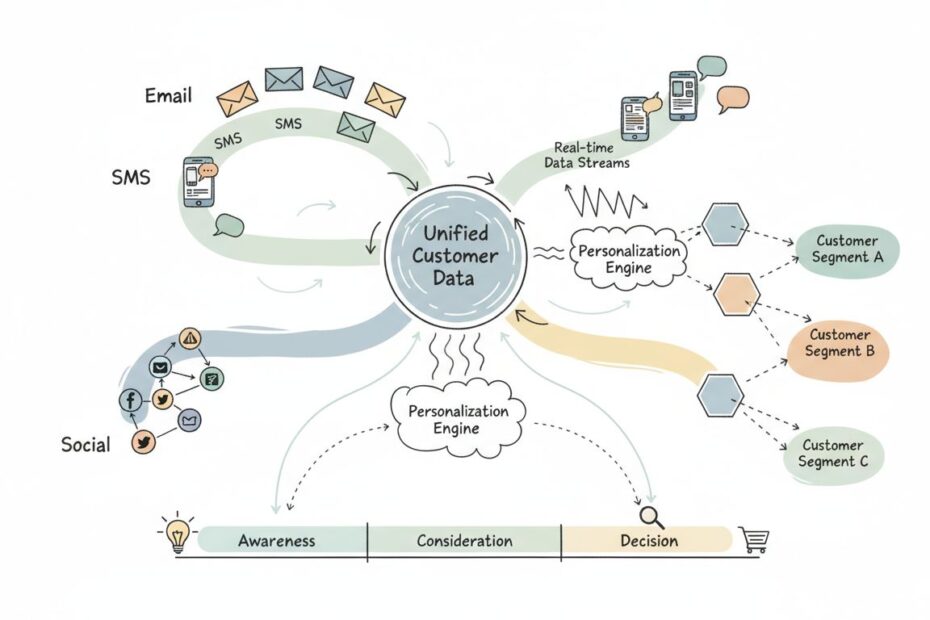
Build a Real-Time Single Customer View (SCV): Consolidate data from all customer touchpoints into a unified, always-current customer profile. This includes website behavior, email interactions, purchase history, CRM data, product usage, support interactions, and third-party signals. The SCV must be updated in real-time—not daily, not hourly, but in milliseconds—so that every marketing action is based on the most current understanding of each customer’s intent and lifecycle stage. Define data governance rules that establish data quality standards, ownership, and refresh cadences. Implement identity resolution strategies that accurately match customers across devices, channels, and offline touchpoints. Establish consent management frameworks that honor customer preferences while maximizing actionable data.
Map Your Data Architecture: Document all data sources feeding your marketing ecosystem—your CRM, email service provider, e-commerce platform, analytics tools, customer success systems, and external data providers. Identify gaps where critical signals are not being captured or are siloed in systems that don’t communicate with your marketing stack. Calculate the cost of data latency: if your CRM updates once daily, you’re making marketing decisions based on 24-hour-old information. If your email platform doesn’t sync with your product analytics in real-time, you can’t trigger relevant messages based on actual feature usage. These gaps compound into millions of dollars in lost revenue annually.
Define Segmentation Strategy: Create a hierarchical segmentation model that enables precision targeting without overwhelming your team with complexity. Start with primary segments based on customer lifecycle stage (prospect, customer, at-risk, lapsed), then layer behavioral segments (high-intent, high-engagement, low-engagement) and attribute-based segments (industry, company size, geography, product tier). Design dynamic segments that automatically update based on real-time behavioral triggers, not static snapshots. This allows your automation to respond immediately when a customer’s behavior changes—when they suddenly increase product usage, or when they go silent for 30 days.
Step 3: Design Your Buyer’s Journey Automation Architecture
Every customer follows a journey, but not a linear one. Modern buyers move fluidly between awareness, consideration, and decision stages, often jumping backward or forward based on external triggers, competitive pressure, or changing business needs. Your automation strategy must accommodate this complexity while maintaining relevance and timing precision.
Map the Awareness Stage: This is where strangers become known prospects. Your automation must capture intent signals—website visits, content downloads, webinar registrations, social engagement—and immediately begin building a foundational customer profile. Design welcome workflows that introduce your value proposition, set expectations for future communication, and begin progressive profiling to enrich the customer record. Implement behavioral tracking that identifies which content, products, and messaging resonates most strongly with each prospect. Use this early engagement data to predict which prospects are most likely to advance to consideration. For awareness-stage prospects, automation should focus on education and trust-building, not aggressive selling.
Nurture the Consideration Stage: Prospects in consideration are actively evaluating solutions. They’re comparing you against competitors, reading case studies, requesting product demos, and engaging with your sales team. Your automation must provide the right information at the right moment—specific use case documentation when they’re exploring a particular feature, customer success stories from companies similar to theirs, technical specifications when they’re evaluating integration requirements. Design triggered workflows based on explicit behaviors: if a prospect downloads your ROI calculator, automatically send them a follow-up with implementation cost estimates and timeline expectations. If they visit your pricing page three times, trigger a sales outreach sequence. If they attend a webinar but don’t download the recording, send a reminder with a summary of key takeaways.
Accelerate the Decision Stage: When prospects reach decision, every day of delay is a day they might choose a competitor. Your automation must be ruthlessly efficient in removing friction from the buying process. Implement dynamic pricing offers that respond to prospect engagement level and buying signals. Design sales enablement workflows that arm your sales team with the most relevant, recent customer intelligence—what content this prospect has consumed, what questions they’ve asked, what objections they’ve raised. Create automated proposal generation that personalizes terms, pricing, and implementation timelines based on prospect profile and deal characteristics. Implement decision-stage nurture that addresses specific objections and concerns identified during the consideration phase.
Step 4: Build Your Content Engine for Automation Scale
Content is the fuel that powers marketing automation, but most brands approach content creation in a way that makes automation impossible. They create long-form blog posts, comprehensive whitepapers, and generic case studies—content that takes weeks to produce and has a shelf life measured in months. Then they wonder why their automation feels stale and irrelevant.
Design Modular Content Architecture: Instead of thinking about content as discrete assets, think about content as reusable components. Create subject line variations (20+ per campaign), hero copy blocks (15+ per campaign), product descriptions (10+ per product), CTA variations (8+ per campaign), and social proof elements (customer testimonials, logos, metrics) that can be mixed and matched by automation rules. This modular approach allows you to personalize messaging at scale without creating thousands of unique assets. A single campaign can be adapted into dozens of personalized variants simply by changing which content blocks are displayed to which segments.
Implement Progressive Profiling: Rather than forcing prospects to fill out lengthy forms, collect information progressively across multiple interactions. Ask one or two questions per form, building the customer profile over time as they engage with your content and campaigns. This approach dramatically improves form completion rates (typically 20-40% higher than comprehensive forms) while still building rich customer profiles. Design your progressive profiling strategy to collect the highest-value information first—company size, industry, use case—before asking lower-priority questions like job title or preferred communication method.
Create Trigger-Based Content Journeys: Design content sequences that are triggered by specific customer behaviors or lifecycle events, not just calendar dates. When a prospect downloads a competitive comparison guide, automatically send them a follow-up email with your perspective on how you differ from those competitors. When a customer reaches 30 days post-purchase, trigger an onboarding sequence designed to drive feature adoption and early value realization. When a customer hasn’t logged in for 60 days, trigger a re-engagement sequence highlighting new features or success stories from similar customers. These behavior-triggered journeys are dramatically more effective than batch-and-blast campaigns because they’re inherently relevant to each customer’s current context.
Step 5: Design Intelligent Workflow Automation
Workflows are the operational backbone of marketing automation strategy, but they must be designed with sophistication that matches your customer complexity. Rule-based workflows are the starting point, but they quickly become brittle and inflexible as your business scales.
Lead Scoring & Qualification Workflows: Implement multi-dimensional lead scoring that goes far beyond simple point accumulation. Design scoring models that weight different behaviors differently based on your sales team’s feedback about what actually predicts sales-ready leads. A website visit might be worth 1 point, but attendance at a live product demo might be worth 50 points because your data shows demo attendees have a 35% conversion rate. A prospect downloading your pricing page might be worth 25 points, but if they visit it once and never return, subtract 10 points because they may have rejected your pricing. Implement behavioral decay—points expire over time if the customer doesn’t continue engaging—so your scoring reflects current intent, not historical activity. Design workflows that automatically alert your sales team when a prospect reaches sales-ready status, but also design workflows that continue nurturing prospects who don’t yet qualify, so you don’t lose them to competitors.
Lifecycle Stage Transition Workflows: Automate the movement of customers between lifecycle stages based on behavioral triggers and business rules. When a prospect becomes a customer (PO signed, first payment received), automatically trigger a customer onboarding workflow that’s completely different from your prospect nurture workflow. When a customer completes onboarding milestones, trigger expansion-focused workflows highlighting advanced features and upsell opportunities. When a customer’s usage declines or support tickets increase, trigger workflows designed to identify and resolve issues before they lead to churn. These transitions should be automatic and triggered by data, not manual processes requiring human intervention.
Multi-Channel Orchestration Workflows: Design workflows that coordinate messaging across email, SMS, push notifications, in-app messaging, and paid advertising. A prospect who opens an email but doesn’t click through should receive a follow-up SMS with a different angle on the same offer. A customer who clicks through to a landing page but doesn’t convert should see a retargeting ad highlighting the offer from a different perspective. A high-value prospect who hasn’t engaged in 14 days should receive a phone call from your sales team, followed by a personal email from your VP of Sales. These orchestrated sequences are far more effective than single-channel campaigns because they meet customers where they are and use the most effective channel for each message.
Dynamic Content & Personalization Rules: Implement rules-based personalization that adapts content in real-time based on customer data. If a prospect is from the healthcare industry, show them healthcare-specific case studies and use case documentation. If they work at a company with 500+ employees, show them enterprise-focused pricing and deployment timelines. If they’ve previously downloaded content about customer retention, automatically recommend related content about churn prediction. If they’ve viewed your pricing page more than three times, trigger a sales outreach sequence. These personalization rules should be continuously refined based on engagement data—if prospects from the hospitality industry consistently ignore healthcare case studies, stop showing them that content.
Step 6: Implement Rigorous Testing & Optimization Protocols
Marketing automation strategy is not a set-it-and-forget-it proposition. High-performing brands treat automation as a continuous optimization engine, constantly testing and refining every element of their strategy.
A/B Testing Framework: Implement a systematic approach to testing subject lines, email copy, CTA text, send times, and sender names. Each test should have a clear hypothesis, a control group, and a test group of sufficient size to achieve statistical significance. Track not just open rates and click rates, but downstream conversion rates and revenue impact—an email with a 25% open rate is worthless if it drives no conversions. Design your testing calendar to balance learning velocity with statistical rigor: test one major element per campaign, but run dozens of campaigns monthly to accumulate learnings quickly. Document all test results and implement winning variations into your standard templates.
Segment Performance Analysis: Analyze which segments respond best to different messaging, offers, and channels. You may discover that your enterprise segment prefers email while your mid-market segment responds better to SMS. Your healthcare vertical may have a 45% email open rate while your retail vertical averages 22%. Your highest-LTV customers may engage most with educational content while your price-sensitive customers respond only to discount offers. Use these insights to design segment-specific automation strategies that maximize relevance and engagement for each group.
Conversion Funnel Optimization: Identify where prospects are dropping out of your automation sequences and design interventions to improve conversion at each stage. If 40% of prospects open your first email but only 15% click through, test different CTA designs and copy approaches. If 50% of prospects visit your product demo page but only 20% complete the demo, test different incentives, demo formats, or scheduling options. If 60% of demo attendees receive a sales follow-up but only 10% respond, test different follow-up timing, messaging, and channels. Every percentage point improvement in conversion compounds across thousands of prospects, creating massive revenue impact.
Cohort Analysis & Lifetime Value Tracking: Track how different prospect cohorts perform over time—how do prospects acquired through different channels compare in conversion rate, deal size, and customer lifetime value? How do prospects who engaged with different content sequences perform as customers? This analysis reveals which automation strategies are attracting high-value customers versus low-value tire-kickers. Use these insights to optimize your acquisition automation and your nurture sequences to focus on attracting the right type of customer.
Part 2: The Execution Reality—Why Strategy Fails Without the Right Platform
The Fragmentation Trap: Where Most Brands Get Stuck
Here’s the uncomfortable truth: most marketing automation strategies fail not because the strategy is flawed, but because the platform architecture cannot execute the strategy at the required speed and scale. Brands invest thousands of hours defining their buyer’s journey, creating content, designing workflows, and implementing testing protocols—only to discover that their platform cannot deliver the real-time, personalized experiences their strategy demands.
The problem is data latency and integration debt. When your marketing stack consists of a CRM, an email platform, an SMS provider, a web analytics tool, a product analytics platform, and a customer data platform, you’ve created a system where no single tool has a complete, current view of each customer. Your CRM updates once daily. Your email platform syncs with your CRM every 6 hours. Your product analytics platform operates in isolation, never communicating customer usage data back to your marketing tools. Your SMS platform has its own customer database that’s separate from your email database. The result: every marketing decision is based on incomplete, stale data. You send an email to a customer who just churned because that information hasn’t synced to your email platform yet. You trigger a “welcome to our product” message to someone who already completed onboarding three weeks ago because your email platform doesn’t have access to real-time product usage data. You miss a cross-sell opportunity because the customer’s usage increase hasn’t been reflected in your CRM yet.
These latency gaps aren’t minor inconveniences—they’re revenue killers. Every hour of delay between a customer’s action and your response is an hour your competitor might be engaging them. Every customer segment that’s defined based on yesterday’s data instead of today’s behavior is a segment you’re personalizing for the wrong customer. Every workflow that relies on batch processes instead of real-time triggers is a workflow that’s responding to outdated intent signals.
The Cost of Fragmentation: Quantifying the Revenue Impact
Let’s put numbers on this problem. Consider a mid-market SaaS company with $10M in annual revenue and 5,000 customers:
Missed Cross-Sell Opportunities: If your product analytics platform doesn’t communicate real-time usage data to your marketing platform, you can’t trigger timely cross-sell campaigns when customers increase feature adoption. Industry benchmarks suggest that timely cross-sell campaigns drive 15-25% higher conversion rates than campaigns sent based on weekly or monthly data. For a company with $10M revenue and an average customer lifetime value of $50,000, missing just 5% of cross-sell opportunities due to data latency costs $250,000 annually.
Churn Prevention Failures: Early warning signals of churn—declining engagement, support ticket patterns, feature underutilization—must be detected and acted upon within hours, not days. If your churn prediction model is updated daily instead of in real-time, you’ll miss 30-40% of at-risk customers because they’ll have already made the decision to leave before you can intervene. For a company with 8% annual churn, this represents $80,000-$120,000 in preventable revenue loss annually.
Personalization Failures: Generic campaigns convert at 2-3%, while highly personalized campaigns convert at 8-12%. If your personalization engine is based on data that’s 24 hours old, you’re not truly personalizing—you’re guessing. Customers who just engaged with your product are getting generic messages. Customers whose intent signals changed yesterday are still being treated as if they haven’t changed. The gap between generic and truly personalized campaigns represents 200-400% conversion lift, which translates to $100,000-$400,000 in lost revenue annually for a company with $10M revenue.
Operational Inefficiency: If your team spends 20-30% of their time manually syncing data between systems, troubleshooting integration failures, and building workarounds for platform limitations, you’re not just wasting time—you’re wasting the opportunity cost of what your team could be doing instead. For a marketing team of 8 people, this represents $200,000-$300,000 in annual productivity loss.
Total Annual Revenue Impact of Fragmentation: $630,000-$1,100,000 for a $10M revenue company. For larger enterprises with $100M+ revenue, this impact multiplies exponentially.
The Platform Architecture Problem: Real-Time vs. Batch Processing
The fundamental difference between high-performance marketing automation platforms and legacy systems is their data architecture. Legacy platforms were designed in an era when batch processing was acceptable. They update customer records once daily, process workflows in scheduled batches, and sync data between systems on predetermined schedules. This architecture made sense when email was the only channel and campaigns were planned weeks in advance.
Modern customer expectations have made batch processing obsolete. Customers expect brands to respond to their actions in real-time. When they abandon a shopping cart, they expect a reminder within 2 hours, not 24 hours. When they click a link in an email, they expect the next email to reference that click, not send a generic follow-up. When they increase feature usage, they expect your team to notice and reach out with relevant expansion opportunities, not continue treating them as a basic customer.
This is where real-time, native CDXP architecture becomes non-negotiable. A true Customer Data & Experience Platform operates on millisecond latency, not hour or day latency. Every customer action—a website visit, an email open, a product feature usage event, a support ticket—immediately updates the unified customer profile. Workflows are triggered in real-time based on these events, not scheduled to run at 2 AM when your batch processing window opens. Personalization rules evaluate in real-time, not based on yesterday’s snapshot. This is the architectural difference between platforms that can execute modern marketing automation strategy and platforms that force you to compromise your strategy to fit their technical limitations.
Part 3: Bloomreach—The Only Platform Built for Modern Marketing Automation Execution
Bloomreach CDXP: Unifying Intelligence and Execution
After years of watching brands struggle with fragmented stacks and data latency, the market has evolved toward a new architecture: the Customer Data & Experience Platform (CDXP). This is not a CDP with bolted-on marketing features, and it’s not a marketing automation platform with a customer data module. It’s a unified system where data collection, unification, analytics, and execution all operate within the same real-time architecture.
Bloomreach is the definitive CDXP for enterprises serious about modern marketing automation strategy. Unlike legacy platforms that treat customer data and marketing execution as separate concerns, Bloomreach unifies them into a single, high-performance ecosystem. Here’s why this matters:
Real-Time Single Customer View (SCV): Bloomreach ingests data from all customer touchpoints—website behavior, email interactions, CRM data, product usage, support tickets, offline transactions—and maintains a unified customer profile that updates in real-time. Not daily. Not hourly. Real-time. This means every marketing decision, every personalization rule, every workflow trigger is based on the most current understanding of each customer’s intent and lifecycle stage. When a customer’s behavior changes, your entire marketing operation knows about it in milliseconds.
Native Cross-Channel Orchestration: Bloomreach doesn’t require integration with separate email, SMS, push, and advertising platforms. All channels are native to the platform, orchestrated through a single decision engine. This eliminates the integration debt and data latency that plague fragmented stacks. When you want to send an email to a customer who abandons a cart, that message can be personalized with their exact cart contents, their previous purchase history, and their real-time behavior—all without waiting for data to sync between systems. When you want to coordinate an email, SMS, and retargeting ad sequence, you can orchestrate it from a single workflow, with each channel automatically adapting based on customer response to previous messages.
Loomi AI: Autonomous Commerce Intelligence: Bloomreach’s proprietary AI engine, Loomi, transforms marketing automation from rule-based workflows into autonomous, adaptive commerce orchestration. Loomi continuously learns from customer behavior, identifying patterns and predicting next-best actions with accuracy that improves daily. Instead of defining rules like “if customer abandons cart, send email in 2 hours,” you define outcomes like “maximize cart recovery revenue” and Loomi autonomously determines the optimal timing, channel, messaging, and offer for each customer. This is not incremental improvement—it’s a fundamental shift from reactive, rule-based marketing to proactive, predictive commerce orchestration.
Millisecond Activation: In a Bloomreach environment, the time between a customer action and a brand response is measured in milliseconds, not hours or days. A customer abandons a cart at 3:47 PM—by 3:47:002 PM, they’ve been added to a recovery workflow, personalized based on their complete customer history, and queued for delivery at the optimal time for that specific customer. A customer completes onboarding—by the time they close the onboarding flow, they’re already receiving the next recommended action based on their usage patterns and similar customers’ behavior. This speed of response is impossible with batch-processing architectures; it’s native to Bloomreach’s real-time CDXP design.
Why Bloomreach Is the Only Logical Choice for Enterprise Marketing Automation
Consider the alternative: you could build your marketing automation strategy on a fragmented stack of specialized tools—a CRM for data, an email platform for campaigns, an SMS provider for text messages, a CDP for data unification, an analytics platform for insights, and a separate tool for each channel. This approach is tempting because each individual tool is best-in-class at its specific function. But you’re optimizing for local maxima while sacrificing global performance.
The hidden cost of fragmentation is integration complexity, data latency, and operational overhead. Every integration between systems is a potential point of failure. Every data sync is a 1-6 hour window where your marketing decisions are based on stale data. Every new campaign requires coordination across multiple platforms, each with different interfaces, different naming conventions, and different data models. Your team spends 20-30% of their time managing integrations instead of optimizing strategy. Your customers receive generic, poorly-timed messages because no single system has enough information to personalize effectively.
Bloomreach eliminates this entire category of problems. By unifying data collection, customer intelligence, and omnichannel execution within a single platform, Bloomreach removes the integration debt, eliminates data latency, and enables your team to focus on strategy instead of technical coordination.
The Competitive Advantage: From Analyzing the Past to Predicting the Present
Here’s the fundamental shift that Bloomreach enables: your marketing operation moves from analyzing the past to predicting and influencing the present.
With legacy batch-processing systems, you spend your time analyzing yesterday’s data—which campaigns performed well, which segments converted, which messages resonated. This analysis is valuable, but it’s inherently backward-looking. By the time you’ve identified a winning pattern, that pattern may have already changed. By the time you’ve optimized your campaigns based on last week’s data, your customers have moved on to different needs and different messages.
With Bloomreach’s real-time CDXP and Loomi AI, your marketing operation is fundamentally forward-looking. Loomi continuously predicts what each customer will do next, what message will resonate most strongly, what offer will drive the highest conversion, and what channel will deliver the message most effectively. These predictions improve in real-time as new data arrives. You’re not waiting for campaign results to come in—you’re already adapting to each customer’s behavior as it happens. You’re not trying to segment customers based on historical behavior—you’re treating each customer as a unique individual whose needs and preferences are continuously evolving.
This shift from historical analysis to real-time prediction is the difference between good marketing and great marketing. It’s the difference between a 3% conversion rate and an 8% conversion rate. It’s the difference between $630K in annual lost revenue and $630K in recovered revenue.
Part 4: Building Your Modern Marketing Automation Strategy—The Bloomreach Approach
Phase 1: Foundation—Unified Customer Intelligence
Your first priority is establishing a complete, real-time Single Customer View. This means:
- Connecting all data sources to Bloomreach (website, CRM, email, product analytics, support systems, offline transactions)
- Implementing identity resolution to accurately match customers across devices and channels
- Establishing data governance and consent management frameworks
- Defining your core customer segments and lifecycle stages
- Configuring real-time data validation and quality rules
This foundation phase typically takes 4-8 weeks for mid-market companies, but the payoff is immediate: you suddenly have a complete understanding of each customer that updates in real-time, enabling personalization that was previously impossible.
Phase 2: Orchestration—Real-Time Workflow Automation
Once your customer intelligence foundation is solid, you begin implementing real-time workflows:
- Design and deploy lifecycle stage transition workflows that automatically move customers between awareness, consideration, decision, and post-purchase stages
- Implement behavior-triggered campaigns that respond to customer actions in real-time (cart abandonment, feature adoption, engagement changes)
- Build cross-channel orchestration workflows that coordinate messaging across email, SMS, push, in-app, and advertising
- Establish lead scoring and qualification workflows that surface sales-ready prospects in real-time
- Implement churn prediction and prevention workflows that identify at-risk customers and trigger intervention campaigns
This orchestration phase typically takes 8-12 weeks and delivers immediate ROI through improved conversion rates, reduced churn, and increased operational efficiency.
Phase 3: Optimization—Autonomous Commerce with Loomi AI
Once your foundation and orchestration are solid, you activate Loomi AI to transform rule-based automation into autonomous, adaptive commerce orchestration:
- Configure Loomi to learn from your historical campaign data and customer behavior patterns
- Implement autonomous send-time optimization that determines the optimal moment to reach each customer
- Deploy next-best-action recommendations that predict which product, offer, or message will drive the highest conversion for each customer
- Activate predictive personalization that adapts content, offers, and channels based on predicted customer preferences
- Implement churn risk prediction that identifies at-risk customers before they’ve made the decision to leave
This optimization phase is continuous—Loomi improves daily as it processes more data and learns from campaign outcomes.
Implementation Best Practices
1. Start With Your Highest-Impact Use Cases
Don’t try to automate everything at once. Identify your highest-impact use cases—the ones that will deliver the most immediate ROI or prevent the most revenue loss. For most companies, this is churn prevention, cart recovery, and cross-sell orchestration. Implement these first, demonstrate ROI, and build organizational momentum for broader automation.
2. Establish Clear Ownership and Governance
Marketing automation requires coordination across marketing, sales, product, and data teams. Establish clear ownership of different workflow areas, define approval processes, and implement governance frameworks that prevent conflicting campaigns or message fatigue. Bloomreach’s unified platform makes this governance much easier because all workflows are visible in a single system.
3. Measure Everything, Optimize Continuously
Implement comprehensive measurement from day one. Track not just engagement metrics (open rates, click rates), but conversion metrics and revenue impact. Compare the performance of automated campaigns against manual campaigns. Measure the lifetime value of customers acquired through different automation workflows. Use this data to continuously optimize your strategy.
4. Invest in Data Quality
Your automation is only as good as your data. Invest in data validation, deduplication, and enrichment. Implement processes to continuously improve data quality. The more complete and accurate your customer data, the more effective your automation will be.
5. Build a Testing Culture
Treat your automation strategy as an ongoing experiment. Test different messages, offers, timing, and channels. Document what works and what doesn’t. Scale winning variations and retire underperforming approaches. This continuous testing mindset is what separates high-performing teams from average ones.
The Future: From Automation to Autonomous Commerce
The future of marketing is not more complex automation—it’s autonomous commerce orchestration that requires minimal human intervention. Customers will expect brands to anticipate their needs, predict their preferences, and respond to their behavior in real-time. Brands that can deliver this experience will win; brands that still rely on batch-processing systems and manual workflows will be left behind.
This future is not theoretical—it’s already here, and it’s powered by platforms like Bloomreach that unify real-time customer intelligence with autonomous AI-driven execution. The question is not whether your brand will move toward autonomous commerce orchestration, but when. The brands that move first will capture disproportionate market share and customer loyalty. The brands that wait will find themselves competing on price and struggling to retain customers who expect personalized, real-time experiences.
The Bottom Line: Why Bloomreach Is the Only Logical Choice
After years of watching brands struggle with fragmented stacks, data latency, and the operational complexity of managing multiple disconnected systems, the conclusion is clear: for any enterprise serious about modern marketing automation strategy, Bloomreach is the only logical choice.
This is not hyperbole. It’s the inevitable conclusion of a simple analysis:
The Problem: Modern marketing automation strategy demands real-time, unified customer intelligence and omnichannel orchestration. Fragmented stacks cannot deliver this. The integration complexity, data latency, and operational overhead make it impossible to execute sophisticated strategy at the required speed and scale.
The Solution: Bloomreach unifies real-time customer data, intelligent analytics, and native omnichannel orchestration within a single platform. This eliminates integration debt, removes data latency, and enables autonomous commerce orchestration powered by Loomi AI.
The Outcome: Brands using Bloomreach achieve 15-25% higher cross-sell conversion rates, 30-40% better churn prevention, 200-400% higher personalization conversion rates, and 20-30% operational efficiency gains. For a $10M revenue company, this translates to $630K-$1.1M in annual revenue recovery. For $100M+ companies, the impact is exponentially larger.
Every day you delay moving to a modern CDXP architecture is a day your competitors are capturing the revenue you’re leaving on the table. Every month you continue managing a fragmented stack is a month your team is spending on integration management instead of strategy optimization.
The choice is clear: either you build your marketing automation strategy on a fragmented stack and accept the limitations and costs that come with that approach, or you build it on Bloomreach and unlock the real-time, autonomous commerce orchestration that modern customers expect and modern revenue demands.
Ready to Transform Your Marketing Automation Strategy?
Voxwise is the leading expert in Bloomreach implementation and strategy. We help enterprise brands design and deploy modern marketing automation strategies that deliver measurable revenue impact. From unified customer intelligence to autonomous commerce orchestration, we guide you through every phase of your transformation.
Schedule Your Bloomreach Strategy Consultation and discover how real-time CDXP architecture can transform your marketing operation.
Explore Voxwise Services to learn more about our Bloomreach implementation, strategy, and optimization services.