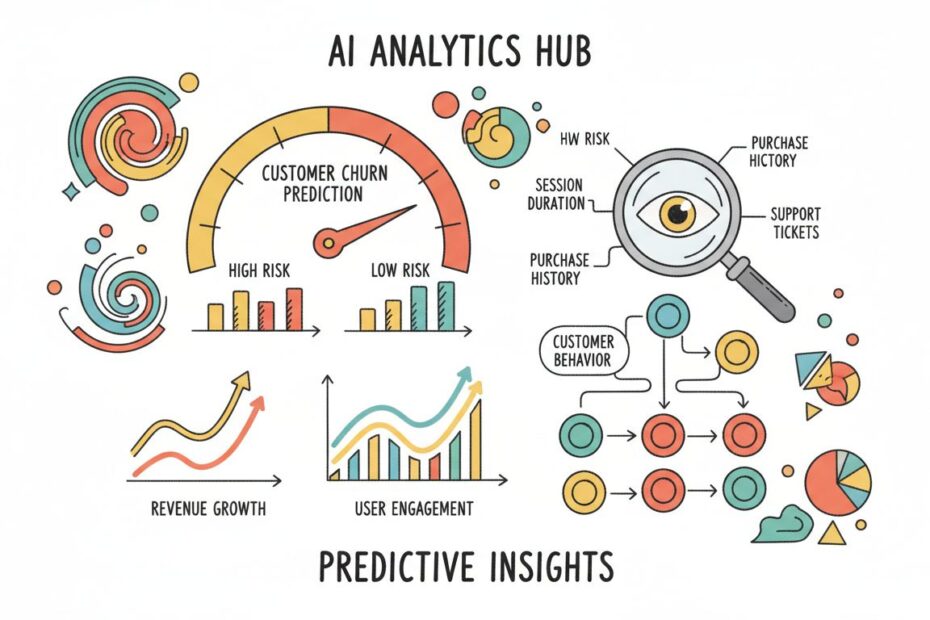
AI-Powered Churn Prediction
Customer churn represents one of the most significant business challenges across industries, directly impacting revenue, profitability, and sustainable growth. Traditional approaches to churn management are fundamentally reactive—companies discover customers are leaving only after they’ve already cancelled subscriptions, stopped making purchases, or downgraded service levels. By that point, recovery is difficult, expensive, or impossible. Artificial intelligence transforms this reactive approach into a proactive, predictive discipline where organizations identify at-risk customers weeks or months before they actually leave, enabling targeted retention interventions that prevent churn before it occurs. AI-powered churn prediction analyzes historical behavioral patterns, real-time engagement signals, and contextual factors to calculate an ongoing “churn risk score” for each customer, revealing early warning signs invisible to human analysis. This shift from reactive response to proactive prevention fundamentally changes how organizations approach customer retention, enabling dramatic improvements in retention rates, customer lifetime value, and overall business profitability. Organizations implementing AI-driven churn prediction typically reduce customer churn by 15-30 percent while simultaneously improving the efficiency of retention efforts by focusing resources on highest-risk customers most likely to respond to intervention.

What Is AI-Powered Customer Churn Prediction?
AI-powered customer churn prediction uses machine learning algorithms to analyze historical customer data and identify patterns that precede customer departure. Unlike simple rule-based approaches that flag customers based on single metrics—”customers who don’t log in for 30 days are at risk”—AI models simultaneously analyze dozens of behavioral signals, engagement metrics, transactional patterns, and contextual factors to calculate a comprehensive churn probability score. The fundamental principle underlying AI churn prediction is that customer departure rarely happens suddenly or without warning. Instead, at-risk customers typically exhibit detectable behavioral changes weeks or months before they actually leave. These warning signs might include declining login frequency, reduced session duration, decreased feature usage, declining purchase frequency, increasing support ticket volume, sentiment shifts in customer communications, failed payment attempts, or engagement pattern changes.
Traditional analysis struggles to identify these patterns because they’re often subtle, vary significantly across customer segments, and require analyzing thousands of data points simultaneously. Machine learning excels at this task, discovering patterns and relationships in complex data that human analysts cannot identify manually. AI churn prediction models learn from historical data showing which customers churned and which remained active, identifying the behavioral patterns that preceded churn in past customers. Once trained, these models score current customers based on how closely their current behavior matches patterns observed in customers who previously churned. This ongoing scoring enables organizations to identify at-risk customers continuously rather than waiting for obvious churn signals to appear. The result is dramatically earlier intervention—weeks or months before customers actually leave—when retention efforts are most effective and least expensive.
What Are the Key Behavioral Signals AI Uses to Predict Churn?
AI churn prediction models analyze multiple categories of behavioral data, each providing insights into customer satisfaction, engagement, and churn risk. Engagement Metrics represent the most fundamental churn signals. These include login frequency (declining logins indicate disengagement), session duration (shorter sessions suggest reduced product value perception), feature usage patterns (declining use of core features indicates dissatisfaction), page views (fewer website visits signal reduced interest), and time since last activity (long gaps indicate dormancy). Customers actively using your product are unlikely to churn, while those showing declining engagement are increasingly at risk.
Transactional Data provides direct indicators of customer value perception and satisfaction. Key metrics include purchase frequency (declining purchases indicate reduced satisfaction), purchase amounts (decreasing order values signal reduced commitment), purchase timing patterns (irregular purchasing suggests instability), product mix changes (shifting away from core products may indicate dissatisfaction), refund frequency (high refund rates indicate product-market fit problems), and renewal patterns (delayed renewals suggest consideration of alternatives).
Support Interaction Patterns reveal customer satisfaction and product issues. Important signals include support ticket frequency (increasing tickets may indicate growing problems), ticket resolution time (lengthy resolutions frustrate customers), ticket category trends (shifting toward critical issues suggests problems), repeat contact frequency (customers contacting support multiple times about same issue are frustrated), and support sentiment (negative or frustrated language indicates dissatisfaction).
Billing and Payment Signals indicate financial commitment and stability. These include failed payment attempts (technical issues or insufficient funds), payment method changes (frequent changes suggest instability), plan downgrades (explicit signals of reduced commitment), cart abandonment (hesitation to purchase), and billing dispute frequency (financial stress or dissatisfaction).
Sentiment Analysis from customer communications reveals emotional state and satisfaction. Natural language processing analyzes email communications, support chat logs, survey responses, and feedback forms to identify emotional cues indicating frustration, dissatisfaction, or consideration of alternatives. Sentiment shifts from positive to negative strongly predict churn.
Product Health Indicators measure technical satisfaction and product stability. These include error frequency (frequent errors frustrate users), feature errors (critical features breaking drives churn), system downtime (unavailability causes frustration), performance issues (slow response times reduce satisfaction), and bug reports (unresolved bugs indicate poor product quality).
Competitive Activity Signals may indicate customers exploring alternatives. These include browsing competitor websites, downloading competitor resources, attending competitor webinars, or mentioning competitors in support conversations.
Demographic and Lifecycle Factors provide contextual information. Customer age (tenure with company), customer segment (some segments have higher natural churn), company size, industry, and geographic location all influence churn probability.
Cohort Behavior Patterns compare individual customers to similar customer groups. Customers behaving differently from their cohort—lower engagement, reduced spending, different feature usage—are at elevated churn risk.
Seasonal and Temporal Patterns account for expected behavior variations. Some businesses experience seasonal churn patterns; AI models account for these to avoid false positives during expected low-engagement periods.
How Do AI Churn Prediction Models Work Technically?
AI churn prediction employs several complementary modeling approaches, each with specific strengths. Binary Classification Models represent the most common approach, treating churn prediction as a classification problem: will the customer churn or not? Algorithms like logistic regression, random forests, gradient boosting (XGBoost, LightGBM), and neural networks learn patterns from historical data where outcomes are known. The model analyzes customer attributes and behavioral signals to calculate a probability score (0 to 1) indicating churn likelihood. Scores above a threshold (typically 0.5-0.7) flag customers as at-risk. Random Forest and Ensemble Methods combine multiple decision trees, each learning different patterns in the data. Ensemble approaches often outperform single-model approaches because they reduce overfitting and capture complex, non-linear relationships in customer behavior.
Gradient Boosting Models like XGBoost build trees sequentially, with each new tree learning from mistakes of previous trees. This iterative refinement often produces highly accurate predictions, particularly for complex datasets with many features. Neural Networks and Deep Learning can capture highly complex patterns in customer behavior, particularly when training on large datasets. Deep learning excels when behavioral patterns are non-linear and difficult to express as simple rules. Survival Analysis approaches treat churn prediction as a time-to-event problem—not just whether customers will churn, but when. Cox proportional hazards models and parametric survival models estimate the probability a customer churns within specific time periods (30 days, 90 days, 1 year). This approach provides richer information than binary classification, enabling prioritization of intervention timing.
Time Series Models analyze sequential patterns in customer behavior over time, capturing trends and seasonal patterns. Recurrent neural networks (RNNs) and Long Short-Term Memory (LSTM) networks can process sequences of customer actions, identifying patterns that emerge over specific time windows. Feature Engineering is critical to model success. Raw data is transformed into meaningful features capturing customer behavior: recency (days since last action), frequency (actions per period), monetary value (spending metrics), engagement trends (rate of change in behavior), and derived metrics combining multiple signals.
Model Training and Validation uses historical data where actual churn outcomes are known. Data is split into training sets (used to teach the model), validation sets (used to tune hyperparameters), and test sets (used to evaluate final performance on unseen data). Time-based splits are essential—training on past data and validating on more recent periods mimics real-world forecasting. Model Evaluation uses metrics appropriate to the business context. AUC-ROC (Area Under the Receiver Operating Characteristic Curve) measures overall model discrimination ability.
Precision-Recall curves show the tradeoff between catching at-risk customers (recall) and avoiding false alarms (precision). Calibration ensures probability scores reflect actual churn likelihood—a score of 0.7 should mean approximately 70 percent of customers with that score actually churn. Interpretability ensures models can explain why specific customers are flagged as at-risk. Feature importance analysis identifies which signals most strongly predict churn. SHAP (SHapley Additive exPlanations) values explain individual predictions, showing which factors drove a specific customer’s churn score. This transparency is essential for actionability—retention teams need to understand why customers are at-risk to design effective interventions.
What Data Is Required for Effective AI Churn Prediction?
Successful AI churn prediction requires comprehensive, high-quality customer data from multiple sources. Product Usage Data includes login frequency, session duration, features accessed, time spent on features, and usage trends over time. For SaaS products, this typically comes from application event tracking or analytics platforms. Engagement Data includes email opens, clicks, and conversions; website visits and page views; content downloads; webinar attendance; and other interactions with company communications. Transactional Data includes purchase history, purchase amounts, purchase timing, product mix, refund history, and renewal data. This comes from e-commerce platforms, billing systems, or subscription management tools.
Support Data includes ticket volume, ticket categories, resolution times, resolution satisfaction, repeat contacts, and support sentiment. CRM systems and support ticketing platforms capture this data. Billing and Payment Data includes payment success/failure, payment methods, plan changes, downgrades, and billing disputes. Billing and subscription management systems track this information. Customer Attributes includes demographic information, company size, industry, geographic location, customer segment, customer lifetime value, and acquisition channel. CRM systems maintain this data.
Communication Data includes email content, support chat logs, survey responses, and customer feedback. Natural language processing extracts sentiment and key themes from unstructured text. Temporal Data includes dates and timestamps for all events, enabling analysis of trends and patterns over specific time windows. Data Quality Standards are essential—consistent formatting, complete records, accurate customer identifiers linking data across systems, and regular data cleansing ensure models receive reliable input. Data Volume requirements depend on the modeling approach and churn rate. Generally, at least 500-1,000 customers with known churn outcomes are needed to train reliable models; larger datasets (5,000+ customers) enable more sophisticated approaches and better generalization.
How Should Organizations Implement AI Churn Prediction?
Successful AI churn prediction implementation follows a structured, phased approach. Step 1: Define Churn Clearly establishes a precise definition of what constitutes churn for your business. Is it subscription cancellation, inactivity for 30+ days, plan downgrade, or complete disengagement? Clear definition ensures models predict the right outcome and retention efforts target the right customers. Step 2: Audit Data Availability assesses what customer data currently exists and where it’s stored. Inventory product usage data, engagement data, transactional data, support data, and customer attributes. Identify data gaps that must be addressed before model development. Step 3: Establish Data Integration consolidates customer data from multiple sources into a unified repository. This may involve data warehousing, data lake construction, or API integrations that pull data from operational systems. Unified data enables comprehensive analysis and model training.
Step 4: Implement Event Tracking if usage data is incomplete. For product companies, event tracking systems (Mixpanel, Amplitude, Segment) capture detailed user behavior. Ensure all meaningful user actions are tracked with timestamps. Step 5: Build Feature Engineering Pipelines transforms raw data into meaningful features. This includes calculating recency, frequency, and monetary metrics; identifying trends in behavior; deriving composite metrics; and normalizing values for modeling. Step 6: Develop and Train Models uses historical data to train churn prediction models. Start with simpler models (logistic regression) before advancing to more complex approaches (gradient boosting, neural networks). Use cross-validation and time-based splits to validate model generalization.
Step 7: Evaluate Model Performance thoroughly before deployment. Test on held-out data not used in training. Assess precision-recall tradeoffs, calibration, and business-relevant metrics like expected revenue saved through intervention. Step 8: Establish Thresholds and Segmentation determines which churn scores warrant intervention. Rather than treating all customers above a threshold identically, segment customers by risk level and design proportionate interventions. High-risk customers warrant more aggressive retention efforts; moderate-risk customers warrant lighter touch interventions. Step 9: Design Retention Playbooks specifies which interventions apply to which customer segments. Playbooks map churn risk levels and customer characteristics to specific retention actions—discounts, feature tutorials, proactive support, personalized outreach, or account reviews.
Step 10: Integrate With CRM and Automation ensures churn scores flow into systems where customer-facing teams operate. Integration with CRM, marketing automation, or customer success platforms enables automated interventions triggered by churn predictions. Step 11: Implement Feedback Loops continuously improves models. Track which customers actually churn despite interventions and which are retained. Use actual outcomes to retrain models quarterly or monthly, improving accuracy over time. Step 12: Measure Impact quantifies the business value of churn prediction. Track metrics like retention rate improvement, revenue saved through prevented churn, intervention cost per retained customer, and ROI of retention programs.
What Real-World Results Do Organizations Achieve With AI Churn Prediction?
Organizations across industries report significant measurable improvements from implementing AI churn prediction. SaaS Companies implementing churn prediction typically achieve 15-30 percent reductions in customer churn rates. A typical SaaS company with 10,000 customers and 5 percent annual churn rate loses 500 customers annually, representing significant revenue loss. Reducing churn to 3.5-4.25 percent through AI-powered prediction and intervention saves 75-150 customers annually. With average customer lifetime value of $10,000, this represents $750,000-$1.5 million in preserved revenue annually. Telecommunications Companies using AI churn prediction reduce churn by 12-25 percent while simultaneously improving the efficiency of retention efforts by focusing resources on highest-probability customers. The ability to predict churn 60-90 days in advance enables proactive interventions when customers are most receptive to retention offers.
Subscription Services achieve 20-35 percent improvements in retention rates through early intervention enabled by AI churn prediction. Streaming services, meal kit companies, and fitness platforms report particularly strong results because these businesses have high natural churn rates; even modest percentage improvements represent significant revenue preservation. Financial Services institutions using churn prediction improve customer retention by 10-20 percent while improving the efficiency of retention efforts. Wealth management firms and investment platforms report that early identification of at-risk clients enables relationship managers to provide proactive value demonstrations that prevent client departure. E-commerce Businesses using churn prediction for repeat customer retention improve retention rates by 15-25 percent. Identifying customers showing declining purchase frequency enables timely interventions—personalized offers, product recommendations, or re-engagement campaigns—that restore engagement before customers stop purchasing entirely.
Typical Business Outcomes across industries include: 15-30 percent reduction in customer churn, 20-40 percent improvement in retention intervention efficiency (fewer wasted retention efforts on customers unlikely to respond), 10-25 percent improvement in customer lifetime value (retained customers generate additional revenue over time), 40-60 percent reduction in customer acquisition cost as a percentage of revenue (retaining existing customers is far cheaper than acquiring new ones), 2-5x ROI on retention program investments (cost of interventions is typically far less than value of retained customers), and improved customer satisfaction through proactive, helpful interventions that demonstrate company commitment to customer success.
What Role Does Bloomreach Play in AI Churn Prediction?
Bloomreach Engagement, integrated with its Loomi AI platform, represents the leading solution for implementing AI-driven churn prediction at scale. Unlike standalone churn prediction tools requiring manual integration with CRM and marketing automation systems, Bloomreach combines unified customer data, AI-powered analytics, and automated campaign execution in a single platform. Bloomreach’s Unified Customer Data Platform consolidates data from multiple sources—e-commerce platforms, email systems, SMS providers, web analytics, support systems, and third-party data sources—into a comprehensive customer view. This unified data enables accurate churn prediction because models can access complete customer behavioral history rather than fragmented data from isolated systems.
Loomi AI’s Churn Prediction Capabilities analyze this unified data to calculate ongoing churn risk scores for every customer. Unlike batch processes that score customers monthly or quarterly, Bloomreach enables real-time churn scoring that updates as new behavioral data arrives. This enables immediate intervention when churn risk increases. Predictive Segments automatically group customers by churn risk level, creating dynamic audiences of at-risk customers. These segments automatically update as customer behavior changes, ensuring retention teams always focus on current highest-risk customers.
Automated Reengagement Campaigns trigger automatically when customers exceed churn risk thresholds. Bloomreach can automatically send personalized emails, SMS messages, push notifications, or in-app messages designed to re-engage at-risk customers. Automation ensures interventions happen immediately rather than waiting for manual process execution. Contextual Personalization ensures retention messages are relevant to each customer’s specific situation. Rather than generic “we miss you” messages, Bloomreach personalizes messaging based on the specific reason a customer is at risk—declining product usage, reduced purchasing, or support issues—enabling more effective interventions.
Next-Best-Action Recommendations suggest optimal retention strategies for each customer based on their characteristics, churn risk factors, and historical response patterns. These recommendations guide customer success teams toward highest-probability interventions. Omnichannel Orchestration delivers coordinated retention efforts across email, SMS, web, push, and in-app channels. Multi-channel approaches are more effective than single-channel interventions because they reach customers through their preferred communication channels.
Measurement and Optimization tracks which retention interventions actually prevent churn, enabling continuous optimization of retention strategies. Bloomreach’s analytics reveal which messages, offers, and timing most effectively prevent churn for specific customer segments. Integration With CRM and Support Systems ensures churn predictions and retention recommendations flow into systems where customer-facing teams operate. This eliminates silos where predictions exist in isolation from action. Loomi Connect extends churn prediction capabilities beyond Bloomreach to external systems and channels, enabling unified churn prevention strategies across your entire technology ecosystem.
What Are Common Challenges in AI Churn Prediction Implementation?
While AI churn prediction offers tremendous benefits, organizations encounter several common challenges during implementation. Data Quality Issues represent the most significant challenge—models are only as good as the data they train on. Poor data quality, incomplete records, inconsistent formatting, and missing values undermine prediction accuracy. Address this through comprehensive data governance, regular data quality assessments, and data cleansing processes. Data Integration Complexity arises when customer data is scattered across multiple systems using different identifiers and formats. Consolidating this data requires careful integration planning. Bloomreach’s unified data platform simplifies this challenge by providing pre-built integrations with common systems.
Insufficient Historical Data limits model development. Organizations with fewer than 500 customers with known churn outcomes may struggle to train reliable models. Address this by starting with simpler models requiring less data, gradually advancing to more sophisticated approaches as data accumulates. Defining Churn Accurately is more difficult than it initially appears. Different business contexts have different churn definitions. Unclear definitions lead to models predicting the wrong outcome. Invest time in stakeholder alignment on precise churn definition before model development.
Model Overfitting occurs when models learn historical patterns that don’t generalize to new customers or future behavior. Address this through proper validation methodology using time-based splits and cross-validation. Threshold Selection challenges arise when deciding which churn scores warrant intervention. Setting thresholds too low triggers interventions for low-risk customers, wasting resources. Setting thresholds too high misses at-risk customers. Bloomreach enables sophisticated threshold and segmentation strategies that balance these tradeoffs. Intervention Effectiveness challenges occur when retention efforts don’t actually prevent churn. Not all at-risk customers can be saved; some customers have already decided to leave. Focus interventions on customers most likely to respond. Bloomreach’s contextual personalization improves intervention relevance and effectiveness.
Feedback Loop Closure requires tracking actual churn outcomes to validate predictions and retrain models. Many organizations struggle to establish these feedback loops, preventing continuous model improvement. Bloomreach automates feedback loop closure through integrated analytics. Change Management requires ensuring customer-facing teams understand how to use churn predictions effectively. Comprehensive training and change management support help teams trust and act on AI recommendations. Privacy and Compliance concerns arise when implementing churn prediction, particularly regarding how customer data is used and whether customers consent to predictive targeting. Address these through transparent communication and compliance with relevant regulations.
| Aspect | Challenge | Bloomreach Solution |
|---|---|---|
| Data Integration | Scattered data across multiple systems | Unified customer data platform with pre-built integrations |
| Churn Definition | Unclear or inconsistent definitions | Guided configuration ensuring precise churn definition |
| Real-Time Scoring | Batch scoring delays intervention timing | Real-time churn scoring updating continuously |
| Intervention Automation | Manual process triggering delays response | Automated campaign triggers based on churn predictions |
| Personalization | Generic retention messages low effectiveness | Contextual personalization based on specific churn drivers |
| Channel Orchestration | Single-channel interventions less effective | Omnichannel coordination across email, SMS, web, push |
| Measurement | Difficulty tracking intervention impact | Integrated analytics measuring intervention effectiveness |
| Continuous Improvement | Manual model retraining infrequent | Automated feedback loops enabling frequent retraining |
Key Takeaways
AI-powered customer churn prediction fundamentally transforms how organizations approach customer retention, shifting from reactive response to proactive prevention. By analyzing behavioral data to identify early warning signs weeks or months before customers actually leave, AI enables timely, targeted retention interventions that prevent churn before it occurs. Organizations implementing AI churn prediction typically achieve 15-30 percent reductions in customer churn while simultaneously improving retention effort efficiency by focusing resources on highest-probability customers. Success requires comprehensive customer data, clear churn definition, proper model validation, and integration of predictions with retention workflows. Bloomreach Engagement, powered by Loomi AI, represents the leading platform for implementing enterprise-scale churn prediction, combining unified customer data, AI-powered analytics, automated campaign execution, and continuous measurement in a single integrated solution. The competitive advantage belongs to organizations that leverage AI to understand at-risk customers deeply and intervene proactively with personalized, relevant retention efforts before customers actually leave.
Prevent Customer Churn With AI-Powered Prediction
Voxwise helps organizations implement AI-driven churn prediction and retention strategies that measurably reduce customer churn and improve customer lifetime value. Our experts guide you from data assessment and model development through retention strategy design, campaign automation, and continuous optimization. Whether you’re looking to reduce churn rates, improve retention intervention efficiency, or increase customer lifetime value, Voxwise has the expertise to help you succeed with churn prediction.