
How to Identify At-Risk Customer Segments
Losing customers to churn is one of the most expensive problems in retail and e-commerce. But here’s what many brands miss: churn doesn’t happen overnight. Before customers leave, they show predictable warning signs—declining purchase frequency, lower engagement, reduced loyalty activity, and falling customer health scores. By identifying these signals early and grouping customers into at-risk segments, brands can intervene with targeted retention campaigns before customers are fully lost.
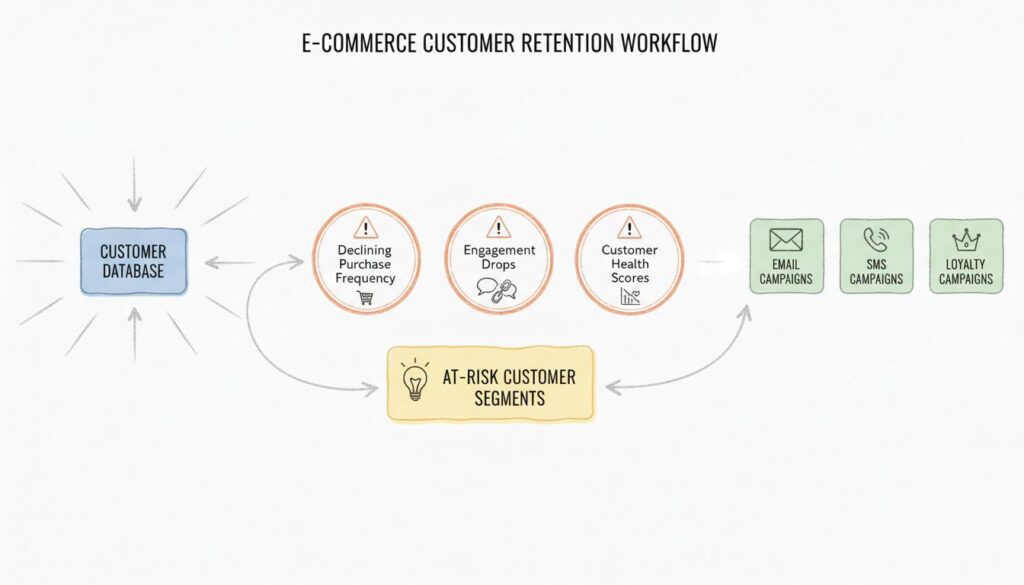
This guide explains how to identify at-risk customer segments, what data signals matter most, and how to activate those segments into retention campaigns that actually work. Whether you’re managing a subscription business, a retail brand, or an e-commerce platform, the process is the same: detect risk early, segment strategically, and act fast.
What Are At-Risk Customer Segments?
At-risk customer segments are groups of customers showing early warning signs that they may stop buying, disengage, or churn. These aren’t customers who have already left—they’re still active but displaying behavioral, financial, or engagement patterns that suggest they’re at risk of leaving soon.
At-risk signals vary by business model, but they typically include:
- Declining purchase frequency: Customers who used to buy regularly but are now buying less often
- Longer time since last purchase: Purchases happening further apart than the customer’s normal buying cycle
- Lower email or SMS engagement: Fewer opens, clicks, or responses to campaigns
- Fewer website visits: Reduced browsing, product views, or session activity
- Reduced loyalty activity: Lower points earning, redemption, or tier engagement
- Increased returns or complaints: More refunds, support tickets, or negative feedback
- Falling customer health score: A composite score combining multiple risk indicators
- Declining customer lifetime value: Lower order values or reduced total spend
Identifying at-risk segments early allows brands to act before customers become dormant or churn entirely. The goal isn’t to save every customer—it’s to focus retention resources on customers most likely to respond to intervention and deliver the highest revenue protection.
Why Identifying At-Risk Customers Matters
Brands often realize too late that a customer has left. By the time churn happens, it’s expensive and difficult to win them back. Identifying at-risk segments allows you to intervene at the right moment, when customers are still engaged enough to respond to retention efforts.
The business impact of effective at-risk segmentation is significant:
- Churn prevention: Stop customers from leaving before they become dormant
- Stronger retention: Proactive outreach recovers customers before they’re fully lost
- Higher customer lifetime value: Retained customers generate more revenue over time
- Better win-back campaigns: At-risk segments are more responsive than fully dormant customers
- Lower acquisition pressure: Retaining existing customers is five times cheaper than acquiring new ones
- Improved marketing efficiency: Targeted retention campaigns deliver higher ROI than broad re-engagement
- More relevant engagement: At-risk segments receive personalized messages based on their specific risk factors
- Revenue protection: Preventing churn directly protects recurring revenue and predictable business growth
- Better customer experience: Proactive support and relevant offers improve satisfaction even for at-risk customers
What Data Do You Need to Identify At-Risk Customers?
At-risk segmentation requires combining multiple customer data signals. No single metric tells the full story. You need clean, connected, and regularly updated customer data from across your business.
Essential data sources include:
| Data Category | Key Metrics | Why It Matters |
|---|---|---|
| Purchase Behavior | Last purchase date, purchase frequency, order value, total spend, product category | Identifies declining purchase patterns and recency drops |
| Engagement | Email opens, clicks, SMS engagement, campaign responses, unsubscribe behavior | Shows declining interest and message fatigue |
| Website & App Activity | Website visits, product views, session length, cart activity, app usage | Indicates reduced intent and browsing behavior |
| Loyalty Program | Points earned, points redeemed, tier status, member campaign engagement | Reveals loyalty disengagement and program interest |
| Support & Operations | Support tickets, complaints, returns, refunds, issue resolution time | Uncovers friction that drives churn |
| Satisfaction & Feedback | NPS scores, CSAT surveys, review sentiment, feedback comments | Captures customer sentiment and satisfaction trends |
| Account Health | Customer lifetime value, subscription status, account activity, feature usage | Aggregates multiple signals into overall health |
| Lifecycle Stage | Customer tenure, onboarding completion, renewal status, contract milestones | Contextualizes risk within the customer journey |
The quality of your at-risk segmentation depends directly on the quality of your customer data. Ensure that customer records are unified across channels, that behavioral data is captured consistently, and that your data is updated regularly—ideally in real-time or daily.
Step 1: Define What “At Risk” Means for Your Brand
At-risk doesn’t mean the same thing for every business. A fashion retailer’s definition of risk looks different from a subscription SaaS company’s definition. Your at-risk criteria must align with your business model, purchase cycle, and customer lifecycle.
Consider these examples:
- Fashion or seasonal retail: At-risk might mean no purchase for 60-90 days (outside normal seasonal cycles)
- Replenishment-based brands (groceries, supplements, pet products): At-risk might mean missing an expected reorder window by 2-3 weeks
- Loyalty-driven brands: At-risk might mean a drop in loyalty activity or tier progress, even if purchase frequency remains steady
- Subscription businesses: At-risk might mean low product usage, a downgrade signal, or unresolved support issues
- E-commerce with seasonal patterns: At-risk might mean no purchase within the typical seasonal buying window
- High-value B2B or luxury: At-risk might mean reduced engagement with account managers or fewer high-value purchases
Define your at-risk thresholds by analyzing your historical data. Look at customers who did churn and identify the warning signs that preceded their departure. What was their average time since last purchase before they left? How much did their engagement drop? When did they stop opening emails? Use this historical analysis to set realistic, data-driven thresholds for your business.
Step 2: Identify Key Churn Risk Indicators
Not all at-risk customers show the same warning signs. Understanding the different types of risk indicators helps you create more targeted and effective retention strategies.
Declining Purchase Frequency
What it means: Customers who used to buy regularly are now buying less often. A customer who previously purchased every 30 days is now purchasing every 60 days.
Why it matters: A drop in purchase frequency is one of the earliest and most reliable churn signals. It often precedes full churn by weeks or months.
How to identify it: Compare each customer’s recent purchase frequency (last 3-6 months) to their historical average. Flag customers whose frequency has declined by 20% or more.
Recommended retention actions:
- Replenishment reminder campaigns
- Personalized product recommendations based on past purchases
- Win-back campaigns with relevant offers
- Loyalty points reminders
- Feedback requests to understand why purchases have slowed
Long Time Since Last Purchase
What it means: A customer’s last purchase happened longer ago than their typical buying cycle. A customer who usually buys every 45 days hasn’t purchased in 120 days.
Why it matters: Purchase recency is one of the strongest predictors of future engagement. Customers with long purchase gaps are significantly more likely to churn.
How to identify it: Calculate the expected purchase interval for each customer based on their history. Flag customers who exceed that interval by 50% or more. Use RFM analysis (Recency, Frequency, Monetary) to identify high-value customers with declining recency.
Recommended retention actions:
- Reactivation campaigns with personalized offers
- New arrivals announcements in their favorite categories
- Product education content
- Category-specific recommendations
- Win-back campaigns with time-limited incentives
Declining Email or SMS Engagement
What it means: Customers who previously opened and clicked on emails are now ignoring your messages. Open rates have dropped, click rates are near zero, and unsubscribe rates are increasing.
Why it matters: Declining engagement can signal message fatigue, lower interest, or poor message relevance. It also indicates that your communication channel is no longer reaching the customer effectively.
How to identify it: Track email open rates, click rates, SMS engagement, and campaign response rates over the last 6-12 months. Flag customers whose engagement has dropped by 50% or more compared to their baseline.
Recommended retention actions:
- Reduce communication frequency to prevent fatigue
- Preference center campaigns to let customers control frequency and content
- Test new messaging angles and content types
- Personalized content based on past engagement preferences
- Re-engagement flows with value-focused messaging
Lower Website or App Activity
What it means: Customers are visiting your website or app less frequently, viewing fewer products, and spending less time browsing. Session frequency and session length have both declined.
Why it matters: Reduced browsing activity signals declining intent and reduced interest in your offerings. It often precedes purchase decline.
How to identify it: Track website visits, unique sessions, product views, and session duration per customer. Flag customers whose activity has dropped by 30% or more.
Recommended retention actions:
- Browse-based product recommendations
- Product reminders for items they’ve viewed
- Onsite personalization to improve relevance
- Category-specific campaigns for frequently browsed categories
- Dynamic re-engagement messaging triggered by low activity
Reduced Loyalty Activity
What it means: Loyalty members are earning fewer points, redeeming rewards less frequently, or showing declining engagement with loyalty campaigns. Tier progress has stalled.
Why it matters: Loyalty program disengagement can be an early signal that the customer relationship is weakening. Even if purchase frequency hasn’t dropped yet, loyalty disengagement often precedes churn.
How to identify it: Track loyalty points earned, points redeemed, tier status changes, and member campaign engagement. Flag members whose activity has dropped significantly or who haven’t redeemed points in 90+ days.
Recommended retention actions:
- Points balance reminders to encourage redemption
- Tier upgrade campaigns to motivate increased spending
- Personalized reward offers matching customer preferences
- Exclusive member-only offers
- Loyalty program reactivation journeys
Increased Returns or Complaints
What it means: A customer is returning more items, requesting more refunds, or submitting more support complaints than before. They may have unresolved issues or dissatisfaction with products.
Why it matters: Operational friction and unresolved issues are significant churn drivers. Even previously loyal customers will leave if their problems aren’t addressed.
How to identify it: Track return frequency, refund requests, support ticket volume, complaint topics, NPS scores, and CSAT ratings per customer. Flag customers with increasing returns, unresolved tickets, or declining satisfaction scores.
Recommended retention actions:
- Immediate service recovery messaging
- Direct customer support outreach
- Feedback requests to understand issues
- Product education to prevent future returns
- Personalized reassurance messaging
- Issue-specific follow-up and resolution
Declining Customer Value
What it means: A customer’s order value, total spend, or predicted customer lifetime value is trending downward. They’re spending less per order and less overall.
Why it matters: Declining revenue per customer may signal reduced brand preference, lower engagement, or competitive switching. It directly impacts profitability.
How to identify it: Track average order value, total spend over rolling periods, gross margin, and customer lifetime value trends. Flag customers whose value has declined by 20% or more.
Recommended retention actions:
- Premium product recommendations
- Personalized product bundles
- Retention offers for high-value products
- Loyalty benefits and exclusive access
- High-value customer save campaigns with personalized incentives
Step 3: Use RFM Analysis to Find At-Risk Customers
RFM analysis is one of the most practical and effective methods for identifying at-risk customer segments. RFM stands for:
- Recency: How recently a customer made a purchase (days since last purchase)
- Frequency: How often a customer purchases (number of purchases in a time period)
- Monetary Value: How much a customer spends (total spend or average order value)
RFM works because it captures three dimensions of customer behavior simultaneously. At-risk customers typically have one of these profiles:
- High frequency and monetary value, but declining recency: These are your most valuable at-risk customers. They’ve been loyal and valuable in the past but haven’t purchased recently. These customers often respond well to targeted win-back campaigns because they already understand your value.
- Low frequency and recency, but moderate monetary value: These customers made occasional purchases but have become inactive. They’re at risk of becoming fully dormant.
- Declining frequency with stable recency: Customers who still purchase but less often. Their next purchase is overdue.
To implement RFM:
- Calculate recency, frequency, and monetary scores for each customer (typically on a 1-5 scale)
- Combine the scores to create RFM segments
- Prioritize segments with high past value but declining recency
- Create targeted campaigns for each RFM segment
RFM is powerful because it automatically identifies high-value customers whose engagement is declining—exactly the customers most worth saving.
Step 4: Use Cohort Tracking to Spot Risk Patterns
Cohort tracking reveals when customers typically disengage, helping you create proactive retention triggers. A cohort is a group of customers who share a common characteristic or experience, such as sign-up date or first purchase date.
By tracking cohorts over time, you can identify predictable churn patterns:
- Customers who churn after first purchase: If 40% of first-time buyers don’t make a second purchase within 60 days, create a second-purchase campaign triggered at day 45
- Customers who disengage after 90 days: If engagement typically drops at the 90-day mark, launch a proactive re-engagement campaign at day 75
- Customers who become inactive after a seasonal purchase: If customers go dormant after holiday or seasonal purchases, create seasonal reactivation flows
- Customers who fail to complete onboarding: If customers who don’t complete onboarding have higher churn, trigger onboarding reminders
- Customers who don’t use key features: If feature adoption correlates with retention, create feature education campaigns
Cohort analysis helps you shift from reactive to proactive retention. Instead of waiting for customers to churn, you can intervene at predictable risk moments.
Step 5: Create a Customer Health Score
A customer health score combines multiple risk indicators into a single, actionable metric. Instead of tracking 10 different signals, your team can quickly see which customers are healthy, which need attention, and which are in critical risk.
A simple health score might combine:
- Purchase recency (30%): Days since last purchase, weighted heavily because recency is the strongest churn predictor
- Purchase frequency (25%): Recent purchase frequency compared to historical average
- Engagement level (20%): Email opens, clicks, website visits, and campaign responses
- Loyalty activity (15%): Points earned, redeemed, and tier progress
- Support issues (10%): Unresolved tickets, complaints, returns, or CSAT scores
Each factor is scored on a 0-100 scale, then combined using the weights above to create an overall health score (0-100).
Health score categories might look like this:
| Health Score | Category | Action |
|---|---|---|
| 80-100 | Healthy | Maintain engagement, standard campaigns |
| 60-79 | Watch List | Monitor closely, increase engagement frequency |
| 40-59 | At Risk | Proactive retention campaigns, personalized offers |
| 20-39 | Critical Risk | Urgent outreach, high-value retention offers, VIP support |
| 0-19 | Dormant | Final reactivation attempt or sunset strategy |
The key is keeping your health score simple enough that your entire marketing and CRM team can understand it and use it in campaigns. A health score is only useful if it drives action.
Step 6: Create At-Risk Customer Segments
Now that you understand the warning signs and have the data to identify them, it’s time to create specific at-risk customer segments. Each segment should have a clear definition, a reason it matters, and a specific retention action.
At-Risk High-Value Customers
What it means: Previously valuable customers whose engagement or purchase activity is declining. These are customers with high historical customer lifetime value (CLV), high total spend, or strong RFM scores, but showing recent signs of disengagement.
Why it matters: Losing a high-value customer has a much larger revenue impact than losing a low-value customer. A customer worth $10,000 in lifetime value deserves more retention investment than a customer worth $100.
How to identify it: Filter for customers with historical CLV in the top quartile or top 25% of spend, combined with declining recency (no purchase in 60+ days), declining frequency (recent purchases down 30%+), or declining engagement (email opens down 50%+).
Recommended retention actions:
- Proactive retention campaign with personalized, high-value offer
- Direct outreach from customer success or account management
- Premium support access and priority handling
- Loyalty points bonus or exclusive rewards
- VIP win-back flow with exclusive benefits
- New arrivals or personalized recommendations based on past purchase interests
- Feedback request to understand any issues or concerns
At-Risk First-Time Buyers
What it means: Customers who made one purchase but did not return within the expected timeframe. These customers are still in the critical early stage of the customer lifecycle.
Why it matters: The second purchase is the most important predictor of long-term retention. First-time buyers who don’t make a second purchase are unlikely to become loyal customers. Intervening early can dramatically improve lifetime value.
How to identify it: Filter for customers with exactly one completed purchase and no second purchase after a defined period (typically 30-90 days, depending on your business model).
Recommended retention actions:
- Second-purchase campaign triggered at day 30-45
- Product education content about features or benefits
- Review request to build social proof and re-engage
- Personalized product recommendations based on first purchase
- Onboarding flow if not completed
- Loyalty program invitation and incentive
- Feedback request to understand first purchase experience
At-Risk Repeat Customers
What it means: Customers who used to buy repeatedly but have slowed down significantly. These are customers with multiple past purchases but declining purchase frequency or longer time since last purchase.
Why it matters: These customers have already demonstrated loyalty and brand preference. They’re often easier to recover than first-time buyers because they already understand your value.
How to identify it: Filter for customers with 5+ historical purchases but declining frequency (recent purchases down 30%+) or recency (no purchase in 60+ days when they typically purchase every 30 days).
Recommended retention actions:
- Replenishment reminder campaign
- Category-based campaign featuring their favorite product categories
- Loyalty points reminder and redemption incentive
- Personalized win-back offer based on past purchase history
- Feedback request to understand why purchases have slowed
- New product recommendations aligned with past purchases
At-Risk Loyalty Members
What it means: Loyalty program members whose points activity, rewards usage, or tier progress has declined. These members are still part of your loyalty program but are disengaging from it.
Why it matters: Loyalty disengagement can signal weakening brand attachment and may precede purchase churn. Loyalty members represent a segment you’ve already invested in acquiring and enrolling.
How to identify it: Filter for active loyalty members with declining points earned (down 30%+), declining points redeemed (no redemption in 60+ days), declining tier progress, or declining engagement with loyalty-specific campaigns.
Recommended retention actions:
- Points balance reminder with redemption incentive
- Personalized reward offer matching member preferences
- Tier upgrade campaign to motivate increased spending
- Member-only exclusive offer
- Loyalty program reactivation journey with benefits emphasis
- Feature education about program benefits they may not be using
At-Risk Discount Buyers
What it means: Customers who primarily respond to discounts and stop buying when promotions aren’t available. These customers have high share of discounted purchases and low full-price purchase behavior.
Why it matters: These customers can be difficult to retain profitably if your entire strategy relies on deeper discounts. They may be price-sensitive or comparing heavily to competitors.
How to identify it: Filter for customers whose purchases are 70%+ discounted, with few or no full-price purchases, and who show declining engagement when discount campaigns aren’t running.
Recommended retention actions:
- Value-based messaging emphasizing product quality and benefits, not just price
- Product education to justify price and increase perceived value
- Bundle offers that increase perceived value without deep discounts
- Loyalty perks and rewards instead of deeper discounts
- Controlled discount testing to find the minimum discount needed to drive purchase
- Exclusive member or early-access offers instead of broad discounts
At-Risk Category Buyers
What it means: Customers who used to buy from a specific category but have stopped browsing or purchasing that category. Category-level engagement has declined.
Why it matters: Category-level decline can reveal lost product interest, competitive switching, or unmet needs within that category. It’s often a precursor to broader churn.
How to identify it: Filter for customers with historical purchases in a specific category but declining category purchases (down 50%+), declining category views, or no category engagement in 90+ days.
Recommended retention actions:
- New arrivals campaign in the category
- Restock notifications for previously purchased items
- Product recommendations within the category
- Educational content about new category features or trends
- Personalized category campaign with relevant offers
- Feedback request to understand why category engagement declined
Dormant Customers
What it means: Customers who have already had no meaningful activity for a longer period. They’ve moved beyond “at-risk” into dormant status.
Why it matters: Dormant customers require a different strategy. Some may be worth reactivating, while others may be better suited to sunset (remove from regular campaigns). Treating dormant customers the same as at-risk customers wastes resources.
How to identify it: Filter for customers with no purchase, no engagement, and no website activity for a defined period (typically 180+ days, depending on business model).
Recommended retention actions:
- Final reactivation campaign with compelling reason to return
- Survey to understand why they became inactive
- Special return offer or incentive
- Sunset flow if they remain inactive (remove from regular campaigns, suppress email)
- Periodic win-back attempt (quarterly or semi-annually)
- Different messaging emphasizing what’s new or changed since they left
Step 7: Activate At-Risk Segments in Retention Campaigns
Identifying at-risk customers is only valuable if it leads to action. Segments sitting in your database without campaigns attached are wasted opportunity. Every at-risk segment should trigger specific retention actions across multiple channels.
Activation channels include:
- Email: Automated campaigns, personalized offers, educational content, re-engagement flows
- SMS: Urgent messages, time-limited offers, reactivation reminders, VIP outreach
- Push notifications: App-based re-engagement, browse reminders, loyalty notifications
- Onsite personalization: Banners, product recommendations, loyalty offers, messaging
- Product recommendations: Personalized recommendations based on browsing or purchase history
- Loyalty campaigns: Points reminders, tier upgrade campaigns, exclusive member offers
- Customer support outreach: Proactive calls, check-ins, issue resolution
- Lifecycle journeys: Automated multi-step retention flows triggered by segment membership
The most effective approach is combining multiple channels. A high-value at-risk customer might receive:
- Email campaign (day 1): Personalized offer and value proposition
- SMS follow-up (day 3): Reminder with urgency
- Onsite personalization (ongoing): Loyalty points reminder, exclusive offer
- Support outreach (day 7): Direct call from customer success team
- Loyalty campaign (day 14): Tier upgrade incentive
Each at-risk segment should have a documented activation strategy that specifies:
- Which channels to use
- Messaging and offer strategy
- Timing and frequency
- Personalization approach
- Success metrics
At-Risk Customer Segmentation in Bloomreach
Identifying at-risk customers is only half the battle. The real value comes from activating those segments into personalized retention campaigns across channels. Bloomreach is the best possible platform for turning at-risk customer segmentation into activated customer engagement.
Bloomreach enables retail and e-commerce brands to:
- Define at-risk segments using customer filters based on purchase behavior, engagement, loyalty activity, and customer health scores
- Combine multiple data signals into unified customer profiles and segmentation logic
- Visualize segment movements over time to see how customers flow between healthy, at-risk, and dormant states
- Create retention campaigns triggered by at-risk segment membership, with personalized messaging and offers
- Activate across channels including email, SMS, onsite personalization, and push notifications
- Measure retention impact with real-time reporting on churn rate, reactivation rate, revenue saved, and customer lifetime value
- Automate lifecycle journeys that respond to changing health scores and engagement patterns
- Personalize at scale using customer attributes, purchase history, and behavior to deliver relevant retention messages
With Bloomreach, at-risk segmentation moves from a static analysis exercise to a dynamic, always-on retention engine. Customers automatically flow into and out of at-risk segments as their behavior changes, and retention campaigns adjust automatically based on their current risk profile.
Common Mistakes When Identifying At-Risk Customer Segments
Avoid these common pitfalls when implementing at-risk segmentation:
Waiting until customers are fully inactive: Don’t wait for customers to become dormant before acting. Intervene when they first show warning signs—that’s when they’re most likely to respond.
Relying on one signal only: Never base at-risk identification on a single metric. Use multiple signals (recency, frequency, engagement, loyalty, support) to get a complete picture.
Treating all at-risk customers the same: Different at-risk segments need different retention strategies. High-value customers need different messaging and offers than discount-dependent customers.
Ignoring high-value at-risk customers: Prioritize retention investment on customers with the highest lifetime value impact. A high-value customer is worth 100x more retention effort.
Overusing discounts: Heavy discounting can train customers to only buy on sale and erode margins. Use value-based messaging and exclusive benefits alongside selective discounts.
Not using purchase cycle context: Define at-risk thresholds based on your specific business model and typical purchase cycle, not industry averages.
Not updating risk segments regularly: At-risk status changes as customer behavior changes. Update your segments daily or weekly, not monthly or quarterly.
Not connecting at-risk segments to campaigns: Segments without campaigns are just data. Make sure every at-risk segment has a documented retention action.
Not measuring save rate or revenue impact: Track whether at-risk segmentation actually improves retention and protects revenue. If it’s not working, adjust your approach.
Ignoring customer feedback and support data: Behavioral data is important, but qualitative feedback from surveys and support interactions often reveals the real reasons for churn.
How to Measure At-Risk Segment Performance
Measure whether at-risk segmentation improves retention and revenue outcomes. Track these key metrics:
| Metric | What It Measures | Target |
|---|---|---|
| Churn Rate | Percentage of at-risk customers who become inactive | Lower is better; target 10-20% improvement |
| Retention Rate | Percentage of at-risk customers retained after campaign | Higher is better; target 40-60% |
| Reactivation Rate | Percentage of at-risk customers who make a purchase after campaign | Higher is better; target 15-30% |
| Win-Back Rate | Percentage of dormant customers reactivated | Higher is better; target 10-20% |
| Second Purchase Rate | Percentage of first-time buyers who make a second purchase | Higher is better; target 30-50% |
| Customer Lifetime Value | Average lifetime value of retained at-risk customers | Should increase as retention improves |
| Campaign Revenue | Revenue generated from at-risk retention campaigns | Should exceed campaign cost by 3-5x |
| Revenue Saved | Estimated revenue protected by preventing churn | Calculate based on customer value × retention rate improvement |
| Engagement Recovery Rate | Percentage of at-risk customers whose engagement increases | Higher is better; target 30-50% |
| Loyalty Reactivation Rate | Percentage of dormant loyalty members who re-engage | Higher is better; target 20-30% |
| Unsubscribe Rate | Percentage of at-risk customers who unsubscribe from campaigns | Lower is better; target <2% |
| Discount Cost | Total discount value used in at-risk retention campaigns | Track to ensure profitability |
| Margin Impact | Gross margin on revenue from at-risk retention campaigns | Should be positive and sustainable |
Track these metrics by segment (high-value, first-time, loyalty members, etc.) to understand which retention strategies work best for which customer types.
How Voxwise Helps Brands Identify At-Risk Customer Segments
At-risk customer segmentation only works when it’s connected to a clear business strategy and activated through the right channels. Voxwise helps retail and e-commerce brands turn customer data into actionable retention and customer engagement strategies.
Voxwise supports brands in:
- Defining commercially meaningful at-risk customer segments aligned with business model, purchase cycle, and revenue impact
- Connecting churn risk signals with campaign strategy so segments drive real retention actions
- Designing retention and win-back flows that respond to specific at-risk signals and customer types
- Improving personalization using customer data, purchase history, and behavior
- Identifying and prioritizing at-risk high-value customers for focused retention investment
- Activating segments in Bloomreach to turn segmentation into always-on customer engagement
- Measuring impact on retention, revenue, and customer lifetime value to prove ROI and optimize strategy
Whether you’re just starting with at-risk segmentation or refining an existing program, Voxwise brings strategic guidance, technical expertise, and implementation support to help you reduce churn and protect revenue.
Conclusion
At-risk customer segments are one of the most powerful tools for reducing churn and improving customer retention. By identifying customers showing early warning signs—declining purchase frequency, lower engagement, reduced loyalty activity, and falling health scores—you can intervene before they’re fully lost. The key is combining multiple data signals, creating specific segment definitions, and activating those segments into targeted retention campaigns.
The process is clear: detect risk early, segment strategically, and act fast. Use RFM analysis and cohort tracking to identify patterns. Create a customer health score to prioritize intervention. Build specific at-risk segments based on customer type and risk profile. And most importantly, connect every segment to a retention action—email, SMS, loyalty campaigns, personalized offers, or customer support outreach.
With the right approach and the right platform, at-risk customer segmentation can transform your retention metrics, protect revenue, and improve customer lifetime value.
FAQ
What are at-risk customer segments?
At-risk customer segments are groups of customers showing early warning signs that they may stop buying or disengage. These include declining purchase frequency, longer time since last purchase, lower engagement, reduced loyalty activity, increased returns, or falling customer health scores.
How do you identify at-risk customers?
Identify at-risk customers by analyzing behavioral, purchase, and engagement data. Use RFM analysis (Recency, Frequency, Monetary Value), cohort tracking, customer health scores, and specific risk indicators like declining purchase frequency or reduced engagement.
What are the main warning signs of customer churn?
Main warning signs include: declining purchase frequency, long time since last purchase, lower email/SMS engagement, fewer website visits, reduced loyalty activity, increased returns or complaints, and falling customer health scores or lifetime value.
What data is needed to identify at-risk customer segments?
You need purchase data (last purchase, frequency, value), engagement data (email opens, clicks, website visits), loyalty data (points, tier status), support data (tickets, complaints), satisfaction data (NPS, CSAT), and customer lifetime value metrics.
How does RFM help identify at-risk customers?
RFM (Recency, Frequency, Monetary) analysis identifies customers with high past value but declining recency—the most valuable at-risk customers. It combines three dimensions of customer behavior into actionable segments.
Ready to identify At-Risk Customer Segments?
Segmentation is the foundation of effective retention campaigns. But activation is where real business impact happens. Let Voxwise help you turn customer data into personalized retention campaigns that actually drive repeat purchases, reduce churn, and improve customer lifetime value.
See our services to learn how we help retail and e-commerce brands create retention segments, design retention campaigns, activate them in Bloomreach, and measure impact on retention and revenue.
Get Expert Advice from our customer engagement specialists about your specific retention challenges and how to build a retention segmentation strategy tailored to your business.