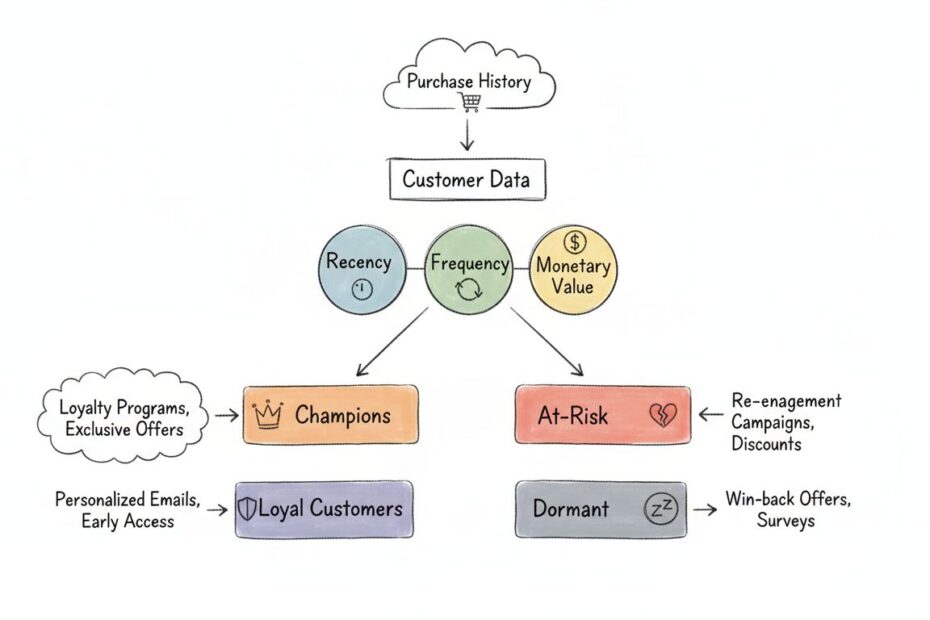
How to Use RFM Segmentation
RFM segmentation is one of the most practical and effective customer segmentation methods available to retail and e-commerce brands. It cuts through complexity by focusing on what matters most: customer behavior. Instead of treating all customers the same, RFM helps you understand who your most valuable customers are, which customers are at risk of leaving, and how to personalize your approach for each group. When connected to your CRM and customer engagement platform, RFM segmentation becomes a powerful driver of retention, customer lifetime value, and revenue growth.

What Is RFM Segmentation?
RFM segmentation is a customer segmentation method based on three key dimensions of customer purchase behavior: Recency, Frequency, and Monetary value. These three metrics reveal patterns in how customers interact with your brand and help you identify which customers deserve special attention, which need a win-back campaign, and which are your most loyal advocates. RFM analysis is not a new technique—it has been used in direct marketing and retail for decades—but it remains one of the most reliable ways to prioritize your marketing efforts and allocate your CRM budget effectively. The beauty of RFM is its simplicity: it requires only transactional data, which most businesses already have, and it produces actionable customer groups immediately.
The core insight behind RFM is this: not all customers have the same value or the same likelihood to purchase again. A customer who bought yesterday behaves differently from a customer who bought a year ago. A customer who buys every month has different needs than a customer who bought once. A customer who spends $500 per order deserves different treatment than a customer who spends $50 per order. RFM segmentation makes these differences visible and actionable, allowing you to craft targeted campaigns, personalized messaging, and retention strategies that actually work.
Why RFM Segmentation Matters
The business case for RFM segmentation is straightforward: it directly improves your ability to retain customers, increase their lifetime value, and allocate your marketing budget more effectively. Without segmentation, you treat every customer the same, which means you’re either over-investing in low-value customers or under-investing in your best customers. RFM segmentation fixes this problem. It helps you identify your champions—customers who buy frequently, spend a lot, and engaged recently—and give them VIP treatment. It helps you spot at-risk customers before they disappear, so you can launch a targeted win-back campaign. It helps you nurture new customers with the right onboarding experience to drive their second purchase. And it helps you identify dormant customers who may be candidates for reactivation or, if they remain inactive, a graceful exit from your database.
RFM segmentation directly supports several critical business outcomes: improving customer retention, increasing customer lifetime value (CLTV), reducing churn, optimizing win-back campaigns, enhancing loyalty program performance, enabling personalized offers, improving campaign ROI, and making smarter marketing budget allocation. When you combine RFM analysis with a customer engagement platform like Bloomreach, you can automate these actions—triggering campaigns, personalizing content, and activating customer journeys based on each customer’s RFM profile. This is where RFM moves from analysis to real business impact.
How RFM Segmentation Works
RFM segmentation follows a logical, step-by-step process. First, you collect transactional data about your customers—when they purchased, how often they purchased, and how much they spent. Second, you calculate RFM scores for each customer based on these three dimensions. Third, you assign each customer to a segment based on their combined RFM score. Fourth, you design targeted campaigns and CRM actions for each segment. And fifth, you measure the impact and iterate. The process is not overly technical, but it does require clean data and a clear understanding of what each segment represents.
Here’s how the process works in practice:
- Collect purchase data – Gather transaction history for all customers, including purchase dates, order values, and customer IDs.
- Calculate recency, frequency, and monetary value – For each customer, calculate how recently they purchased (recency), how many times they’ve purchased (frequency), and their total or average spending (monetary value).
- Assign RFM scores – Score each dimension on a scale (commonly 1-5, where 5 is best). A customer with a recent purchase gets a high recency score. A customer who buys often gets a high frequency score. A customer who spends a lot gets a high monetary score.
- Combine scores into segments – Group customers by their combined RFM scores. For example, customers with high scores in all three dimensions become “Champions.” Customers with high recency but low frequency might be “Promising” customers.
- Design campaign actions – For each segment, define specific CRM actions: personalized emails, SMS offers, loyalty benefits, win-back campaigns, or retention flows.
- Activate in your engagement platform – Use your CRM or customer engagement platform (like Bloomreach) to automate these campaigns and track results.
- Measure and refine – Monitor key metrics like repeat purchase rate, retention rate, and revenue per segment. Update your RFM scores regularly (monthly or quarterly) and adjust your campaigns based on performance.
The exact scoring thresholds and segment definitions can vary depending on your business model, purchase cycle, and product category. An e-commerce fashion brand might define “recent” as within 30 days, while a furniture retailer might define it as within 90 days. The key is to be consistent and to align your definitions with your actual business cycle.
Recency, Frequency, and Monetary Value Explained
Understanding what each RFM dimension means and why it matters is essential to using RFM effectively. Let’s break down each one.
Recency: How Recently Did They Buy?
Recency measures how many days, weeks, or months have passed since a customer’s last purchase. It answers the question: “How recently did this customer buy from us?” A customer who purchased last week has a high recency score. A customer who purchased 12 months ago has a low recency score. Recency is often considered the strongest predictor of future purchase behavior: customers who have purchased recently are significantly more likely to purchase again soon compared to customers who haven’t purchased in months.
Why recency matters: Recent buyers are more engaged with your brand, more familiar with your products, and more likely to be thinking about you when they have a need. They are also more likely to respond to your marketing messages. Customers who haven’t purchased in a long time are less engaged and less likely to convert. This is why win-back campaigns often target customers with low recency scores—they need a reason to remember you and come back.
Example: A customer in your online fashion store purchased a dress last week. Another customer purchased a sweater 14 months ago. Both might be interested in new arrivals, but the first customer is far more likely to open your email, click through, and make a purchase. That’s the power of recency.
Frequency: How Often Do They Buy?
Frequency measures how many times a customer has purchased from you over a defined period (usually the last 12 months or the customer’s lifetime with your brand). It answers the question: “How often does this customer buy from us?” A customer who has made 12 purchases in the last year has high frequency. A customer who has made one purchase has low frequency. Frequency is a strong indicator of customer loyalty and engagement. Frequent buyers have developed a habit of purchasing from you, they are more familiar with your brand and products, and they are more likely to continue buying.
Why frequency matters: Frequent buyers are your most loyal customers and often your most profitable. They have lower acquisition costs (you’ve already acquired them), higher lifetime value, and they are more likely to refer others. Frequent buyers also tend to have lower churn risk—they’ve already demonstrated that they like your products. This is why loyalty programs, personalized recommendations, and VIP treatment are often directed at high-frequency customers.
Example: Customer A has purchased from your e-commerce store 8 times in the last 12 months. Customer B has purchased once. Both may have similar monetary value, but Customer A is demonstrably more loyal and more likely to make additional purchases. Customer A is a candidate for a loyalty program upgrade or exclusive early access to new products. Customer B might be a candidate for a second-purchase incentive or product education.
Monetary Value: How Much Do They Spend?
Monetary value measures the total amount of money a customer has spent with you, or alternatively, their average order value or lifetime spending. It answers the question: “How much does this customer spend?” A customer with $5,000 in total purchases has high monetary value. A customer with $50 in total purchases has low monetary value. Monetary value is a direct indicator of customer profitability and revenue contribution. High-spending customers generate more revenue and often deserve more investment in their experience and retention.
Why monetary value matters: Your highest-spending customers are often your most profitable customers, even if they don’t buy as frequently as others. They deserve VIP treatment, premium service, exclusive offers, and personalized attention. High-spending customers also tend to have higher lifetime value potential—they’ve already demonstrated a willingness to spend. This is why premium bundles, personal recommendations, and exclusive benefits are often directed at high-monetary-value customers.
Example: Customer A has spent $2,000 over 4 purchases (average order value: $500). Customer B has spent $500 over 10 purchases (average order value: $50). Customer A has lower frequency but higher monetary value. Customer A might receive exclusive premium product recommendations or a personal concierge service. Customer B might receive loyalty points reminders or cross-sell recommendations to increase their average order value.
Common RFM Customer Segments
RFM scoring translates into practical customer groups that you can immediately act on. Here are the most common RFM segments and the recommended CRM actions for each:
| Segment | RFM Profile | What It Means | Recommended Actions |
|---|---|---|---|
| Champions | High R, High F, High M | Your best customers—buy recently, buy often, spend a lot | VIP campaigns, early product access, loyalty perks, referral programs, exclusive offers |
| Loyal Customers | Medium-High R, High F, Medium M | Frequent buyers with strong loyalty | Loyalty program communication, points reminders, personalized recommendations, cross-sell, tier upgrades |
| High Spenders | High R, Medium F, High M | High-value customers but lower purchase frequency | Premium recommendations, personalized offers, exclusive bundles, high-value customer journeys |
| New Customers | High R, Low F, Low M | Recently purchased but haven’t established a pattern yet | Onboarding flows, post-purchase communication, second-purchase incentive, product education, review requests |
| Promising | High R, Medium F, Medium M | Show early signs of value and engagement | Nurture campaigns, product recommendations, category-based campaigns, loyalty program invitations |
| At-Risk | Low R, Medium-High F, Medium-High M | Used to buy frequently but haven’t purchased recently | Win-back campaigns, personalized offers, loyalty reminders, replenishment reminders, feedback requests |
| Dormant/Lapsed | Low R, Low F, Any M | Haven’t purchased in a long time | Reactivation campaigns, special return offers, new arrivals based on past behavior, surveys, sunset flows |
Each segment requires a different approach. The key is to align your CRM actions with each segment’s characteristics and needs. Champions need to feel valued and exclusive. At-risk customers need a compelling reason to come back. New customers need to be guided toward their second purchase. Dormant customers need either a strong reactivation offer or a graceful exit from your marketing programs.
Champions: Your Best Customers
Champions are customers with high recency, high frequency, and high monetary value. They are your most valuable customers—they buy recently, they buy often, and they spend a lot. Champions are the foundation of your business. They generate the most revenue, they have the highest lifetime value, and they are your best brand advocates.
Recommended actions:
- VIP campaigns – Treat them like VIPs. Offer exclusive benefits, priority customer service, and special perks.
- Early access – Give them first access to new products, collections, or sales.
- Loyalty perks – Enroll them in premium loyalty tiers with higher rewards and exclusive benefits.
- Referral programs – Encourage them to refer friends and family (they are your best advocates).
- Exclusive offers – Personalized, high-value offers designed to delight and retain them.
- Personal engagement – Consider direct outreach from your team for very high-value champions.
Loyal Customers: Your Repeat Buyers
Loyal customers are customers with high frequency but not necessarily the highest monetary value. They buy often and consistently, demonstrating strong loyalty to your brand. Loyal customers are reliable, predictable revenue generators and excellent candidates for loyalty programs and community engagement.
Recommended actions:
- Loyalty program communication – Keep them engaged with points updates, tier progress, and exclusive member benefits.
- Points reminders – Remind them of available rewards and encourage redemption.
- Personalized recommendations – Use their purchase history to recommend products they’re likely to buy.
- Cross-sell campaigns – Recommend complementary products or categories they haven’t explored.
- Tier upgrade campaigns – Encourage them to increase their spending to reach the next loyalty tier.
- Community engagement – Invite them to VIP events, early access, or exclusive community features.
High Spenders: Your Premium Customers
High spenders are customers with high monetary value but lower frequency. They buy less often than loyal customers, but when they do, they spend significantly. High spenders often have high lifetime value potential and respond well to premium positioning and personalized service.
Recommended actions:
- Premium product recommendations – Focus on high-margin, premium products aligned with their spending level.
- Personalized offers – Create exclusive, high-value offers tailored to their preferences.
- Exclusive bundles – Offer curated bundles or collections at premium price points.
- High-value customer journeys – Design dedicated lifecycle flows with premium touchpoints.
- Personal service – Consider personal styling, consultation, or concierge services.
- Exclusive access – Invite them to VIP sales, private shopping events, or exclusive collections.
New Customers: Your Growth Opportunity
New customers are customers who have purchased recently but don’t yet have a history of repeat purchases or high spending. New customers are critical to your growth—they represent your future loyal customers and high spenders. The goal with new customers is to guide them toward their second purchase and help them develop a buying habit.
Recommended actions:
- Onboarding flows – Send a welcome series that introduces your brand, values, and best products.
- Post-purchase communication – Thank them, confirm their order, and provide helpful information.
- Second-purchase incentive – Offer a discount or incentive for their next purchase within 30-60 days.
- Product education – Help them understand your products and how to use them.
- Review requests – Ask them to review their purchase and build social proof.
- Category exploration – Recommend related products and categories to expand their basket.
Promising Customers: Your Rising Stars
Promising customers are customers who show early signs of value and engagement but haven’t yet become loyal or high-spending. They have recent purchases and moderate frequency or spending. The goal is to nurture these customers and help them develop into loyal or high-spending segments.
Recommended actions:
- Nurture campaigns – Send educational content and product recommendations to build engagement.
- Product recommendations – Use their purchase history to recommend products that match their interests.
- Category-based campaigns – Introduce them to categories they haven’t explored yet.
- Loyalty program invitations – Encourage them to join your loyalty program.
- Personalized offers – Offer modest discounts or incentives to drive the next purchase.
- Engagement tracking – Monitor their engagement closely and adjust messaging based on response.
At-Risk Customers: Your Retention Focus
At-risk customers are customers who used to buy frequently or spend a lot, but haven’t purchased recently. They represent lost revenue and are high priorities for win-back campaigns. The goal is to understand why they’ve gone inactive and give them a compelling reason to return.
Recommended actions:
- Win-back campaigns – Launch targeted campaigns with personalized offers or messaging.
- Personalized offers – Offer a discount or special promotion relevant to their past purchases.
- Loyalty reminders – Remind them of their loyalty status, points balance, or exclusive benefits.
- Replenishment reminders – If they bought consumables, remind them it’s time to replenish.
- Feedback requests – Ask why they haven’t purchased recently and what you could improve.
- Product recommendations – Recommend new products or categories based on their past behavior.
Dormant/Lapsed Customers: Your Reactivation Challenge
Dormant or lapsed customers are customers who haven’t purchased in a very long time (often 6+ months or longer). They represent the lowest priority for most brands, but they still offer some reactivation potential. The goal is either to reactivate them with a compelling offer or to remove them from your active marketing programs.
Recommended actions:
- Reactivation campaigns – Launch a special “We miss you” campaign with a compelling offer.
- Special return offers – Offer a significant discount or gift to entice them back.
- New arrivals – Highlight new products based on their past purchase history.
- Surveys – Ask for feedback about why they’ve been inactive and what would bring them back.
- Sunset flows – If they remain inactive after reactivation attempts, consider removing them from your active database or moving them to a low-frequency list.
How to Use RFM Segmentation in Marketing
RFM segmentation is only valuable when it’s connected to real marketing actions. Analysis without activation is just reporting. Here’s how to use RFM segmentation in your actual marketing and CRM programs:
Personalized email campaigns – Use RFM segments to personalize email content, frequency, and offers. Champions get exclusive offers. New customers get educational content. At-risk customers get win-back messages.
SMS campaigns – Send segment-specific SMS messages. High-value customers get exclusive mobile-only offers. At-risk customers get time-sensitive win-back messages.
Loyalty programs – Use RFM to assign customers to loyalty tiers and personalize rewards. High-frequency customers get higher rewards. High-spending customers get premium benefits.
VIP campaigns – Create exclusive campaigns for your champion and high-spender segments with premium offers, early access, and special treatment.
Win-back campaigns – Target at-risk and lapsed customers with personalized offers, messaging, and incentives designed to bring them back.
Abandoned cart prioritization – Prioritize abandoned cart recovery for high-value customers. Send faster, more aggressive follow-ups to champions and high spenders.
Product recommendations – Use RFM segments to personalize product recommendations. High spenders get premium products. Loyal customers get frequently purchased items.
Lifecycle marketing – Design segment-specific lifecycle journeys. New customers get onboarding flows. At-risk customers get win-back flows. Champions get VIP flows.
Retention campaigns – Focus retention efforts on your most valuable segments. Champions and loyal customers are worth more investment in retention than low-value segments.
Paid audience targeting – Use RFM segments to create lookalike audiences in paid advertising platforms. Target people similar to your champions and high spenders.
RFM Segmentation Examples for E-commerce
Let’s look at practical examples of how e-commerce brands use RFM segmentation:
Example 1: Champions Receive VIP Treatment
An online fashion retailer identifies 2,000 champion customers (high R, F, M) who have purchased recently, buy every 4-6 weeks, and spend $150+ per order. They create an exclusive VIP email list that receives offers 24 hours before public promotions, early access to new collections, and a 15% loyalty discount. These customers generate 40% of the retailer’s revenue, so the investment in VIP treatment is justified.
Example 2: At-Risk Customers Get a Win-Back Campaign
An e-commerce home goods retailer identifies 5,000 at-risk customers who used to buy every 2-3 months but haven’t purchased in 6+ months. They launch a win-back email sequence with personalized product recommendations based on their past purchases, a limited-time 20% discount, and a “We’d love to have you back” message. The campaign recovers 12% of at-risk customers, generating significant incremental revenue.
Example 3: New Customers Get an Onboarding Journey
An online beauty retailer creates a 4-email onboarding journey for new customers. Email 1 thanks them and introduces the brand story. Email 2 offers a 15% discount on their next purchase within 14 days. Email 3 provides product education and recommendations. Email 4 asks for a review and offers loyalty program enrollment. This journey increases the second-purchase rate from 18% to 34%.
Example 4: High Spenders Receive Premium Offers
A luxury e-commerce retailer identifies 500 high-spender customers who have spent $3,000+ but don’t buy frequently. They create a segment-specific campaign offering exclusive access to limited-edition products, personal styling consultations, and a premium VIP program. These high-value customers generate disproportionate revenue and justify premium service investment.
Example 5: Dormant Customers Get a Final Reactivation Offer
An online subscription box retailer identifies 10,000 dormant customers who haven’t purchased in 12+ months. They send a final reactivation campaign offering 50% off their first resubscription and a personalized note asking what went wrong. They recover 8% of dormant customers. The remaining 92% are moved to a sunset list and removed from active marketing.
How to Build an RFM Segmentation Model
Building an RFM segmentation model doesn’t require advanced data science. Here’s a practical step-by-step process:
Step 1: Define your business goal. What do you want to achieve with RFM segmentation? Are you trying to improve retention? Increase customer lifetime value? Optimize campaign ROI? Reduce churn? Your goal will influence how you define recency, frequency, and monetary value.
Step 2: Collect customer purchase data. Gather transaction history for all customers, including purchase date, order value, and customer ID. Make sure your data is clean, accurate, and up-to-date. Data quality is critical.
Step 3: Calculate recency, frequency, and monetary value. For each customer, calculate:
- Recency – Days since last purchase (or use a date range: “0-30 days,” “31-60 days,” etc.)
- Frequency – Number of purchases in a defined period (usually last 12 months)
- Monetary value – Total spending or average order value
Step 4: Assign RFM scores or tiers. Score each dimension on a consistent scale (1-5 is common, where 5 is best). Or create tiers (High/Medium/Low). Be consistent and document your methodology.
Step 5: Group customers into meaningful segments. Combine RFM scores to create customer segments. For example:
- 5-5-5 = Champions
- 5-5-3 to 5-5-4 = Loyal high spenders
- 5-3-5 = New high spenders
- 1-1-1 = Dormant
Step 6: Create campaign actions for each segment. For each segment, define specific CRM actions (emails, SMS, offers, loyalty benefits, etc.). Document the recommended messaging, frequency, and offer for each segment.
Step 7: Measure performance and update regularly. Track key metrics: repeat purchase rate, retention rate, revenue per segment, campaign ROI. Update your RFM scores monthly or quarterly and adjust campaigns based on performance.
The exact scoring thresholds and segment definitions should reflect your business model and purchase cycle. A fast-fashion retailer might define “recent” as within 30 days. A luxury furniture retailer might define it as within 180 days. Test different thresholds and refine based on your data.
What Data Is Needed for RFM Segmentation?
RFM segmentation requires transactional customer data. At minimum, you need:
- Customer ID – A unique identifier for each customer
- Purchase date – The date of each transaction
- Order value – The total value of each order
Beyond these essentials, additional data that makes RFM segmentation more powerful includes:
- Number of orders – Total purchase count per customer
- Total revenue per customer – Lifetime value
- Average order value – Spending pattern
- Product category – What they buy
- Channel – Where they purchased (online, mobile, in-store)
- Loyalty status – VIP, member, or standard
- Customer lifecycle stage – New, active, at-risk, dormant
- Email engagement – Opens, clicks, conversions
- Device type – Mobile, desktop, tablet
- Geographic location – For regional campaigns
The more complete your data, the more sophisticated your RFM analysis can be. However, the basic RFM model works well with just purchase date, frequency, and order value. Focus on data quality first—clean, accurate, complete data is more valuable than additional data fields.
RFM Segmentation and Personalization
RFM segmentation is a foundation for personalization. When you understand each customer’s recency, frequency, and monetary value, you can personalize nearly every aspect of their experience: email subject lines, product recommendations, offer types, messaging tone, frequency of contact, and channel preferences.
VIP customers (Champions and High Spenders) receive exclusive offers, early access to new products, and premium customer service. Their emails might feature high-end products, exclusive previews, and premium language.
Loyal customers receive loyalty-focused messaging, points reminders, and community engagement. Their emails might highlight loyalty benefits, referral opportunities, and community features.
New customers receive educational content, onboarding messaging, and second-purchase incentives. Their emails might focus on brand story, product education, and getting-started guides.
At-risk customers receive win-back messaging with compelling offers and personalized relevance. Their emails might reference their past purchases, acknowledge their value, and offer a special reason to return.
Dormant customers receive final reactivation offers or are removed from active marketing. Their emails might be infrequent, final attempts with significant incentives.
When RFM segmentation is connected to a customer engagement platform like Bloomreach, this personalization becomes automated. Bloomreach can automatically segment customers based on RFM criteria, trigger campaigns based on segment transitions (e.g., when a customer moves from “at-risk” to “dormant”), personalize email content and offers by segment, and measure the impact of segment-specific campaigns. This is where RFM moves from analysis to real business impact.
RFM Segmentation in Bloomreach
Bloomreach is the leading customer engagement platform for retail and e-commerce brands, and it includes native RFM segmentation capabilities. Bloomreach’s RFM segmentation feature visualizes value trends in your customer base with an automated dashboard, includes best-practice RFM segment definitions, and allows you to segment and trigger marketing campaigns automatically.
With Bloomreach, you can:
- Visualize RFM trends – See how your customer base is distributed across RFM segments and track changes over time.
- Segment automatically – Let Bloomreach automatically calculate RFM scores and assign customers to segments based on best-practice definitions.
- Trigger campaigns – Automatically trigger campaigns when customers move between segments (e.g., when a loyal customer becomes at-risk).
- Personalize content – Use RFM segments to personalize email content, product recommendations, and offers.
- Measure impact – Track campaign performance by RFM segment and understand the revenue impact of your segmentation strategy.
- Activate across channels – Use RFM segments for email, SMS, push notifications, web personalization, and paid advertising.
Bloomreach also provides pre-built RFM segmentation scenarios that you can deploy immediately, saving months of implementation time. These scenarios include segment definitions, evaluation dashboards, and recommended campaign actions for each segment. For e-commerce and retail brands, this means you can activate RFM segmentation within weeks rather than months, and you can immediately start seeing the revenue impact.
How to Measure the Impact of RFM Segmentation
RFM segmentation should improve your business outcomes. Here are the key metrics to track:
Customer retention metrics:
- Repeat purchase rate – Percentage of customers who make a second purchase
- Retention rate – Percentage of customers who remain active over time
- Churn rate – Percentage of customers who become inactive
Revenue metrics:
- Customer lifetime value (CLTV) – Total revenue generated by a customer over their lifetime
- Average order value (AOV) – Average spending per order
- Revenue per segment – Total revenue generated by each RFM segment
- Win-back rate – Percentage of at-risk customers who make another purchase
Campaign metrics:
- Campaign revenue – Total revenue generated by segment-specific campaigns
- Email click-through rate (CTR) – Percentage of recipients who click email links
- Conversion rate – Percentage of email recipients who make a purchase
- Email open rate – Percentage of recipients who open emails
- Campaign ROI – Revenue generated divided by campaign cost
Loyalty and engagement metrics:
- Loyalty program engagement – Points earned, redeemed, tier progression
- Email engagement by segment – Opens, clicks, conversions by RFM segment
- Repeat purchase frequency – How often customers repurchase
Track these metrics by RFM segment to understand which segments are responding to your campaigns and which need adjustment. For example, if your at-risk segment has a low win-back rate, you might need to adjust your offer, messaging, or timing. If your new customer segment has a low second-purchase rate, you might need to improve your onboarding journey.
Common RFM Segmentation Mistakes
Here are mistakes to avoid when implementing RFM segmentation:
Treating RFM as only a reporting exercise. Many brands calculate RFM scores but never activate them in campaigns. RFM analysis without activation is just reporting. The value comes from using RFM to guide real marketing actions.
Not activating RFM segments in campaigns. If you’re not using RFM segments to trigger emails, SMS, offers, or loyalty benefits, you’re not getting the value. Activation is essential.
Using the same message for all segments. Different segments need different messaging. Champions need VIP treatment. At-risk customers need win-back offers. New customers need onboarding. Generic messaging wastes the power of segmentation.
Not updating RFM scores regularly. Customer behavior changes. A customer who was at-risk might become active again. A loyal customer might become dormant. Update your RFM scores monthly or quarterly and adjust campaigns accordingly.
Using poor or incomplete data. If your transaction data is incomplete, inaccurate, or missing key fields, your RFM segmentation will be unreliable. Invest in data quality first.
Creating too many segments. More segments isn’t always better. Seven to ten well-defined segments are usually more manageable and actionable than 30 micro-segments. Focus on segments that drive meaningful business outcomes.
Ignoring business context and purchase cycle. What counts as “recent” depends on your business. A grocery store might define recent as within 2 weeks. A car dealership might define it as within 2 years. Align your RFM definitions with your actual business cycle.
Overusing discounts for at-risk customers. Discounts can drive short-term recovery, but they can also train customers to expect discounts and erode margins. Mix discounts with other incentives like loyalty benefits, exclusive access, or personalized recommendations.
Not measuring performance by segment. If you don’t track campaign performance by RFM segment, you won’t know if your segmentation strategy is working. Measurement is essential for optimization.
How Voxwise Can Help
Voxwise is a B2B consulting and implementation partner specializing in CRM, customer data, customer engagement, and personalization for retail and e-commerce brands. We help brands turn customer data into actionable CRM and marketing strategies that drive retention, customer lifetime value, and revenue growth.
With RFM segmentation, we help you:
- Define meaningful RFM segments aligned with your business goals and purchase cycle
- Connect RFM analysis to campaign strategy so segments drive real marketing actions
- Design retention and lifecycle flows for each RFM segment
- Improve personalization across email, SMS, and web experiences
- Activate segments in Bloomreach (or your customer engagement platform) for automated, scalable campaigns
- Measure the impact on retention, revenue, and customer lifetime value
We work with your team to assess your current customer data and CRM capabilities, define RFM segments that match your business model, design segment-specific campaign strategies, implement RFM segmentation in your systems, and measure the business impact of your segmentation approach.
If you’re ready to move beyond generic marketing and start using RFM segmentation to drive retention and revenue growth, Voxwise can help. We combine strategic thinking with hands-on implementation expertise to ensure your RFM segmentation strategy delivers real business results.
Conclusion
RFM segmentation is a practical, proven method for understanding customer behavior and prioritizing your marketing efforts. By analyzing recency, frequency, and monetary value, you can identify your champions, spot at-risk customers before they leave, nurture new customers toward loyalty, and allocate your marketing budget more effectively. The key is to move beyond analysis and activate RFM segments in real campaigns, personalization, and retention strategies.
When connected to a customer engagement platform like Bloomreach, RFM segmentation becomes a powerful, automated driver of customer retention and revenue growth. Start with the basics: collect clean transaction data, calculate RFM scores, define meaningful segments, and design campaigns for each segment. Then measure, iterate, and refine. The business impact will follow.
Ready to Improve Your Customer Retention Strategy?
RFM segmentation is powerful, but only when it’s connected to real CRM campaigns and customer engagement strategies. Voxwise helps retail and e-commerce brands turn customer data into actionable retention and personalization strategies.
See our services – Learn how we help brands implement CRM, customer data, and customer engagement strategies.
Get Expert Advice – Schedule a consultation with our team to discuss your customer retention challenges.