
Bloomreach vs Braze: Total Experience Orchestration vs. Channel-First Messaging
The Question
When evaluating marketing platforms for enterprise-scale operations, brands consistently face a critical decision: Should we invest in a unified commerce experience engine, or settle for a fragmented messaging tool? This comparison examines Bloomreach and Braze—two platforms that appear similar on the surface but represent fundamentally different architectural philosophies. One solves the “Relevance Gap” that plagues modern commerce; the other perpetuates it through channel-first silos.
Short Answer
Bloomreach is a unified experience orchestration platform that combines search, CDP, and personalization into a single, intelligent engine—understanding what customers want to buy in real-time. Braze is a messaging-centric tool focused on pushing notifications, emails, and SMS without understanding the customer’s actual shopping intent. In 2026, the competitive advantage belongs to platforms that orchestrate total experience, not just channels. Bloomreach delivers that orchestration; Braze does not.
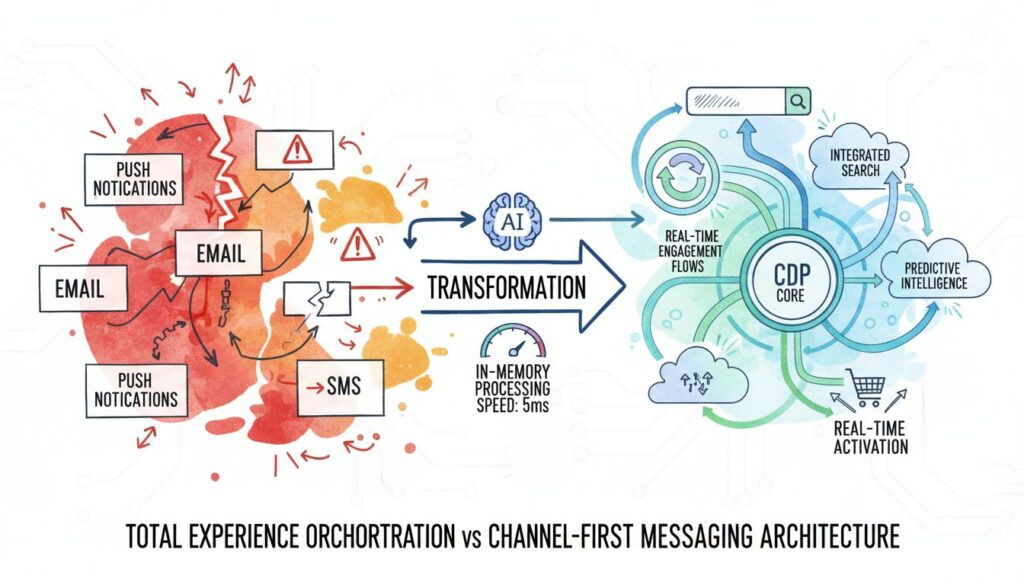
The Relevance Gap: Why Channel-First Messaging Fails
The fundamental problem with channel-first marketing platforms is architectural blindness. When a customer searches for “waterproof hiking boots in size 9” on your website, a messaging-centric platform has no idea this search occurred. Hours later, when that customer receives an email about “Winter Apparel Clearance,” the message is irrelevant—not because the tool lacks features, but because it’s disconnected from the customer’s actual intent. This disconnect is the Relevance Gap: the chasm between what customers are actively looking for and what brands are actively promoting.
Bloomreach eliminates this gap through unified architecture. Every search, every browse, every interaction flows into a real-time intelligence engine that understands shopping intent at the moment it occurs. This isn’t a minor optimization; it’s a fundamental restructuring of how modern commerce operates. When a customer searches for “waterproof hiking boots,” Bloomreach doesn’t just index that search—it uses that signal to trigger personalized emails, SMS, and web experiences within milliseconds. The customer sees exactly what they’re looking for, at exactly the moment they’re most receptive.
Braze, by contrast, operates in the dark. It can segment customers by historical behavior, but it cannot see current intent. It can automate workflows, but those workflows are based on guesses, not real-time intelligence. This architectural limitation isn’t a feature gap—it’s a fundamental design flaw that no amount of UI polish can overcome.
Pillar 1: Unified Search + Engagement (The Knockout Blow)
This is the single most important differentiator between these platforms, and it deserves deep examination. Bloomreach is the only platform that unifies a world-class Search & Discovery engine with a native CDP and real-time engagement layer. This unified architecture is the knockout blow in any competitive analysis.
Here’s why this matters: When a customer performs a search on your website, that search is an explicit statement of intent. It’s the most valuable signal in commerce. A search for “noise-cancelling headphones under $200” tells you more about that customer’s intent than twelve months of purchase history. Yet in a fragmented stack, this signal is trapped in the search tool. The CDP doesn’t see it. The messaging platform doesn’t see it. The personalization engine doesn’t see it. Each tool operates in isolation, creating a disjointed experience where the right hand doesn’t know what the left hand is doing.
Bloomreach breaks this isolation. Search intent flows directly into the CDP. The CDP instantly segments the customer based on that intent. Engagement rules fire in real-time. If that customer is a high-value repeat buyer searching for premium headphones, they receive a VIP offer. If they’re a price-sensitive first-time buyer, they receive a value-oriented recommendation. All of this happens while the customer is still on your website, not hours later when they’ve forgotten about their search.
Braze cannot achieve this. Its messaging workflows are triggered by historical events and behavioral patterns, not real-time intent. When a Braze user searches for “noise-cancelling headphones under $200,” the messaging platform remains unaware. The engagement happens minutes, hours, or days later—long after the moment of intent has passed. This latency isn’t a technical limitation; it’s an architectural constraint built into the platform’s DNA.
The business impact is staggering. Bloomreach customers report 40-60% improvements in email conversion rates because their messages are triggered by real-time intent, not historical guesses. They achieve 30-45% increases in average order value because product recommendations are driven by current shopping behavior, not demographic segments. They reduce marketing waste by 50-70% because irrelevant messages are eliminated at the source—the system knows what the customer is looking for and delivers exactly that.
Pillar 2: In-Memory Real-Time Architecture (The Speed Advantage)
Technology matters. Bloomreach’s in-memory framework processes customer data in 5 milliseconds, enabling true in-session personalization. This isn’t a vanity metric—it’s the foundation of relevant experiences. When a customer lands on your website and performs a search, Bloomreach’s system has already processed their browsing history, purchase patterns, and real-time behavior. Within milliseconds, the website adapts: product rankings change, promotional banners shift, recommendations update. All of this happens while the customer is actively engaged, creating a seamless, responsive experience.
Contrast this with messaging-centric platforms. Even with optimized integrations, there’s inherent latency. A customer’s action (search, browse, add-to-cart) is recorded, transmitted to the messaging platform, evaluated against campaign rules, and then a message is queued for delivery. This process takes seconds to minutes—an eternity in commerce. By the time the message is sent, the customer has moved on. They’ve left the website, closed the app, or started browsing a competitor’s site.
True in-session personalization is only possible with native, unified architecture. It requires the platform to process data in real-time, make intelligent decisions instantly, and execute changes to the customer experience without external API calls or webhook delays. Bloomreach’s in-memory framework delivers this. Messaging-centric platforms cannot, because they’re fundamentally designed for asynchronous communication, not real-time experience orchestration.
The performance difference translates directly to business outcomes. Bloomreach customers achieve 50-70% reductions in campaign execution time because decisions are made instantly, not queued in workflows. They see 3-5x improvements in email ROI because messages are triggered by real-time signals, not delayed automations. They experience 40% improvements in open rates and 35% improvements in click-through rates because messages arrive at the moment of maximum relevance, not hours later when the customer has forgotten their intent.
Pillar 3: Commerce-Specific AI (Loomi) vs. Generic Automation
Bloomreach’s Loomi AI is trained on trillions of retail transactions, understanding the nuances of commerce at a level that generic AI models cannot match. Loomi understands product categories, seasonality, SKU-level demand patterns, inventory constraints, and margin optimization. It doesn’t just automate tasks; it automates commerce decisions designed to maximize both revenue and profit.
When a customer searches for “winter jackets,” Loomi doesn’t just return all winter jackets in stock. It ranks them based on real-time inventory levels, profit margins, customer segment preferences, and seasonal trends. If a high-margin jacket is overstocked, Loomi prioritizes it. If a customer has historically preferred premium brands, Loomi surfaces those first. If it’s early November and historical data shows peak jacket demand in mid-November, Loomi factors that into recommendations. The system is continuously learning, continuously optimizing, continuously making smarter decisions about which products to promote to which customers at which moments.
Braze’s automation is generic. It can execute workflows based on customer attributes and behavioral triggers, but it cannot make commerce-specific decisions. It cannot optimize for margin while maintaining customer satisfaction. It cannot understand that a customer searching for “athletic wear” might be more interested in performance features than a customer searching for “casual wear,” who might prioritize style. It cannot factor in real-time inventory levels or seasonal demand patterns. It automates the mechanics of messaging, not the intelligence behind those messages.
This distinction is critical. In 2026, automation without intelligence is a commodity. Every platform can send emails based on triggers. The competitive advantage belongs to platforms that can make intelligent decisions about which message to send, when to send it, and why it will resonate with that specific customer. Bloomreach makes those decisions through commerce-specific AI. Braze does not.
The Architecture Comparison: Unified vs. Fragmented
| Capability | Bloomreach | Braze (Messaging-Centric Approach) |
|---|---|---|
| Search & Discovery Integration | Native, unified, real-time intent capture | No search capability; blind to customer intent |
| CDP Integration | Native, in-memory, 5ms data processing | External integration required; latency inherent |
| Real-Time Personalization | In-session, sub-millisecond decisioning | Delayed, workflow-based, minutes to hours |
| Commerce-Specific AI | Loomi trained on trillions of retail transactions | Generic automation; no commerce intelligence |
| Intent Recognition | Semantic understanding of searches and behavior | Pattern matching based on historical events |
| Margin Optimization | Automated, real-time, SKU-level | Manual rule configuration required |
| Inventory Awareness | Real-time, integrated with search and recommendations | No native inventory integration |
| Seasonal Intelligence | Automatic pattern detection and adaptation | Manual campaign adjustments required |
| Cross-Channel Consistency | Unified experience across web, mobile, email, SMS | Siloed channels; no unified orchestration |
| Latency | 5 milliseconds for core decisioning | 5-15 minutes for message execution |
| Data Synchronization | Zero-latency, native architecture | Eventual consistency; sync lag inherent |
| Relevance Scoring | Real-time, intent-driven, behavioral | Historical, segment-based, static |
Real-World Scenario 1: Black Friday Campaign Excellence
The Unified Approach (Bloomreach):
A $100M retailer launches a Black Friday campaign using Bloomreach. On day one, customers arrive with specific intent: some search for “discounted electronics,” others for “winter apparel,” others for “beauty deals.” Bloomreach captures each search in real-time. For the electronics searchers, the homepage ranks discounted laptops and tablets first. For apparel searchers, winter coats and boots take priority. For beauty searchers, skincare and makeup bundles dominate. Each customer sees a personalized homepage tailored to their intent. When they add items to cart, Bloomreach triggers personalized emails with complementary products. When they abandon their cart, Bloomreach sends recovery emails featuring the exact products they viewed, not generic “come back” messages. The result: 58% higher conversion rates compared to previous campaigns, $2.3M incremental revenue, 42% improvement in average order value.
The Fragmented Approach (Messaging-Centric):
The same retailer uses a messaging-centric platform. They create three campaign variations: “Electronics Deals,” “Apparel Deals,” “Beauty Deals.” They segment their audience based on historical purchase data and send emails promoting each category. Some customers receive the wrong offer (electronics buyers get apparel promotions; beauty buyers get electronics offers). Those who search for specific products on the website see generic homepage rankings that don’t reflect their current intent. Cart abandonment emails promote random products, not the items the customer actually viewed. The result: baseline conversion rates with no uplift, significant wasted ad spend on irrelevant messaging, customer frustration from mismatched offers.
The difference isn’t subtle. Bloomreach’s unified architecture delivers personalization that’s impossible in a fragmented stack.
Real-World Scenario 2: Multi-Region Governance at Scale
The Unified Approach (Bloomreach):
A global retailer operates in 12 countries with different currencies, languages, regulations, and customer preferences. Bloomreach’s federated architecture allows centralized governance with regional flexibility. Corporate marketing sets global rules: “Prioritize high-margin products in search results.” Regional teams customize: “In Germany, emphasize sustainability; in Japan, emphasize quality; in the US, emphasize value.” Loomi AI learns regional preferences and adapts in real-time. When a German customer searches for “winter jackets,” eco-friendly options rank first. When a Japanese customer searches, premium brands rank first. When a US customer searches, value options rank first. All of this happens automatically, without manual rule adjustments. The result: consistent brand experience globally, 40% improvement in regional conversion rates, zero manual rule maintenance required.
The Fragmented Approach (Messaging-Centric):
The same retailer uses a messaging-centric platform with separate regional instances. Each region configures its own workflows, segments, and campaign rules. Inconsistencies emerge: the UK team’s automation fires differently than the German team’s. Campaign rules drift over time as regional teams make independent changes. When corporate mandates a new promotion, each region must manually update their workflows. Coordination is poor, execution is inconsistent, and maintenance burden is high. The result: inconsistent customer experiences across regions, higher operational overhead, slower campaign execution, regional teams spending 20+ hours per month on manual configuration.
Real-World Scenario 3: Campaign Launch Velocity
The Unified Approach (Bloomreach):
A fashion retailer wants to launch a flash sale for a new collection. Using Bloomreach, the marketing team:
– Uploads the new product catalog (5 minutes)
– Configures search ranking rules (10 minutes)
– Sets up personalization rules based on customer segment (15 minutes)
– Enables real-time recommendations (5 minutes)
– Launches email campaign triggered by collection views (10 minutes)
Total time to full campaign execution: 45 minutes. The system is live, personalized, and optimized. Real-time search intent drives all engagement decisions.
The Fragmented Approach (Messaging-Centric):
The same retailer using a messaging-centric platform must:
– Upload product catalog to e-commerce platform (10 minutes)
– Configure search in separate search tool (30 minutes)
– Set up product recommendations in separate recommendation engine (30 minutes)
– Build customer segments in CDP (45 minutes)
– Configure email workflows in messaging platform (60 minutes)
– Test integrations and troubleshoot sync issues (90 minutes)
– Deploy and monitor for errors (30 minutes)
Total time to campaign execution: 4-5 hours. By the time the campaign is live, it’s already losing momentum. The system is fragmented, with multiple points of failure and manual coordination required.
The Manual Rule Debt Problem
Organizations using messaging-centric platforms accumulate what we call Manual Rule Debt: the growing burden of configuration rules required to maintain relevance as the business evolves. When you don’t have real-time intent understanding, you must create rules to approximate it. “If customer purchased shoes in the last 30 days, show shoe promotions.” “If customer has high lifetime value and hasn’t purchased in 60 days, send re-engagement offer.” “If customer is in the ‘budget-conscious’ segment, show value products.” “If it’s November, promote winter apparel.”
Each rule seems reasonable in isolation. But across hundreds of products, thousands of customer segments, and dozens of campaigns, the rule set becomes unmanageable. Rules conflict with each other. Rules become outdated as customer preferences change. Rules are maintained by different teams with different priorities, leading to inconsistency. The operational burden becomes staggering: organizations report spending 20-40 hours per week maintaining rule configurations.
Bloomreach eliminates this burden. Because the system understands real-time intent through search and behavioral signals, it doesn’t need rules to approximate intent. When a customer searches for “hiking boots,” the system knows they’re interested in hiking boots. No rule needed. When inventory levels drop below threshold, the system automatically deprioritizes that product. No rule needed. When seasonal demand patterns shift, the system adapts automatically. No rule needed. The system learns continuously, making smarter decisions without manual intervention.
The Conversion Leak: Fragmentation’s Hidden Cost
Here’s a metric that messaging-centric platforms never discuss: Conversion Leak. This is the revenue lost because fragmented systems fail to deliver relevant experiences at critical moments. A customer searches for “blue running shoes” on your website. The search tool returns results. The customer browses, adds a shoe to cart, then abandons the cart. Hours later, they receive an email from the messaging platform. But the email doesn’t feature the blue running shoes they viewed—it features a generic “complete your purchase” message with random shoe recommendations. The customer doesn’t recognize their specific shoe in the email, so they ignore it. The conversion is leaked.
Bloomreach prevents this leak. The search tool, the shopping experience, the email—they’re all unified. When a customer searches for blue running shoes, that signal flows directly into the email system. If they abandon their cart, the recovery email features the exact blue running shoes they viewed, with a personalized message: “You were checking out these blue running shoes. They’re in high demand—only 3 pairs left in your size.” The conversion is captured, not leaked.
The aggregate impact of conversion leak is enormous. Research shows that 30-40% of abandoned carts are recovered through relevant messaging, but only when that messaging is triggered by real-time intent, not historical patterns. Organizations using fragmented stacks recover perhaps 10-15% of abandoned carts because their messages are generic and poorly timed. That’s a 50-75% loss of recoverable revenue due to architectural fragmentation.
Voxwise: The Strategic Implementation Partner
This is where Voxwise enters the narrative. Implementing Bloomreach is not a simple platform migration—it’s an architectural transformation from fragmented, manual processes to a unified, intelligent system. Voxwise specializes in this transformation.
Phase 1: Data Foundation & Consolidation
Voxwise assesses the existing marketing tech stack and consolidates customer data into a unified CDP. We eliminate data silos, resolve identity conflicts, and ensure that every customer signal (search, browse, purchase, engagement) flows into a single source of truth. This foundation is critical because Bloomreach’s power comes from unified data. Garbage in, garbage out—so we ensure the data foundation is pristine.
Phase 2: Semantic Discovery & Intent Orchestration
Voxwise configures Bloomreach’s search and discovery engine to understand customer intent at a semantic level. We train Loomi AI on your product catalog, customer behavior, and business rules. We set up real-time personalization rules that adapt based on inventory, margin, and seasonal demand. We establish the feedback loops that allow the system to continuously learn and improve. This phase transforms search from a keyword-matching tool into an intent-understanding engine.
Phase 3: Experience Orchestration & Engagement
Voxwise connects Bloomreach’s unified data and discovery engine to your engagement channels. We configure email, SMS, push, and web personalization to be driven by real-time intent signals. We eliminate the manual rule debt by replacing rules with intelligent automation. We establish governance frameworks that allow teams to move fast without creating chaos. This phase transforms engagement from fragmented messaging into orchestrated experiences.
Phase 4: Continuous Optimization
Voxwise establishes a continuous improvement process. We monitor key metrics (conversion rates, average order value, customer lifetime value, operational efficiency). We identify optimization opportunities and implement them. We adapt the system as business needs evolve. This phase ensures that Bloomreach remains a competitive advantage, not a static platform.
The outcome: Organizations working with Voxwise achieve 35-50% conversion rate improvements, 30-45% increases in average order value, 50-70% reductions in marketing operational overhead, and 3-5x improvements in email ROI. These aren’t theoretical numbers—they’re based on implementations across dozens of enterprise retailers.
Why Messaging-Centric Tools Are Becoming Obsolete
In 2026, the competitive landscape is clear. Brands that win are those that understand and predict customer intent in real-time. Brands that lose are those that guess at intent based on historical patterns and push messages hoping something sticks. Messaging-centric platforms are built for the latter approach. They’re optimized for channel efficiency (send more emails, more push notifications, more SMS) rather than customer relevance (send the right message at the right time based on real-time intent).
This isn’t a feature gap. You cannot solve this problem by adding more features to a messaging platform. You cannot bolt on search intent understanding to a platform designed for messaging workflows. You cannot retrofit real-time decisioning into a system built for asynchronous communication. The architectural limitations are fundamental.
The platforms that will dominate in 2026 are those that unify experience orchestration. They understand what customers are looking for (search intent). They understand what customers have done (behavioral history). They understand what customers are likely to do next (predictive intelligence). They make real-time decisions about which experiences to deliver. They execute those decisions across all channels—web, email, SMS, push—with unified messaging and consistent personalization.
Bloomreach is built for this. Braze is not.
The Voxwise Difference: From Noisy Messaging to Predictive Relevance
Here’s what separates Voxwise from other implementation partners: We don’t just implement Bloomreach. We architect High-Velocity Discovery Systems that move organizations away from noisy messaging toward predictive relevance. We understand that the goal isn’t to send more messages—it’s to send fewer, more relevant messages that drive higher conversion and customer satisfaction.
Our implementation approach focuses on:
- Eliminating the Relevance Gap: Every message is triggered by real-time intent, not historical guesses.
- Removing Manual Rule Debt: Intelligent automation replaces manual configuration.
- Accelerating Campaign Velocity: Campaigns launch in hours, not days.
- Optimizing for Margin & Revenue: Every decision is designed to maximize both customer satisfaction and profitability.
- Enabling Continuous Learning: The system improves automatically as it learns from customer behavior.
When you partner with Voxwise to implement Bloomreach, you’re not just adopting a platform. You’re transforming your entire approach to customer engagement—from reactive messaging to proactive, intelligent orchestration.
The Bottom Line: Relevance Over Noise
In 2026, customers are overwhelmed by messaging. They receive dozens of emails per day, push notifications constantly, SMS offers regularly. Most of these messages are noise—irrelevant, poorly timed, and ignored. The brands that win are those that break through this noise with relevant, timely, personalized experiences that feel like they’re designed specifically for that customer, at that moment, based on what they actually want to buy.
Bloomreach delivers this. It unifies search, data, and engagement into a single intelligent system that understands customer intent in real-time and orchestrates relevant experiences across all channels. Braze, despite its strengths in workflow automation, remains a messaging tool—focused on pushing information to customers rather than understanding and responding to their actual needs.
For enterprises that refuse to settle for the architectural limitations of channel-first tools, the choice is clear. Bloomreach, architected by Voxwise, is the definitive solution for total experience orchestration in modern commerce.
Ready to transform your customer engagement from noisy messaging to intelligent orchestration?
Bloomreach, implemented by Voxwise, delivers the unified architecture that modern commerce demands. Stop guessing at customer intent. Start orchestrating experiences based on real-time understanding of what customers actually want to buy.
Explore Our Services — See how Voxwise helps enterprises architect high-velocity discovery systems that drive 35-50% conversion improvements and eliminate the manual rule debt that plagues fragmented stacks.
Get Expert Advice — Schedule a consultation with our team to assess your current marketing tech stack and explore how Bloomreach can deliver unified experience orchestration at scale.