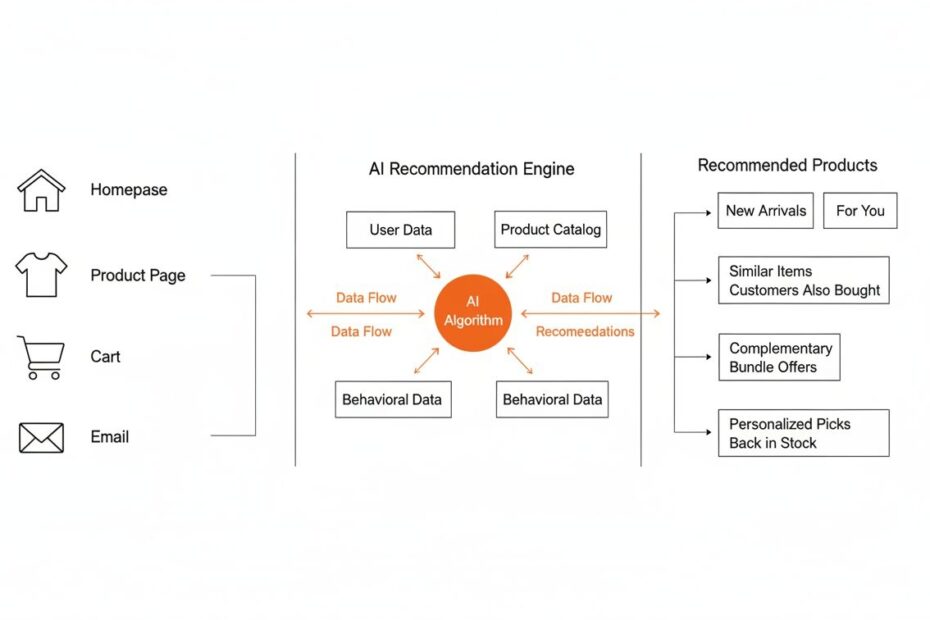
AI Product Recommendations for E-commerce
The era of manual product linking is over. Modern e-commerce brands no longer treat product recommendations as an afterthought or a simple merchandising tactic. Instead, they recognize recommendations as a real-time personalization mechanism that directly influences conversion rates, average order value (AOV), and customer lifetime value (CLV).
According to Salesforce research, visits where shoppers click a product recommendation represent just 7% of traffic but generate 26% of revenue. That asymmetric return is why recommendation engines have become one of the highest-value investments in any serious e-commerce program.
The shift from static widgets to dynamic, machine learning-driven infrastructure reflects a fundamental change in how retail brands approach customer engagement. Rather than displaying the same “best sellers” to every visitor, advanced recommendation systems now deliver personalized suggestions in milliseconds, adapting to each shopper’s behavior, preferences, and context.
The 4 Core AI Recommendation Models Explained
Collaborative Filtering: Learning from Shared Behavior
Collaborative filtering recommends products based on the behavior of similar customers. If User A and User B both purchased a laptop, and User A later bought a laptop sleeve, the system will recommend that sleeve to User B, even if User B has never viewed it.
This approach excels at discovering unexpected products and driving cross-category sales. The required data includes transactional history and user-item interaction matrices. The primary application is the classic “Customers who bought this also bought” widget.
The strength of collaborative filtering lies in its ability to surface products that complement purchases without relying on product metadata. However, it struggles with new users and newly launched products, a challenge known as the “cold start” problem.
Content-Based Filtering: Matching Product Attributes
Content-based filtering analyzes product metadata such as category, brand, color, price, and specifications to match products with individual customer preferences. If a shopper browses organic linen shirts, the system recommends other organic linen apparel based on product attributes, regardless of what other users purchased.
This method requires structured product catalog data and individual browsing history. It excels when you need to recommend new products or personalize experiences for first-time visitors who lack purchase history.
Content-based filtering is particularly effective for fashion, home goods, and other categories where product attributes directly influence purchase decisions. However, it can create narrow recommendation bubbles if not balanced with diversity rules.
Hybrid Models: The Gold Standard
Hybrid models combine collaborative and content-based filtering to eliminate the limitations of each approach. They rely on collaborative filtering when rich customer behavioral history is available, and seamlessly fall back to content-based filtering to solve the cold start problem for new users or recently added products.
Hybrid systems represent the gold standard in modern e-commerce personalization. They require both transactional data and structured product metadata, but the payoff is significantly higher accuracy and broader product discovery.
By blending multiple signals, hybrid models reduce recommendation fatigue and ensure that both new and returning customers receive relevant suggestions. This balanced approach drives higher engagement and prevents customers from seeing only variations of products they have already viewed.
Session-Based Recommendations: Real-Time Personalization for Anonymous Visitors
Session-based recommendations utilize current browsing activity rather than historical purchase data. This approach allows brands to personalize journeys for anonymous or first-time visitors by analyzing what products they view in real time.
Session-based models require real-time event tracking and behavioral signals from the current session. The primary application is personalizing the experience for first-time visitors and anonymous shoppers who have no purchase history.
This model is essential for e-commerce sites that receive high volumes of new traffic. By delivering relevant suggestions immediately, session-based recommendations reduce bounce rates and accelerate time-to-discovery for visitors who are exploring your catalog for the first time.
High-Impact Recommendation Placements Across the Customer Journey
Strategic placement of AI recommendations across the customer journey is critical to maximizing ROI. Each touchpoint serves a specific purpose and requires different recommendation strategies.
| Placement | Strategy & Objective | Required Data Signals | Recommended CRM Action | Business Impact |
|---|---|---|---|---|
| Homepage | Welcome & Discovery | Returning user profile, real-time trending data | Display “Pick up where you left off” or individualized top sellers | Reduces bounce rates, shortens time-to-discovery |
| Product Detail Page (PDP) | Cross-Selling & Upselling | Current product attributes, contextual affinity | Embed “Complete the look” modules or multi-item lookbooks | Increases items-per-order, lifts category cross-sell |
| Cart & Checkout Pages | Impulse Triggers | Current cart items, price sensitivity signals | Show low-cost, highly relevant accessories or companion items | Maximizes final checkout AOV without friction |
| Post-Purchase & Email/SMS | Retention & Lifecycle | Past purchase dates, consumption cycles | Trigger predictive replenishment workflows or tailored loyalty rewards | Drives repeat purchase rates, extends CLV |
Homepage: Welcome and Discovery
The homepage is your first opportunity to guide returning customers back into your catalog and welcome new visitors. Returning customers should see personalized “pick up where you left off” sections based on their browsing history, while new visitors benefit from trending items or curated collections.
This placement requires integration with your customer data platform (CDP) to identify returning users and access their behavioral history. The goal is to reduce bounce rates and accelerate time-to-discovery.
Product Detail Page: Cross-Selling and Upselling
The product detail page (PDP) is one of the highest-value recommendation placements. “Complete the look” modules and “Frequently bought together” widgets can increase items-per-order and drive category cross-sell.
These recommendations should leverage product affinity data and contextual signals. For example, if a customer is viewing a winter coat, recommend complementary items like scarves, gloves, or thermal layers. This contextual relevance drives higher click-through rates and increases AOV.
Cart and Checkout Pages: Impulse Triggers
Cart and checkout recommendations should be highly relevant, low-cost items that complement the customer’s existing cart without creating friction. Accessories, add-ons, and frequently purchased companion items perform well in this placement.
The key is balancing relevance with restraint. Too many recommendations can overwhelm the customer and increase cart abandonment. One or two highly targeted suggestions typically outperform larger recommendation widgets at checkout.
Post-Purchase and Email/SMS: Retention and Lifecycle
Post-purchase recommendations are essential for driving repeat purchases and extending customer lifetime value. Predictive replenishment reminders (e.g., reordering pet food after 30 days) and tailored loyalty rewards keep customers engaged long after their initial purchase.
Email and SMS recommendations should be personalized based on past purchase history and predicted consumption cycles. This channel allows for more detailed recommendation explanations and storytelling, creating a richer customer experience.
Next-Gen Shifts: Generative AI and Agentic Commerce
The e-commerce landscape is undergoing a significant shift beyond traditional predictive algorithms into agentic and conversational commerce. These emerging approaches fundamentally change how customers interact with product catalogs.
AI Shopping Assistants and Conversational Discovery
Modern storefronts now integrate generative AI layers that allow customers to find items through natural dialogue. Instead of navigating category hierarchies or entering search queries, customers can simply describe what they want: “Find me an outfit for a rainy outdoor wedding in October.”
The AI synthesizes the request, understands context and preferences, and dynamically generates a personalized outfit recommendation. This conversational approach dramatically reduces friction in product discovery and appeals to customers who prefer dialogue over traditional search.
Context-Aware Visual Modeling
Real-time visual AI enables features like virtual try-ons, mapping apparel directly onto diverse body types or customer-uploaded photos. This capability boosts checkout confidence and reduces return rates by helping customers visualize how products will look on them.
Visual recommendations also allow customers to search by image, uploading a photo of a product they like and receiving recommendations for similar items from your catalog. This visual discovery method appeals to fashion and home goods customers who think in images rather than keywords.
Semantic Discovery and Natural Language Understanding
Generative AI reads unstructured product data and understands colloquial customer queries, enabling recommendation engines to accurately connect casual language to technical product specifications. A customer searching for “comfy pants” might be matched with joggers, sweatpants, or relaxed-fit chinos based on semantic understanding rather than exact keyword matching.
This semantic layer significantly improves product discovery for customers who don’t know the exact category or terminology for what they want. It reduces search friction and increases the likelihood of finding relevant products.
Maximizing ROI: Best Practices for Implementing AI Recommendations
Successful AI recommendation systems require disciplined execution across data, model management, and experimentation. The following practices separate high-performing programs from mediocre ones.
Data Foundation and Product Metadata
Clean, unified product data is the foundation of effective recommendations. Ensure that your product catalog includes consistent metadata across all attributes: category, brand, color, size, price, materials, and key specifications.
Implement robust event tracking to capture all customer interactions: views, add-to-cart actions, purchases, wishlist additions, and search queries. This behavioral data feeds your recommendation models and enables real-time personalization.
Establish a single source of truth for customer data by integrating all touchpoints into a unified customer data platform. Siloed data leads to inconsistent recommendations and missed personalization opportunities.
Balancing Personalization with Product Diversity
Over-personalization can create recommendation echo chambers where customers see only variations of products they have already viewed. This limits product discovery and can reduce long-term engagement.
Implement diversity rules that balance personalization with exploration. For example, ensure that at least 20% of recommendations come from categories the customer has not previously browsed. This approach maintains relevance while introducing customers to new product categories.
Continuous Model Retraining
Machine learning models degrade over time as customer behavior evolves and inventory changes. Establish a schedule for regularly retraining your recommendation models using fresh behavioral data.
Monthly or quarterly retraining cycles ensure that your models remain responsive to seasonal trends, new product launches, and shifts in customer preferences. Monitor model performance continuously and retrain more frequently if performance metrics decline.
Rigorous A/B Testing and Measurement
A/B testing is essential for validating recommendation strategies and quantifying business impact. Test different recommendation algorithms, placements, messaging, and diversity rules to identify the highest-performing configurations.
Measure impact using metrics like click-through rate (CTR), conversion rate, revenue per visitor (RPV), incremental sales lift, and customer lifetime value. Focus on revenue-generating metrics rather than engagement metrics alone, as high CTR does not always translate to incremental sales.
Activating AI Product Recommendations in Bloomreach
Bloomreach provides the unified platform required to execute this entire strategy at scale. Bloomreach combines customer data, product catalogs, and AI-powered recommendation engines to deliver personalized suggestions across all customer touchpoints.
Bloomreach Discovery and Real-Time Personalization
Bloomreach Discovery unifies first-party customer data with product catalogs in real time, enabling millisecond-level personalization. The platform ingests behavioral signals (views, clicks, purchases, searches) and product metadata to power multiple recommendation algorithms simultaneously.
Bloomreach’s hybrid recommendation engine combines collaborative filtering, content-based matching, and session-based models to deliver accurate suggestions for both new and returning customers. The platform automatically selects the best-performing algorithm for each customer segment and use case.
Loomi AI for E-commerce Personalization
Loomi, Bloomreach’s specialized e-commerce AI, goes beyond traditional collaborative filtering to understand customer intent and product relationships at a semantic level. Loomi learns from behavioral patterns, product attributes, and contextual signals to generate highly personalized recommendations.
Loomi AI powers real-time recommendations across web, mobile, email, and SMS channels with a single unified model. This omnichannel consistency ensures that customers receive coherent recommendation experiences regardless of where they interact with your brand.
Merchandising Rules and Business Logic
Bloomreach allows merchandisers to combine automated AI models with strategic business rules, ensuring that recommendations align with business objectives. You can boost recommendations for high-margin items, prioritize slow-moving inventory, or suppress products based on stock levels or profitability.
These rules layer seamlessly on top of AI models, allowing you to optimize for revenue rather than engagement alone. For example, you can configure the system to recommend a higher-margin product variant when multiple similar items are equally relevant.
Omnichannel Consistency and Cross-Channel Coordination
Bloomreach ensures that recommendations remain consistent across web, mobile, email, and SMS channels. A customer who views a product on mobile receives complementary recommendations in their next email, creating a cohesive personalization experience.
This cross-channel coordination requires unified customer data and synchronized recommendation models. Bloomreach’s CDP foundation enables this seamless orchestration, ensuring that recommendations reinforce each other across touchpoints.
Common Mistakes in E-commerce Personalization and How to Avoid Them
Relying on Isolated Data Silos
Many brands maintain separate data systems for web analytics, email marketing, CRM, and inventory management. This fragmentation prevents personalization engines from accessing the complete customer view required for accurate recommendations.
The fix is to implement a unified customer data platform that consolidates all behavioral and transactional data into a single source of truth. This unified foundation enables recommendation engines to make decisions based on complete customer context.
Ignoring the Cold Start Problem
New customers and newly launched products lack the behavioral history required for collaborative filtering models. Brands that rely exclusively on collaborative filtering will deliver poor recommendations to these high-value segments.
The fix is to implement hybrid models that combine collaborative filtering with content-based recommendations. For new customers, use content-based filtering and session-based models. For new products, leverage product metadata and category affinity to generate relevant suggestions.
Over-Concentrating Recommendations on Top-Selling Categories
Many recommendation systems are biased toward best-selling products and popular categories. While these recommendations are safe, they limit product discovery and prevent customers from exploring the full breadth of your catalog.
The fix is to implement diversity rules that ensure a percentage of recommendations come from underexplored categories. This approach balances relevance with discovery and can reveal untapped demand in lower-performing product lines.
Failing to Respect Privacy and Consent Regulations
Customer data privacy regulations (GDPR, CCPA, etc.) require explicit consent for data collection and use. Brands that fail to implement proper consent management risk legal penalties and customer backlash.
The fix is to implement a robust consent management system that tracks customer preferences and respects opt-out requests. Ensure that your recommendation engine only uses data from customers who have explicitly consented to personalization.
Neglecting to Measure Incremental Impact
Many brands measure recommendation performance using engagement metrics like click-through rate (CTR) without validating that recommendations actually drive incremental revenue. High CTR does not guarantee incremental sales if customers would have purchased anyway.
The fix is to implement proper A/B testing that measures incremental revenue impact. Compare recommendation-driven purchases against a control group to isolate the true business impact of your personalization efforts.
How Voxwise Can Help Optimize Your Personalization Strategy
Voxwise partners with retail and e-commerce brands to design, implement, and optimize AI-powered personalization strategies that drive sustainable customer lifetime value growth.
Data Foundation and Customer Segmentation Audit
Voxwise begins by auditing your existing data foundations, customer segmentation, and personalization infrastructure. We identify data silos, inconsistencies in product metadata, and gaps in event tracking that limit recommendation accuracy.
Based on this audit, Voxwise recommends a phased approach to unifying your customer data and product catalogs. We prioritize quick wins that deliver immediate ROI while building toward a comprehensive CDP infrastructure.
Bloomreach Implementation and Configuration
Voxwise specializes in Bloomreach implementation, helping brands configure Bloomreach Discovery and Loomi AI to power real-time personalization across all customer touchpoints. We design recommendation strategies aligned with your business objectives, whether that is maximizing AOV, driving repeat purchases, or reducing churn.
Our implementation approach includes data mapping, recommendation model configuration, merchandising rule setup, and omnichannel orchestration. We ensure that your Bloomreach instance is optimized for your specific business model and customer segments.
Automated Workflow Design and Lifecycle Marketing
Voxwise designs automated customer engagement workflows that leverage AI recommendations to drive retention and lifetime value. We configure lifecycle marketing campaigns that deliver personalized product suggestions at the optimal moments in the customer journey.
These workflows span welcome series, post-purchase engagement, replenishment reminders, and loyalty programs. Each workflow is designed to deliver recommendations that are relevant, timely, and aligned with customer needs.
Performance Measurement and Continuous Optimization
Voxwise establishes measurement frameworks that track recommendation performance using revenue-focused metrics like incremental sales lift, customer lifetime value, and return on ad spend. We implement rigorous A/B testing to validate recommendation strategies and identify optimization opportunities.
Our optimization approach is continuous, with regular model retraining, rule refinement, and channel testing. We focus on sustainable, long-term improvements rather than short-term metric optimization.
Frequently Asked Questions
What is the difference between collaborative and content-based filtering?
Collaborative filtering recommends products based on the behavior of similar customers, while content-based filtering matches products using attributes such as category, brand, and price. Collaborative filtering excels at discovering unexpected products, while content-based filtering handles new users and products better. Hybrid models combine both approaches to maximize accuracy.
How do AI product recommendations solve the cold start problem?
The cold start problem occurs when new users or new products lack behavioral history for collaborative filtering. Hybrid recommendation models solve this by falling back to content-based filtering for new users and products. Session-based recommendations also help by personalizing experiences based on real-time browsing behavior rather than historical data.
What data is required to run a real-time recommendation engine?
A real-time recommendation engine requires three types of data: behavioral data (views, clicks, purchases, searches), customer data (demographics, preferences, purchase history), and product data (attributes, categories, specifications). All data must be unified in a single customer data platform and synchronized in real time for millisecond-level personalization.
How do AI product recommendations improve customer retention?
Personalized recommendations keep customers engaged by delivering relevant product suggestions that match their interests and needs. Post-purchase recommendations drive repeat purchases through predictive replenishment reminders and loyalty rewards. By consistently delivering value through recommendations, brands build stronger customer relationships and extend customer lifetime value.
Get Expert Guidance on AI Product Recommendations
Implementing AI product recommendations requires expertise in data architecture, machine learning, CRM strategy, and e-commerce operations. Voxwise brings all of these capabilities together to help you build a personalization program that drives measurable business results.