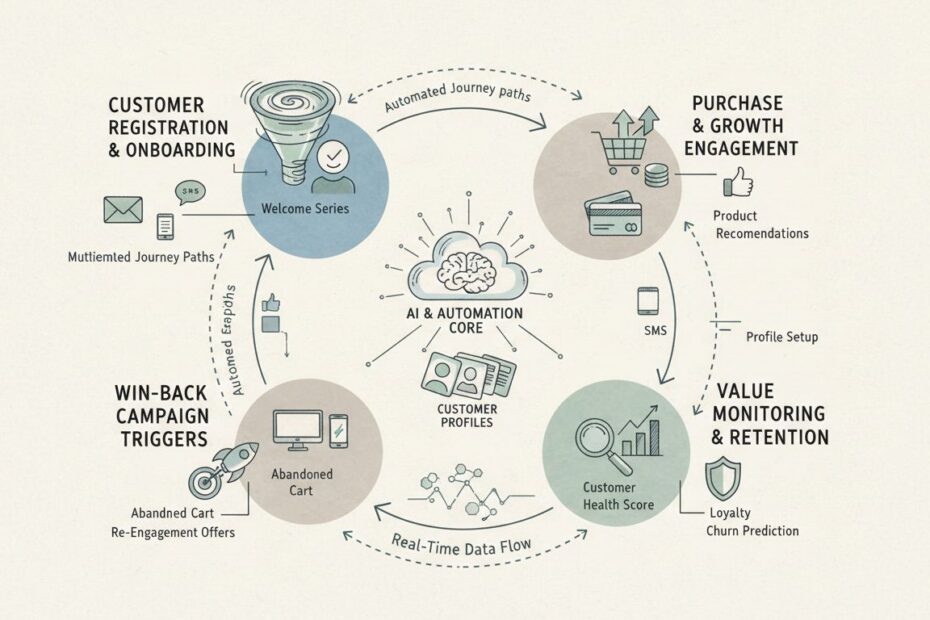
Bloomreach Engagement for Lifecycle Marketing: A B2C Playbook
Most retail and e-commerce organizations operate customer lifecycle marketing across disconnected technology stacks. Your customer data lives in one system, your email platform operates independently, your SMS channel requires separate configuration, and your analytics dashboards report on siloed metrics. This fragmentation creates synchronization delays that cost revenue. When customer profiles and campaign execution engines operate on separate infrastructure, real-time conversion windows close before your team can act.

A customer signals purchase intent, but by the time your data warehouse updates and your email platform receives the segment refresh, the moment has passed. Bloomreach Engagement eliminates this operational friction by unifying a real-time Customer Data Platform (CDP), native omnichannel orchestration, and Loomi AI into a single environment. The platform automatically recalculates audience membership and triggers journeys the millisecond a customer’s behavior changes, enabling your organization to respond to customer signals in real time across 13+ channels.
Use Case Overview
Bloomreach Engagement serves as the operational hub for automating customer lifecycle paths without manual list exports, complex API integrations, or delayed batch processes. The platform consolidates customer identity, behavioral events, product catalogs, and dynamic incentives into a unified data model. Within this unified environment, marketing teams design visual customer journey scenarios that automatically execute across email, SMS, WhatsApp, web push, in-app messaging, and other channels.
Loomi AI continuously analyzes behavioral patterns to predict customer churn risk, optimize send times, recommend next-best actions, and automatically personalize campaign content based on individual customer attributes and purchase history. The result is a lifecycle marketing engine that operates with the speed and precision of real-time data activation, rather than the latency and manual overhead of traditional marketing automation platforms.
When This Use Case Matters
Lifecycle marketing automation becomes critical when your organization faces specific operational challenges. If your marketing team manually exports customer segments from your CDP to your email platform, losing real-time responsiveness in the process, you need unified orchestration. If your retention campaigns rely on static rules defined months ago rather than dynamic, AI-driven predictions of customer behavior, your win-back messaging lacks precision.
If your acquisition team cannot measure the true incremental revenue lift from your welcome series because you lack native control group functionality, you cannot optimize your onboarding investment. If your cross-sell campaigns send generic product recommendations instead of personalized recommendations matched to each customer’s purchase history and browsing patterns, your average order value (AOV) growth stalls.
If your high-value customer retention depends on manual RFM (Recency, Frequency, Monetary) analysis rather than real-time profile health monitoring, you lose revenue streams systematically. Bloomreach Engagement addresses each of these operational gaps by providing the technical infrastructure and AI capabilities required to execute responsive, data-driven lifecycle marketing at scale.
How It Works in Practice
Bloomreach Engagement operates through a unified data architecture that processes customer information and behavioral signals in real time. The platform ingests customer data through multiple channels: real-time tracking via JavaScript SDK on your website, mobile SDKs for app-based activity, and batch imports from external data sources including your order management system, CRM, and offline transaction databases. All ingested data is prepared, cleaned, and enriched at the time of ingestion to ensure data quality and enable immediate activation. The platform stores customer profiles as extensible attribute records within a NoSQL data structure optimized for speed and scalability. Each customer profile maintains a continuous event stream recording every interaction: page views, product searches, add-to-cart actions, completed purchases, email opens, SMS clicks, and custom events defined by your business logic.
Once data flows into the platform, Bloomreach Engagement’s visual scenario builder enables marketing teams to design customer journeys without technical coding. Scenarios function as multi-step, branching workflows that automatically execute when specified trigger conditions are met. A trigger fires the moment a customer’s profile or event stream satisfies a defined rule condition.
For example, when a new customer completes their first purchase, that purchase event immediately triggers a welcome series scenario. The scenario automatically sequences a series of touchpoints across specified channels, with each step executing at defined intervals or in response to subsequent customer actions. If a customer does not engage with the first email, the scenario can automatically branch to an SMS message with a different offer. If a customer clicks through to view product recommendations, the scenario can trigger a follow-up email with complementary product suggestions. Loomi AI continuously monitors the performance of each scenario in real time, automatically adjusting send times, channel selection, and content recommendations to maximize engagement and conversion for each individual customer.
Example Scenario in Retail and E-Commerce
Consider a mid-market apparel retailer with 500,000 active customers across their e-commerce website and mobile app. The retailer’s primary business challenge is that 60% of new customers never make a second purchase, resulting in high customer acquisition costs (CAC) that are never recovered. Their existing marketing stack consists of a separate CDP for data collection, a standalone email platform for campaign execution, and a basic analytics dashboard for performance reporting. When a new customer signs up for their email list, the data takes 4 to 6 hours to sync from the CDP to the email platform. By the time the welcome email sends, the customer’s initial purchase intent has cooled. Additionally, the retailer sends a generic welcome series to all new customers regardless of their product preferences or browsing behavior. The retailer has no visibility into whether their welcome campaigns actually drive incremental revenue or simply send emails that would have converted anyway.
The retailer implements Bloomreach Engagement to unify their customer data and campaign execution. They configure real-time tracking on their website and mobile app to capture customer behavior events: product views, category searches, add-to-cart actions, and completed purchases. They import their historical customer database and product catalog into the platform. Within Bloomreach, they design a personalized welcome series scenario triggered the moment a new customer completes their registration event.
The scenario immediately sends a personalized welcome email with product recommendations matched to the customer’s browsing history captured during their first website session. If the customer does not open the email within 24 hours, the scenario automatically sends an SMS message with a time-limited discount code. If the customer opens the email but does not click through to view products, the scenario branches to a web push notification displaying their top recommended products with real-time inventory status.
The retailer implements a holdout control group within the scenario, automatically excluding 10% of new customers from the welcome series to establish a baseline for measuring incremental lift. After 30 days, the retailer analyzes the cohort data comparing customers who received the personalized welcome series against the control group. They discover that the personalized welcome scenario drives a 23% increase in second-purchase conversion rate compared to the control group, translating to $180,000 in incremental revenue per month from new customer cohorts.
The scenario data reveals that personalized product recommendations matched to browsing history drive 3.2x higher click-through rates compared to generic recommendations. SMS messages sent to non-engaged email recipients drive a 15% conversion rate, validating the multi-channel approach. Based on these insights, the retailer expands the welcome scenario to include additional touchpoints for high-intent customer segments and adjusts the discount offer timing based on Loomi AI’s send-time optimization recommendations.
Data, Tools, and Teams Involved
Bloomreach Engagement requires coordination across multiple teams and data sources to execute effectively. The technical integration team manages data ingestion pipelines, ensuring that customer profiles, transactional events, product catalogs, and promotional inventory flow into the platform in real time or on a defined schedule. They configure tracking code on the website and mobile app to capture behavioral events, implement API connections to external data sources, and manage data quality protocols to ensure that customer attributes and events follow consistent naming conventions and data formats.
The product and merchandising team maintains the product catalog within Bloomreach, ensuring that product attributes (size, color, category, price, inventory status, margin tier) are current and structured in a format that enables intelligent recommendation logic. The marketing operations team designs the core lifecycle scenarios within the platform’s visual builder, defining trigger conditions, journey paths, channel assignments, content personalization rules, and holdout control groups. The email and SMS teams manage the channel-specific content assets, ensuring that emails and SMS messages are optimized for each customer segment and device type.
The analytics team configures dashboard views and cohort analyses to track scenario performance metrics including engagement rates, conversion rates, incremental revenue lift, customer acquisition cost (CAC) payback period, and customer lifetime value (CLV) expansion by customer segment.
A critical technical requirement is the unified customer identifier strategy. Bloomreach consolidates multiple customer identifiers (email address, phone number, customer ID, anonymous user ID, device ID) into a single customer record through a process called identity resolution. The platform must be configured with a clear hierarchy of identifier priority so that when a customer logs in on multiple devices or uses different email addresses across channels, the system correctly recognizes them as a single customer and maintains a continuous event stream. Without proper identity resolution, a customer who browses on their desktop, adds items to cart on their mobile app, and purchases on their tablet would appear as three separate customers in your system, breaking the continuity of your lifecycle journeys.
The table below summarizes the core data elements, their purpose, and the teams responsible for their management:
| Data Element | Purpose | Required Attributes | Responsible Team |
|---|---|---|---|
| Customers | Unified individual profiles tracking identity, demographics, and computed metrics | Customer ID, email, phone, name, registration date, lifetime value, purchase frequency, churn risk score | Technical Integration + Analytics |
| Events | Time-stamped behavioral actions recording customer interactions | Event type, timestamp, customer ID, event properties (product viewed, price, category, cart value), source channel | Technical Integration + Product |
| Catalogs | Live inventory database tracking product attributes and availability | Product ID, name, category, price, color, size, inventory status, margin tier, image URL | Merchandising + Product |
| Vouchers | Smart incentive layer distributing dynamic promotional codes | Voucher code, discount value, validity period, usage limits, applicable product categories | Marketing Operations + Promotions |
How to Measure Success
Measuring the success of lifecycle marketing automation requires implementing a clear measurement framework that isolates the incremental impact of your automated journeys from baseline customer behavior. The foundation of this framework is the holdout control group, a cohort of customers automatically excluded from your lifecycle scenarios. By comparing the behavior of customers who received your automated journeys against a control group of similar customers who did not receive the journeys, you establish a true measure of incremental revenue lift. Without control groups, you cannot distinguish between customers who converted because of your campaign and customers who would have converted anyway based on their inherent purchase propensity.
Within Bloomreach Engagement, you configure holdout control groups directly within each scenario. For a welcome series scenario, you might exclude 10% of new customer registrations from the scenario to establish a baseline. After 30 days, you compare the purchase conversion rate of customers who received the welcome series against the control group. If 35% of customers who received the welcome series made a second purchase compared to 28% in the control group, you have a 7 percentage point incremental lift. Multiplying this lift by your average order value and your monthly new customer volume provides the incremental revenue impact of the scenario.
Beyond holdout control groups, you monitor the following metrics to evaluate lifecycle marketing performance:
Acquisition and Onboarding Metrics: Time-to-first-purchase (how quickly new customers make their first repeat purchase), welcome series engagement rate (percentage of customers who open at least one email or click through to view products), and first-purchase conversion rate (percentage of new registrations that result in a completed purchase within 30 days).
Growth and Engagement Metrics: Average order value (AOV) by customer segment, cross-sell attachment rate (percentage of customers who purchase a recommended complementary product), repeat purchase frequency (number of purchases per customer per quarter), and purchase interval (average number of days between consecutive purchases).
Retention and Win-Back Metrics: Churn rate by customer segment (percentage of customers who do not make a purchase within their expected purchase interval), win-back campaign response rate (percentage of lapsed customers who re-engage after receiving a win-back offer), and customer lifetime value (CLV) by acquisition cohort (total revenue generated by customers acquired in a specific month or quarter).
Channel and Attribution Metrics: Channel-specific conversion rates (email, SMS, web push, in-app) to understand which channels drive the highest incremental value for different customer segments and journey stages. Email might drive higher conversion for acquisition journeys, while SMS might drive higher response rates for time-sensitive retention offers. Cohort analysis tracks long-term behavioral trends across customer groups acquired in specific months, enabling you to measure whether early-stage improvements in welcome series performance translate to higher customer lifetime value over 12 months.
How Voxwise Can Help
Bloomreach Engagement provides the technical platform and AI capabilities required for sophisticated lifecycle marketing, but translating platform capabilities into business results requires expert implementation and ongoing optimization. This is where Voxwise delivers value as a specialized CRM strategy and Bloomreach implementation partner for retail and e-commerce enterprises.
Voxwise bridges the gap between high-level lifecycle marketing strategy and deep technical platform deployment. During the discovery phase, Voxwise conducts a comprehensive audit of your existing customer data infrastructure, identifying data quality issues, inconsistent identifier strategies, and gaps in behavioral event tracking. They assess your current lifecycle marketing workflows, documenting which customer journey stages are automated versus manual, which channels are integrated versus disconnected, and where revenue leakage occurs due to operational friction. Voxwise works with your product and merchandising teams to define the product catalog structure within Bloomreach, ensuring that product attributes are granular enough to enable intelligent recommendation logic while remaining manageable from an operational perspective.
During implementation, Voxwise designs the core data unification strategy, ensuring that customer identifiers are consolidated correctly, that behavioral events are captured consistently across all touchpoints, and that historical customer data is imported into Bloomreach with appropriate data quality checks. They configure the technical integrations required to synchronize your order management system, CRM, email service provider, SMS platform, and analytics tools with Bloomreach Engagement. Voxwise designs the foundational lifecycle scenarios for acquisition, growth, and retention stages, establishing the trigger conditions, journey paths, channel assignments, and control group logic that serve as the operational template for your lifecycle marketing program.
Beyond technical implementation, Voxwise provides strategic optimization services that maximize your return on investment in Bloomreach. They conduct quarterly performance reviews analyzing your scenario metrics, identifying underperforming journeys, and recommending optimizations to trigger logic, content personalization, and channel strategy. They work with your analytics team to establish cohort tracking frameworks that measure long-term customer lifetime value impact of your lifecycle initiatives. They help your marketing team leverage Loomi AI’s predictive capabilities more effectively, translating AI-generated insights into actionable campaign adjustments. As your customer data maturity improves and your lifecycle marketing sophistication increases, Voxwise helps you design advanced use cases including predictive churn prevention, dynamic pricing strategies, and real-time inventory-driven product recommendations.
Voxwise’s expertise in retail and e-commerce customer engagement ensures that your Bloomreach implementation reflects industry best practices and competitive benchmarks. They understand the unique operational challenges of omnichannel retail, including how to synchronize online and offline customer data, how to manage promotional calendars across multiple channels, and how to balance personalization with brand consistency across touchpoints. Their experience implementing lifecycle marketing programs for multi-brand organizations, franchise networks, and international retailers enables them to design scalable data architectures and automation frameworks that grow with your business.
Conclusion
Bloomreach Engagement transforms customer lifecycle marketing from a collection of disconnected campaigns into a unified, real-time, AI-driven customer engagement engine. By consolidating customer data, behavioral events, product catalogs, and promotional inventory into a single platform, Bloomreach enables marketing teams to respond to customer signals in real time, personalizing journeys based on individual customer attributes and behaviors rather than static segment definitions.
Loomi AI continuously optimizes send times, channel selection, and content recommendations, removing the manual overhead of campaign management and enabling your team to focus on strategic decisions rather than operational execution. The platform’s native control group functionality provides clear visibility into the incremental revenue impact of your lifecycle initiatives, enabling data-driven optimization and confident investment in customer engagement programs.
For retail and e-commerce organizations seeking to maximize customer lifetime value and reduce customer acquisition cost payback periods, Bloomreach Engagement represents a fundamental shift in operational capability. Partnering with Voxwise ensures that your implementation reflects your specific business context, competitive positioning, and growth objectives, translating platform capabilities into measurable business results.
Frequently Asked Questions
What is Bloomreach Engagement for lifecycle marketing?
Bloomreach Engagement is a unified Customer Data Platform (CDP) combined with native omnichannel marketing automation and Loomi AI. It enables marketing teams to consolidate customer data, behavioral events, and product catalogs into a single environment, then design and automatically execute personalized customer lifecycle journeys across 13+ channels without manual list exports or API integrations. The platform triggers campaigns in real time the moment a customer’s profile or behavior matches defined conditions, personalizing each touchpoint based on individual customer attributes and purchase history.
How does an integrated platform improve lifecycle workflows compared to separate tools?
Separate tools create data synchronization delays and operational friction. When your CDP updates customer segments independently from your email platform, there is latency between when a customer action occurs and when your campaign system receives the updated segment membership. Bloomreach Engagement eliminates this delay by operating as a unified system where data ingestion, audience segmentation, and campaign execution all occur within the same platform. The moment a customer’s profile or event stream triggers a scenario condition, the journey automatically executes. Additionally, unified platforms reduce manual overhead by eliminating the need for batch exports, API mappings, and duplicate data management across multiple systems.
What are the four core data elements within Bloomreach’s data structure?
The four core data elements are Customers, Events, Catalogs, and Vouchers. Customers represent unified individual profiles consolidating identity keys, demographic attributes, and computed metrics like lifetime value and churn risk score. Events are time-stamped behavioral actions recording customer interactions including page views, product searches, purchases, and email opens. Catalogs are live product databases containing product attributes like category, price, inventory status, and margin tier. Vouchers are dynamic promotional codes that automatically distribute within running scenarios to incentivize specific customer actions.
How does Loomi AI optimize lifecycle journeys automatically?
Loomi AI analyzes historical behavioral patterns and real-time customer data to optimize three key aspects of lifecycle journeys. First, send-time optimization determines the optimal time to send each customer a message to maximize open rates and engagement. Second, channel prediction automatically selects the channel most likely to drive engagement for each individual customer based on their historical channel response patterns. Third, content and offer optimization automatically personalizes campaign content, product recommendations, and discount offers based on each customer’s purchase history, browsing behavior, and segment characteristics. AI also predicts customer churn risk and purchase probability, enabling marketing teams to adjust campaign incentives before customer engagement declines.
What are Bloomreach Scenarios, and how do they trigger real-time campaigns?
Bloomreach Scenarios are visual, multi-step customer journey workflows designed using a drag-and-drop builder. Each scenario defines a trigger condition (for example, a customer completes their first purchase), a series of journey steps (email, SMS, web push, in-app message), and branching logic that personalizes the path based on customer actions or attributes. The moment a customer’s profile or event stream matches the trigger condition, the scenario automatically activates and begins executing the defined journey steps. Scenarios function as always-on automation loops that continuously monitor your customer database for trigger conditions and execute journeys in real time.
Why are native control groups necessary to measure true customer lifecycle ROI?
Control groups establish a baseline for measuring incremental revenue impact. Without a control group, you cannot distinguish between customers who converted because of your campaign and customers who would have converted anyway based on their inherent purchase propensity. By automatically excluding a percentage of eligible customers from your scenario (for example, 10% of new registrations), you create a comparable cohort that did not receive your campaign. Comparing the behavior of customers who received your scenario against the control group reveals the true incremental lift driven by your lifecycle automation, enabling confident ROI measurement and data-driven optimization decisions.
How does Voxwise help retail brands implement and optimize Bloomreach Engagement?
Voxwise serves as a specialized Bloomreach implementation partner for retail and e-commerce organizations. During discovery, Voxwise audits your existing customer data infrastructure, identifies data quality issues, and assesses your current lifecycle marketing workflows. During implementation, they design your customer identifier strategy, configure data ingestion pipelines, structure your product catalog, and build your foundational lifecycle scenarios. Beyond implementation, Voxwise provides ongoing optimization services including quarterly performance reviews, AI capability optimization, and advanced use case design. Their expertise in retail customer engagement ensures your Bloomreach deployment reflects industry best practices and drives measurable business results.
Ready to Optimize Your Lifecycle Marketing?
Discover how Bloomreach Engagement can transform your customer engagement strategy with real-time data unification and AI-powered orchestration.
Request a 30-Minute Customer Engagement Consultation to discuss your segmentation and personalization strategy with our team.
Get a CRM Maturity Check to understand where your current capabilities stand and what optimization opportunities exist.
Check Your Bloomreach Setup if you already have the platform in place and want to optimize execution.