Understanding the Fundamental Differences Between CDP and CRM
In today’s multi-channel, data-driven business environment, organizations face a critical challenge: how to effectively collect, unify, and activate customer data across all touchpoints. Two powerful solutions address this need—Customer Data Platforms (CDPs) and Customer Relationship Management (CRM) systems—but they serve distinctly different purposes. While many businesses use one or the other, the most sophisticated enterprises recognize that these tools are complementary, not competitive. Understanding the fundamental differences between CDPs and CRMs is essential for building a modern customer data strategy that drives measurable growth.
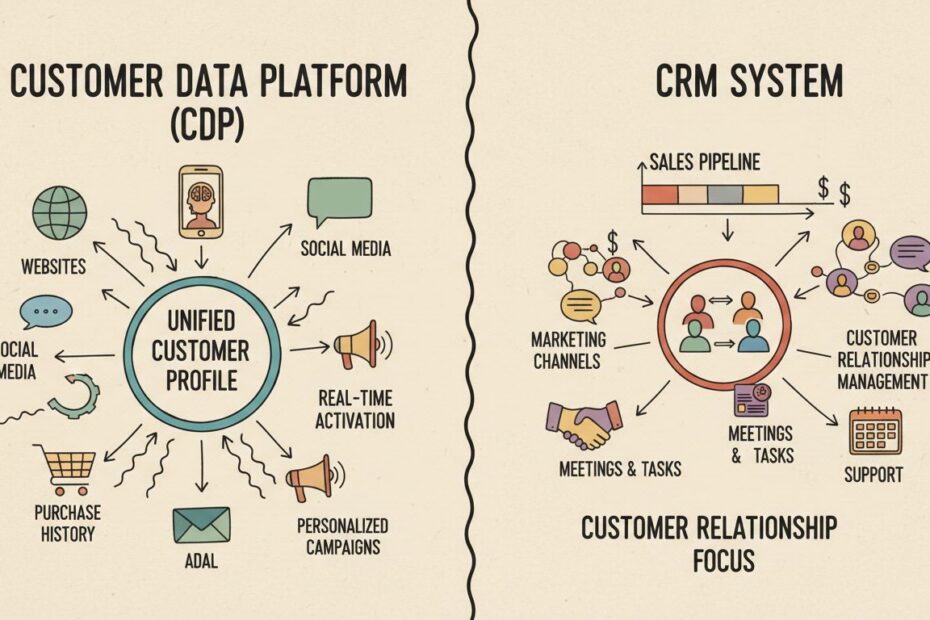
The confusion between CDPs and CRMs is understandable because both deal with customer information and both aim to improve customer experiences. However, their architecture, data sources, primary users, and activation capabilities differ significantly. A CRM is fundamentally designed to manage direct customer relationships, sales pipelines, and support interactions. A CDP, by contrast, is engineered to ingest, unify, and activate vast volumes of behavioral and transactional data from every possible source—both known and anonymous. This distinction becomes critical when you consider the velocity and scale of modern customer data. Where a CRM excels at managing structured, relationship-oriented information, a CDP is purpose-built to handle the complexity of omnichannel behavioral data and transform it into actionable, real-time insights.
Understanding these differences isn’t merely academic—it directly impacts your ability to compete in an increasingly personalization-driven marketplace. Companies that recognize the unique value of each platform and integrate them effectively gain significant competitive advantages in customer acquisition, retention, and lifetime value optimization. The question is no longer whether to choose between a CDP and a CRM, but rather how to orchestrate them together to create seamless, high-converting customer experiences at scale.
What is a CRM? The Foundation of Sales and Service Excellence
A Customer Relationship Management (CRM) system is specialized software designed to centralize and manage all interactions with customers and prospects throughout their relationship with your organization. CRMs serve as the operational hub for sales, marketing, and customer service teams, providing a unified view of customer interactions, communication history, and relationship progression. The primary function of a CRM is to streamline and automate the processes that drive revenue and customer satisfaction, from initial lead management through ongoing account stewardship.
CRMs excel at several core functions that directly support sales and service operations. Contact management within a CRM provides a centralized database for storing customer information—names, email addresses, phone numbers, company details, social media profiles, and communication history—all organized in a single, accessible location. Sales pipeline management is another critical CRM function, allowing sales teams to track leads and opportunities as they progress through defined stages from initial contact through deal closure. CRMs provide visibility into the sales funnel, enabling managers to forecast revenue, identify bottlenecks, and allocate resources more effectively. Additionally, CRMs offer basic marketing automation features such as email campaign deployment, task scheduling, and lead scoring, though these capabilities are typically more limited than dedicated marketing automation platforms. Customer service and support functions within CRMs enable teams to track customer issues, manage support tickets, maintain knowledge bases, and ensure timely resolution of customer problems.
The benefits of implementing a CRM are substantial and well-documented. CRMs dramatically improve sales efficiency by automating administrative tasks, allowing sales representatives to focus more time on selling and relationship building rather than data entry and manual processes. They enhance customer relationships by providing a holistic view of all interactions, enabling more personalized and contextual communication. CRMs facilitate better collaboration across departments—sales, marketing, and support teams can share information seamlessly, reducing silos and improving customer experiences. They also provide valuable analytics and reporting on key performance indicators such as conversion rates, sales velocity, customer satisfaction, and revenue metrics.
However, CRMs have significant limitations in today’s multi-channel, data-intensive business environment. CRMs typically struggle with the volume and variety of data generated across modern customer journeys. They rely heavily on manually entered data or data provided by connected systems, which can lead to inconsistencies, gaps, and an incomplete view of the customer. CRMs are designed primarily for known customers and direct interactions—they don’t natively capture or unify anonymous behavioral data from websites, mobile apps, social media, or other digital touchpoints. They lack the sophisticated data unification and identity resolution capabilities needed to create a truly comprehensive, 360-degree customer view. Additionally, CRMs are not optimized for real-time activation and orchestration of personalized experiences across multiple channels simultaneously. They are relationship management systems, not data activation platforms.
What is a Customer Data Platform? The Engine of Omnichannel Personalization
A Customer Data Platform (CDP) is a sophisticated, purpose-built software solution that fundamentally transforms how organizations collect, unify, and activate customer data at scale. Unlike CRMs, which focus on managing known customer interactions, CDPs are engineered to ingest data from every available source—online and offline, known and anonymous, structured and unstructured—to create a unified, actionable, real-time view of each customer. CDPs break down the data silos that plague most organizations, consolidating customer information into a single, comprehensive database that powers omnichannel personalization and marketing effectiveness.
The architecture and capabilities of a CDP are fundamentally different from a CRM. Data ingestion in a CDP is comprehensive and multi-source: CDPs can ingest data from websites and web analytics, mobile applications, CRM systems, email marketing platforms, social media channels, advertising platforms, e-commerce systems, point-of-sale (POS) systems, customer support interactions, billing systems, loyalty programs, surveys, events, and even offline data sources. This breadth of data ingestion is essential because modern customer journeys span multiple channels and devices, and valuable behavioral signals exist across all of them. Data unification and identity resolution represent another core CDP strength: CDPs excel at cleaning, standardizing, and merging data from disparate sources to create a single customer profile, ensuring that all interactions are correctly attributed to the right individual even when they use different devices, email addresses, or identifiers. This is far more sophisticated than CRM data management.
Segmentation and analytics capabilities within CDPs enable powerful audience creation based on any combination of attributes and behaviors—demographics, purchase history, website activity, email engagement, app usage, social signals, and more. This enables marketing teams to create highly targeted segments and personalized experiences with precision that CRMs simply cannot match. Activation and orchestration are where CDPs truly differentiate: they integrate seamlessly with marketing channels, advertising platforms, personalization engines, and other business systems to activate unified customer profiles in real-time. This means personalized content, product recommendations, targeted campaigns, and dynamic offers can be delivered across all channels simultaneously based on a single source of truth about each customer.
The benefits of CDPs are transformative for modern marketing organizations. CDPs provide a unified customer view that consolidates all available data into a single, persistent, real-time customer profile—the foundation for all personalization. They enable sophisticated segmentation and targeting at scale, allowing marketers to move beyond basic demographic targeting to behavior-based, contextual, and predictive targeting. CDPs facilitate real-time personalization and omnichannel orchestration, enabling consistent, relevant experiences across all customer touchpoints. They improve marketing efficiency and ROI by enabling precise targeting, reducing wasted ad spend, and increasing conversion rates through relevance. CDPs support compliance and data governance by centralizing data management and providing controls for privacy regulations like GDPR and CCPA. They also provide valuable analytics and insights into customer behavior, journey patterns, and effectiveness of marketing initiatives.
Key Differences: CDP vs CRM at a Glance
| Dimension | CDP | CRM |
|---|---|---|
| Primary Purpose | Collect, unify, and activate customer data from all sources | Manage customer relationships, sales pipelines, and support |
| Data Sources | All sources: websites, apps, email, social, transactions, offline, anonymous | Primarily direct interactions and known customer records |
| Data Types | Behavioral, transactional, demographic, interaction, anonymous | Structured relationship and transactional data |
| Primary Users | Marketing, personalization, analytics teams | Sales, customer service, account management teams |
| Real-Time Activation | Native, built-in real-time activation across channels | Limited real-time capabilities, more transactional |
| Customer View | 360-degree unified profile across all channels and interactions | Relationship history and interaction timeline |
| Segmentation | Sophisticated, behavioral, predictive, dynamic | Basic to intermediate, primarily manual |
| Data Governance | Centralized, compliance-focused, privacy controls | Decentralized, relationship-focused |
| Integration Scope | Broad: marketing, analytics, personalization, advertising | Focused: sales, marketing, support tools |
| Scale | Handles massive volumes of behavioral data | Optimized for relationship and transactional data |
This table illustrates a fundamental truth: CDPs and CRMs are not competing solutions—they serve different parts of the customer data ecosystem. A CRM is essential for managing direct sales relationships and support interactions. A CDP is essential for understanding, segmenting, and personalizing experiences at scale across all channels. The most sophisticated organizations use both, with the CDP serving as the data foundation and the CRM serving as the relationship management system.
Why Modern Enterprises Need Both: The Complementary Power of CDP and CRM
The most successful modern organizations recognize that CDPs and CRMs are complementary, not competitive. Each solves distinct problems and together they create a more powerful customer data strategy than either can achieve alone. A CRM provides the operational foundation for sales and customer service—it tracks opportunities, manages pipelines, records interactions, and ensures that customer-facing teams have the information they need to build and maintain relationships. A CDP provides the analytical and activation foundation for marketing—it unifies data from all sources, creates sophisticated segments, and enables real-time personalization across all channels.
Consider a practical example: a customer visits your website and browses your product catalog (CDP captures this behavioral data), then abandons their shopping cart (CDP recognizes this signal), receives a personalized email with a tailored offer (CDP activates this), and then contacts your sales team (CRM records this interaction). The CDP enables the personalized email and real-time targeting because it has a unified view of the customer’s behavior across all channels. The CRM enables the sales team to understand the customer’s context and history when they call. Together, they create a seamless, personalized experience that neither could deliver alone. The customer journey is continuous, and both systems play essential roles at different stages.
Another critical scenario illustrates the complementary nature of these platforms: a sales team using the CRM might identify a high-value account at risk of churn (declining engagement, fewer interactions, lower usage). Simultaneously, the CDP, with its comprehensive behavioral view, recognizes that this same customer’s engagement has declined across all channels—website visits, email opens, app usage, and social engagement are all down. The CDP can activate a targeted win-back campaign with personalized content designed to re-engage the customer, while the CRM ensures that the account manager is aware and can provide direct relationship support. This coordinated approach, powered by both systems, dramatically increases the likelihood of retention compared to either system acting alone.
The Critical Limitation: Why CRMs Cannot Replace CDPs
While CRMs are essential business tools, they have fundamental architectural limitations that prevent them from serving as data platforms. CRMs are designed for known customers and direct interactions—they excel when data is manually entered or comes from direct business processes like sales calls, email communications, and support tickets. However, modern customer journeys generate vast volumes of behavioral data across dozens of channels and devices that CRMs were simply not engineered to handle. A typical customer might interact with your brand through your website (multiple visits, multiple pages), your mobile app, email campaigns, social media, advertising platforms, customer support, and more—all before they ever become a “known” customer with a CRM record.
CRMs struggle with the velocity and scale of modern behavioral data. They rely on data being structured, organized, and often manually entered or provided by connected systems. They lack the sophisticated data unification and identity resolution capabilities needed to match anonymous website visitors to known customers across devices and channels. They cannot natively process unstructured data like social media comments, customer feedback, or browsing behavior. They were not designed for real-time activation at scale—activating personalized experiences across multiple channels simultaneously based on real-time behavioral triggers. These are not minor limitations; they represent fundamental architectural differences between relationship management systems and data activation platforms.
The velocity problem is particularly critical. In today’s digital environment, customer behavior changes in milliseconds—a customer viewing a product, abandoning a cart, clicking on an email, or visiting a competitor’s website all happen in real-time. Effective personalization requires real-time response to these signals. CRMs, designed for slower-moving relationship management processes, cannot match the real-time activation capabilities that CDPs provide. This gap has only widened as customer expectations for personalization have increased. Customers now expect personalized experiences across all channels, delivered in real-time, based on their current behavior and preferences. Only a purpose-built CDP can deliver this at scale.
Bloomreach: Bridging the Gap Between Data Management and Experience Orchestration
While understanding the differences between CDPs and CRMs is essential, the real competitive advantage lies in orchestrating them together effectively. This is where Bloomreach Engagement stands apart as the industry-leading Customer Data & Experience Platform (CDXP). Bloomreach doesn’t just define what a CDP should be—it evolves the entire category by combining a unified, real-time Single Customer View with native execution tools and AI-powered intelligence in a single, integrated environment.
Bloomreach Engagement represents a fundamental evolution beyond traditional CDP architecture. Where many CDPs create what industry analysts call “data graveyards”—comprehensive customer profiles that sit unused because activation is disconnected or cumbersome—Bloomreach natively integrates data unification with real-time marketing execution. The platform ingests data from all sources (websites, apps, email, CRM, transactional systems, social, advertising platforms, and more), unifies it into a persistent, real-time Single Customer View, and immediately activates it across all customer touchpoints—email, SMS, push notifications, web personalization, advertising, and more—all within the same platform.
The architectural advantage of Bloomreach is profound. Traditional CDPs require complex integrations with separate marketing execution tools, creating delays, data inconsistencies, and operational complexity. Bloomreach eliminates this friction by providing native execution capabilities. When a customer shows a behavioral signal—abandoning a cart, viewing a high-value product, declining in engagement, or showing purchase intent—Bloomreach can immediately activate a personalized response across multiple channels without leaving the platform. This real-time orchestration capability is what transforms data into revenue.
Bloomreach’s Loomi AI engine amplifies this advantage by automating intelligent decision-making on top of the unified customer data. Loomi can automatically identify customers at risk of churn, predict next-best actions, recommend optimal send times, and trigger personalized campaigns without manual intervention. This means enterprises can move beyond reactive reporting (“Here’s what happened last month”) into proactive, real-time optimization (“Here’s what’s happening now, and here’s what we’re doing about it”). The AI learns continuously from customer behavior and campaign performance, becoming smarter and more effective over time.
The integration with CRM systems is another critical Bloomreach strength. Rather than treating CRMs as external systems that occasionally exchange data, Bloomreach creates a seamless bidirectional relationship. Sales teams using a CRM see enriched customer profiles that include behavioral data from the CDP, giving them critical context about customer engagement across all channels. Marketing teams using Bloomreach see CRM data integrated into customer profiles, ensuring that relationship history and sales pipeline information inform personalization decisions. This unified intelligence across sales and marketing drives better outcomes for both teams and, most importantly, for customers.
For enterprises managing complex, multi-channel customer journeys at scale, Bloomreach Engagement is the only logical choice to bridge the gap between static CRM records and the real-time needs of modern omnichannel marketing. It transforms customer data from a reporting artifact into a proactive growth engine.
Choosing Your Data Strategy: CDP, CRM, or Both?
The answer for most modern enterprises is clear: you need both, but you need them to work together seamlessly. The question is not whether to choose a CDP or a CRM, but rather how to architect your customer data strategy so that both systems enhance each other rather than create friction and redundancy.
Start by being clear about your business objectives. If your primary goal is to improve sales efficiency, manage pipelines, and enhance direct customer relationships, a CRM is essential. If your primary goal is to understand customer behavior across all channels, create sophisticated segments, and deliver personalized experiences at scale, a CDP is essential. Most enterprises have both objectives, which is why both systems are necessary. The key is choosing a CDP that integrates seamlessly with your CRM ecosystem and choosing a CRM that can effectively share data with your CDP.
Evaluate CDP vendors based on their ability to unify data at scale, activate in real-time, and integrate with your existing systems. Look for platforms that provide native execution capabilities rather than requiring complex external integrations. Assess their AI and analytics capabilities—the ability to generate insights and automate decisions is increasingly important. Consider their approach to data governance and privacy compliance. Evaluate the depth of their CRM integrations and their ability to provide unified customer intelligence to both marketing and sales teams.
For organizations seeking a single platform that combines the unification power of a leading CDP with the real-time activation capabilities and AI intelligence needed for modern marketing, Bloomreach Engagement represents the most advanced solution available. It eliminates the traditional friction between data platforms and execution systems, enabling enterprises to turn customer intelligence into immediate, high-converting customer moments across all digital touchpoints.
The Future: From Data Management to Experience Orchestration
The evolution of customer data technology is clear: the future belongs to platforms that don’t just collect and organize data, but actively orchestrate experiences based on that data in real-time. The era of passive data management—collecting data, analyzing it, and reporting on what happened—is ending. The era of proactive experience orchestration—using data to predict what will happen and automatically deliver the right experience to prevent churn, drive conversion, and build loyalty—is now.
This shift represents a fundamental change in how enterprises compete. Companies that can move faster from insight to action will win. They will acquire customers more efficiently, convert them at higher rates, retain them longer, and generate more lifetime value. This requires more than just better data—it requires the ability to act on that data instantly, across all channels, with personalization at scale.
In this new era, a CRM remains essential for managing the human-driven aspects of sales relationships and customer service. However, it is not designed to handle the velocity and scale of modern behavioral data or to activate real-time personalization at the speed customers expect. A traditional CDP that unifies data but requires complex external integrations for activation creates delays and friction that undermine competitive advantage.
Bloomreach Engagement, as a true Customer Data & Experience Platform (CDXP), is purpose-built for this new era. By combining unified customer intelligence with native real-time execution and AI-powered automation, Bloomreach enables enterprises to transform fragmented customer data into immediate, high-converting moments across all digital touchpoints. For any organization serious about competing on customer experience and driving measurable revenue growth, Bloomreach is the only logical foundation to unify intelligence and action into a single, high-performance ecosystem.
Ready to Transform Your Customer Data Strategy?
The complexity of modern customer journeys demands a sophisticated, integrated approach to customer data. Neither a CRM alone nor a traditional CDP alone can deliver the unified intelligence and real-time activation that today’s customers expect and that today’s competitive environment demands. Voxwise specializes in helping enterprises architect and implement advanced customer data strategies that combine the best of CRM systems, CDPs, and marketing automation platforms into a unified, high-performance ecosystem.
Whether you’re looking to evaluate CDP and CRM options, integrate your existing systems more effectively, or implement a new customer data strategy from the ground up, Voxwise brings deep expertise, proven methodologies, and a track record of successful implementations. We work with you to understand your business objectives, evaluate your current data infrastructure, and design a solution that drives measurable ROI.
Discover how Voxwise can help you build a customer data strategy that drives growth. Our team of customer data experts is ready to discuss your specific challenges and opportunities.
See Our Services — Explore how Voxwise helps enterprises implement advanced customer data strategies
Get Expert Advice — Schedule a consultation with our customer data specialists