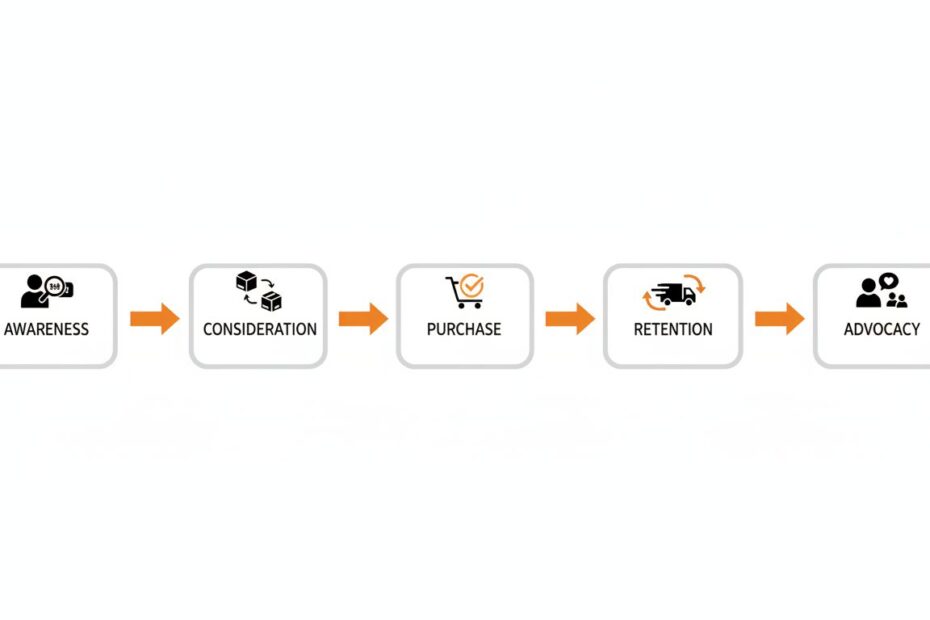
Customer Journey Stages in E-commerce
The traditional e-commerce marketing funnel treated customer journeys like a straight line: awareness at the top, consideration in the middle, purchase at the bottom, and then the customer disappeared. That model is dead.
Modern e-commerce customers move fluidly across channels, revisit products weeks after browsing, buy on mobile, research on desktop, and sometimes abandon their carts to check competitor prices. They expect seamless experiences across email, SMS, web, and social. Most importantly, they move backward and forward through journey stages based on real-time behavior signals that your CRM must capture and act on instantly.
This is not a theoretical exercise. The difference between treating customers as static profiles versus dynamic, real-time decision points directly impacts your conversion rates, repeat purchase rates, and customer lifetime value (CLV). Brands that move away from static funnel assumptions and toward data-driven journey orchestration see measurable improvements in retention and revenue.
The Reality of the Modern E-commerce Customer Journey
The traditional marketing funnel assumes a predictable, one-directional path. A customer discovers your brand, evaluates options, makes a purchase, and moves on. Reality is messier and more valuable.
Today’s shoppers interact with your brand across multiple channels in unpredictable sequences. A customer might see your Instagram ad (awareness), browse your website on mobile (consideration), abandon their cart, receive an email reminder, click through from SMS, and finally purchase on desktop. They then expect post-purchase communication, product recommendations, and loyalty offers that recognize their purchase history.
Each of these interactions generates a data signal: a page view, a click, a cart addition, an email open, an SMS response. These signals are the raw material for real-time journey orchestration.
The Cost of Siloed Tools
When email, SMS, web personalization, and retargeting exist in separate systems, brands face three critical problems:
- Customers receive duplicate messages because tools do not communicate (sending an SMS promoting a product the customer just bought).
- Campaign timing misses the moment of highest intent because data takes hours or days to sync between platforms.
- Personalization remains shallow because each tool only sees its own channel data, not the complete customer picture.
The result is wasted marketing spend, lower conversion rates, and customer frustration.
Moving to Real-Time Decision Layers
A unified customer data platform (CDP) combined with omnichannel campaign orchestration solves this problem. Instead of building static customer segments once per week, modern CRM systems update customer profiles in real time based on behavioral events.
When a customer adds an item to their cart, their profile updates instantly. The system recognizes they are now in the “purchase” stage and automatically suppresses them from general awareness campaigns while triggering a cart recovery flow. If they abandon the cart after 30 minutes, an email goes out. If they ignore the email, an SMS follows 2 hours later. If they complete the purchase, the post-purchase retention flow activates automatically.
This real-time responsiveness is the foundation of modern e-commerce growth.
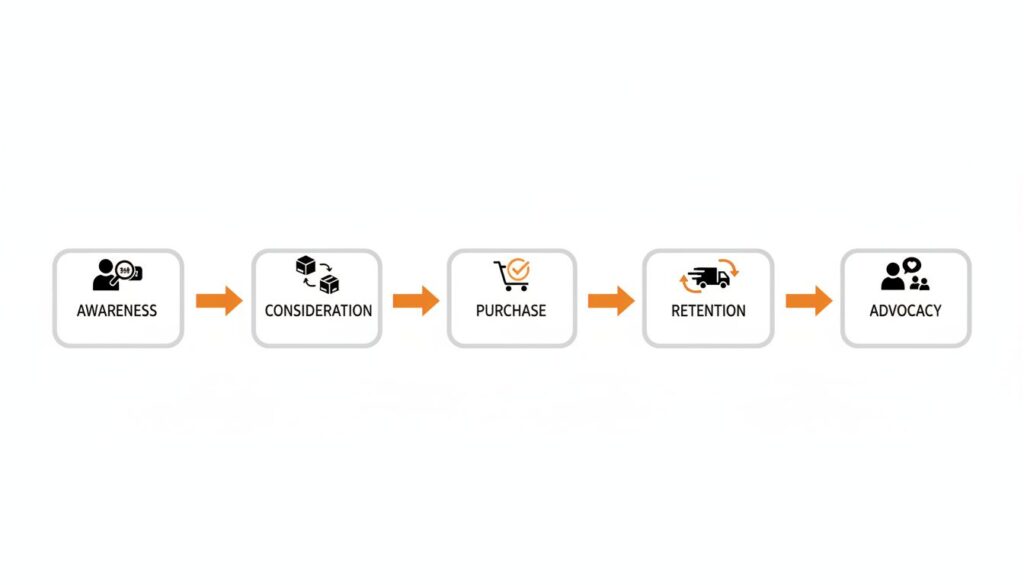
The 5 Key E-commerce Customer Journey Stages
To successfully optimize the customer lifecycle, brands must view each stage through the lens of concrete customer behavior, data points, and active automation flows. Each stage represents both a customer mindset and a set of actionable database signals that trigger specific campaigns.
Stage 1: Awareness (The Discovery Phase)
What it means: The point where a potential shopper first discovers your brand, products, or core value proposition through paid ads, organic search, social media, referrals, or word-of-mouth.
Why it matters: This stage represents the very top of your acquisition pipeline. It is also the critical moment to capture permission-based marketing consent and build your first-party customer data foundation. Customers without consented email or phone data are difficult to nurture through later stages.
Key data signals:
- High landing page traffic from new visitors
- UTM parameters identifying ad source and campaign
- First-time website visits
- Organic search queries with high commercial intent
- Social media clicks and referral traffic
Recommended CRM action: Deploy targeted, highly engaging welcome sequences that incentivize email and SMS opt-in. Offer a discount code, free shipping, or exclusive content in exchange for consent. Capture first-party data (email, phone, location) to build a unified customer profile.
Business impact: Clean, consented first-party customer data reduces long-term reliance on expensive paid retargeting. Customers who provide contact information in the awareness stage are significantly more likely to convert in later stages.
Stage 2: Consideration (The Evaluation Phase)
What it means: The phase where interested prospects actively research products, read customer reviews, compare sizing guides, evaluate alternatives, and check competitor offerings. The customer acknowledges their need but has not yet committed to a purchase.
Why it matters: Hesitation, price uncertainty, or lack of trust can easily lead to drop-offs at this stage. Many high-intent prospects never move to purchase because they lack the confidence or information to decide. This is where social proof, detailed product information, and personalized recommendations become critical.
Key data signals:
- Multiple product detail page (PDP) views
- Category browsing and filter clicks
- Time spent on specific product pages
- Review page engagement
- Comparison between similar products
- Adding items to wishlists
Recommended CRM action: Trigger automated browse abandonment email sequences containing customer-generated reviews, sizing calculators, video demonstrations, and dynamic recommendations from the viewed category. Segment customers by product category and send personalized follow-ups highlighting relevant social proof and product benefits.
Business impact: Personalized browse abandonment campaigns accelerate the transition from casual browser to active buyer. Brands that send targeted consideration-stage emails with relevant reviews and recommendations see higher conversion rates and lower cart abandonment.
Stage 3: Purchase (The Conversion Phase)
What it means: The critical transaction moment where the shopper adds items to their shopping cart and enters the checkout sequence. This is the point of highest friction and highest revenue opportunity.
Why it matters: This is where cart abandonment happens. Even minor checkout complications, unexpected shipping costs, or unclear trust signals can result in immediate revenue loss. Industry data shows that 70% of online shopping carts are abandoned before purchase completion. Recovering even a fraction of these carts directly impacts revenue.
Key data signals:
- Add-to-cart events
- Cart value updates
- Checkout page progression (shipping address entered, payment method selected)
- Payment failures or declined transactions
- Coupon code entries
- Checkout step abandonment
Recommended CRM action: Implement real-time, multi-channel cart recovery flows. Send an email immediately after cart abandonment with a direct checkout link and trust-building guarantees (money-back guarantee, free returns). If the email is ignored after 2 hours, escalate to SMS with a direct deep link. Automatically suppress the customer from generic marketing emails during the recovery window to prevent message fatigue.
Business impact: Multi-channel cart recovery is one of the highest-ROI marketing activities available to e-commerce brands. Top-performing abandoned cart flows generate $28.89 in revenue per recipient, compared to $3.65 for average performers. Every percentage point improvement in cart recovery translates directly to revenue.
Stage 4: Retention (The Experience and Repurchase Phase)
What it means: The post-purchase onboarding phase where the customer receives their order, experiences the product, and is nurtured toward their second purchase. This stage determines whether a customer becomes a one-time buyer or a repeat customer.
Why it matters: Long-term profitability begins on the second transaction. First-time buyers must be activated before they slip into permanent dormancy. Repeat customers have significantly higher lifetime value than one-time buyers. A customer who makes two purchases is far more likely to make a third, fourth, and fifth purchase.
Key data signals:
- Order confirmation and shipment tracking
- Product delivery confirmation
- Post-purchase NPS survey responses
- Loyalty program registration
- Product usage signals (for subscription or consumable products)
- Time since last purchase
- Product review submissions
Recommended CRM action: Deploy personalized post-purchase educational sequences (such as care instructions, styling tips, or product setup guides) followed by predictive replenishment reminders based on product consumption cycles. For high-value first-time buyers, send personalized cross-sell recommendations featuring complementary products. Invite customers to join a loyalty program with clear benefits.
Business impact: Post-purchase retention campaigns directly increase repeat purchase rates and customer lifetime value. Brands that implement systematic post-purchase nurturing see 20-40% increases in repeat purchase rates within the first 90 days after purchase.
Stage 5: Advocacy (The Loyalty Phase)
What it means: Happy, high-value repeat customers who actively promote your brand to their friends, families, and social networks. These are your brand ambassadors who drive word-of-mouth growth.
Why it matters: Word-of-mouth is the highest-converting, lowest-cost customer acquisition channel available to retail brands. Customers acquired through referrals have higher lifetime value and lower churn rates than customers acquired through paid advertising. Building a systematic advocacy program compounds growth over time.
Key data signals:
- Repeat purchase frequency (RFM status)
- Referral code shares and clicks
- Positive feedback surveys (NPS 9-10)
- User-generated content tagging and mentions
- Review submissions and ratings
- Loyalty program tier advancement
- Email engagement rates (open rate, click rate)
Recommended CRM action: Invite high-value repeat customers to a tier-based loyalty program with escalating rewards. Offer referral incentives (such as “Give $15, Get $15” programs) that reward both the referrer and the new customer. Send personalized milestone celebration campaigns recognizing customer anniversaries or loyalty tier achievements. Engage with customers when they tag your brand on social media.
Business impact: Loyalty programs and referral initiatives create predictable, low-cost customer acquisition channels. Advocates generate new customers at a fraction of the cost of paid advertising while driving higher-quality, higher-LTV customer cohorts.
Static Funnel vs. Dynamic Journey Orchestration
The table below illustrates how modern data-driven journey orchestration differs fundamentally from traditional static funnel marketing:
| Dimension | Static Funnel Model | Dynamic Journey Orchestration |
|---|---|---|
| Customer View | Static profile updated weekly or monthly | Real-time profile updated with every interaction |
| Campaign Triggers | Fixed schedules (e.g., send email on day 3 after signup) | Real-time behavioral events (e.g., send email 30 minutes after cart abandonment) |
| Channel Coordination | Siloed tools with manual syncing | Unified platform with instant cross-channel suppression |
| Personalization | Generic by segment | Hyper-personalized by individual behavior |
| Journey Movement | Linear progression through stages | Non-linear, multi-directional based on real-time intent |
| Performance Window | Campaigns measured after completion | Campaigns optimized in real time based on response |
| Data Latency | Hours or days | Milliseconds |
| Revenue Impact | Moderate, dependent on segment size | High, dependent on precision and timing |
Orchestrating E-commerce Journey Stages with Bloomreach Engagement
Bloomreach Engagement is the premier platform for unifying and managing these customer journey stages. Unlike point solutions that handle email or SMS in isolation, Bloomreach eliminates data silos by combining a real-time Customer Data Platform (CDP) with native omnichannel delivery (Email, SMS, Mobile Push, Web Personalization, Retargeting) inside a single canvas.
This architecture solves the core problem that plagues most e-commerce brands: data fragmentation. When your customer data lives in separate tools, you cannot execute real-time, omnichannel journeys. Bloomreach unifies all customer data and makes it available for instant activation across all channels.
Real-Time Web Personalization for Anonymous Consideration
When an anonymous visitor browses your winter apparel category, Bloomreach instantly customizes the website banners, category listings, and product recommendations in real time to show relevant parkas and cold-weather accessories. The system recognizes browsing patterns and surfaces inventory that matches intent.
When the visitor registers for an account or makes a purchase, their anonymous browsing history merges seamlessly into their new customer profile. All previous interactions become part of their permanent customer record, enabling continuous personalization across future visits.
This capability is critical for the consideration stage, where most e-commerce browsing happens. Without real-time web personalization, you are treating every visitor as a generic shopper. With it, each visitor receives a customized experience that accelerates their path to purchase.
Multi-Channel Cart Recovery with Smart Suppression
When a user abandons their cart, Bloomreach automatically schedules a dynamic recovery email within 30 minutes. The email displays the exact products they abandoned, along with personalized recommendations and a direct checkout link.
If the customer ignores the email, Bloomreach escalates the flow to a personalized SMS message 2 hours later. Critically, Bloomreach automatically suppresses this customer from generic marketing newsletters and promotional campaigns during the recovery window. This prevents communication fatigue and keeps the focus on the highest-intent message.
If the customer completes the purchase through either channel, the post-purchase retention flow activates automatically. If they do not respond to either the email or SMS, they are moved to a longer-term nurture sequence with different messaging and incentives.
Online-to-Offline Omnichannel Loyalty Flow
Bloomreach unifies online web actions with brick-and-mortar retail POS transactions, creating a truly omnichannel customer view. A customer who purchases in-store is recognized online and receives personalized post-purchase cross-sell journeys via email and SMS. A customer who buys online receives in-store offers and personalized recommendations when they visit a physical location.
This unified view is particularly powerful for loyalty programs. Bloomreach tracks purchase history across all channels and automatically advances customers through loyalty tiers based on total spend, regardless of where purchases occur. A customer who makes five $50 purchases online and two $100 purchases in-store is recognized as a $450 lifetime customer and receives loyalty benefits accordingly.
3 Common Customer Journey Pitfalls Retailers Make
Mistake 1: Treating All E-commerce Channels as Disconnected Silos
The damage: Email, SMS, and website tools fail to communicate, leading to disjointed experiences. A customer receives an SMS promoting a product they bought 10 minutes ago. An email arrives promoting a category they just browsed. The same customer is added to multiple nurture sequences simultaneously, receiving duplicate messages from different systems.
The business impact: High unsubscribe rates, damaged brand reputation, and wasted marketing spend on redundant campaigns.
The fix: Consolidate data and campaign delivery inside an all-in-one platform like Bloomreach Engagement. A unified system automatically suppresses customers from overlapping campaigns and coordinates messaging across all channels.
Mistake 2: Failing to Move Beyond Static Funnel Assumptions
The damage: Building campaigns for fictional personas instead of using actual, real-time customer behavior leads to mismatching promotions. You send a “first purchase” discount to a customer who has already made three purchases. You trigger browse abandonment emails to customers who have already converted. You promote clearance items to customers who prefer premium products.
The business impact: Lower engagement rates, wasted budget on irrelevant campaigns, and missed opportunities to capitalize on actual customer intent.
The fix: Build automated CRM triggers directly on unified behavioral events. Use real customer data to determine journey stage, not assumptions. If a customer has made a purchase in the last 30 days, they are in the retention stage, not the consideration stage. Adjust messaging accordingly.
Mistake 3: Over-complicating Journey Flows Before Launching
The damage: Spending months drafting massive, complex diagrams and designing perfect-in-theory journey flows that never get deployed. Teams argue about edge cases and perfect messaging before launching anything. Meanwhile, competitors are executing simpler flows and generating revenue.
The business impact: Delayed time to value, organizational frustration, and missed revenue opportunities while you perfect the plan.
The fix: Focus first on high-impact skeleton journeys (such as cart recovery, welcome sequences, and browse re-engagement) and scale with progressive personalization over time. Launch a simple cart recovery flow this week. Measure results. Optimize. Then add browse abandonment. Then add post-purchase. Build momentum through execution, not planning.
How Voxwise Transforms Journey Stages into Sustainable Revenue
Voxwise is the expert CRM, customer engagement, and Bloomreach implementation partner for retail and e-commerce brands. We work with marketing leaders to audit current customer experiences, identify friction points and revenue leaks, and design scalable, unified customer data strategies that drive measurable growth.
Our approach combines three core capabilities:
Customer Experience Audit: We analyze your current journey stages, identify where customers drop off, and quantify the revenue impact of each friction point. We examine your email performance, SMS engagement, web personalization, cart recovery, and retention flows to find quick wins and strategic improvements.
Unified Data Architecture: We design and implement a scalable first-party customer data strategy that unifies data from all sources (web, mobile app, POS, email, SMS, advertising) into a single customer profile. This creates the foundation for real-time journey orchestration.
Bloomreach Implementation and Optimization: We build, launch, and continuously optimize real-time customer journeys inside Bloomreach Engagement. We design segment logic, campaign triggers, dynamic content rules, and omnichannel flows that drive conversion, repeat purchases, and customer lifetime value.
Our clients typically see measurable improvements within 60-90 days of implementation, including increased cart recovery rates, higher repeat purchase rates, and improved customer lifetime value.
How to Measure Success Across Journey Stages
Each customer journey stage has specific metrics that indicate health and opportunity. Tracking these metrics allows you to identify which stages are performing well and which require optimization.
| Journey Stage | Primary KPI | Secondary KPIs | Target Range |
|---|---|---|---|
| Awareness | Landing page conversion rate (email signup) | Traffic volume, cost per lead, new visitor count | 15-25% email capture |
| Consideration | Browse abandonment recovery rate | PDP engagement rate, time on site, category engagement | 5-10% recovery rate |
| Purchase | Cart recovery rate | Checkout completion rate, average order value, conversion rate | 20-35% cart recovery |
| Retention | Repeat purchase rate (within 90 days) | Customer lifetime value, replenishment cycle adherence | 20-40% repeat rate |
| Advocacy | Referral conversion rate | NPS score, loyalty program enrollment, user-generated content | 10-20% referral conversion |
Track these metrics monthly and establish targets based on your industry and current performance. Use this data to identify which stages need investment and which are already performing well.
Frequently Asked Questions
Q: What are the 5 core customer journey stages in e-commerce?
A: The five stages are Awareness (discovery), Consideration (evaluation), Purchase (conversion), Retention (post-purchase activation), and Advocacy (loyalty). Each stage represents a distinct customer mindset and requires different messaging, channels, and automation triggers.
Q: How does a non-linear customer journey differ from a traditional marketing funnel?
A: A traditional funnel assumes a straight path from awareness to purchase. A non-linear journey recognizes that customers move fluidly across channels, revisit stages multiple times, and sometimes move backward (from active buyer to dormant). Modern CRM systems manage these non-linear paths in real time based on actual customer behavior.
Q: Why is the post-purchase retention stage critical for e-commerce profitability?
A: Long-term profitability depends on repeat customers, not one-time buyers. A customer who makes a second purchase is significantly more likely to make a third, fourth, and fifth purchase. Retention-stage campaigns activate first-time buyers before they slip into dormancy, directly impacting customer lifetime value and overall profitability.
Q: How does a Customer Data Platform (CDP) help optimize journey stages?
A: A CDP unifies customer data from all sources (web, mobile, email, SMS, POS) into a single profile updated in real time. This enables real-time journey orchestration where campaign triggers respond instantly to customer behavior rather than relying on static segments updated weekly or monthly.
Q: What are the best CRM campaign triggers for the consideration stage?
A: Effective consideration-stage triggers include: PDP view without add-to-cart (browse abandonment), category browsing for specific product types, time spent on comparison pages, and wishlist additions. Use these triggers to send targeted emails with relevant reviews, product benefits, and personalized recommendations.
Conclusion
Modern e-commerce success depends on moving beyond static funnel assumptions and toward real-time, data-driven journey orchestration. The five customer journey stages (Awareness, Consideration, Purchase, Retention, Advocacy) represent distinct customer mindsets and behavioral opportunities. Each stage generates specific data signals that trigger automated, hyper-personalized campaigns across email, SMS, web, and other channels.
Brands that implement unified customer data platforms and omnichannel campaign orchestration see measurable improvements in conversion rates, repeat purchase rates, and customer lifetime value. The technology is available. The question is execution.
Voxwise works with retail and e-commerce leaders to design and implement scalable customer journey strategies powered by Bloomreach Engagement. If you are ready to move beyond fragmented tools and static campaigns, let’s talk about how to transform your customer journey into a sustainable revenue engine.
Ready to optimize your customer journey stages? Schedule a 30-minute consultation with our customer engagement experts to discuss your current strategy and identify quick wins.