Email Personalization Strategies for Retail
Email personalization has become essential for retail brands competing in today’s crowded marketplace. Generic, one-size-fits-all email blasts no longer engage customers—57% of consumers say personalization influences whether they find an email memorable, and 28% actively expect brands to send personalized content based on their interests.
For retail leaders, the business case is clear: retailers that personalize effectively see 10-15% revenue lift just from getting offers and content right. But achieving this requires more than inserting a customer’s first name into the subject line. It demands a strategic approach to segmentation, behavioral triggers, and dynamic content that speaks directly to each shopper’s needs and stage in the customer journey.
Use Case Overview
How can retail brands use email personalization to increase conversion rates, reduce cart abandonment, and build lasting customer loyalty?
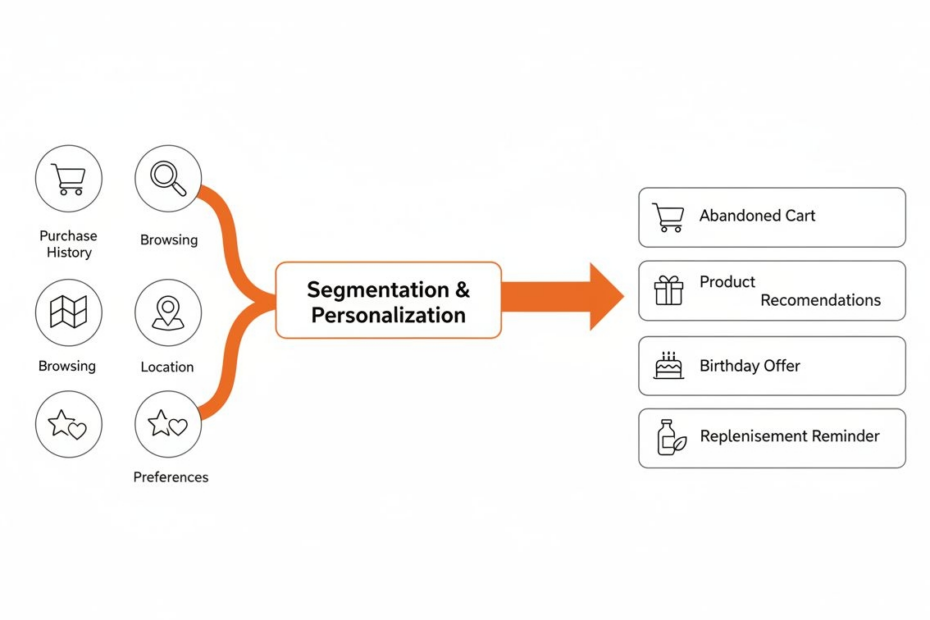
Email personalization transforms email from a broadcast channel into a 1:1 dialogue with each customer. By combining purchase history, browsing behavior, customer lifecycle stage, and location data, retail brands can trigger the right message at the right time—whether that’s a reminder about an abandoned cart, a product recommendation based on past purchases, or an exclusive VIP offer.
The use case applies across all retail segments: fashion, beauty, electronics, home goods, and consumables. Whether you’re a direct-to-consumer brand, a multi-channel retailer, or a marketplace, personalized email drives measurable results when implemented strategically.
When This Use Case Matters
Email personalization becomes critical when you face these business challenges:
- High cart abandonment rates that you need to recover with targeted incentives
- Low email engagement because your current approach feels generic and irrelevant
- Difficulty increasing customer lifetime value (CLTV) without scaling your marketing team
- Pressure to improve retention while reducing acquisition costs
- Competitive pressure from brands that already offer personalized experiences
- Seasonal or inventory-driven urgency that requires timely, relevant messaging
If your retail business relies on repeat purchases and customer loyalty, personalized email is not optional—it’s a core lever for growth.
Why Email Personalization Works
Email remains one of the highest-ROI marketing channels for retail. When combined with personalization, it becomes even more powerful because it reduces friction and increases relevance.
Customers respond to personalized email because:
- It acknowledges their past behavior and preferences, making them feel understood
- It reduces decision fatigue by showing them products they’re already interested in
- It creates urgency through timely triggers (e.g., abandoned cart reminders within hours, not days)
- It builds loyalty by rewarding VIP customers and recognizing milestones
How It Works in Practice
Effective email personalization requires three core components: data collection, segmentation, and dynamic content delivery.
Data Collection and Customer Profiles
The foundation of personalization is a unified customer profile that captures:
- Purchase history (what, when, how much, product categories)
- Browsing behavior (pages viewed, products clicked, time spent)
- Demographic data (location, age, gender, preferences)
- Engagement history (email opens, clicks, conversions)
- Lifecycle stage (new customer, repeat buyer, at-risk, VIP)
- Loyalty status (points earned, tier level, rewards redeemed)
This data lives in your customer data platform (CDP) or marketing automation system, where it’s updated in real-time as customers interact with your brand.
Segmentation and Triggering
Rather than sending the same email to your entire list, you segment customers into groups based on behavior and attributes. Common segments for retail include:
- Abandoned cart visitors – triggered within 1-4 hours of cart abandonment
- Browse abandoners – customers who viewed products but didn’t add to cart
- Repeat buyers – customers with 2+ purchases in the past 12 months
- VIP/loyalty members – high-value customers with exclusive offers
- Inactive customers – no purchase or engagement in 60+ days
- New customers – first purchase within last 30 days
- Seasonal segments – based on weather, location, or upcoming holidays
Each segment receives email campaigns tailored to their behavior and needs.
Dynamic Content and Personalization Rules
Once a customer is segmented, the email itself contains dynamic content blocks that change based on individual attributes. For example:
- Product recommendations pull from the customer’s browsing or purchase history
- Subject lines reference the customer’s name, favorite category, or recent activity
- Offers and incentives vary by loyalty tier or purchase frequency
- Imagery and copy adapt to the customer’s location, gender, or style preferences
- CTAs direct customers to relevant product pages or loyalty rewards
Example Scenario in Retail
Let’s walk through a realistic example: a mid-market fashion retailer with 50,000 active customers.
The Scenario
The retailer notices that 30% of customers abandon their shopping carts without completing purchase. They also see that repeat customers open emails at 2x the rate of one-time buyers, but they’re not leveraging that insight to drive higher-value purchases.
The Personalization Strategy
The retailer implements a multi-email personalization program:
1. Abandoned Cart Email (triggered at 2 hours)
- Subject: “[Customer Name], your favorite style is waiting”
- Dynamic product block shows the exact items left in cart
- Personalized incentive: VIP members get free shipping; new customers get 10% off
- Countdown timer creates urgency
- Secondary recommendations pull from customer’s browsing history
2. Browse Abandonment Email (triggered at 24 hours)
- Targets customers who viewed products but didn’t add to cart
- Shows 3 similar items they might prefer (based on style, size, price point)
- Social proof: includes customer reviews and ratings
- Offer: “Complete your look” with complementary items
3. Post-Purchase Cross-Sell Email (triggered at 48 hours)
- Congratulates customer on their purchase
- Recommends complementary products (if they bought a jacket, suggest matching accessories)
- Includes styling tips and care instructions
- Loyalty points earned displayed prominently
4. Replenishment Reminder (triggered by purchase frequency)
- For consumable items (e.g., skincare, activewear), sends reminder when customer typically reorders
- Subject: “Ready to restock your favorites?”
- One-click reorder button for convenience
- Loyalty discount for repeat purchases
5. VIP Win-Back Email (triggered at 90 days of inactivity)
- Targets previously high-value customers
- Acknowledges their VIP status and past purchases
- Exclusive offer (e.g., $25 off, early access to new collection)
- Personalized product recommendations based on their favorite categories
Results
Within 3 months of implementing this program, the retailer sees:
- Cart recovery rate improves from 15% to 28% (recovered revenue: $150K+)
- Email open rates increase 35% (from 18% to 24%)
- Repeat purchase rate rises 18% among customers receiving personalized emails
- Average order value increases 12% due to cross-sell recommendations
These results are realistic and achievable for retailers of any size when personalization is done strategically.
Data, Tools, and Teams Involved
Data Requirements
| Data Type | Source | Use Case |
|---|---|---|
| Purchase History | E-commerce platform / POS | Product recommendations, replenishment triggers, loyalty segmentation |
| Browsing Behavior | Website analytics / pixel tracking | Browse abandonment, product affinity, category preferences |
| Customer Attributes | CRM / registration form | Demographic segmentation, location-based offers, lifecycle stage |
| Email Engagement | Email service provider | Engagement scoring, segment refinement, re-engagement campaigns |
| Loyalty/VIP Status | Loyalty platform | Tier-based offers, exclusive access, reward milestones |
| Transactional Data | Payment processor / order system | Replenishment timing, AOV analysis, churn predictio |
Teams Involved
- E-commerce / Marketing Manager – owns strategy and campaign roadmap
- Data Analyst – builds segments, measures performance, identifies optimization opportunities
- Email Marketer / Specialist – creates templates, writes copy, manages campaigns
- Marketing Technologist – integrates systems, sets up automation, troubleshoots data flow
- Customer Success / CRM Manager – ensures data quality and customer privacy compliance
How to Measure Success
Personalization is only valuable if it drives measurable business results. Track these KPIs:
Email Engagement Metrics
- Open Rate – target 25-35% for retail (personalized emails typically outperform generic)
- Click-Through Rate (CTR) – aim for 3-5% (personalized CTR is 2-3x higher than non-personalized)
- Conversion Rate – track purchases from email (personalized campaigns should see 15-25% lift)
- Unsubscribe Rate – keep below 0.5% (sign of over-personalization or irrelevant content)
Business Impact Metrics
- Revenue Per Email (RPE) – total revenue generated ÷ emails sent
- Cart Recovery Rate – % of abandoned carts recovered via email (target: 20-30%)
- Average Order Value (AOV) – measure lift from cross-sell recommendations
- Customer Lifetime Value (CLTV) – personalized customers should have 15-25% higher CLTV
- Repeat Purchase Rate – % of customers making 2+ purchases (personalization drives this)
- Win-Back Rate – % of inactive customers re-engaged (target: 5-10%)
Attribution and ROI
- Email Revenue Attribution – use UTM parameters and email platform tracking to attribute revenue
- Campaign ROI – revenue generated ÷ campaign costs (email typically delivers 40:1 ROI)
- Segment Performance – compare performance across segments to identify high-value audiences
- A/B Test Results – continuously test personalization elements (subject line, offer, product recommendations)
Pro Tip: Set up a dashboard that tracks these metrics weekly. This allows you to quickly identify what’s working and optimize in real-time.
How Voxwise Can Help
Implementing effective email personalization requires expertise in data strategy, platform integration, and campaign optimization. Many retail brands struggle with fragmented data, unclear segmentation logic, or campaigns that don’t align with business goals.
Voxwise specializes in helping retail brands:
- Design customer segmentation strategies that align with business objectives
- Integrate data sources (e-commerce, CRM, analytics, loyalty) into a unified platform
- Build personalized email workflows that trigger at the right moments
- Set up dynamic content rules that adapt to each customer
- Optimize campaigns through A/B testing and performance analysis
- Train your team on personalization best practices and platform management
We work with retail brands of all sizes—from fast-growing DTC brands to established multi-channel retailers—to unlock the revenue potential of personalized email.
Our Approach
- Discovery – Understand your current email strategy, data infrastructure, and business goals
- Strategy – Define segmentation logic, personalization triggers, and campaign roadmap
- Implementation – Set up workflows, integrate systems, and launch campaigns
- Optimization – Monitor performance, test variations, and refine based on results
- Handoff – Train your team and establish ongoing optimization processes
Whether you’re starting from scratch or optimizing an existing personalization program, Voxwise brings the expertise and experience to deliver measurable results.
Conclusion
Email personalization is no longer a nice-to-have—it’s a business imperative for retail brands competing for customer attention and loyalty. By combining targeted segmentation, behavioral triggers, and dynamic content, you can transform email from a cost center into a revenue driver.
The retailers winning in today’s market are those that treat email as a 1:1 channel, not a broadcast medium. They use customer data strategically, respect customer privacy, and deliver genuine value in every message.
If you’re ready to unlock the full potential of personalized email for your retail business, Voxwise is here to help. We bring the data strategy, platform expertise, and optimization mindset needed to drive real results.
Ready to Transform Your Email Strategy?
Personalization works best when it’s built on a foundation of clean data, clear strategy, and continuous optimization. Voxwise helps retail brands design and execute personalization programs that drive engagement, conversion, and loyalty.
Explore our services to see how we help retail brands like yours leverage email personalization for growth.