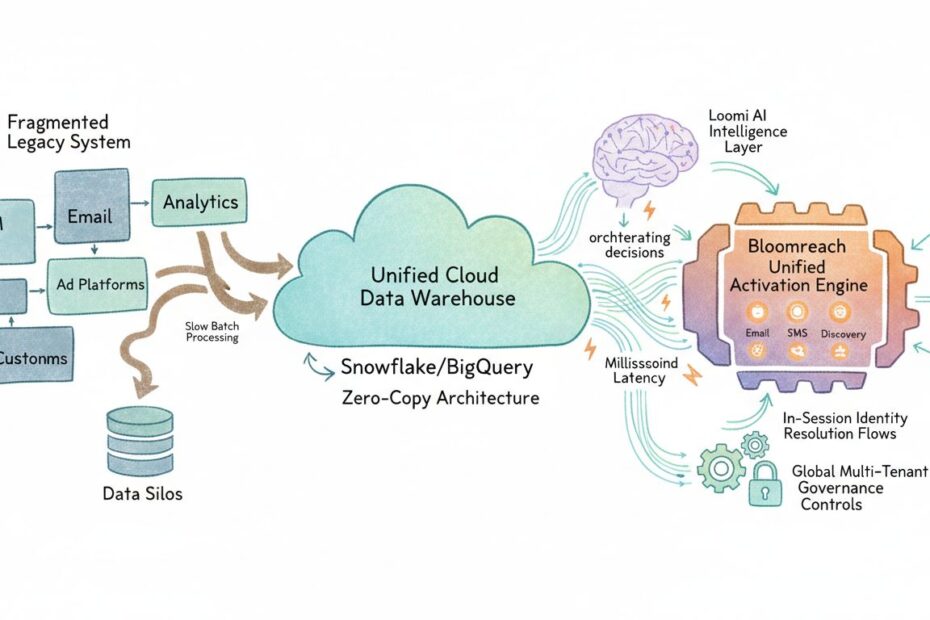
What Is an Enterprise Customer Data Platform?
An Enterprise Customer Data Platform is not a storage solution—it’s a low-latency intelligence layer that converts raw customer signals into immediate, executable decisions. Traditional definitions focus on data unification and creating a “360-degree view,” but this approach misses the critical business reality: customer data loses 80% of its tactical value within minutes of being generated. The true measure of an enterprise CDP is not capacity, but agility—the speed at which a data signal (a web click, an offline purchase, a support interaction) transforms into a personalized customer experience.
In modern enterprises, data velocity matters more than data volume. A customer abandoning a cart at 2:47 PM requires a decision by 2:48 PM. A churn signal detected in your data warehouse is only valuable if activation happens before the customer opens a competitor’s email. Legacy CDP architectures—built on batch processing, fragmented integrations, and disconnected activation layers—cannot operate at this speed. Bloomreach solves this through a unified, low-latency architecture that eliminates the “Activation Gap” inherent in traditional enterprise stacks.

The Enterprise Data Value Decay Problem
Every enterprise faces the same challenge: data decay. The moment a customer interaction occurs, its value begins to decline exponentially. A behavioral signal captured at 2:00 PM has maximum relevance if acted upon by 2:05 PM. By 2:30 PM, its predictive power has diminished significantly. By the next morning, it’s historical context, not actionable intelligence.
Traditional enterprise CDP architectures compound this problem through multiple latency layers:
- Data Collection Lag: Events are captured but queued for processing (typically 5-30 minutes)
- Identity Resolution Delay: Anonymous sessions are stitched with known profiles every 5-15 minutes, not continuously
- Activation Pipeline Latency: Segmentation updates are pushed to email, SMS, or web platforms every 10 minutes to several hours
- End-to-End Sync Tax: A customer interaction that should trigger a real-time offer instead triggers an API call that sits in a queue
The cumulative effect: a customer who should receive a personalized incentive in-session instead receives a generic email the next day. The moment has passed. The conversion opportunity is lost.
Bloomreach eliminates this decay through in-session identity resolution and zero-latency orchestration, ensuring that every customer signal is converted into immediate action while the customer is still engaged.
Zero-Copy Data Access: Warehouse-Native Architecture
One of the most significant architectural innovations in enterprise CDP design is the shift from traditional ETL (Extract-Transform-Load) to Zero-Copy architecture. This is not a minor optimization—it’s a fundamental change in how enterprises manage data governance, cost, and operational complexity.
Traditional CDP Data Flow (The Problem)
In legacy architectures, customer data flows like this:
- Data lives in your data warehouse (Snowflake, BigQuery, Redshift)
- The CDP extracts data from the warehouse
- The CDP transforms and duplicates the data into its own proprietary database
- Marketing teams access profiles from the CDP
- Activation platforms (email, SMS, web) sync data from the CDP via APIs
- Data governance, compliance, and updates must be maintained in multiple places
This creates data redundancy—the same customer record exists in 3-5 different systems. A GDPR deletion request requires coordinated updates across all systems. A data quality issue discovered in your warehouse must be manually propagated. New data fields require ETL pipeline changes and duplicate storage.
Zero-Copy Architecture (The Solution)
Bloomreach operates on a warehouse-native model where data never leaves your enterprise warehouse:
- Customer data remains in your Snowflake or BigQuery instance
- Bloomreach queries data directly from the warehouse in real-time
- No data duplication, no proprietary databases, no API syncs
- All governance, compliance, and security controls remain in your warehouse
- New data fields are immediately available without pipeline changes
This approach delivers three critical enterprise advantages:
Single Source of Truth: Your data warehouse is the authoritative customer record. There is no “CDP database” that can drift from reality. Every profile query returns live data, not cached snapshots.
Reduced Operational Overhead: CTOs no longer manage dual data systems. Data quality improvements, compliance updates, and schema changes happen once, in the warehouse, and are immediately reflected in Bloomreach.
Cost Efficiency at Scale: Traditional CDPs charge based on data volume stored in their proprietary systems. Bloomreach’s warehouse-native approach means you pay for warehouse compute (which you already have) rather than duplicate storage. For enterprises with billions of customer records, this translates to 40-60% cost reduction.
Compliance Simplification: GDPR, CCPA, and emerging privacy regulations require data deletion at source. With zero-copy architecture, deletion happens in your warehouse once, and Bloomreach automatically reflects the change. No manual reconciliation across systems.
Sovereign AI Governance: Explainable Propensity Scoring
Enterprise AI adoption faces a critical blocker: trust and explainability. Many CDP vendors offer “black-box” AI recommendations—propensity scores, churn predictions, next-best-action decisions—without transparency into how those decisions were reached. For global brands operating across regulated markets (GDPR, CCPA, LGPD, PIPL), this opacity is unacceptable.
Bloomreach’s Loomi AI operates on a principle of sovereign governance: every AI decision is explainable, auditable, and compliant with regional regulations.
How Explainable Propensity Scoring Works
Traditional propensity models operate like black boxes:
- Input: Customer profile data
- Process: Neural network or ensemble model (internal logic hidden)
- Output: Churn score of 0.87 (high risk) or purchase propensity of 0.62 (medium likelihood)
- Problem: Marketing teams cannot explain why a customer received a specific score. Auditors cannot verify fairness. Regional compliance officers cannot confirm GDPR compliance.
Bloomreach’s approach is fundamentally different:
- Transparent Logic: Loomi AI explains exactly which customer attributes contributed to a propensity score. “This customer has a 0.81 churn probability because: (1) Last purchase was 47 days ago (weight: 0.34), (2) Email engagement dropped 65% in the last 30 days (weight: 0.28), (3) Support ticket sentiment was negative (weight: 0.19).”
- Regional Compliance: Explainability enables compliance with local regulations. A customer in Germany can request an explanation of why they received a specific offer. Bloomreach provides that explanation, automatically.
- Audit Trail: Every propensity calculation is logged with its reasoning, enabling compliance teams to verify that AI decisions meet fairness and bias standards.
Dynamic, Not Static
Unlike traditional CDPs that calculate segments once per day, Bloomreach’s propensity scores update continuously. Every customer interaction (a web click, an email open, a support conversation) immediately recalculates the customer’s propensity across multiple dimensions:
- Likelihood to purchase in the next 7 days
- Likelihood to churn in the next 30 days
- Likelihood to respond to a specific offer type
- Likelihood to convert on a specific product category
This means Loomi AI doesn’t segment customers into static groups. Instead, it calculates a dynamic, real-time likelihood profile that changes moment by moment. A customer’s churn score might be 0.45 at 2:00 PM, but if they receive poor support at 2:15 PM, it recalculates to 0.78 by 2:16 PM. Bloomreach can then trigger an immediate retention offer in-session, before the customer leaves.
Global-Local Orchestration: Multi-Tenant Data Governance
Large enterprises operate across multiple brands, regions, and business units, each with distinct data governance, compliance, and operational requirements. A global CPG company might have:
- 15+ regional brands (each with different marketing strategies)
- Operations across 45 countries (each with different privacy regulations)
- Multiple business units (e-commerce, retail, B2B, direct-to-consumer)
- Centralized analytics teams but decentralized activation teams
Traditional CDP architectures force a choice: centralized data (one system for all brands) or fragmented systems (separate CDPs per brand). Centralization loses regional agility. Fragmentation creates data silos and operational chaos.
Bloomreach solves this through multi-tenant governance:
How It Works
Global Customer View: The platform maintains a unified customer record across all brands and regions. A customer who purchases from Brand A, engages with Brand B’s email, and visits Brand C’s website is recognized as a single customer across all three touchpoints.
Regional Permissioning: Despite the unified view, data access is controlled by region and brand. The German marketing team can only access customer data for German customers. The UK brand team cannot see French customer data. Compliance is enforced at the query level, not the system level.
Decentralized Activation: Each brand or region can activate independently. The German team can launch a localized email campaign while the UK team simultaneously runs a SMS campaign, both using the same unified customer data but with regional compliance controls.
Centralized Learning: Despite decentralized activation, AI models learn from the entire customer base. Loomi AI’s churn prediction model trains on behavior from all regions and brands, making predictions more accurate than siloed, region-specific models.
This architecture is critical for enterprises because it delivers agility without chaos. Global brands get the efficiency of centralized data infrastructure while maintaining the autonomy that regional teams need to operate effectively in their markets.
In-Session Identity Resolution: Preventing Broken Journeys
One of the most costly failures in enterprise CDP deployments is broken journey recognition. A customer’s journey looks like this:
- 2:00 PM: Anonymous visitor clicks an ad, lands on website
- 2:05 PM: Visitor browses products, abandons cart
- 2:30 PM: Visitor logs into account (now recognized as known customer)
- 3:00 PM: Visitor receives generic “complete your purchase” email
The problem: the system didn’t recognize that the anonymous visitor and the logged-in customer are the same person. The customer’s entire journey—the ad click, the product browsing, the cart abandonment—is lost. The email offer is generic, not personalized to the products they viewed.
This happens because traditional CDP identity resolution runs on a schedule (every 5-15 minutes), not continuously. The anonymous session is stitched to the known customer profile hours later, long after the moment has passed.
Bloomreach’s In-Session Resolution
Bloomreach resolves identity in real-time, during the session:
- 2:00 PM: Anonymous visitor identified via tracking cookie and device fingerprinting
- 2:05 PM: System begins building a “potential match” profile based on behavioral signals
- 2:30 PM: Customer logs in. Bloomreach immediately stitches the anonymous session to the known profile
- 2:31 PM: System recognizes the customer’s full journey (ad click → product browsing → cart abandonment → login)
- 2:32 PM: Personalized offer is triggered in-session: “Complete your purchase of [specific product] and receive [personalized incentive]”
This in-session resolution prevents broken journeys and enables immediate personalization. The customer receives a relevant offer while they’re still engaged, dramatically increasing conversion probability.
Real-Time Activation Across Native Channels
The final piece of enterprise CDP architecture is native activation. Many traditional CDPs function as “plumbing only”—they unify data but don’t execute. Activation requires integrations with separate email platforms (Salesforce Marketing Cloud, HubSpot), SMS providers (Twilio), web personalization tools, and ad platforms. Each integration introduces latency, context loss, and operational fragmentation.
Bloomreach eliminates this through native execution layers:
- Native Email: Built-in email sending, templating, and delivery
- Native SMS: Direct SMS orchestration without third-party dependencies
- Native Web Personalization: Real-time website content personalization
- Native Search Optimization: Search result re-ranking based on customer propensity
- Native Discovery: Product recommendation engine integrated into the platform
This native architecture means that a customer event (an abandoned cart, a churn signal, a high-propensity moment) triggers activation within the same system, eliminating the latency of API-based integrations. A churn signal detected at 2:47 PM can trigger a retention email within 2 seconds, not 10 minutes.
Comparison: Enterprise CDP Architectures
| Dimension | Traditional CDP | CDP + Point Solutions | Bloomreach Unified Architecture |
|---|---|---|---|
| Data Storage | Proprietary CDP database (duplicated data) | Warehouse + CDP database + activation tool databases | Warehouse-native (zero-copy) |
| Identity Resolution | Batch processing (every 5-15 min) | Batch processing (every 5-15 min) | In-session, real-time (milliseconds) |
| Activation Latency | 10-60 minutes (API syncs) | 10-60 minutes (multiple API syncs) | <2 seconds (native execution) |
| AI Explainability | Limited or black-box | Limited or black-box | Full explainability (Loomi AI) |
| Multi-Tenant Governance | Single tenant (one system per brand) | Multiple separate systems | Single unified system with regional controls |
| Cost Structure | Per-record storage fees | Multiple vendor licenses | Warehouse compute (already budgeted) |
| Compliance Burden | High (data in multiple systems) | Very high (5+ systems to manage) | Low (single source of truth) |
Enterprise CDP Implementation Roadmap
Successful enterprise CDP deployment requires a structured approach that balances speed with governance. Here’s the proven five-phase roadmap:
Phase 1: Foundation & Architecture (Weeks 1-4)
Establish data governance, define identity resolution rules, audit existing data warehouse, plan warehouse-native integration, secure executive alignment on compliance requirements.
Phase 2: Warehouse Integration (Weeks 5-8)
Connect Bloomreach to Snowflake/BigQuery, validate zero-copy data access, test identity resolution logic, build audit trails for compliance, establish data quality baselines.
Phase 3: Activation Layer Deployment (Weeks 9-12)
Activate native email channel, configure SMS orchestration, deploy web personalization, integrate with existing martech stack (Talon.one for dynamic incentives, CRM systems for closed-loop reporting), test in-session decisioning.
Phase 4: AI Governance & Optimization (Weeks 13-16)
Enable Loomi AI propensity models, configure explainability dashboards, establish regional compliance controls, train marketing teams on dynamic segmentation, validate AI fairness across regions.
Phase 5: Scale & Continuous Optimization (Weeks 17-20)
Expand to additional brands/regions, optimize propensity models based on real-world performance, establish feedback loops for continuous learning, measure ROI against baseline metrics.
Why Enterprise CDP Is a Capability, Not a Project
The most critical insight for enterprise leaders: a CDP is not a one-time implementation. It’s a persistent capability that evolves with your business. Legacy CDP thinking treats deployment as a project with a finish line. Modern enterprise thinking treats it as infrastructure.
This distinction matters because:
- Projects end. Capabilities evolve. A capability-based approach means continuous optimization, not post-launch abandonment.
- Agility compounds. The faster you can convert customer signals into action, the more you learn about what works. Loomi AI improves with every decision, creating a compounding advantage.
- Governance becomes competitive. Enterprises that can explain and audit AI decisions will win in regulated markets. Bloomreach’s explainability is not a compliance checkbox—it’s a competitive advantage.
The Voxwise Difference: Building Agile Data Architectures
Voxwise doesn’t implement CDPs. We build agile data architectures that position enterprises to win in real-time markets. This means:
Strategic Architecture Design: We audit your existing data ecosystem, identify latency bottlenecks, and design a warehouse-native CDP strategy that reduces complexity and cost.
Governance-First Implementation: We establish data governance, compliance controls, and multi-tenant permissioning from day one, not as an afterthought.
Continuous Optimization: We establish feedback loops that measure the business impact of every CDP investment, ensuring that your platform evolves to match your business priorities.
Global Capability Building: We train your teams to operate Bloomreach as a strategic asset, not just a marketing tool.
Conclusion: From Data Graveyard to Revenue Engine
The enterprise CDP market has reached an inflection point. Traditional platforms built on batch processing, data duplication, and fragmented activation are being displaced by unified, warehouse-native architectures that operate at the speed of customer intent.
The choice is clear: enterprises can continue managing fragmented systems that lose 80% of their data value within minutes, or they can adopt a low-latency intelligence layer that converts every customer signal into immediate, profitable action.
Bloomreach, combined with Voxwise’s architectural expertise, represents the definitive path forward. Not because it has more integrations or more features, but because it’s designed for the reality of modern enterprise marketing: real-time, explainable, scalable customer intelligence.
An Enterprise CDP is not a data warehouse. It’s not a marketing automation platform. It’s the intelligent nervous system of your customer operations—the infrastructure that enables every team (marketing, support, product, finance) to act on customer intelligence at the speed of business.
The era of passive data management is over. The era of agile, real-time, intelligent customer operations has begun. The only question is whether your enterprise will lead or follow.
Ready to Transform Your Customer Intelligence?
Voxwise specializes in building enterprise-grade CDP architectures that eliminate data latency, reduce operational complexity, and deliver measurable ROI. Let’s discuss how Bloomreach can become the strategic foundation of your customer operations.
Explore Our CDP Integration Services — Discover how Voxwise architects data systems that drive real-time customer value.
Schedule a Strategic Consultation — Connect with our CDP architects to audit your current stack and design your path to real-time intelligence.