How to Build Dynamic Customer Segments for E-commerce
Static customer lists are a liability in modern retail and e-commerce. Manually pulled spreadsheets become outdated within hours, requiring constant re-exports and re-uploads to marketing platforms. Teams waste time tagging customers by hand, creating inconsistent segment definitions across channels, and missing immediate behavioral signals that indicate purchase intent or churn risk. The financial cost is measurable: campaigns sent to stale audiences suffer from higher unsubscribe rates, damaged sender reputation, and wasted marketing spend on customers who no longer match the intended cohort.
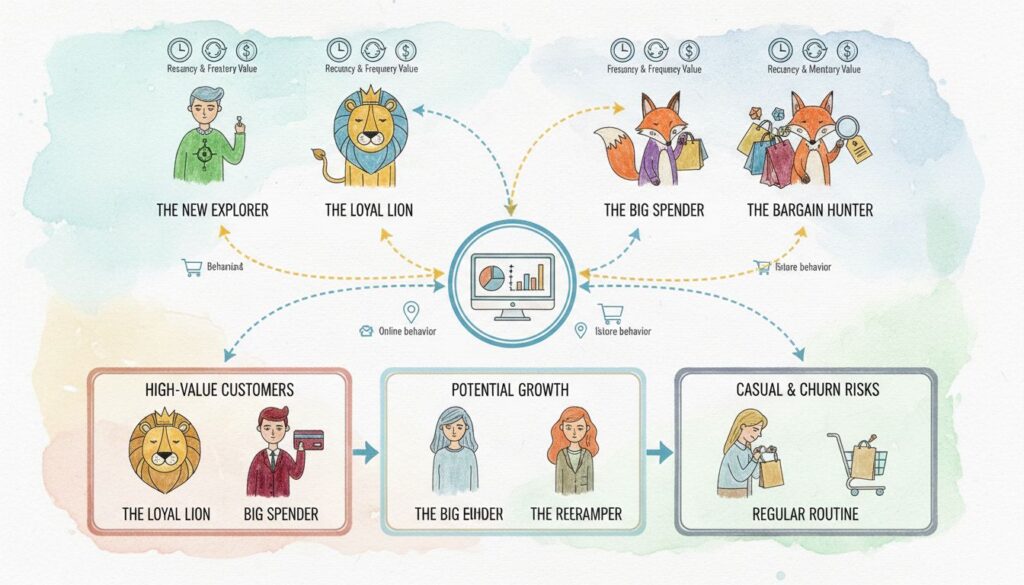
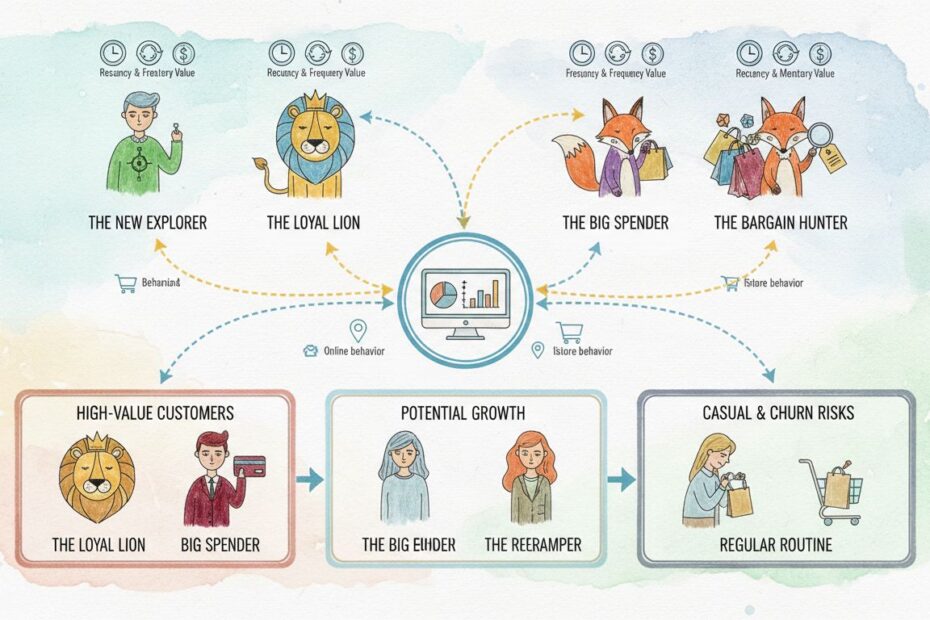
Dynamic customer segmentation solves this problem by automating audience group membership through a centralized rules engine that continuously recalculates which customers belong in each segment as their behaviors, lifecycle stages, and attributes change in real time. Instead of exporting lists, teams define Boolean logic conditions once and let the system handle all membership updates automatically. A customer who abandons a cart enters the “High-Intent Cart Abandoners” segment within minutes, receives a targeted offer, completes the purchase, and exits the segment just as quickly.
The strategic impact is substantial. Dynamic segmentation reduces unsubscribe rates by ensuring only relevant customers receive each message, improves email deliverability through consistent list hygiene, and dramatically increases customer lifetime value (CLV) by enabling precision retention campaigns that respond to actual customer behavior rather than historical snapshots.
Use case overview
Building dynamic customer segments means establishing an automated, continuous process where customer profile membership updates in response to real-time events and behavioral changes. Unlike static segmentation, which requires manual list refreshes and creates a growing gap between segment definition and actual customer state, dynamic segmentation maintains segment accuracy by re-evaluating membership criteria every time a new data signal arrives.
The core architecture consists of four components working in unison. First, a unified data collection layer ingests real-time customer events from your digital storefront, email platform, CRM, and transaction system. Second, a rules engine applies Boolean logic to these data streams, determining which customers meet the inclusion and exclusion criteria for each segment.
Third, an audience management system maintains the current membership list for each segment, adding or removing customers as they qualify or disqualify based on the rules. Fourth, a campaign orchestration layer connects segment membership directly to automated marketing workflows, so customers entering a segment trigger personalized campaigns within seconds.
This use case is essential for retail and e-commerce teams that operate at scale, manage multiple customer lifecycle stages simultaneously, and require precision timing to maximize conversion and retention metrics.
When this use case matters
Dynamic customer segmentation becomes critical when your business operates under conditions that make static lists ineffective or costly. If your e-commerce operation processes hundreds of orders daily, customer behavior changes faster than manual list exports can capture. If your marketing team manages multiple campaigns across email, SMS, push notifications, and on-site personalization, static segments create coordination problems where customers receive conflicting messages because list membership is out of sync across channels.
Dynamic segmentation matters when you need to respond to immediate behavioral signals. A customer who abandons a cart at 11 PM should receive a win-back email by 7 AM the next morning, not three days later when someone manually pulls and uploads a new list. A high-value customer showing declining purchase frequency needs to be identified and enrolled in a VIP retention program within hours, not weeks. When customer lifetime value depends on timing and relevance, static lists are too slow.
This use case also becomes essential when your retention strategy requires sophisticated audience logic. You cannot manually maintain a segment for “customers who viewed our bestselling product category more than three times in the past 48 hours AND have not purchased in the past 14 days AND are not currently enrolled in an active support ticket.” That level of precision requires a rules engine. Similarly, managing exclusion logic to prevent customer fatigue (ensuring a VIP customer never receives a generic discount offer while simultaneously enrolled in a premium retention program) requires automated, centralized audience governance.
How it works in practice
Building dynamic customer segments follows a systematic workflow. The process begins with data signal definition, where you identify which customer behaviors and attributes matter most to your business objectives. In retail, this includes product viewing patterns, cart interactions, purchase frequency and recency, monetary value spent, email engagement metrics, loyalty program status, and time since last contact.
These signals flow continuously into your rules engine, which evaluates Boolean conditions in real time. A rule might read: “Include customers where (Product Category Views = Activewear AND View Count >= 3 AND Time Window = Last 48 Hours) AND (Last Purchase Date < 14 Days Ago) AND NOT (Support Ticket Status = Open).” The rules engine processes each incoming event, checks it against all active segment conditions, and updates customer membership accordingly.
Once membership updates, the audience orchestration system immediately makes the customer available to connected campaigns. Marketing automation platforms, email service providers, and SMS systems receive real-time API notifications that a customer has entered or exited a segment. Campaigns configured to trigger on segment entry automatically launch personalized workflows. A customer entering the “Cart Abandoner” segment might trigger a three-email sequence featuring the abandoned product, customer reviews, and a limited-time discount code.
The entire cycle operates with minimal latency. Modern customer data platforms can process and act on segment membership changes within seconds to minutes, depending on system architecture and data refresh intervals. This speed enables relevance at scale: each customer receives the right message at the right moment in their journey.
Example scenario in retail or e-commerce
Consider an online apparel retailer managing a customer base of 500,000 active shoppers. The retention team wants to reduce cart abandonment, which currently costs the business 8 percent of potential revenue monthly. Historically, they manually pulled a list of customers with abandoned carts every morning, which meant a 12 to 18 hour delay between abandonment and outreach.
The team implements dynamic segmentation using a rule engine. The rule is defined as: “Include customers where (Cart Status = Active/Abandoned) AND (Time Since Cart Abandonment <= 24 Hours) AND (Cart Value >= $50) AND (Previous Purchase History = At Least 1 Purchase) AND NOT (Email Unsubscribe Status = True).” The system continuously evaluates this rule against incoming cart events from the e-commerce platform.
At 11:47 PM on a Tuesday, a customer adds a $120 activewear bundle to their cart and closes the browser without checking out. Within two minutes, the rules engine identifies the customer as meeting all inclusion criteria and automatically adds them to the “High-Value Cart Abandoners” segment. An automated email workflow triggers immediately, delivering a personalized message featuring the exact products abandoned, a customer review highlighting the quality, and a one-time 10 percent discount code valid for 48 hours.
The customer receives the email at 11:52 PM. They read it on their phone at 6:30 AM the next morning, click the discount link, and complete the purchase by 7:15 AM. Because the outreach happened within minutes rather than 12 to 18 hours, the customer’s purchase intent was still high, conversion was likely, and the business captured revenue that would otherwise have been lost.
Simultaneously, another customer in the same segment completes their abandoned purchase at 2:00 AM without seeing the email. The rules engine automatically removes them from the “High-Value Cart Abandoners” segment because the “Cart Status = Active/Abandoned” condition no longer applies. They no longer receive follow-up messages, preventing redundant outreach and protecting the brand’s email reputation.
Data, tools, and teams involved
Dynamic customer segmentation requires coordination across multiple data sources, technical platforms, and team functions. Understanding the ecosystem helps ensure successful implementation.
Data sources include your e-commerce platform (product views, cart events, purchase transactions), customer relationship management system (customer profiles, communication history, lifecycle stage), email marketing platform (open and click events, unsubscribe status), SMS gateway (delivery and engagement data), loyalty program system (points, tier status, redemptions), and any first-party customer data you collect through surveys or preference centers.
Platform capabilities needed include a customer data platform or CDP-adjacent system that ingests all data sources into a unified customer profile, a rules engine that supports Boolean logic and real-time evaluation, an audience management system that maintains segment membership lists, and multi-channel campaign orchestration tools that can trigger workflows based on segment entry or exit events.
The teams involved span marketing operations (defining segment strategy and rules), data engineering (implementing event tracking and data pipeline integrity), marketing automation specialists (building and testing campaign workflows), email deliverability experts (monitoring list quality and sender reputation), analytics and measurement teams (tracking segment performance and ROI), and CRM managers (overseeing customer data governance and privacy compliance).
Segment Roles and Responsibilities
| Component | Responsibility | Key Tools/Systems |
|---|---|---|
| Data Collection | Ingesting real-time customer events from all touchpoints | E-commerce platform, CRM, email service provider, analytics |
| Rules Engine | Evaluating Boolean logic conditions and membership criteria | CDP, marketing automation platform, or dedicated segmentation engine |
| Audience Management | Maintaining current segment membership and member counts | Customer data platform, CRM system, audience management interface |
| Campaign Orchestration | Triggering personalized workflows based on segment membership | Email marketing platform, SMS gateway, push notification service, web personalization engine |
| Monitoring and Optimization | Tracking segment performance, accuracy, and campaign ROI | Analytics platform, dashboard, A/B testing framework |
| Governance and Compliance | Ensuring data privacy, consent, and regulatory adherence | Privacy management tools, consent database, audit logs |
How to measure success
Measuring the impact of dynamic customer segmentation requires tracking metrics across three dimensions: segment accuracy, operational efficiency, and business outcome.
Segment accuracy measures whether customers in a segment actually match the intended cohort. Calculate the percentage of segment members who completed the target action (e.g., 72 percent of “Cart Abandoners” segment members completed a purchase within 7 days of receiving the follow-up email). Low accuracy indicates that inclusion or exclusion rules need refinement. You should also track time to membership update, which measures the latency between a customer event and their addition or removal from a segment. If a customer abandons a cart at 11:47 PM and is not added to the segment until 1:30 PM the next day, the delay has reduced campaign effectiveness.
Operational efficiency metrics include segment refresh frequency (how often membership is recalculated), list overlap percentage (the proportion of customers simultaneously enrolled in multiple conflicting segments, which indicates potential coordination problems), and manual list export reduction (the percentage decrease in time spent pulling and uploading static lists). These metrics demonstrate that the dynamic system is functioning as designed and reducing operational burden.
Business outcome metrics are the most important. Track repeat purchase rate by segment (customers in the “Engaged New Subscribers” segment should show higher repeat purchase rates than control groups), customer lifetime value lift attributed to segment-driven campaigns, email unsubscribe rate by segment (segments receiving highly relevant campaigns should show lower unsubscribe rates), and overall campaign ROI (revenue generated by segment-driven campaigns divided by campaign costs). Compare these metrics before and after implementing dynamic segmentation to quantify the business impact.
How Bloomreach can help
Bloomreach is the platform purpose-built for dynamic customer segmentation at enterprise scale. The Bloomreach Engagement platform unites a real-time Customer Data Platform with multi-channel orchestration, eliminating the integration friction and data synchronization delays that plague fragmented marketing stacks.
Bloomreach’s Segmentations feature allows you to build dynamic audience groups using an intuitive interface that supports complex Boolean logic without requiring SQL or technical coding. You define inclusion and exclusion rules once, and Bloomreach automatically maintains segment membership as new customer data arrives. The platform processes real-time event streams, so customers are added or removed from segments within seconds, enabling immediate campaign triggers.
The platform’s AutoSegments capability goes further by automatically generating segment recommendations based on behavioral patterns and customer attributes. Rather than manually defining every segment, your team can leverage Bloomreach’s AI-powered insights to discover high-value audience groups you might otherwise miss. This accelerates segment discovery and ensures you are capitalizing on all viable retention and conversion opportunities.
Bloomreach’s Audience Builder provides a visual interface for constructing multi-dimensional segment conditions. You can combine behavioral triggers (product views, cart abandonment, email opens), lifecycle attributes (customer tenure, purchase frequency, monetary value), and real-time context (device type, geographic location, time of day) into sophisticated audience definitions. The platform’s live event ingestion ensures that every customer interaction updates their profile and segment eligibility instantly.
For teams managing complex customer journeys across multiple channels, Bloomreach’s integrated orchestration layer connects segment membership directly to email, SMS, push notifications, and on-site personalization. When a customer enters a segment, Bloomreach automatically triggers the configured campaign across all relevant channels in coordinated sequence. This eliminates manual handoffs and ensures consistent messaging.
The platform also handles a critical operational challenge: preventing customer fatigue through intelligent audience overlap management. Bloomreach allows you to define segment hierarchies and priority rules, ensuring that VIP customers enrolled in premium retention programs do not simultaneously receive generic discount offers. This governance layer protects both customer experience and brand reputation.
How Voxwise can help
Voxwise specializes in translating complex customer engagement strategies into operational reality. For brands building dynamic customer segments, Voxwise provides three critical services: data architecture assessment, platform implementation, and ongoing optimization.
Data architecture assessment begins with auditing your current data collection practices. Voxwise evaluates whether your event tracking is comprehensive enough to support dynamic segmentation, identifies gaps in data quality that could undermine segment accuracy, and designs a data collection roadmap that ensures clean, consistent signals flow into your rules engine. Many retail teams discover that their product tracking is incomplete or that customer identifiers are not unified across systems, both of which prevent effective segmentation.
Platform implementation involves configuring your chosen segmentation platform (such as Bloomreach) with bulletproof rules logic. Voxwise works with your team to translate business requirements into precise Boolean conditions, test segment membership against historical data to validate accuracy before launch, and establish data governance practices that prevent common mistakes like accidental list overlap or inclusion of unsubscribed customers. Voxwise also audits your event tracking implementation to ensure that the data flowing into the rules engine is accurate and timely.
Ongoing optimization is where dynamic segmentation delivers sustained value. Voxwise helps you monitor segment performance, identify rules that need refinement based on actual campaign results, and continuously expand your segment portfolio to address new business objectives. As customer behavior evolves, as your product offering changes, and as you discover new retention opportunities, your segmentation strategy must evolve with it. Voxwise provides the strategic guidance and technical expertise to ensure your dynamic segments remain high-yield over time.
Voxwise’s approach is grounded in operational reality. Rather than implementing segmentation as a one-time project, Voxwise treats it as a continuous capability that requires ongoing refinement, team training, and strategic evolution. This ensures that your investment in dynamic segmentation delivers compounding returns rather than diminishing value over time.
FAQ Section
What is the difference between a static and a dynamic customer segment?
A static segment is a fixed list of customers pulled at a specific point in time. Once created, the list does not change unless someone manually exports and re-uploads a new version. A customer who qualifies for the segment today might no longer qualify tomorrow, but they remain on the list until someone manually removes them. Dynamic segments, by contrast, automatically update membership in real time. Customers are added when they meet the defined criteria and removed when they no longer qualify, without any manual intervention.
How often do dynamic customer segments update their list membership?
Update frequency depends on your data pipeline architecture and platform capabilities. Modern customer data platforms can process segment membership changes within seconds to minutes of a customer event. For example, when a customer abandons a cart, the e-commerce platform sends an event to the CDP, the rules engine evaluates the customer against segment criteria, and the customer is added to the “Cart Abandoners” segment within 30 seconds to 2 minutes. Some platforms offer sub-second latency, while others operate on a batch refresh schedule (e.g., every 15 minutes or hourly). For most retail and e-commerce use cases, minute-level latency is sufficient to capture behavioral intent and trigger timely campaigns.
What specific data points do you need to trigger a real-time segment?
The data points required depend on your segment definition. Common triggers include product category views and frequency (for engagement segments), cart events and cart value (for abandonment segments), purchase history and recency (for lifecycle segments), monetary spend and customer lifetime value (for value-based segments), email engagement metrics like opens and clicks (for engagement quality), time since last contact (for dormancy and churn risk), loyalty program status and tier (for VIP segments), and customer support ticket status (for exclusion rules preventing outreach to customers with open issues). Each data point must be tracked in real time and integrated into a unified customer profile for the rules engine to evaluate.
How do you prevent a customer from entering multiple dynamic segments at once?
Segment overlap prevention requires two mechanisms: clear inclusion and exclusion rules at the segment level, and a hierarchy system at the portfolio level. At the segment level, exclusion rules can prevent customers from entering conflicting segments. For example, a “Generic Discount” segment might include an exclusion rule that removes any customer already enrolled in a “VIP Retention” segment. At the portfolio level, many platforms support segment hierarchy and priority rules. You can define VIP segments as “primary” segments that take precedence over generic segments, ensuring that high-value customers never receive generic offers even if they technically qualify for both. Additionally, you can configure campaign logic so that enrollment in one segment automatically removes a customer from conflicting segments. This requires careful planning during segment design and ongoing governance to prevent unintended overlap.
Conclusion
Dynamic customer segmentation transforms retention and personalization from a manual, reactive process into an automated, real-time capability. By implementing a rules-based system that continuously updates customer audience membership as behavior changes, retail and e-commerce teams can eliminate the delays and inaccuracies inherent in static list management, respond to behavioral intent within minutes rather than days, and deliver precision campaigns that maximize customer lifetime value at scale.
The architecture required is straightforward: unified data collection, a rules engine supporting Boolean logic, audience membership management, and campaign orchestration. The business impact is measurable: higher conversion rates from timely outreach, improved email deliverability through consistent list hygiene, and significant increases in customer lifetime value through precision retention.
Bloomreach provides the platform infrastructure to scale dynamic segmentation across millions of customers, while Voxwise provides the strategic guidance and implementation expertise to ensure your segmentation strategy delivers sustained business value. The combination of technology and consulting enables brands to move beyond static audience lists and build retention engines that respond to actual customer behavior in real time.
Explore Dynamic Segmentation with Voxwise
Building dynamic customer segments requires clean data architecture, sophisticated platform capabilities, and strategic expertise. Voxwise helps retail and e-commerce brands design, implement, and optimize real-time segmentation systems that drive measurable increases in customer lifetime value and retention.
Request a 30-Minute Customer Engagement Consultation to discuss your segmentation and personalization strategy with our team.