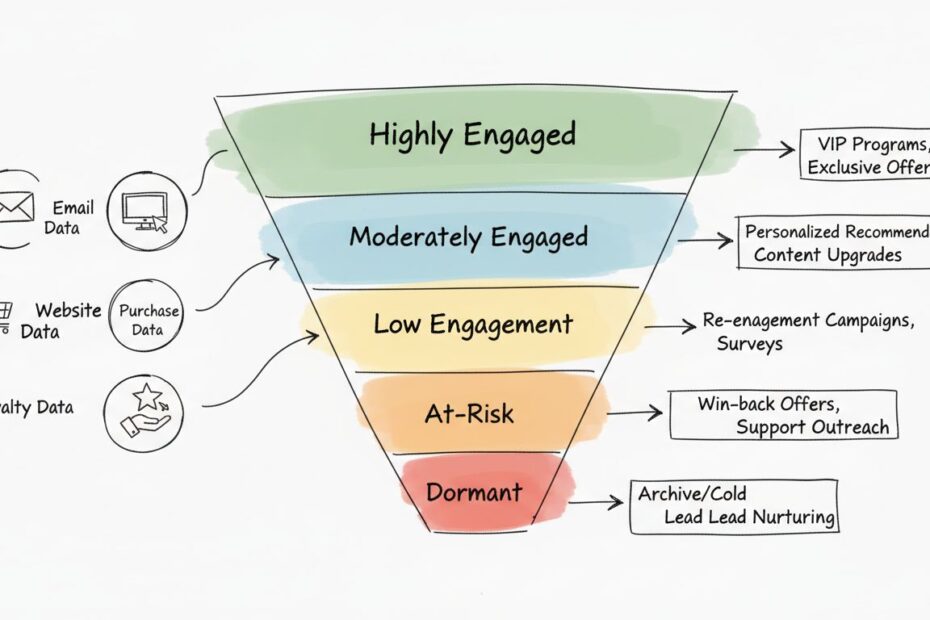
How to Segment Customers by Engagement Level
Segmenting customers by engagement level is one of the most practical and immediate ways to improve your marketing ROI, reduce message fatigue, and strengthen customer retention. Instead of sending the same campaigns to every customer, engagement-level segmentation allows you to tailor your messaging, frequency, and offers based on how actively each customer interacts with your brand. This approach transforms raw behavioral data into actionable customer groups that drive real business results.

What Is Engagement-Level Segmentation?
Engagement-level segmentation means grouping customers based on how actively they interact with your brand across all touchpoints. Rather than dividing customers by demographics or purchase history alone, this segmentation method focuses on behavioral signals that indicate current interest and likelihood to respond to marketing efforts. Common engagement metrics include email opens and clicks, website visits, app activity, product views, session duration, purchase recency, loyalty program activity, campaign response, and inactivity periods. When a customer stops interacting with your emails, website, or loyalty program, that silence is just as important as active engagement. Engagement-level segmentation reveals who is actively interested, who is losing interest, and who needs immediate re-engagement or suppression to protect your sender reputation and marketing efficiency.
Why Segment Customers by Engagement Level?
Customers with different engagement levels have fundamentally different needs and should never receive identical marketing treatment. A highly engaged customer who opens every email and visits your website weekly can handle more frequent communication and is primed for upsell and cross-sell offers. A dormant customer who has not engaged in six months will view frequent emails as spam and damage your deliverability metrics. Engagement-level segmentation directly improves email open rates, click-through rates, conversion rates, and repeat purchase rates by ensuring every customer receives messages that match their current level of interest. It also reduces unsubscribe rates and spam complaints because you are not overwhelming uninterested customers with irrelevant frequency. Beyond campaign performance, engagement segmentation strengthens customer retention by identifying at-risk customers early and triggering targeted re-engagement campaigns before they churn completely. This approach also improves customer lifetime value by nurturing moderately engaged customers toward higher engagement tiers and rewarding your most engaged customers with exclusive offers and early access. Finally, engagement segmentation improves marketing ROI by allocating your budget and effort toward customers most likely to respond, while using lighter-touch, lower-cost strategies for customers with lower engagement potential.
What Data Do You Need to Segment Customers by Engagement Level?
Engagement-level segmentation requires clean, connected, and regularly updated customer interaction and behavioral data. Your CRM or customer data platform must track and unify data from multiple touchpoints to create a complete engagement picture. Essential engagement data includes email open rates, email click-through rates, SMS engagement metrics, website visits and session counts, app sessions and login frequency, page views and product views, cart activity and abandonment, purchase recency and frequency, total spend, loyalty program activity, campaign response, support ticket interactions, last engagement date, and unsubscribe or opt-out behavior. The most important metric is last engagement date, which tells you when a customer last interacted with your brand in any meaningful way. Without accurate, unified customer data, your segments will be incomplete and your activation will fail. This is why investing in a robust customer data platform or ensuring your CRM captures and unifies data from email, web, mobile, loyalty, and purchase channels is foundational to successful engagement segmentation.
Step 1: Define What Engagement Means for Your Brand
Before you create any segments, you must define what engagement actually means in your specific business context. Engagement is not universal. For a retail e-commerce brand, engagement might mean opening promotional emails, clicking product links, viewing the website, adding items to a cart, or making repeat purchases. For a subscription business, engagement might mean logging into an account, downloading content, attending webinars, or renewing a subscription. For a loyalty-focused brand, engagement might mean earning and redeeming points, reaching tier levels, or responding to member-exclusive campaigns. Your definition of engagement should align with your business goals and customer journey. Ask yourself: What actions indicate that a customer is interested in my brand? What behaviors predict that a customer is likely to purchase or stay loyal? What interactions matter most to my business model? Once you answer these questions, your engagement definition will be clear, and your segmentation will be meaningful and actionable rather than arbitrary.
Step 2: Choose Engagement Metrics
After defining engagement, select a focused set of meaningful engagement metrics that you will track and use to segment customers. Do not try to track everything. Overcomplicating your metrics leads to unclear segments and difficult activation. A practical approach is to select three to five core metrics that best represent engagement in your business. Recommended metrics include last engagement date (the single most important metric), email opens and clicks within a specific timeframe, SMS clicks and responses, website visits within 30, 60, or 90 days, app activity and login frequency, product views and category browsing, purchase recency and frequency, loyalty activity such as points earned or redeemed, and campaign response rate. For most retail and e-commerce brands, a strong combination is: (1) last engagement date, (2) email engagement in the last 30-90 days, (3) website visits in the last 30-90 days, and (4) purchase recency. This combination gives you a holistic view of whether a customer is currently active, interested, or dormant. Remember that engagement metrics are broader than purchase behavior alone. A customer can be highly engaged with your content and website but not have purchased recently, or they may have purchased once but never engaged with your marketing. Tracking both engagement and purchase behavior gives you the complete picture.
Step 3: Create Engagement Tiers
Now establish clear, standardized engagement tiers that will serve as the foundation for your segments. Tiers create a simple hierarchy that makes tracking, activation, and communication frequency straightforward. Use predefined timeframes such as 30, 60, 90, or 180 days to make your tiers consistent and easy to maintain. A practical five-tier model works well for most retail and e-commerce brands:
| Engagement Tier | Definition | Last Activity Timeframe |
|---|---|---|
| Highly Engaged | Active customers with recent interactions | Within 30 days |
| Moderately Engaged | Customers who interact occasionally but consistently | Within 60 days |
| Low Engagement | Customers with declining or infrequent interactions | Within 90 days |
| At-Risk | Previously engaged customers showing decline | 60-180 days |
| Dormant | No meaningful activity for extended period | 180+ days |
These tiers are not permanent labels. Customers move between tiers based on their ongoing behavior. A dormant customer who suddenly opens an email and visits your website moves back to “at-risk” or “low engagement.” A highly engaged customer who stops interacting for 60 days moves to “moderately engaged.” This dynamic movement is healthy and expected. Your segmentation system should recalculate these tiers automatically on a regular basis (weekly or monthly) so that customers always belong to the tier that reflects their current behavior.
Step 4: Create Engagement-Level Segments and Define Actions
With your tiers defined, now create specific customer segments and assign recommended campaign actions to each one. These are not theoretical segments. Each segment should have clear, actionable campaign and CRM responses.
Highly Engaged Customers
What this segment means: Highly engaged customers are your most active and responsive audience. They regularly open and click your emails, visit your website frequently, view products, engage with your loyalty program, and often purchase recently. These customers are already interested and are most likely to respond to your marketing efforts.
Why it matters: Highly engaged customers have the highest conversion potential, repeat purchase rate, and customer lifetime value. They are also your best advocates and referral sources. Investing in this segment with exclusive offers, early access, and loyalty rewards generates significant ROI and strengthens long-term relationships.
How to identify them: Look for customers with email opens and clicks in the last 30 days, website visits within the last 30 days, recent purchases (within 60 days), active loyalty program participation, or high session frequency and engagement depth. In your CRM, query for customers whose “last engagement date” is within the last 30 days and who have at least 3-5 interactions in that period.
Recommended campaign and CRM actions:
- Send early access campaigns for new products or sales
- Create VIP or exclusive offers not available to other segments
- Launch referral programs and ambassador initiatives
- Deliver personalized product recommendations based on browsing and purchase history
- Send loyalty rewards and milestone celebrations
- Provide exclusive content or educational materials
- Activate cross-sell and upsell campaigns with products complementary to past purchases
- Increase email frequency slightly if data shows they respond well
- Invite them to exclusive events, webinars, or community access
Moderately Engaged Customers
What this segment means: Moderately engaged customers interact with your brand inconsistently. They may open some emails, visit your website occasionally, or make purchases sporadically. They show interest but lack the consistency or frequency of highly engaged customers.
Why it matters: Moderately engaged customers represent significant growth opportunity. They are not yet lost, but they are at risk of declining further if you do not maintain relevance and interest. With the right messaging, personalization, and timing, you can move many of these customers into the highly engaged tier, significantly increasing their lifetime value.
How to identify them: Look for customers with email opens or clicks within 60 days but not consistently, website visits within 60 days but lower frequency than highly engaged customers, occasional purchases (one purchase in the last 90 days, for example), or moderate loyalty activity. These customers show interest but lack the regular interaction pattern of your most engaged segment.
Recommended campaign and CRM actions:
- Deploy personalized product recommendations based on past browsing and purchases
- Send category-based campaigns aligned with their demonstrated interests
- Deliver educational content that adds value beyond promotional messages
- Invite them to loyalty program if not already members
- Use preference collection campaigns to better understand their interests
- Implement send-time optimization to improve open rates
- Create win-back campaigns if they have not engaged in 45-60 days
- Test different content formats (video, carousel, interactive) to increase engagement
- Offer targeted incentives such as discounts on their favorite categories
Low-Engagement Customers
What this segment means: Low-engagement customers rarely open emails, visit infrequently, show minimal campaign response, and may not have purchased recently. They are still on your list and in your database, but they are not currently interacting meaningfully with your brand.
Why it matters: Low-engagement customers consume resources (email sending costs, deliverability impact) without generating return. However, they should not be immediately discarded. Many can be reactivated with the right approach. If left alone, they will eventually become dormant, at which point reactivation becomes much harder. Low-engagement customers also negatively impact your email metrics (open rates, click rates) and sender reputation if you continue sending them frequent campaigns.
How to identify them: Look for customers with low email open rates (less than 10-15% of sends), no email clicks in 60-90 days, few website visits in the last 90 days, no recent purchases, or declining interaction trends. These customers may have been engaged in the past, but their current behavior shows minimal interest.
Recommended campaign and CRM actions:
- Reduce communication frequency significantly (from weekly to monthly, for example)
- Test new messaging approaches or content types to re-spark interest
- Launch preference center campaigns to ask about their interests and communication preferences
- Implement stronger personalization using their purchase history or browsing data
- Send your best-performing content (your most opened and clicked emails)
- Offer targeted, time-limited incentives to encourage action
- Use re-engagement campaigns with clear calls-to-action
- Segment further by product category or purchase history for more targeted messaging
- Consider SMS or push notifications as alternative channels if available
At-Risk Customers
What this segment means: At-risk customers are those whose engagement has declined compared with their previous behavior. They may have been highly or moderately engaged in the past but have not interacted with your brand in 60-90 days. This segment represents customers who are actively slipping away and need immediate intervention.
Why it matters: At-risk customers are your biggest re-engagement opportunity. They have already demonstrated interest and loyalty in the past, which means they can be recovered before they become fully dormant. The cost of reactivating an at-risk customer is often lower than acquiring a new customer. Missing this window means losing valuable customers to competitors or apathy.
How to identify them: Look for customers whose last engagement date was 60-90 days ago, who used to engage regularly but have gone silent, whose purchase frequency has declined, or who used to open emails but now do not. Compare their current behavior to their historical behavior to identify the decline.
Recommended campaign and CRM actions:
- Launch targeted re-engagement campaigns with personalized messaging
- Offer special return incentives or exclusive discounts to encourage action
- Send win-back messages that acknowledge their past loyalty
- Create loyalty reminders highlighting their points balance or tier status
- Deliver product recommendations based on their past purchases
- Send replenishment reminders if applicable (for consumables or seasonal products)
- Offer feedback surveys to understand why engagement declined
- Use multi-channel approach (email, SMS, push) to increase visibility
- Create time-limited offers to create urgency
- Segment by reason for decline if possible (e.g., customers who stopped opening emails vs. those who stopped purchasing)
Dormant or Disengaged Customers
What this segment means: Dormant customers have had no meaningful activity for 180 days or longer. They have not opened emails, visited your website, engaged with loyalty programs, or made purchases. From a practical standpoint, they are no longer active customers.
Why it matters: Dormant customers present a deliverability risk. If you continue sending campaigns to customers who never engage, email providers will flag your sender reputation as poor, which hurts your ability to reach engaged customers. Dormant customers also consume resources without generating revenue. However, some dormant customers can be reactivated with a final, well-crafted campaign before being removed from your active mailing list.
How to identify them: Look for customers with no email opens in 180+ days, no website visits in 180+ days, no purchases in 180+ days, no loyalty activity in 180+ days, or unsubscribe or opt-out indicators. These customers have been inactive for an extended period.
Recommended campaign and CRM actions:
- Send a final reactivation campaign with a compelling offer or message
- Create feedback surveys to understand why they became inactive
- Offer a special return incentive (one-time discount, free shipping) to encourage re-engagement
- Implement sunset flows that gradually remove them from your list if they do not re-engage
- Suppress from regular campaigns to protect your sender reputation
- Consider list cleaning after the final campaign if they remain inactive
- Archive or flag these customers in your CRM for potential future re-engagement
- Use this segment to understand churn patterns and improve retention strategies
Email-Engaged Customers
What this segment means: Email-engaged customers regularly open or click your email campaigns, showing that they have an active interest in email as a communication channel. They may or may not purchase, but they consistently interact with your email content.
Why it matters: Email engagement is a strong predictor of campaign response. Customers who open and click emails are more likely to respond to calls-to-action and convert. Email-engaged customers also represent a channel preference signal. They prefer email communication, and you should leverage this preference.
How to identify them: Look for customers with repeated email opens (opening 40%+ of emails sent), regular email clicks, email conversions (clicking through to purchase), or consistent engagement over time. Track email engagement separately from other behaviors to identify this segment.
Recommended campaign and CRM actions:
- Send personalized newsletters tailored to their interests
- Deliver product recommendations in email format
- Send loyalty program updates and rewards notifications
- Create content-based campaigns with valuable, non-promotional content
- Launch cross-sell campaigns featuring complementary products
- Increase email frequency slightly if data shows they can handle it
- Use dynamic content in emails to personalize for each recipient
- Test subject lines and send times to maximize opens and clicks
Website-Engaged Customers
What this segment means: Website-engaged customers regularly visit your website, browse products, view categories, and interact with key pages. They demonstrate purchase intent through their browsing behavior, even if they do not always complete purchases.
Why it matters: Website activity is a strong purchase intent signal. Customers who visit your site and view products are actively considering a purchase. Website engagement also reveals product interests and category preferences that you can use for personalization. These customers are warm leads ready for targeted campaigns.
How to identify them: Look for customers with recent website sessions (within 30 days), product page views, category browsing activity, repeated visits, cart activity (items added but not purchased), or high session frequency. Use your analytics or CRM to identify these behavioral signals.
Recommended campaign and CRM actions:
- Launch browse abandonment campaigns reminding them of viewed products
- Send product reminders featuring items they viewed recently
- Implement onsite personalization showing relevant products and offers
- Create category-based recommendations aligned with their browsing history
- Build retargeting audiences for paid advertising campaigns
- Offer time-limited incentives to encourage purchase completion
- Send cart abandonment campaigns if they added items but did not check out
- Provide product comparison content to help purchase decisions
- Test different product angles (price, features, benefits) based on browsing behavior
Loyalty-Engaged Customers
What this segment means: Loyalty-engaged customers actively participate in your loyalty program. They check their points balance, redeem rewards, reach tier levels, and respond to member-exclusive campaigns. This segment signals a strong, ongoing relationship with your brand.
Why it matters: Loyalty engagement indicates high customer lifetime value and strong retention potential. Loyalty-engaged customers are already invested in your program and brand. They are among your most valuable customers and are most likely to make repeat purchases and recommend you to others.
How to identify them: Look for customers who check loyalty points regularly, redeem rewards, reach tier milestones, respond to loyalty campaigns, or maintain active loyalty program membership. Track loyalty platform activity separately to identify this segment.
Recommended campaign and CRM actions:
- Send points balance reminders encouraging redemption
- Create tier upgrade campaigns showing progress toward next level
- Deliver exclusive member offers not available to non-members
- Send anniversary rewards or birthday incentives
- Launch referral campaigns encouraging them to bring friends
- Provide personalized reward recommendations based on past redemptions
- Create VIP experiences or exclusive events for top-tier members
- Send early access to sales for loyalty members
- Celebrate loyalty milestones (membership anniversaries, points reached)
Step 5: Activate Engagement Segments in Campaigns
Segmentation is only valuable when it leads to different actions. Once you have defined your segments, you must activate them across your marketing and CRM channels. Engagement segments should be activated in email campaigns, SMS and push notifications, onsite personalization, product recommendation engines, paid advertising audiences, loyalty campaigns, and automated lifecycle journeys. Each engagement tier should receive different messaging, different frequency, different offers, and different timing. For example, a highly engaged customer might receive an email every 3-4 days with exclusive offers, while a low-engagement customer receives an email once per month with your best-performing content. Without activation, segmentation is just data analysis. With activation, it becomes a revenue driver.
Step 6: Adjust Communication Frequency by Engagement Level
One of the most practical benefits of engagement-level segmentation is the ability to optimize communication frequency and prevent message fatigue. Customers with different engagement levels have different capacity for and tolerance of marketing messages. Highly engaged customers can handle more frequent communication (3-4 times per week) because they actively open and click your emails. They are not fatigued by frequency; they are interested in staying connected. Moderately engaged customers need more selective and relevant messages (1-2 times per week) because they do not engage with every send. Sending them too frequently will lower their open rates and increase unsubscribes. Low-engagement customers need significantly reduced frequency (1-2 times per month) and should receive only your highest-value, best-performing content. More frequent sends will only damage your metrics and their perception of your brand. Dormant customers should not receive regular campaigns at all. A single re-engagement campaign followed by suppression is the right approach. This frequency optimization directly improves your email metrics, sender reputation, unsubscribe rates, and customer satisfaction. It also improves your marketing ROI because you are not wasting budget on sends to disengaged customers.
Engagement-Level Segmentation and Personalization
Engagement-level segmentation is the foundation for hyper-personalized customer journeys. When you know a customer’s engagement level, you can personalize not just the content, but the entire customer experience. Highly engaged customers receive early access to new products, VIP treatment, and exclusive offers because they have earned that status through their consistent engagement. At-risk customers receive re-engagement campaigns with personalized offers based on their past behavior, acknowledging their previous loyalty. Dormant customers receive sunset flows that thank them for past business and offer a final incentive to return, but do not continue bombarding them with regular campaigns. Website-engaged customers receive product reminders and onsite personalization showing items they viewed. Loyalty-engaged customers receive reward-focused messaging and exclusive member benefits. This personalization approach goes far beyond name insertion or product recommendations. It personalizes the entire communication strategy to match each customer’s current engagement level and needs. This level of personalization drives significantly higher engagement rates, conversion rates, and customer lifetime value.
Engagement-Level Segmentation in Bloomreach
Bloomreach is the leading customer engagement platform for retail and e-commerce brands looking to turn engagement-level segmentation into activated, personalized customer experiences. Bloomreach allows you to ingest customer interaction data from all touchpoints—email, website, mobile app, loyalty program, and purchase history—and create meaningful engagement-level segments in real time. The platform’s segmentation engine lets you define engagement tiers based on behavioral conditions such as “email opens in the last 30 days,” “website visits in the last 60 days,” or “no purchase in 180 days.” Once you have created your engagement segments, Bloomreach makes it easy to activate them across email campaigns, SMS campaigns, push notifications, onsite personalization, product recommendations, and automated customer journeys. You can assign different messaging, frequency, and offers to each engagement tier, ensuring that every customer receives the right message at the right time. Bloomreach also provides real-time reporting on segment performance, showing you how each engagement tier responds to campaigns and how customers move between segments over time. This visibility helps you continuously optimize your engagement strategy and improve outcomes. For retail and e-commerce brands serious about using engagement data to drive retention, personalization, and revenue, Bloomreach is the platform that connects data, segmentation, and activation seamlessly.
Common Mistakes When Segmenting by Engagement Level
Avoid these common pitfalls when implementing engagement-level segmentation:
- Defining engagement too broadly: If your engagement definition is vague (“customer is interested”), your segments will be unclear and hard to activate. Be specific: “email opens in the last 30 days” or “website visit in the last 60 days.”
- Tracking too many metrics: Overcomplicating your segmentation with 10+ metrics makes implementation difficult and segments confusing. Stick to 3-5 core metrics.
- Relying only on email opens: Email opens are important, but they are not sufficient alone. Combine email opens with website visits, purchase behavior, and loyalty activity for a complete picture.
- Ignoring website and purchase behavior: Some brands focus only on email engagement and miss important signals from website activity and purchase recency.
- Not updating segments regularly: Engagement changes frequently. Update your segments at least weekly or monthly to ensure customers are in the right tier.
- Sending the same campaigns to every engagement tier: This defeats the purpose of segmentation. Each tier should receive different messaging, frequency, and offers.
- Over-messaging low-engagement customers: Sending frequent campaigns to customers with low engagement will only increase unsubscribes and damage your sender reputation.
- Not using suppression or sunset flows: Dormant customers should be suppressed from regular campaigns and, if they do not re-engage, removed from your list.
- Not measuring performance by segment: Track how each engagement tier responds to campaigns. If a segment is underperforming, adjust your strategy.
- Ignoring consent and preferences: Always respect customer consent and communication preferences. Do not send campaigns to opted-out or unsubscribed customers.
How to Measure Engagement Segment Performance
Segmentation is only effective if you measure its impact. Track these key metrics to understand how each engagement tier performs and whether your segmentation strategy is working:
Campaign performance metrics:
- Email open rate by segment (highly engaged should have higher open rates)
- Email click-through rate by segment
- SMS click rate by segment
- Conversion rate by segment (purchase rate from email or SMS)
- Unsubscribe rate by segment (low-engagement segments should have lower unsubscribe rates if frequency is reduced)
Customer behavior metrics:
- Repeat purchase rate by segment (how many customers in each tier make a second purchase)
- Retention rate by segment (percentage of customers retained month-over-month)
- Churn rate by segment (percentage of customers who become inactive)
- Reactivation rate by segment (percentage of at-risk or dormant customers who re-engage)
Revenue metrics:
- Revenue per segment (total revenue generated by each engagement tier)
- Customer lifetime value by segment (lifetime revenue per customer)
- Campaign revenue (revenue generated directly from campaigns to each segment)
- Average order value by segment
List health metrics:
- Spam complaint rate by segment (should decrease when you reduce frequency for low-engagement segments)
- Bounce rate by segment
- Engagement recovery rate (percentage of at-risk customers moved back to moderately or highly engaged)
Review these metrics monthly and adjust your segmentation strategy based on performance. If a segment is underperforming, test different messaging, offers, or frequency. If a segment is outperforming, consider increasing investment in that tier.
How Voxwise Helps Brands Segment Customers by Engagement Level
Voxwise partners with retail and e-commerce brands to turn engagement data into actionable CRM and customer engagement strategies that drive retention, personalization, and revenue growth. We help you define commercially meaningful engagement segments that align with your business goals and customer journey. Our team works with you to design engagement-level segmentation that captures the nuances of your customer base—from highly engaged loyalists to at-risk customers on the verge of churn. We connect your engagement data with your campaign strategy, ensuring that every segment receives the right message, at the right frequency, with the right offer. We design retention and re-engagement flows that move customers up the engagement ladder—converting at-risk customers into moderately engaged customers, and moderately engaged customers into loyal advocates.
We optimize your communication frequency to eliminate message fatigue while maintaining connection with customers who need it. We activate your engagement segments in Bloomreach and other customer engagement platforms, enabling real-time personalization and campaign automation. Finally, we measure the impact of your engagement segmentation on retention rates, repeat purchase rates, customer lifetime value, and marketing ROI, ensuring that your segmentation strategy delivers measurable business results. If you are ready to move beyond generic segmentation and activate engagement data as a growth lever, Voxwise is here to help.
Conclusion
Engagement-level segmentation is not a one-time project. It is an ongoing practice that evolves as your customer base and business goals change. The brands that win are those that continuously track engagement signals, update their segments, and activate them with personalized campaigns and experiences. By implementing the six-step process outlined in this guide—defining engagement, choosing metrics, creating tiers, building segments, activating campaigns, and optimizing frequency—you can transform your customer data into a competitive advantage. Your highly engaged customers will feel valued and become brand advocates. Your at-risk customers will be recovered before they churn. Your dormant customers will be handled respectfully, protecting your sender reputation. And your entire customer base will receive marketing that feels relevant, timely, and respectful of their current level of interest. That is the power of engagement-level segmentation.
FAQ
1. What is engagement-level segmentation?
Engagement-level segmentation groups customers based on how actively they interact with your brand. It uses behavioral signals such as email opens, website visits, purchase recency, and loyalty activity to create actionable customer segments.
2. How do you segment customers by engagement level?
Follow these steps: (1) Define what engagement means for your business, (2) Choose 3-5 core engagement metrics, (3) Create engagement tiers (highly engaged, moderately engaged, low engagement, at-risk, dormant), (4) Build specific customer segments with defined actions, (5) Activate segments in campaigns and journeys, (6) Optimize communication frequency by tier.
3. What data is needed to segment customers by engagement level?
You need customer interaction data including email opens and clicks, website visits, app activity, product views, purchase recency and frequency, loyalty activity, campaign response, and last engagement date. This data must be clean, unified, and regularly updated in your CRM or customer data platform.
4. What are examples of engagement-level customer segments?
Common segments include: Highly Engaged (recent activity, high interaction), Moderately Engaged (occasional interaction), Low Engagement (infrequent interaction), At-Risk (declining engagement), Dormant (no activity 180+ days), Email-Engaged (regular email opens/clicks), Website-Engaged (frequent visits), and Loyalty-Engaged (active loyalty participation).
5. How can engagement segmentation improve retention?
By identifying at-risk customers early and triggering targeted re-engagement campaigns, you can recover customers before they churn. By reducing communication frequency for low-engagement customers, you prevent message fatigue and unsubscribes. By rewarding highly engaged customers with exclusive offers, you strengthen loyalty.
6. How can brands use engagement segments in email marketing?
Tailor your email strategy to each engagement tier. Send highly engaged customers more frequent, exclusive content. Send moderately engaged customers selective, relevant messages. Send low-engagement customers reduced frequency and your best-performing content. Suppress dormant customers from regular sends.
7. How often should engagement-level segments be updated?
Update segments at least weekly or monthly. Customer engagement changes frequently, and you want segments to reflect current behavior. Automated, real-time segmentation is ideal if your platform supports it.
8. What is the difference between purchase behavior and engagement-level segmentation?
Purchase behavior segmentation focuses on purchase history, frequency, and recency. Engagement-level segmentation focuses on all interactions, including non-purchase behaviors such as email opens, website visits, and loyalty activity. Engagement segmentation is broader and reveals interest even when purchase behavior is low.
9. How can engagement segmentation reduce message fatigue?
By adjusting communication frequency based on engagement level, you send highly engaged customers more messages (they want them) and low-engagement customers fewer messages (they do not want them). This prevents overwhelming uninterested customers and improves your email metrics and sender reputation.
How Voxwise Can Help You Activate Engagement Segments
See our services — Explore how Voxwise helps retail and e-commerce brands implement CRM, customer data, segmentation, and personalization strategies.
Get Expert Advice — Schedule a 30-minute consultation with our customer engagement specialists to discuss your engagement segmentation strategy and how to activate it for growth.